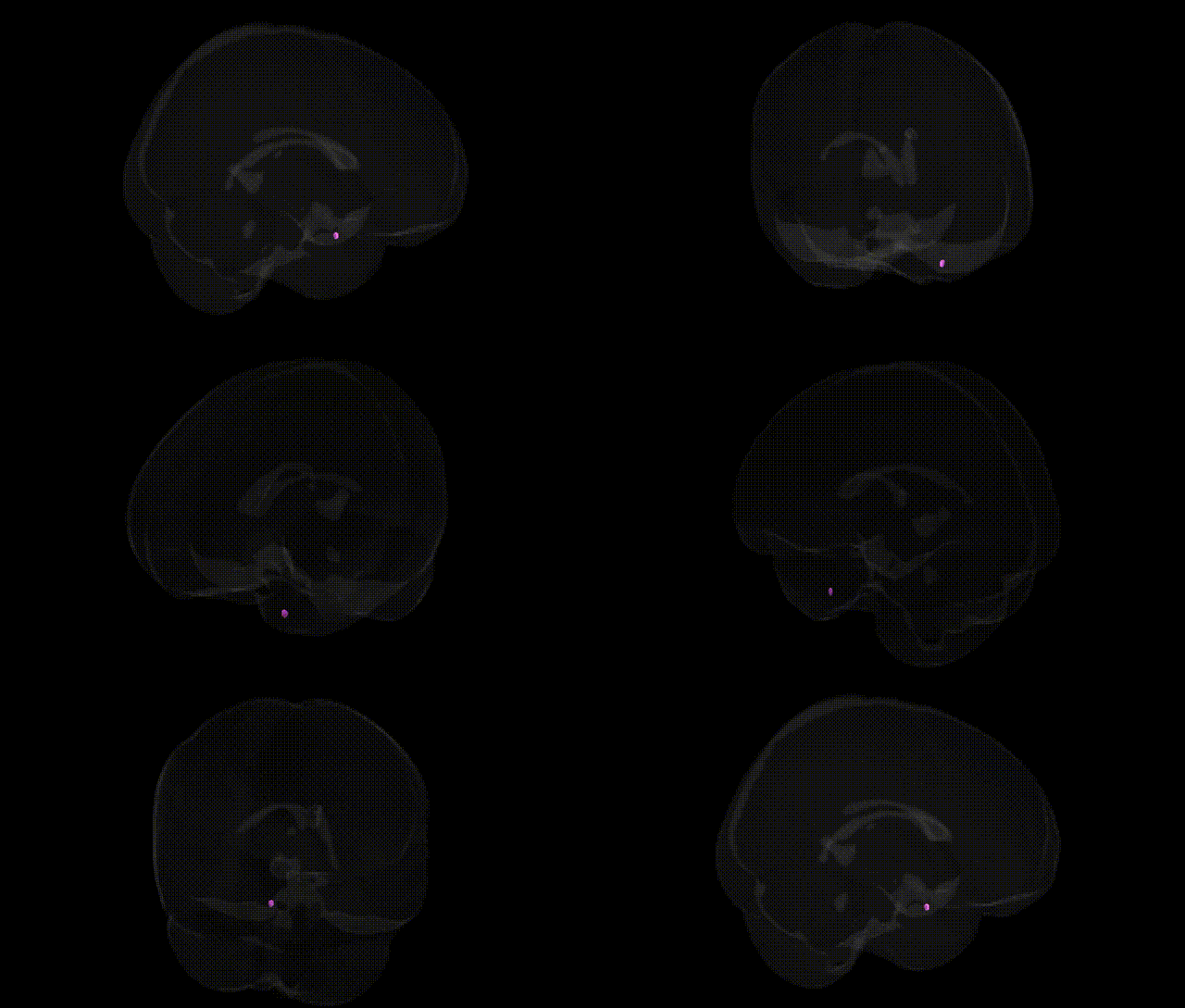
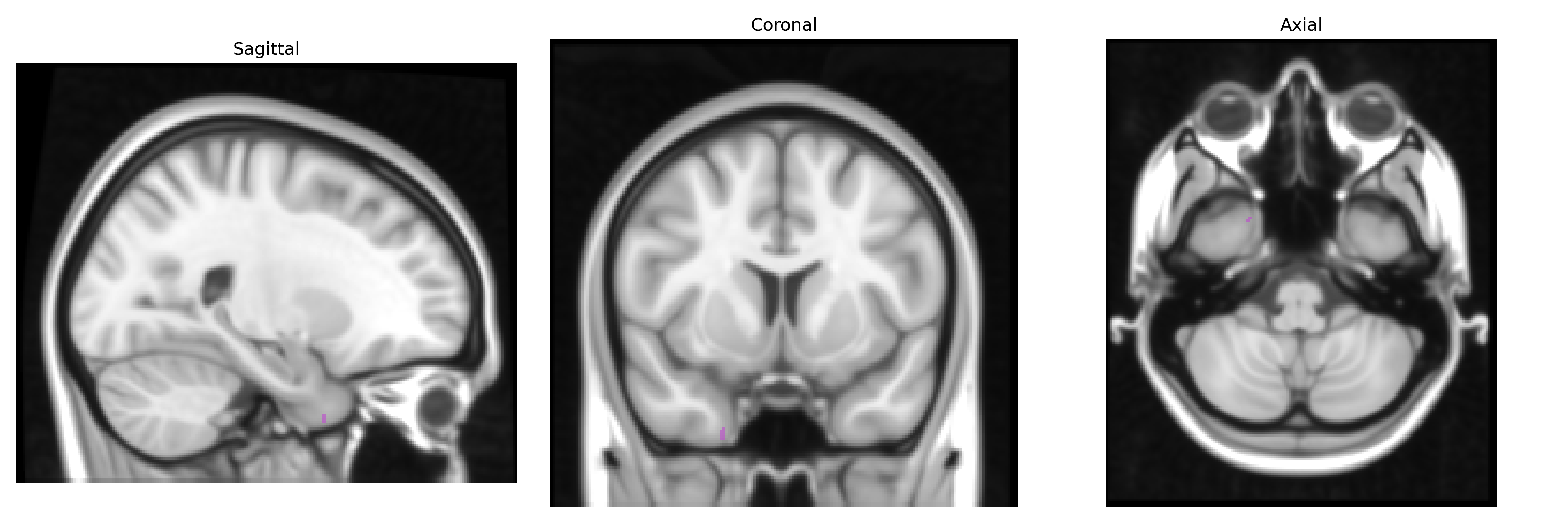
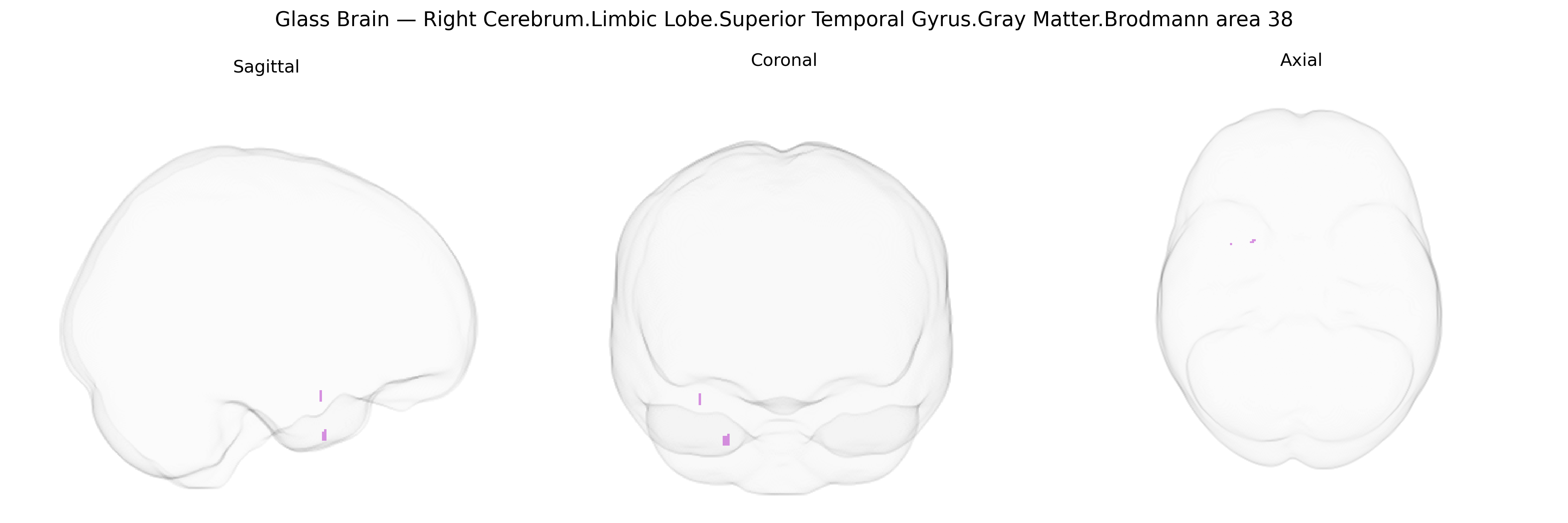
The bilateral Right Cerebrum.Limbic Lobe.Superior Temporal Gyrus.Gray Matter.Brodmann area 38 corresponds to the temporal pole, a cortical region located at the most anterior part of the superior temporal gyrus and associated with higher-order social, emotional, and semantic processing. Cytoarchitectonically defined as Brodmann area 38, this region integrates multimodal sensory inputs (auditory, visual, and somatosensory) with limbic and paralimbic networks, contributing to the representation of complex concepts, personal memories, and affective valence. It is involved in social cognition, language comprehension (especially narrative and emotional prosody), and the contextualization of autobiographical experiences, with strong connectivity to the amygdala, hippocampus, orbitofrontal cortex, and other temporal association areas. There is no direct Wikipedia article for this exact Talairach label; a closely related structure is the temporal pole: Temporal pole.
Brodmann area 38 (temporal pole) in the right superior temporal gyrus is part of the limbic/anterior temporal network implicated in socioemotional processing, semantic memory, and multimodal integration, and genetic associations linked to this region arise mainly from imaging-genetics and GWAS of cortical morphology and neuropsychiatric traits. Large-scale brain MRI GWAS (e.g., ENIGMA and UK Biobank) have identified common variants in genes involved in neurodevelopment and synaptic function—including loci near genes such as HMGA2, WNT signaling components, and several neuronal adhesion and axon guidance genes—associated with temporal pole cortical thickness, surface area, or gray-matter volume, although specific right BA38-focused loci are typically reported at the level of broader temporal or anterior temporal regions rather than fine Talairach-defined parcels. Polygenic risk scores for schizophrenia, major depressive disorder, bipolar disorder, and autism spectrum disorder show correlations with altered structure and connectivity of the anterior temporal/limbic network that encompasses BA38, consistent with case–control MRI findings of temporal pole gray-matter reduction in these disorders, but without a single gene uniquely tied to this subregion. Additional GWAS and candidate-gene work link temporal pole/anterior temporal morphometry or activation to traits such as social cognition, face and voice processing, and emotional recognition, again implicating distributed polygenic effects (e.g., variants in synaptic, glutamatergic, and calcium-channel genes) rather than region-specific mutations, and highlighting BA38 as a convergence zone where broadly acting neurodevelopmental and psychiatric risk variants manifest structural and functional differences.
Overview generated by GPT-4o (2026).
Region ID: 60
Hemisphere: bilateral
Atlas: Talairach labels 1mm
Full Quality Version: Download MP4
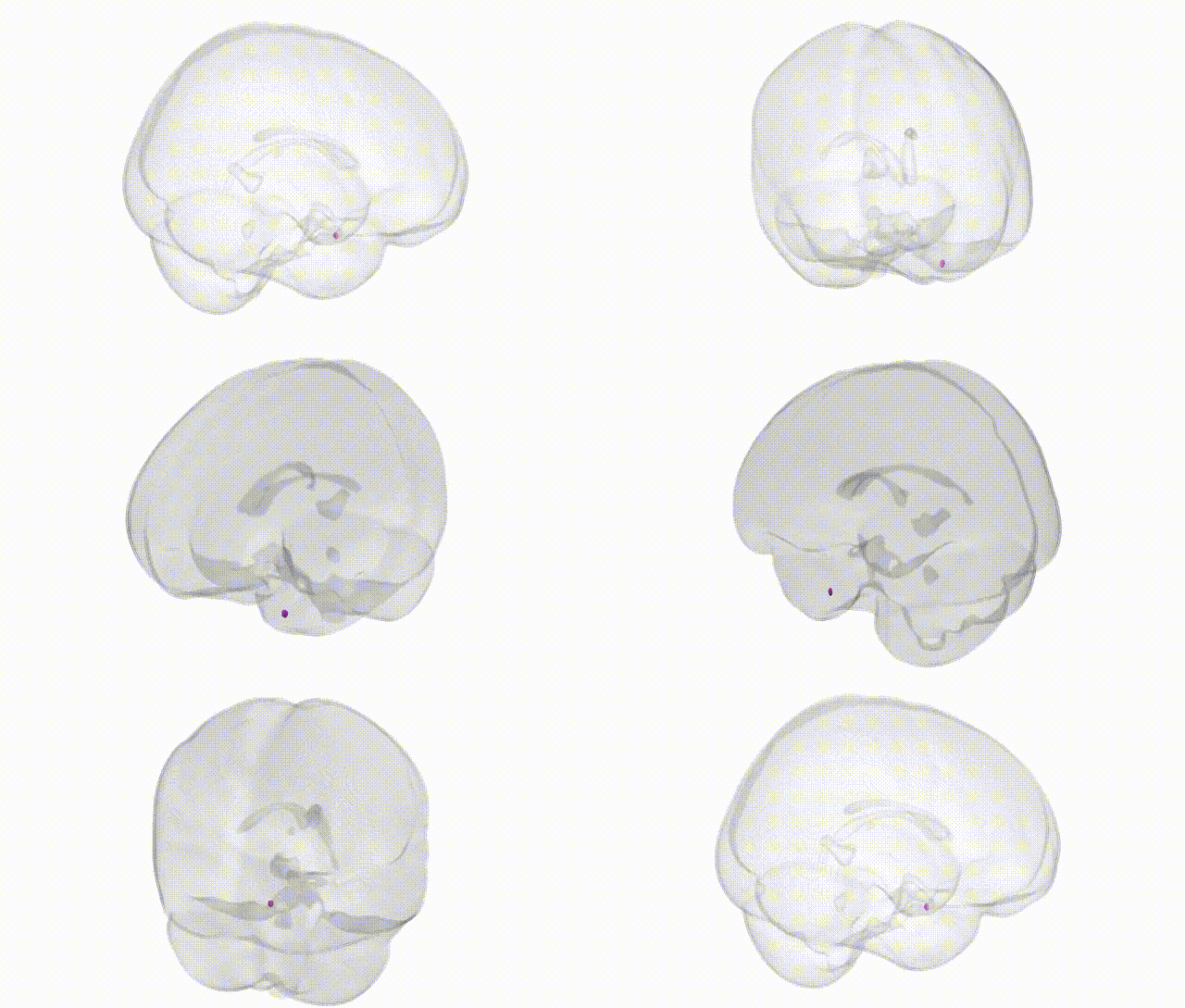
Full Quality Version: Download MP4
Wali Sidiqyar*, Gaurav Rudravaram*, Elyssa M. McMaster, Trent M. Schwartz, Adam M. Saunders, Kurt G. Schilling, Bennett A. Landman "Introducing SPINS: A Shared Public Visualization Library of Neuroanatomical Structures." Medical Imaging with Deep Learning- short paper
This resource is licensed under CC0 1.0 Universal (Public Domain).