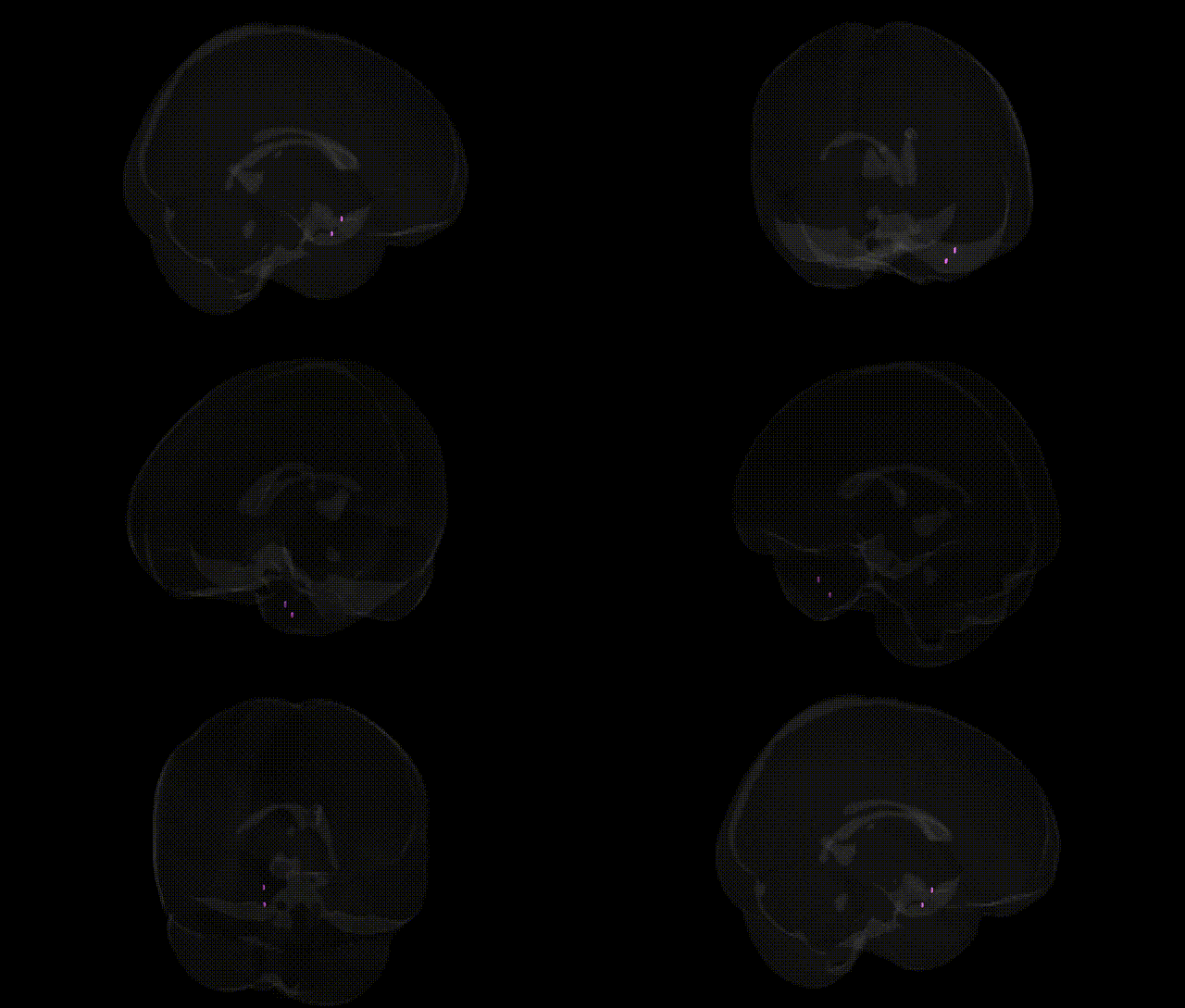
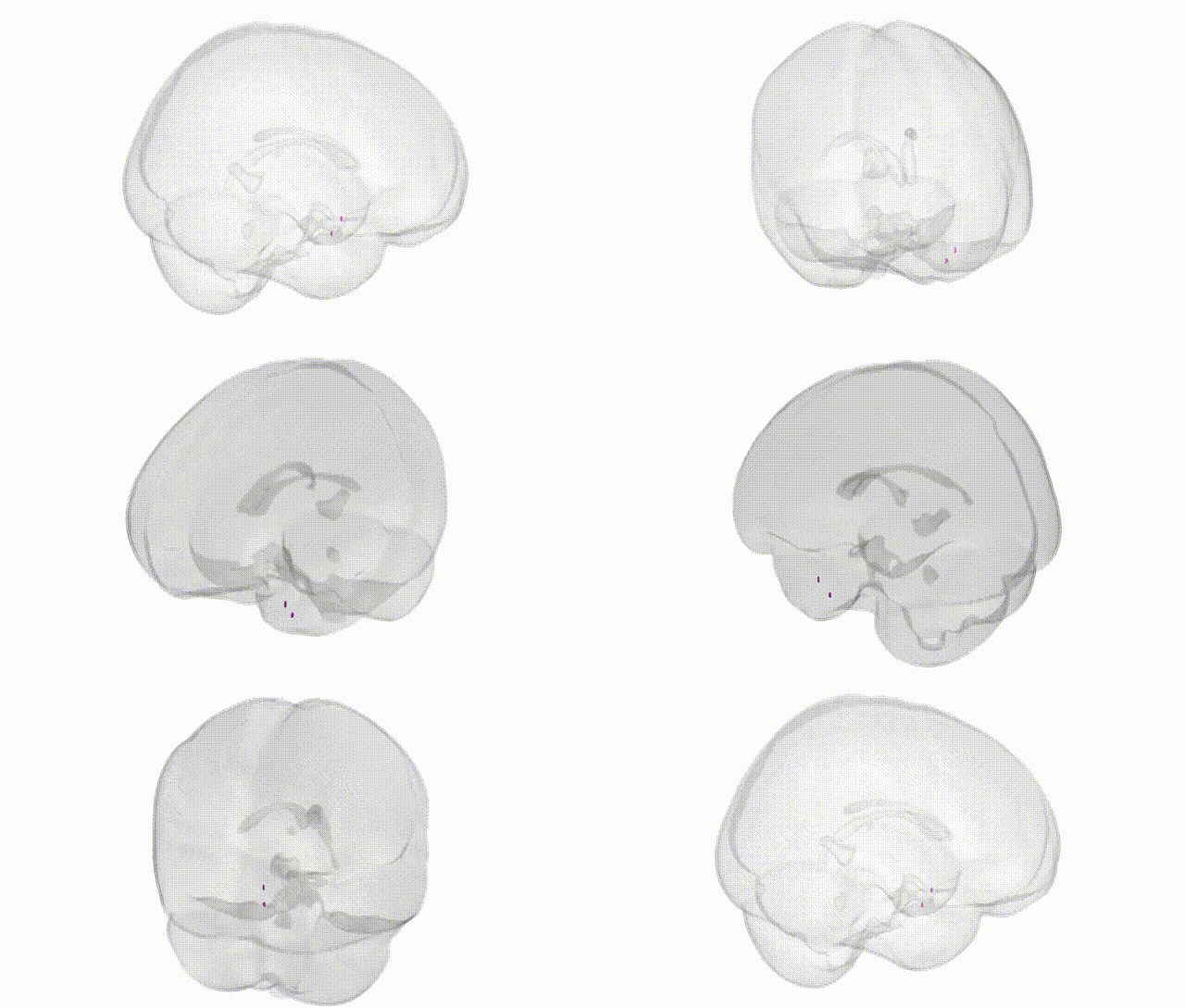
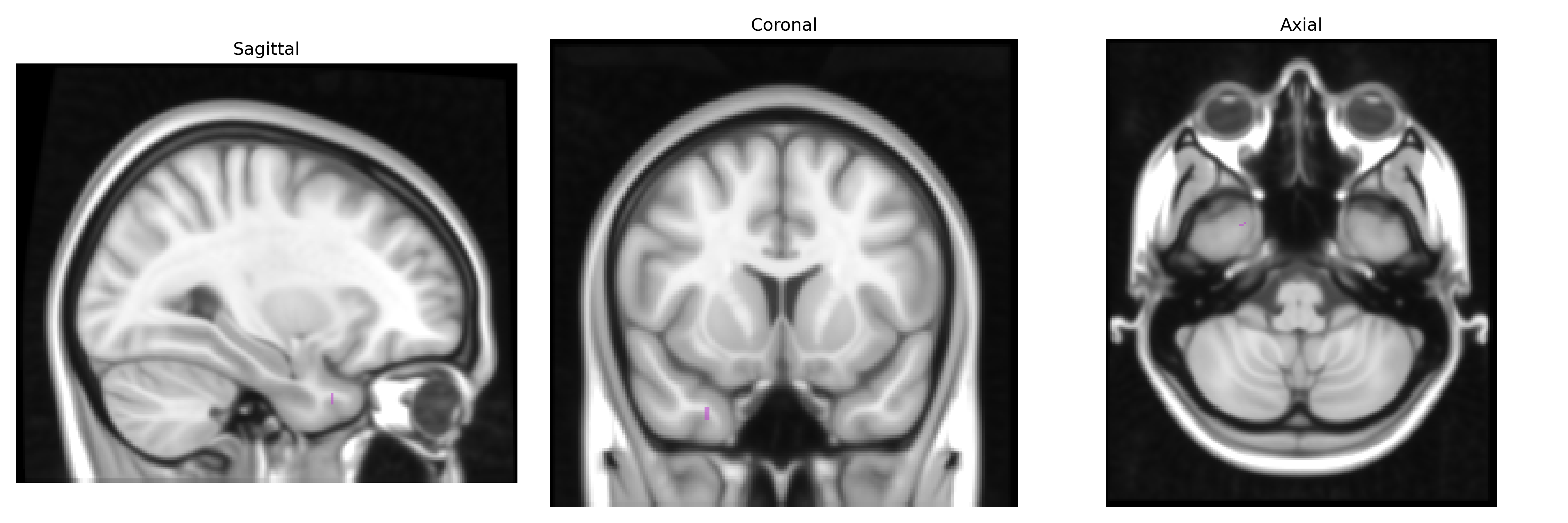
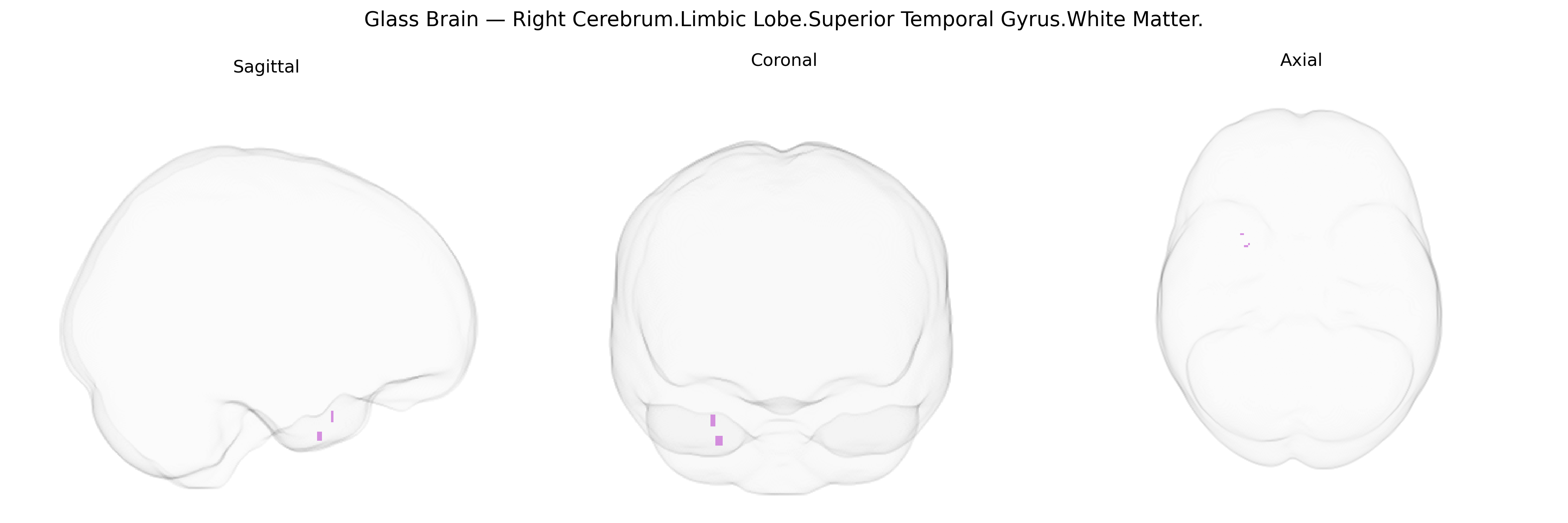
The bilateral Right Cerebrum.Limbic Lobe.Superior Temporal Gyrus.White Matter corresponds to deep myelinated fiber pathways coursing beneath the superior temporal gyrus within the limbic-associated portions of the right temporal lobe. These white matter tracts include association fibers connecting auditory and higher-order temporal cortices with limbic structures such as the hippocampus and amygdala, as well as projections to frontal and parietal regions involved in language, memory, and socio-emotional processing. Functionally, this region supports rapid communication between neocortical superior temporal areas (including primary and secondary auditory regions) and limbic networks, facilitating integration of auditory information with affective, mnemonic, and contextual signals. There is no direct link for this exact composite label; a related structure is the Superior Temporal Gyrus.
The bilateral Right Cerebrum Limbic Lobe Superior Temporal Gyrus white matter, as defined by the Talairach 1 mm atlas, lies at the interface of temporal association cortex and limbic circuitry, and genetic associations to this region typically emerge from imaging‑genetics and GWAS of white‑matter microstructure and temporo‑limbic connectivity rather than from region‑specific candidate studies. Large diffusion MRI GWAS (e.g., UK Biobank–based) have identified common variants influencing temporal lobe white‑matter tracts (including superior temporal and adjacent arcuate/superior longitudinal fasciculi) in genes involved in axon guidance, myelination, and neurodevelopment such as CNTNAP2, NRG1/ERBB signaling components, LINGO1, MAG, and PLP1, as well as broader neurodevelopmental loci (e.g., near PAX6 and ROBO family genes) that impact temporal white‑matter integrity. These temporal‑limbic white‑matter measures show genetic correlations with neuropsychiatric disorders including schizophrenia, bipolar disorder, major depression, and autism spectrum disorder, consistent with GWAS implicating synaptic and myelination genes (e.g., CACNA1C, GRIN2A, C4A region) that also associate with altered temporal lobe connectivity. Variants linked to language and social‑communication traits (FOXP2 pathway genes, CNTNAP2, and common ADHD/autism risk loci) have been connected, via imaging genetics, to altered superior temporal and adjacent limbic white‑matter organization, while temporal white‑matter microstructure heritability and polygenic overlap have been reported with traits such as cognitive ability, educational attainment, and risk‑taking behavior. Although no major GWAS has isolated a single locus uniquely and specifically for “Right Cerebrum Limbic Lobe Superior Temporal Gyrus White Matter” as labeled in Talairach space, convergent evidence from diffusion‑MRI GWAS, disorder‑focused imaging‑genetics studies, and polygenic correlation analyses indicates that genetic variation influencing neurodevelopmental and myelination processes, particularly in axon guidance and synaptic signaling pathways, contributes to interindividual differences in the structure and connectivity of this temporo‑limbic white‑matter region and to vulnerability for psychotic, mood, and neurodevelopmental disorders.
Overview generated by GPT-4o (2026).
Region ID: 57
Hemisphere: bilateral
Atlas: Talairach labels 1mm
Full Quality Version: Download MP4
Full Quality Version: Download MP4
Wali Sidiqyar*, Gaurav Rudravaram*, Elyssa M. McMaster, Trent M. Schwartz, Adam M. Saunders, Kurt G. Schilling, Bennett A. Landman "Introducing SPINS: A Shared Public Visualization Library of Neuroanatomical Structures." Medical Imaging with Deep Learning- short paper
This resource is licensed under CC0 1.0 Universal (Public Domain).