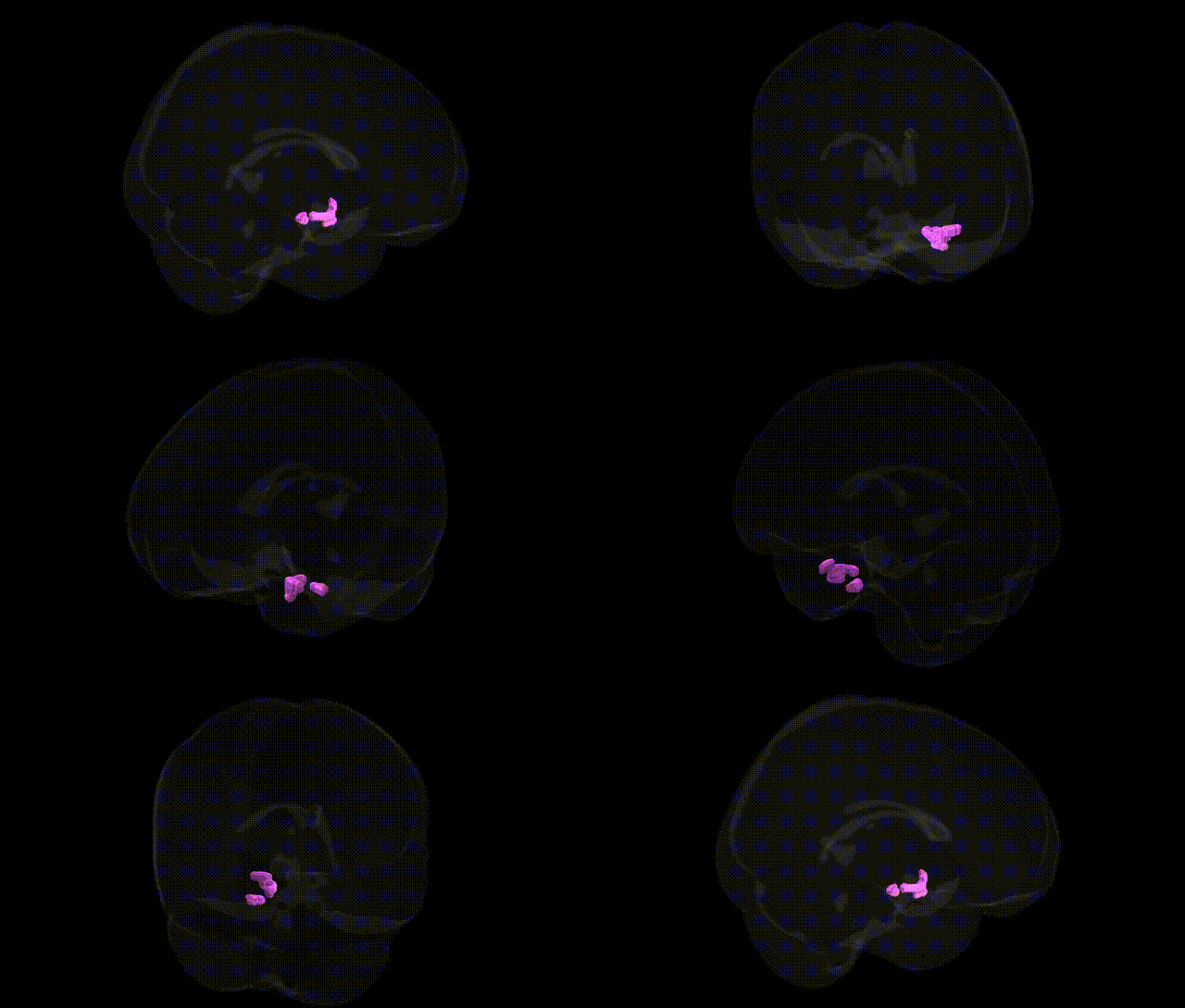
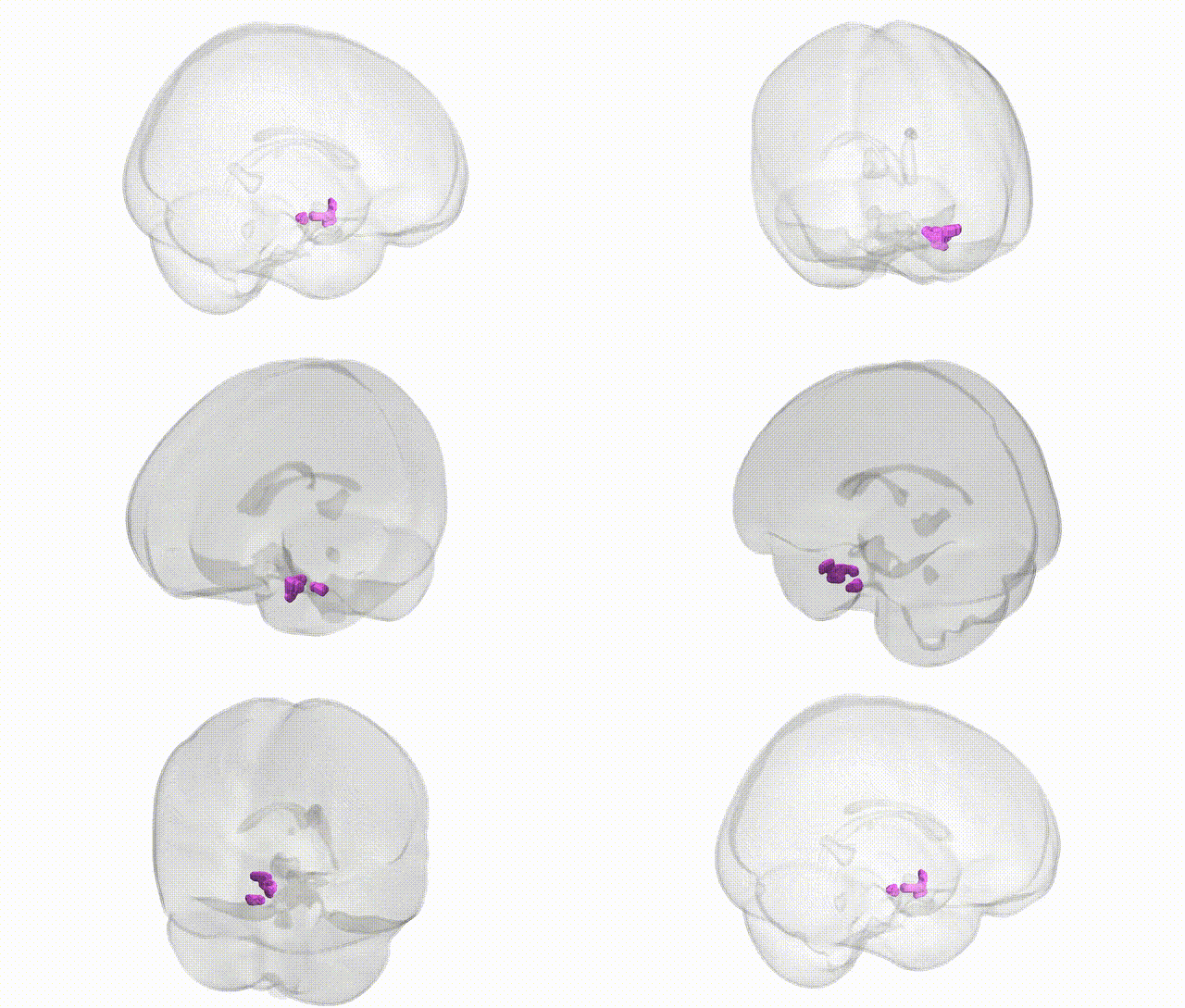
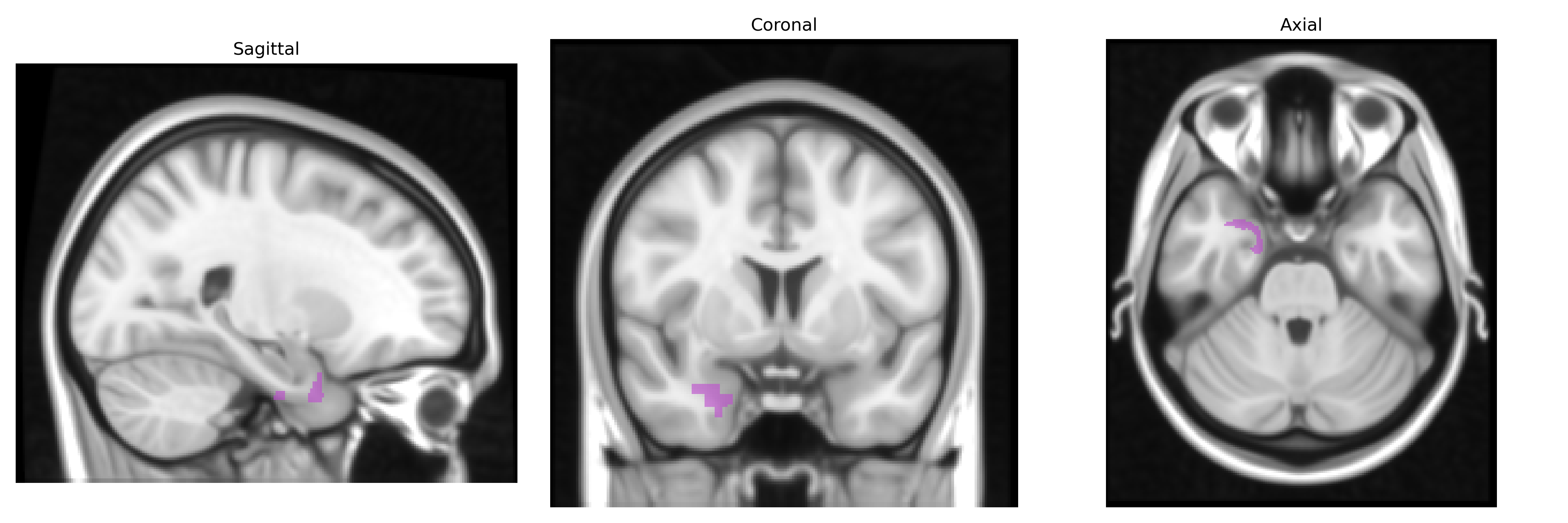
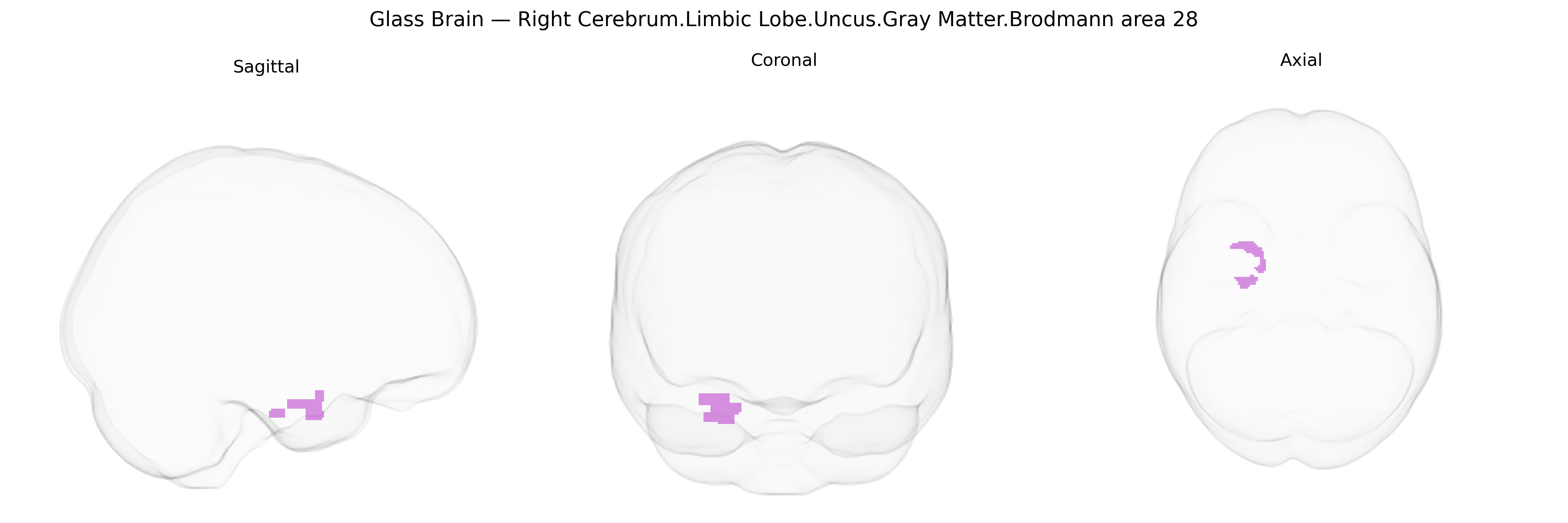
The bilateral Right Cerebrum.Limbic Lobe.Uncus.Gray Matter.Brodmann area 28 corresponds primarily to the entorhinal cortex, a key allocortical region of the medial temporal lobe that forms a critical interface between the hippocampal formation and widespread neocortical areas. Histologically, it is characterized by a relatively simple laminar organization compared with neocortex, reflecting its role in processing highly integrated multimodal information. Functionally, this region participates in episodic memory, spatial navigation, and the consolidation and retrieval of declarative memories by relaying inputs from association cortices to the hippocampus and receiving hippocampal outputs. It is part of the limbic system and shows early and severe neurodegenerative changes in Alzheimer’s disease, including neurofibrillary tangle accumulation, which contribute to early memory impairment and disorientation. Entorhinal cortex
The bilateral right uncus of the limbic lobe (Brodmann area 28, entorhinal cortex) is a key medial temporal structure implicated in memory, olfaction, and emotional processing, and genetic associations involving this region emerge mainly from imaging‑genetics and GWAS of structure, function, and disease. Variants in APOE (especially ε4) and other Alzheimer’s disease–risk genes (e.g., CLU, PICALM, BIN1, TREM2) are repeatedly associated with entorhinal/uncal atrophy and tau/amyloid burden, consistent with this area’s early involvement in Alzheimer’s pathology. Large neuroimaging GWAS (e.g., ENIGMA, UK Biobank–based studies) have identified multiple loci influencing entorhinal and adjacent medial temporal cortical thickness and volume, including variants near genes involved in neurodevelopment, synaptic function, and axon guidance (such as MIR-137–related loci, and genes in glutamatergic and calcium-signaling pathways), some of which overlap with schizophrenia and major depression risk loci. Genetic studies of temporal lobe epilepsy frequently implicate medial temporal structures including the uncus/entorhinal cortex, with associations involving hippocampal sclerosis–related genes and polygenic risk shared with generalized epilepsy; structural GWAS highlight entorhinal cortical thinning as an intermediate phenotype. Additional associations link this region’s structural or functional variation to traits such as general cognitive ability, episodic memory performance, neuroticism, and anxiety-related phenotypes, suggesting that polygenic architectures for cognition and affect partly exert their effects through genetically driven differences in entorhinal/uncal anatomy and connectivity.
Overview generated by GPT-4o (2026).
Region ID: 95
Hemisphere: bilateral
Atlas: Talairach labels 1mm
Full Quality Version: Download MP4
Full Quality Version: Download MP4
Wali Sidiqyar*, Gaurav Rudravaram*, Elyssa M. McMaster, Trent M. Schwartz, Adam M. Saunders, Kurt G. Schilling, Bennett A. Landman "Introducing SPINS: A Shared Public Visualization Library of Neuroanatomical Structures." Medical Imaging with Deep Learning- short paper
This resource is licensed under CC0 1.0 Universal (Public Domain).