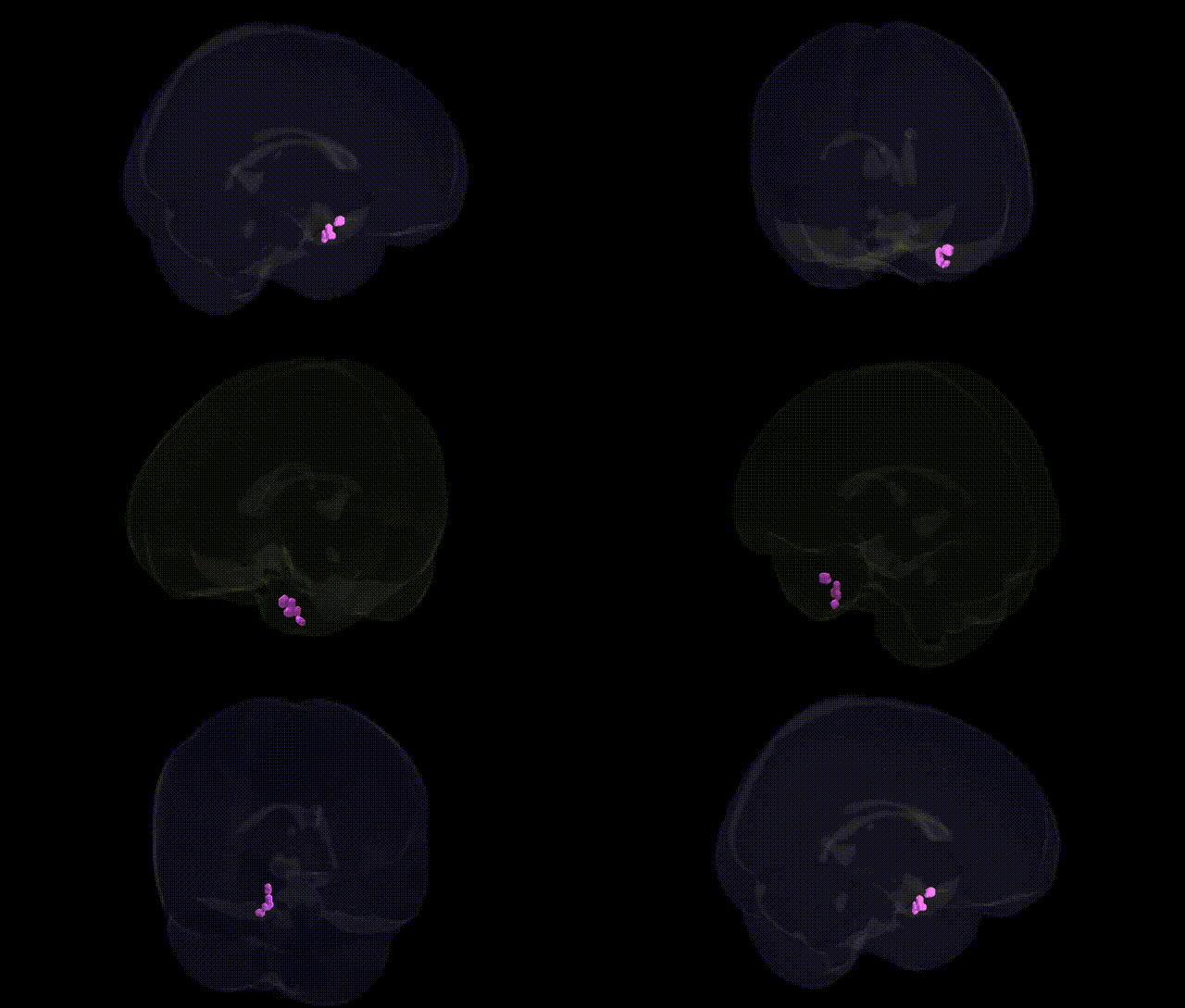
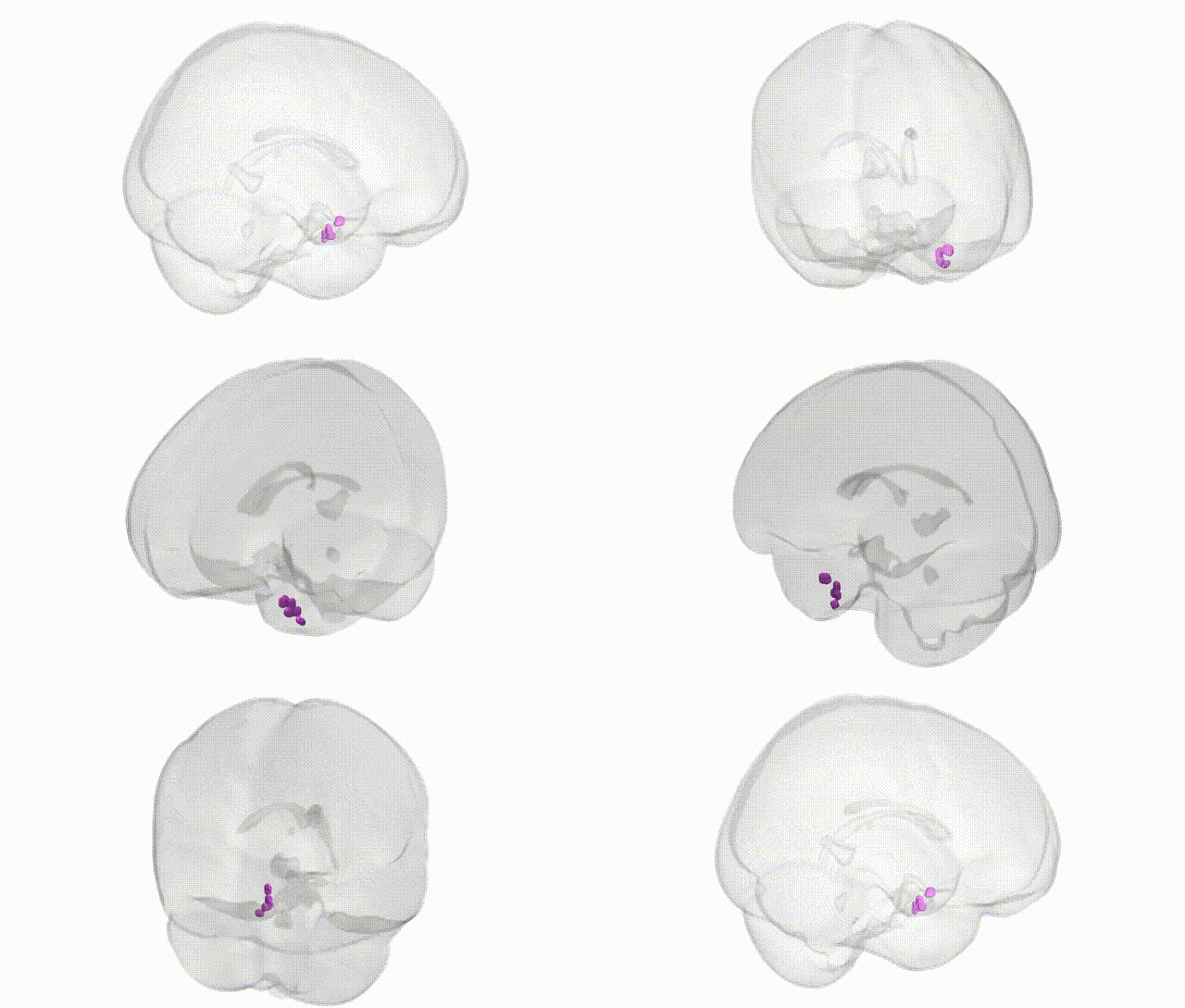
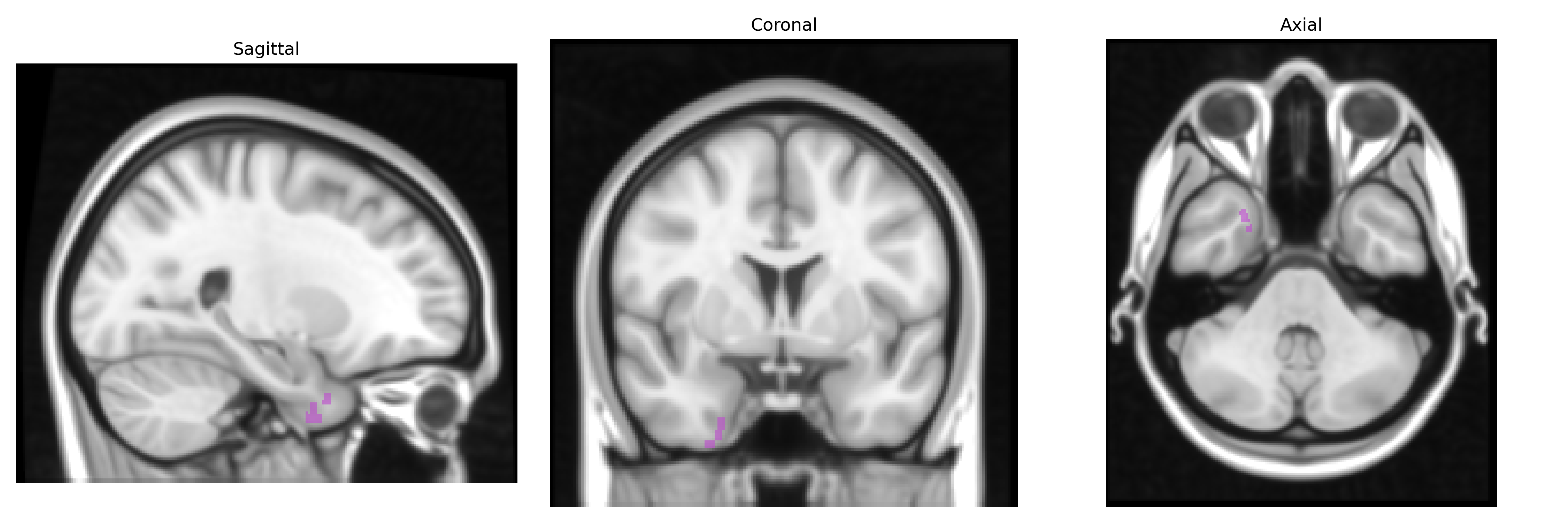
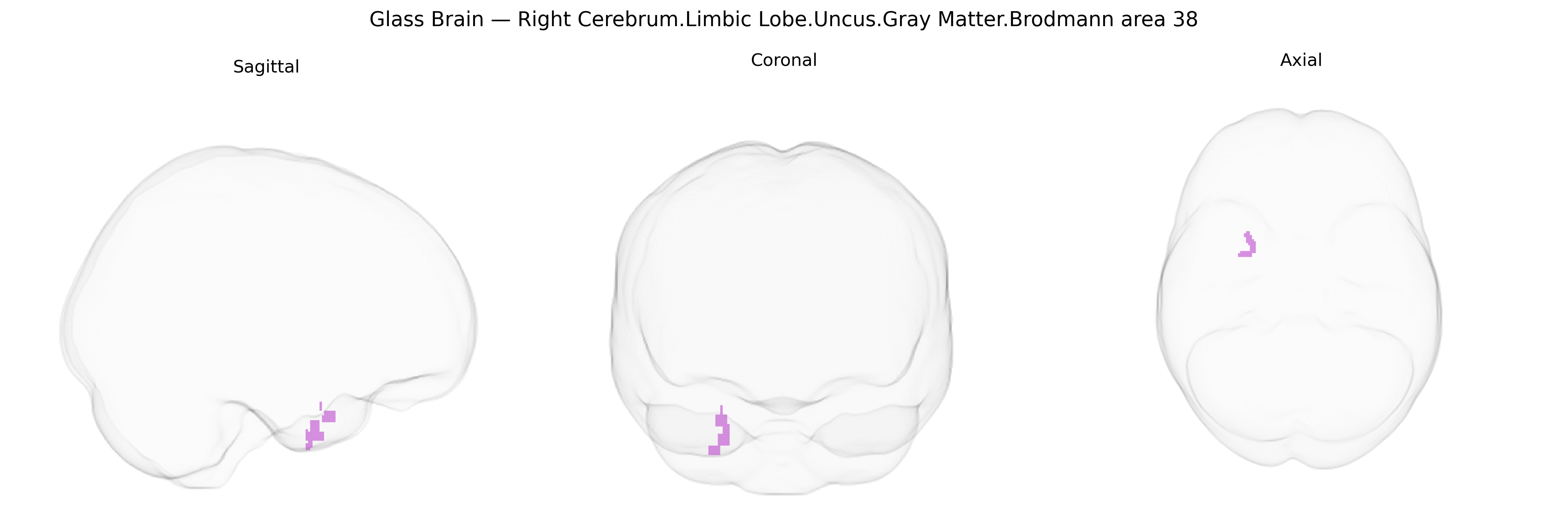
The bilateral Right Cerebrum.Limbic Lobe.Uncus.Gray Matter.Brodmann area 38 corresponds to the anterior portion of the parahippocampal gyrus and uncus in the medial temporal lobe, encompassing the temporopolar cortex (Brodmann area 38) that integrates high-level multimodal sensory information with limbic structures. This region is implicated in emotional processing, associative memory, and semantic integration, linking olfactory, visual, and auditory inputs with affective and mnemonic circuits. Structurally, it lies anterior to the hippocampal formation and amygdala, with strong reciprocal connections to the orbitofrontal cortex and other temporal association areas, supporting roles in social cognition, complex conceptual processing, and contextual evaluation of stimuli. There is no direct link for Brodmann area 38; a related structure is the Temporal pole.
The bilateral right anterior temporal pole/uncus region corresponding to Brodmann area 38, as defined in the Talairach 1 mm atlas, has been implicated in several genetically influenced neuropsychiatric traits, though typically via broader anterior temporal or limbic networks rather than BA38-specific loci. Large GWAS of major depressive disorder, bipolar disorder, schizophrenia, and autism spectrum disorder have identified risk variants (e.g., in genes such as CACNA1C, GRIN2A, and several synaptic and calcium-channel genes) whose effects on brain structure and function include altered anterior temporal and limbic gray-matter volume or connectivity, encompassing the temporal pole and uncus. Imaging–genetics and ENIGMA consortium studies link polygenic risk scores for schizophrenia, depression, and Alzheimer’s disease to morphometric differences in anterior temporal regions, while temporal pole and uncus atrophy is a hallmark of genetically driven frontotemporal dementia syndromes (notably MAPT, GRN, and C9orf72 mutations). Additional heritable variation in this region is suggested by twin and family studies showing moderate to high heritability of anterior temporal lobe volume and cortical thickness, and by GWAS of subcortical and limbic structures that indirectly affect the uncus (e.g., hippocampal and amygdalar networks). However, no widely replicated GWAS has identified variants acting exclusively or predominantly on Brodmann area 38 gray matter, and most current genetic associations involving this area arise from distributed polygenic influences on limbic and anterior temporal circuitry rather than region-specific genetic effects.
Overview generated by GPT-4o (2026).
Region ID: 35
Hemisphere: bilateral
Atlas: Talairach labels 1mm
Full Quality Version: Download MP4
Full Quality Version: Download MP4
Wali Sidiqyar*, Gaurav Rudravaram*, Elyssa M. McMaster, Trent M. Schwartz, Adam M. Saunders, Kurt G. Schilling, Bennett A. Landman "Introducing SPINS: A Shared Public Visualization Library of Neuroanatomical Structures." Medical Imaging with Deep Learning- short paper
This resource is licensed under CC0 1.0 Universal (Public Domain).