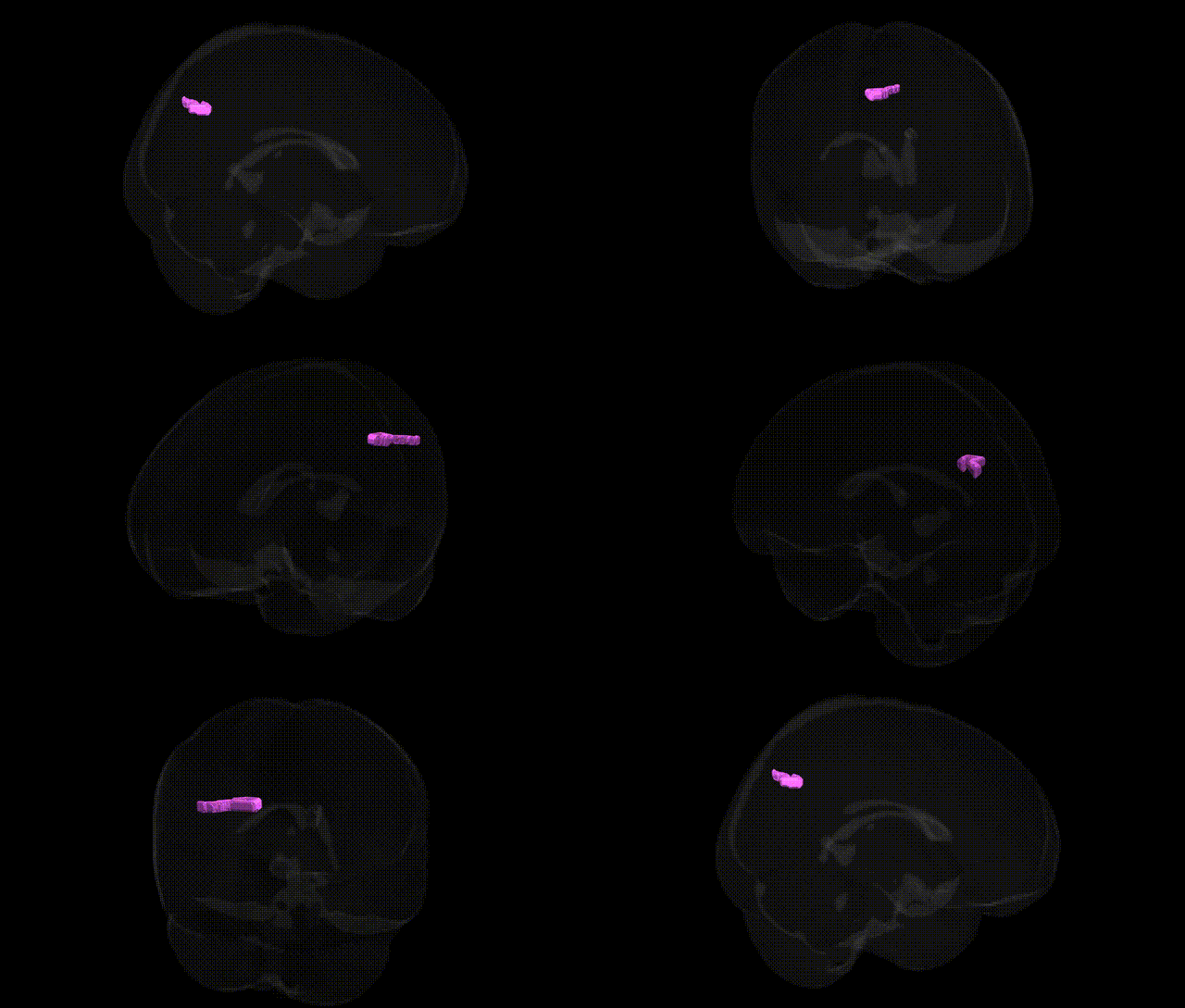
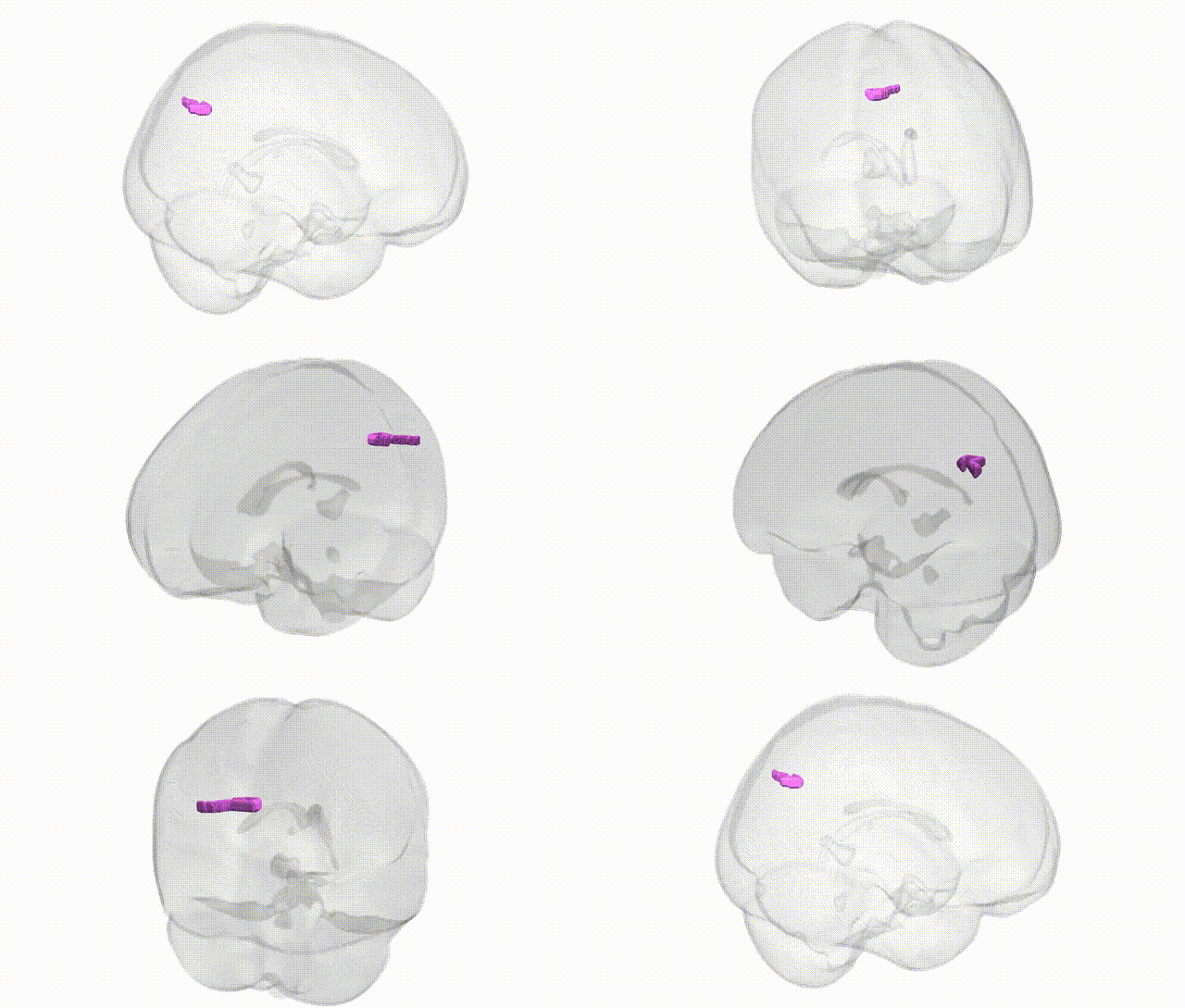
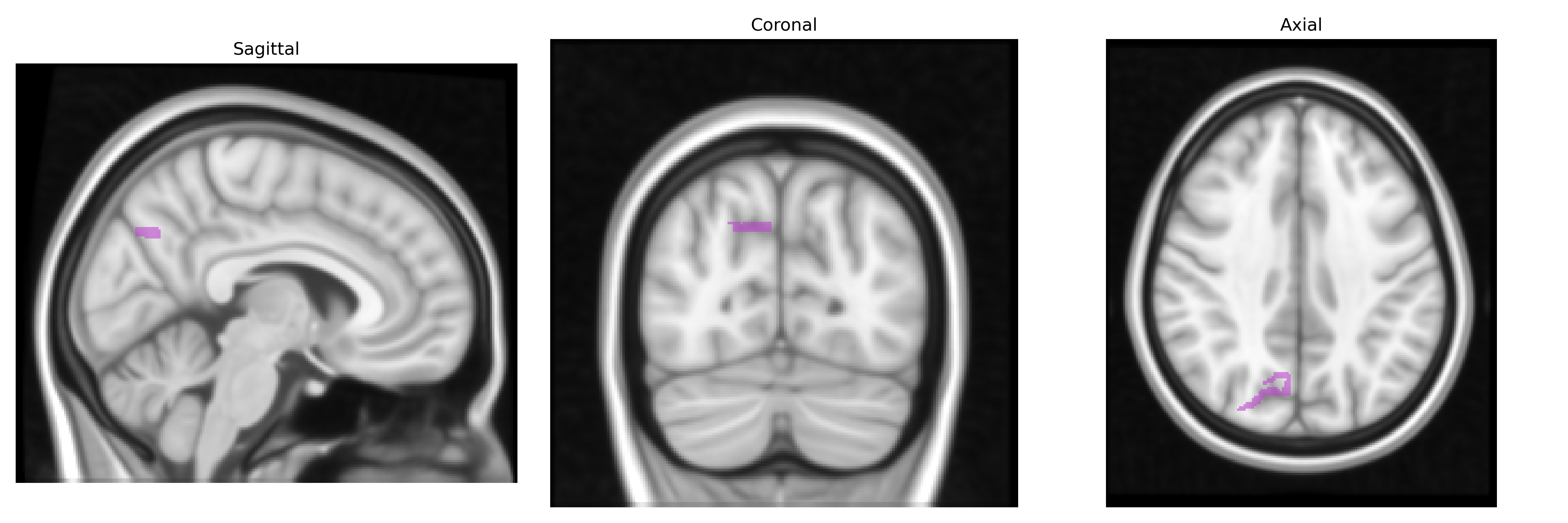
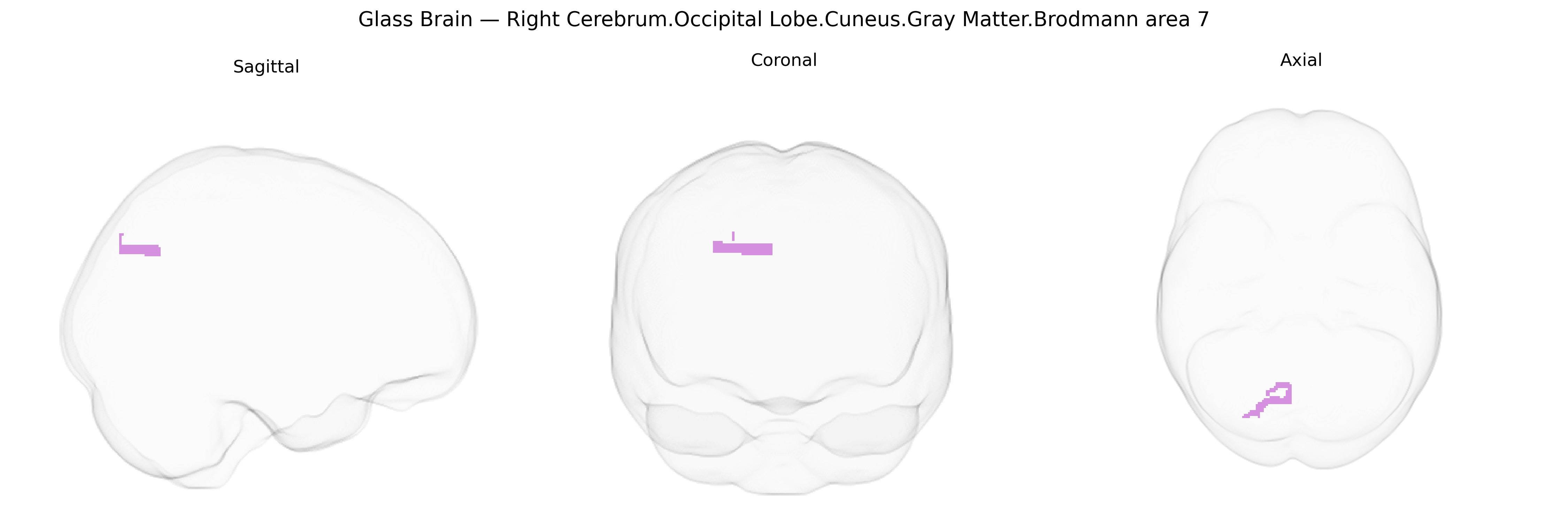
The bilateral Right Cerebrum.Occipital Lobe.Cuneus.Gray Matter.Brodmann area 7 corresponds to gray matter in the medial occipital cortex localized to the cuneus, mapped within the Talairach 1 mm atlas under Brodmann’s cytoarchitectonic area 7, which is more classically associated with superior parietal lobule and posterior parietal cortex. In this atlas context, the label reflects a posterior extension or mapping overlap of BA7 into the medial occipital region, where it participates in higher-order visuospatial integration, visuomotor coordination, and the transformation of visual input into spatial representations relevant for attention and movement planning. Neuronal populations in this region receive convergent visual and multimodal inputs, contributing to the construction of an internal model of extrapersonal space and integration of eye, head, and limb position with visual information. There is no direct Wikipedia article for this exact Talairach-defined region; a related structure is Brodmann area 7.
The bilateral right cuneus gray matter encompassing Brodmann area 7, as defined in the Talairach 1 mm atlas, is a higher-order visual and visuospatial integration region whose structural and functional variation has been implicated in multiple genetically influenced traits and disorders. GWAS of cortical thickness and surface area (e.g., ENIGMA and UK Biobank consortia) have identified common variants in genes related to neurodevelopment, synaptic function, and axon guidance—such as microtubule-associated and cell-adhesion genes—that are associated with cuneus/occipital-parietal morphology, although these findings typically refer to broader occipital or parietal clusters rather than Brodmann area 7 specifically. Cuneus and adjacent BA 7 involvement has been reported in imaging genetics studies of schizophrenia, major depressive disorder, bipolar disorder, and autism spectrum disorder, where risk alleles in genes including CACNA1C, ZNF804A, and others modulate gray matter volume or functional connectivity in dorsal visual and visuospatial networks. Polygenic risk for disorders such as schizophrenia and depression has been associated with altered occipital and cuneus activation during visual processing and attention tasks, while genetic influences on general cognitive ability, working memory, and attentional control show distributed effects that often encompass BA 7–related dorsal stream regions. In addition, GWAS of visual phenotypes, migraine, and reading-related traits have occasionally implicated occipital and parietal regions including the cuneus, though these associations typically reflect widespread network-level effects rather than region-exclusive genetic loci. Overall, genetic associations with this right BA 7 cuneus area emerge primarily from large-scale imaging genetics and polygenic risk studies that highlight its role within broader visuospatial, attentional, and psychopathology-related networks, rather than from loci uniquely tied to this specific Talairach-defined region.
Overview generated by GPT-4o (2026).
Region ID: 953
Hemisphere: bilateral
Atlas: Talairach labels 1mm
Full Quality Version: Download MP4
Full Quality Version: Download MP4
Wali Sidiqyar*, Gaurav Rudravaram*, Elyssa M. McMaster, Trent M. Schwartz, Adam M. Saunders, Kurt G. Schilling, Bennett A. Landman "Introducing SPINS: A Shared Public Visualization Library of Neuroanatomical Structures." Medical Imaging with Deep Learning- short paper
This resource is licensed under CC0 1.0 Universal (Public Domain).