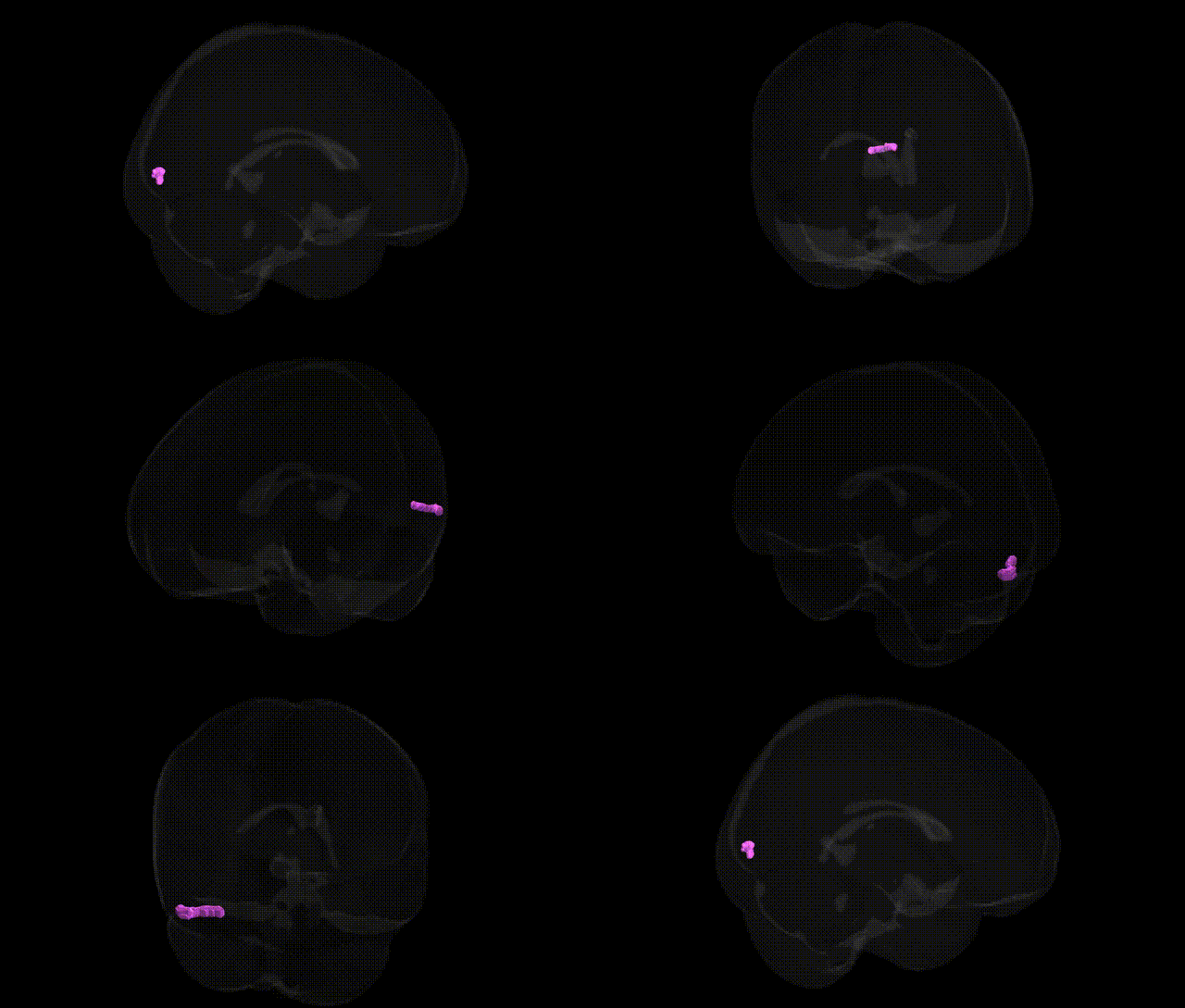
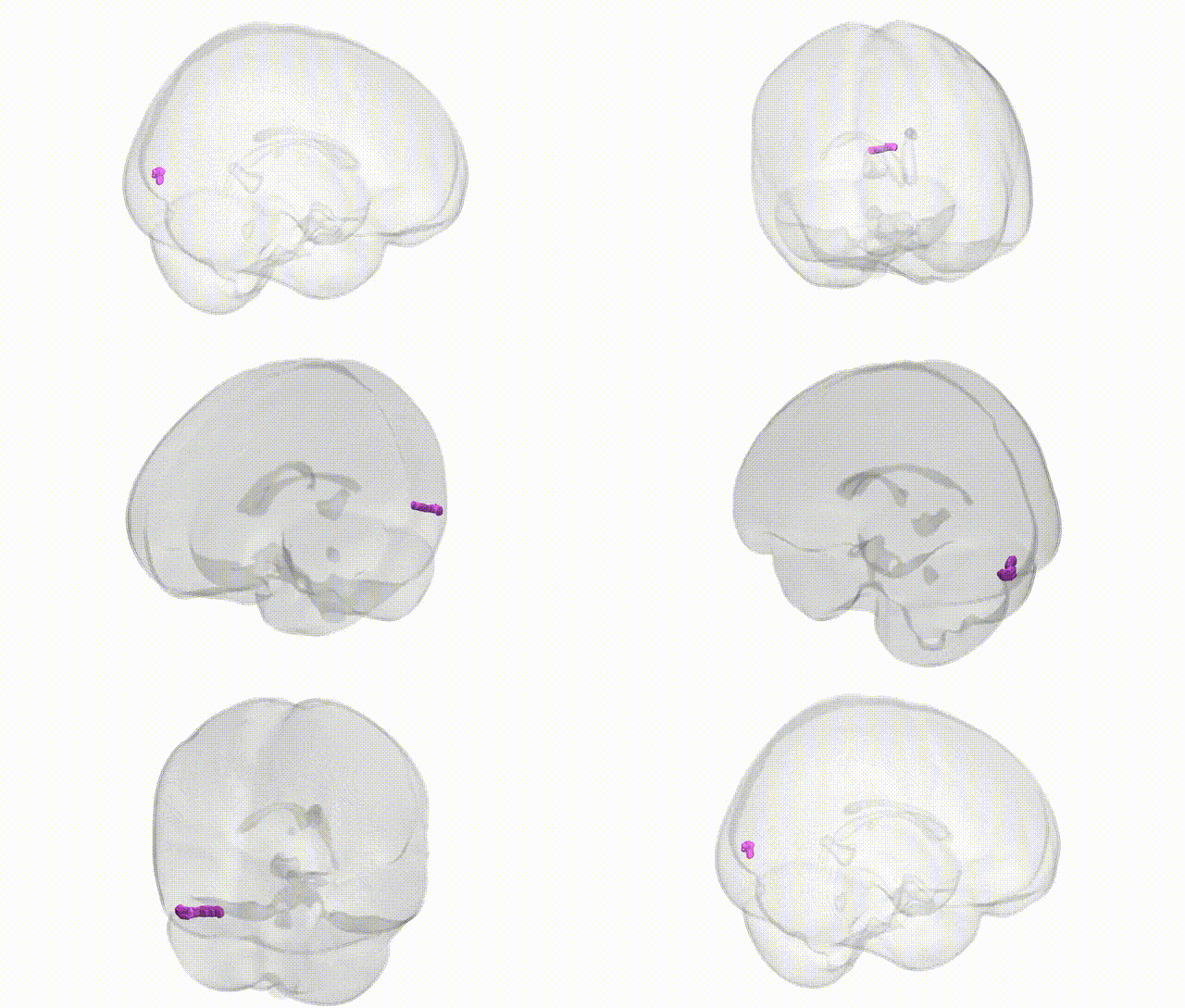
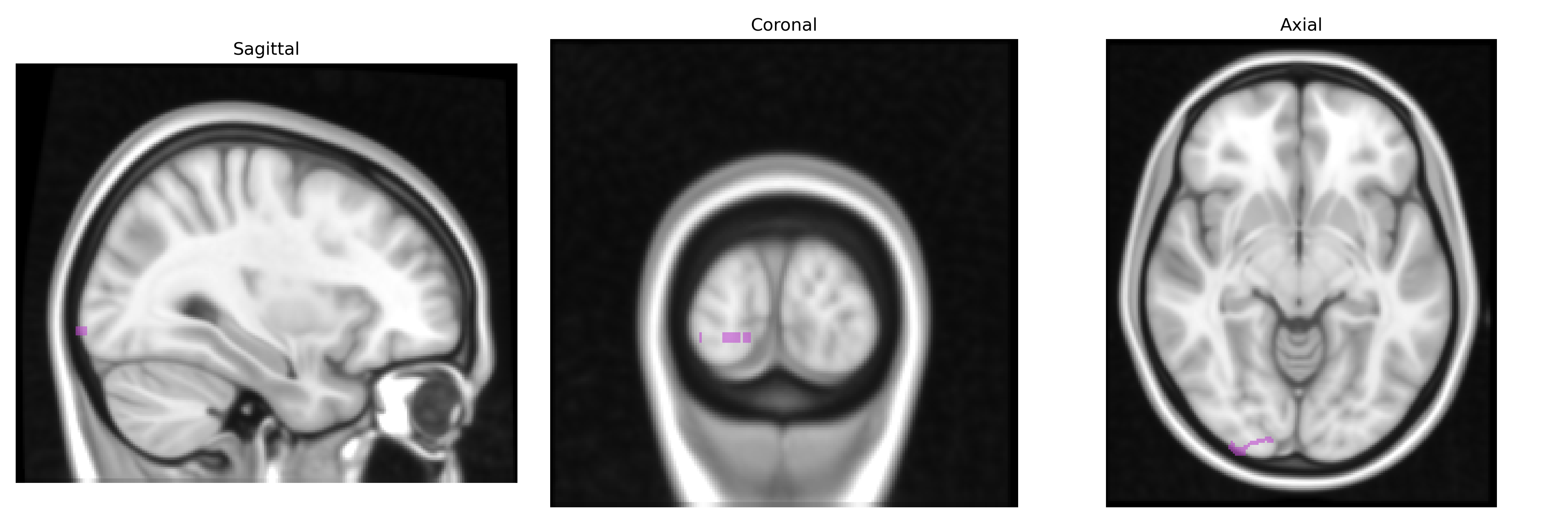
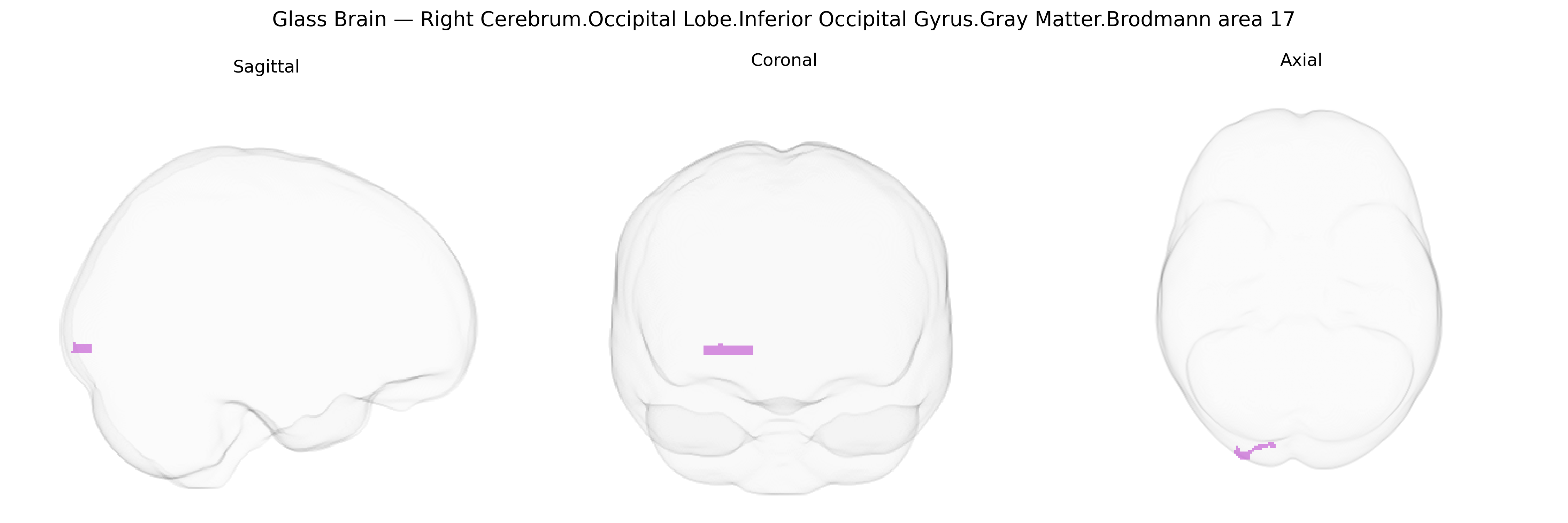
Bilateral Right Cerebrum.Occipital Lobe.Inferior Occipital Gyrus.Gray Matter.Brodmann area 17 corresponds to primary visual cortex (V1) located along the banks of the calcarine fissure, extending into the inferior occipital gyrus where it processes retinotopically organized input from the contralateral visual field. This cytoarchitectonically defined area is characterized by a prominent line of Gennari in layer IV, dense myelination, and high neuron packing density, reflecting its role as the main cortical recipient of thalamic projections from the lateral geniculate nucleus. Neurons in this region encode basic visual features such as orientation, spatial frequency, contrast, and ocular dominance, forming the initial cortical stage of visual information processing that is relayed to higher-order extrastriate visual areas. There is no direct link for this exact Talairach label; a related structure is Brodmann area 17.
The bilateral right occipital lobe inferior occipital gyrus gray matter within primary visual cortex (Brodmann area 17) has been implicated in several genetic and GWAS-based associations, mainly via imaging-genetics and neuropsychiatric studies that use voxel-based or parcel-based measures overlapping this Talairach-defined region. Multiple large-scale GWAS of cortical thickness, surface area, and regional volume have identified common variants in genes involved in neurodevelopment (for example, MIR137, DLG2, GRIN2B, and other synaptic or axon-guidance genes) associated with occipital and specifically primary visual cortex morphology, although these findings typically report broader “occipital” or “pericalcarine/primary visual” regions rather than a narrowly defined inferior occipital gyrus BA17 label. Structural and functional alterations in or near BA17 show genetic associations in disorders such as schizophrenia, bipolar disorder, autism spectrum disorder, and major depression, where polygenic risk scores correlate with visual cortex thickness or volume, and some risk loci map to pathways involving glutamatergic signaling, synaptic plasticity, and neuronal migration. GWAS of visual-related traits—such as refractive error, myopia, and visual processing performance—have also implicated genes (e.g., those affecting retinal development and visual pathway integrity) that indirectly associate with primary visual cortex structure or activation, though causal pathways remain incompletely resolved. Overall, genetic influences on this region appear highly polygenic, with modest, distributed effects contributing to individual differences in primary visual cortex anatomy and susceptibility to neurodevelopmental and psychiatric conditions that exhibit structural or functional anomalies in BA17 and adjacent occipital territories.
Overview generated by GPT-4o (2026).
Region ID: 305
Hemisphere: bilateral
Atlas: Talairach labels 1mm
Full Quality Version: Download MP4
Full Quality Version: Download MP4
Wali Sidiqyar*, Gaurav Rudravaram*, Elyssa M. McMaster, Trent M. Schwartz, Adam M. Saunders, Kurt G. Schilling, Bennett A. Landman "Introducing SPINS: A Shared Public Visualization Library of Neuroanatomical Structures." Medical Imaging with Deep Learning- short paper
This resource is licensed under CC0 1.0 Universal (Public Domain).