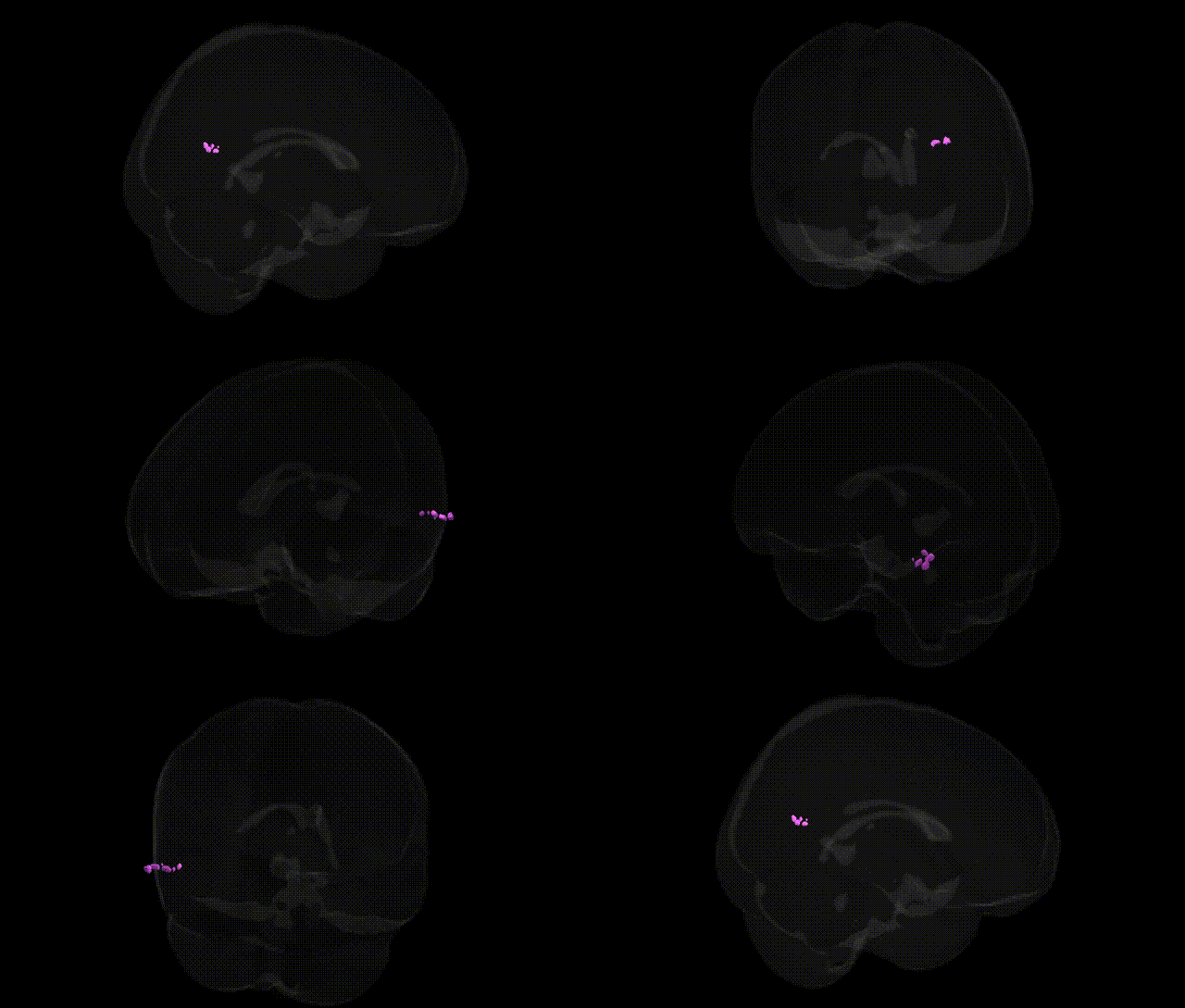
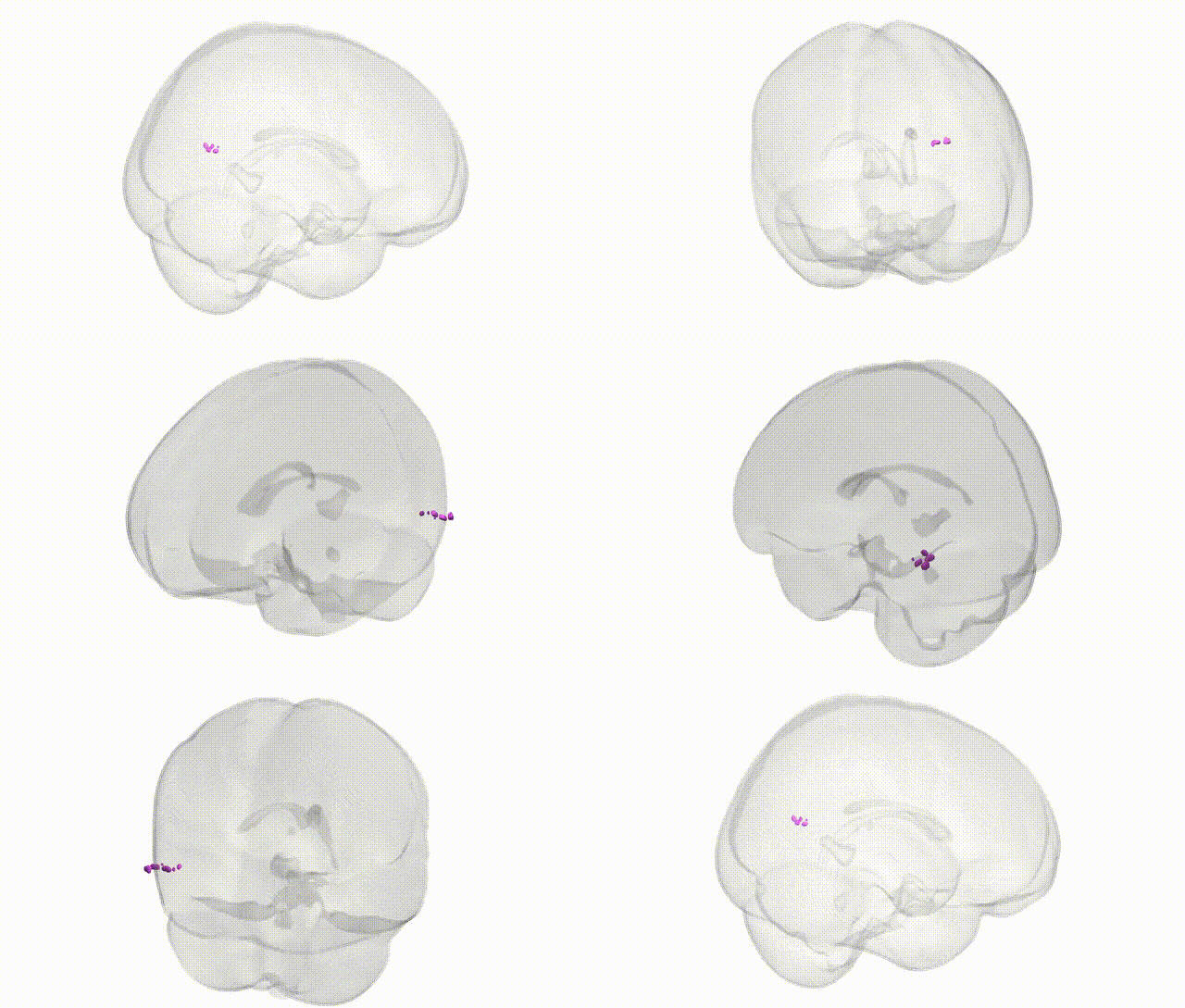
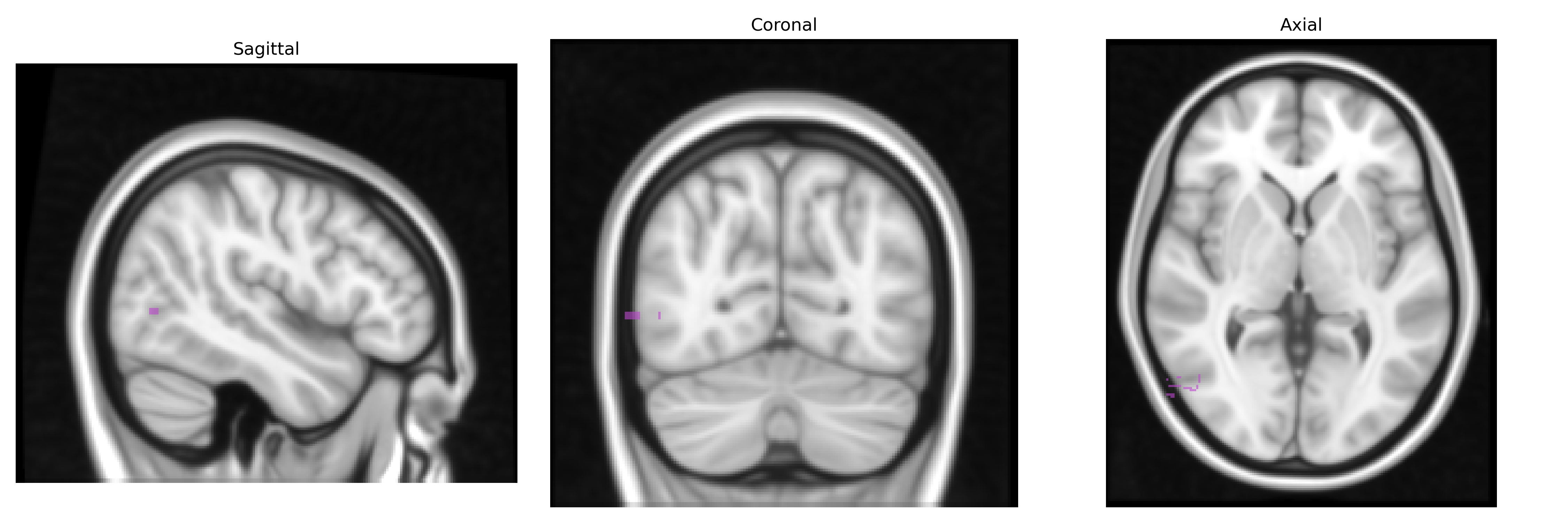
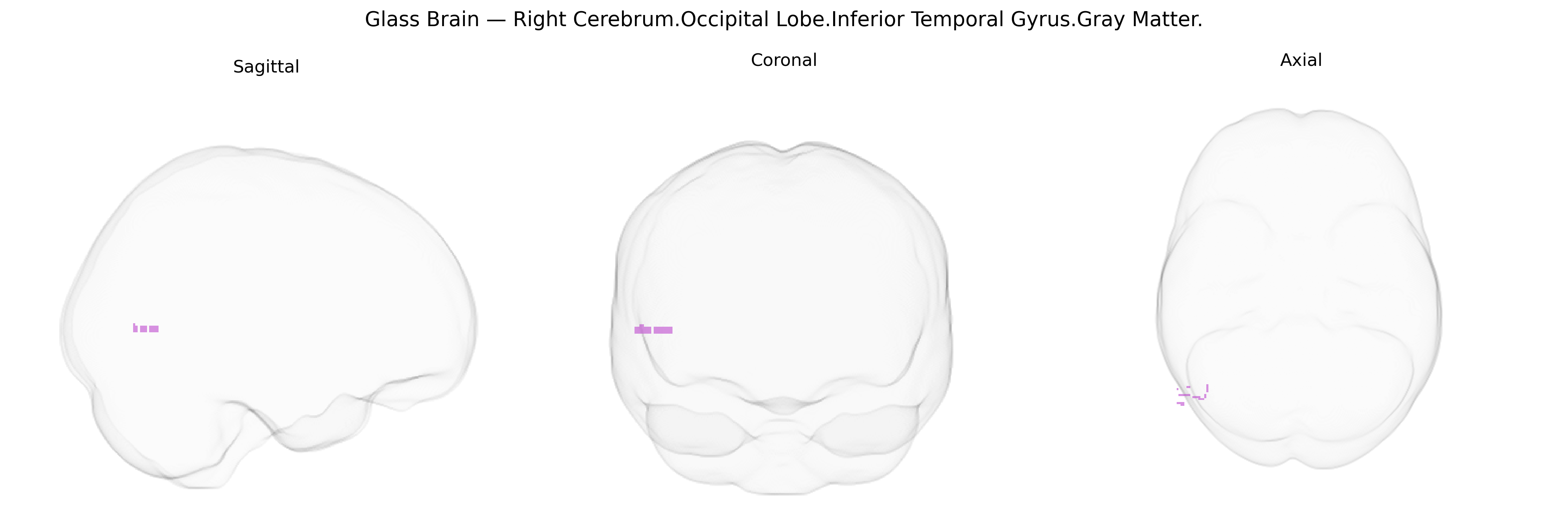
The bilateral Right Cerebrum.Occipital Lobe.Inferior Temporal Gyrus.Gray Matter corresponds to cortical tissue along the ventral occipito-temporal surface where occipital visual areas transition into the inferior temporal cortex, a key component of the ventral “what” visual processing pathway. This region participates in higher-order visual object processing, including shape, color, and complex pattern recognition, and contributes to category-selective responses such as faces, words, and other meaningful objects, depending on precise sub-regions and hemispheric specialization. It receives convergent input from earlier visual areas and projects to distributed temporal and frontal networks involved in object memory, semantic processing, and visual perception. While there is no specific Wikipedia article for this exact Talairach-defined label, it is closely related to the Inferior temporal gyrus.
The bilateral Right Cerebrum.Occipital Lobe.Inferior Temporal Gyrus.Gray Matter region in the Talairach 1 mm atlas corresponds largely to ventral occipito-temporal areas involved in high-level visual processing (including object and face recognition), and genetic associations have been inferred mainly through imaging genetics and GWAS of cortical morphology rather than region-specific candidate-gene work. Large-scale brain MRI GWAS (e.g., ENIGMA, UK Biobank) have identified multiple loci influencing occipital and inferior temporal cortical thickness and surface area, including variants in or near genes implicated in neurodevelopment and synaptic function (such as MIR137, TBR1/EMX2-linked regions, and other neuronal differentiation loci), though most signals are not exclusive to this gyrus and often span broader occipito-temporal parcels. Polygenic risk for schizophrenia, major depression, and bipolar disorder has been associated with structural alterations (reduced gray-matter volume or thickness) in inferior temporal and adjacent occipital regions, and GWAS of visual cortical thickness and fusiform/ventral temporal morphology have implicated genes involved in axon guidance and myelination that may contribute to susceptibility for neurodevelopmental conditions such as autism spectrum disorder and dyslexia via alterations of ventral visual-stream circuitry. Additionally, imaging-genetic analyses linking Alzheimer’s disease and general cognitive ability polygenic scores to occipito-temporal atrophy and variability in inferior temporal gray matter suggest that common variants influencing neurodegeneration and cognitive performance partly act through this region’s structure, although precise gene–region mappings remain broad and are typically reported at the level of larger occipito-temporal or inferior temporal parcels rather than the exact Talairach-defined bilateral Right Cerebrum.Occipital Lobe.Inferior Temporal Gyrus.Gray Matter label.
Overview generated by GPT-4o (2026).
Region ID: 549
Hemisphere: bilateral
Atlas: Talairach labels 1mm
Full Quality Version: Download MP4
Full Quality Version: Download MP4
Wali Sidiqyar*, Gaurav Rudravaram*, Elyssa M. McMaster, Trent M. Schwartz, Adam M. Saunders, Kurt G. Schilling, Bennett A. Landman "Introducing SPINS: A Shared Public Visualization Library of Neuroanatomical Structures." Medical Imaging with Deep Learning- short paper
This resource is licensed under CC0 1.0 Universal (Public Domain).