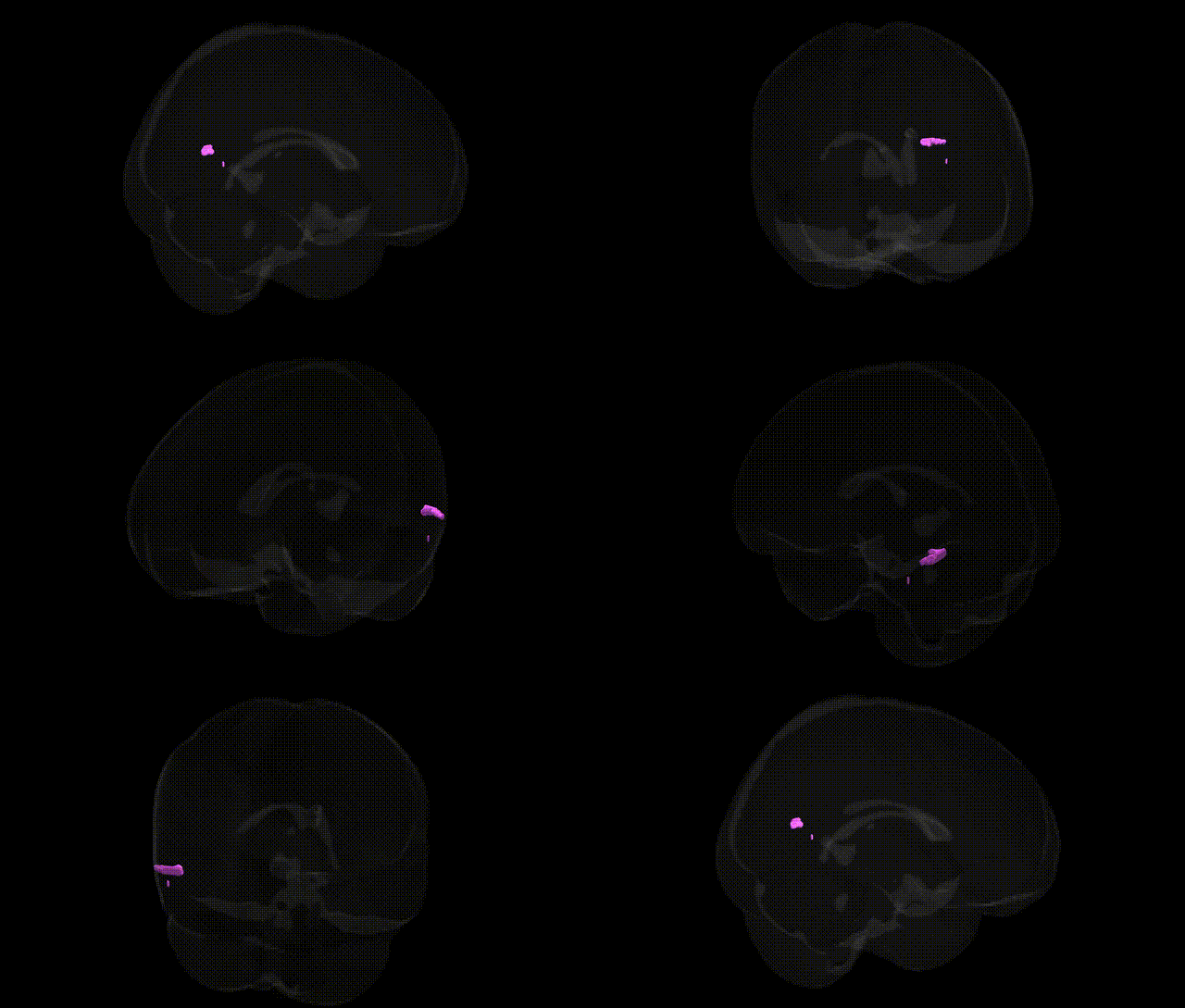
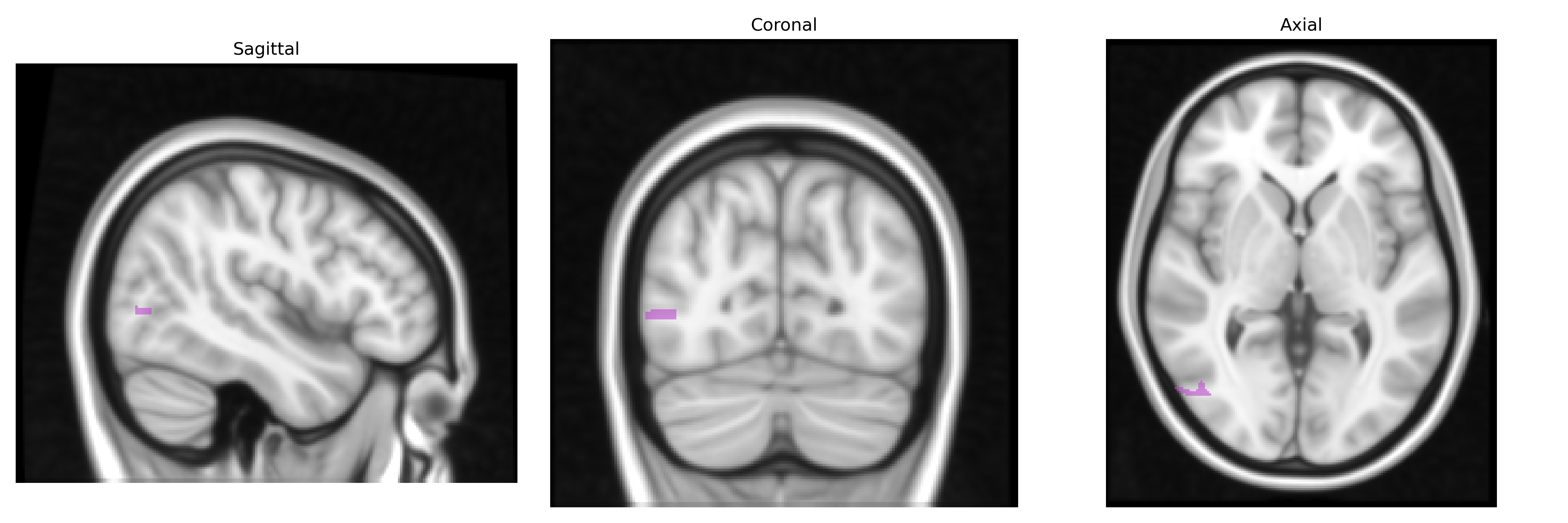
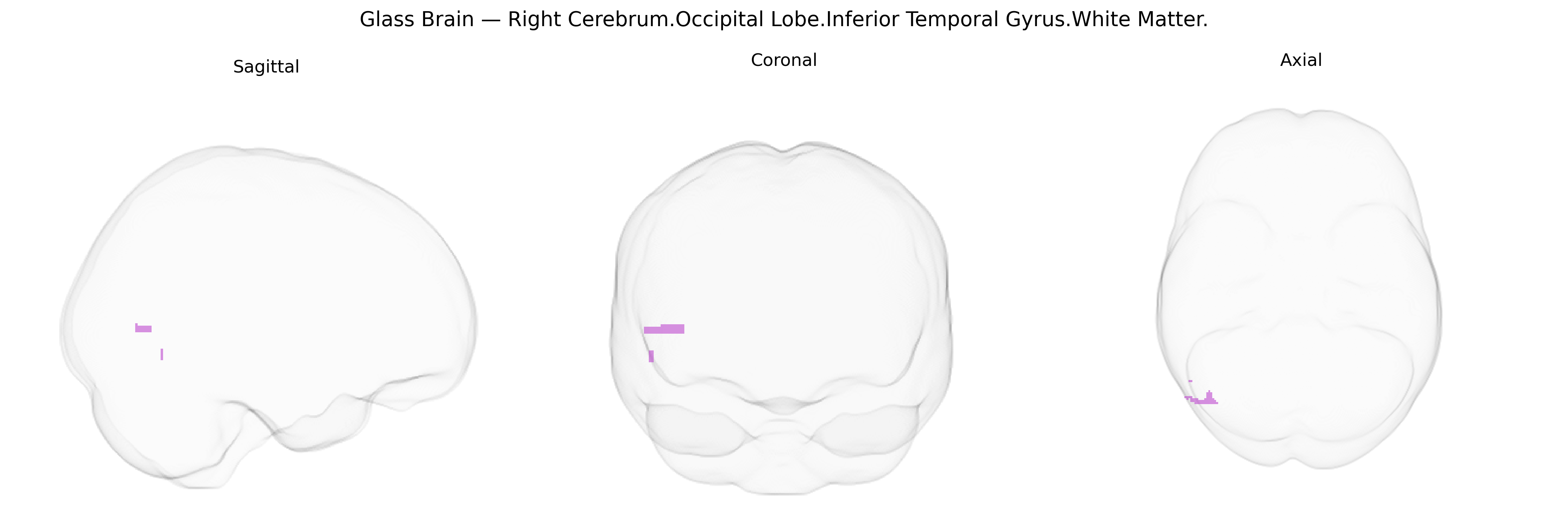
The bilateral Right Cerebrum.Occipital Lobe.Inferior Temporal Gyrus.White Matter refers to the deep myelinated fiber tracts underlying the inferior temporal gyrus at the occipital–temporal junction in the right hemisphere, as defined in the Talairach 1 mm atlas. These white matter pathways interconnect occipital visual areas with temporal regions involved in object recognition, high-level visual processing, and aspects of memory, contributing to ventral visual stream (“what pathway”) functions. They include portions of long association fibers such as the inferior longitudinal fasciculus and adjacent short U-fibers linking neighboring gyri, thereby supporting the transmission and integration of visual information from primary and extrastriate cortex to temporal lobe structures. There is no direct link for this precise composite label; a related structure is the Inferior temporal gyrus.
The bilateral right occipital lobe–inferior temporal gyrus white matter region, as defined in the Talairach 1 mm atlas, corresponds largely to posterior ventral temporal pathways involved in visual object processing and higher-order visual cognition, and genetic associations are typically inferred from imaging genetics studies of related functional and structural phenotypes rather than this specific label. GWAS of diffusion MRI and cortical measures have identified multiple common variants influencing microstructure and connectivity in adjacent inferior temporal and occipital pathways—often implicating genes involved in axon guidance, myelination, and synaptic plasticity (e.g., loci near NPTN, BIN1, CNTNAP2, and neurodevelopmental genes broadly), though these effects are usually reported for larger tract-based or parcel-based entities (such as inferior longitudinal fasciculus or ventral visual stream) rather than the precise Talairach-defined region. Genetically informed studies of visual word form and object recognition networks show overlap with this ventral occipito-temporal territory, with heritable influences on white matter integrity and functional activation linked to reading ability and developmental dyslexia, where risk genes like DCDC2, KIAA0319, and ROBO1 have been associated with changes in posterior temporal–occipital connectivity. In neuropsychiatric GWAS, polygenic risk for schizophrenia, bipolar disorder, major depression, and autism spectrum disorder has been associated with altered microstructure and volume in nearby inferior temporal and occipital white matter, suggesting that large sets of risk variants affecting neurodevelopment and synaptic signaling converge on this region’s connectivity, although individual gene–region associations remain nonspecific. Additionally, GWAS of brain-wide white matter integrity and occipital/temporal visual networks have linked this territory to genetic influences on cognitive traits such as intelligence, processing speed, and educational attainment, again through distributed polygenic effects rather than single locus–specific findings. Overall, known genetic associations involving this region are indirect, arising from imaging genetics of broader ventral visual and temporal–occipital white matter systems, with contributions from polygenic neurodevelopmental, myelination, and cognitive trait loci rather than unique, well-characterized variants tied specifically to the bilateral Right Cerebrum.Occipital Lobe.Inferior Temporal Gyrus.White Matter Talairach label.
Overview generated by GPT-4o (2026).
Region ID: 327
Hemisphere: bilateral
Atlas: Talairach labels 1mm
Full Quality Version: Download MP4
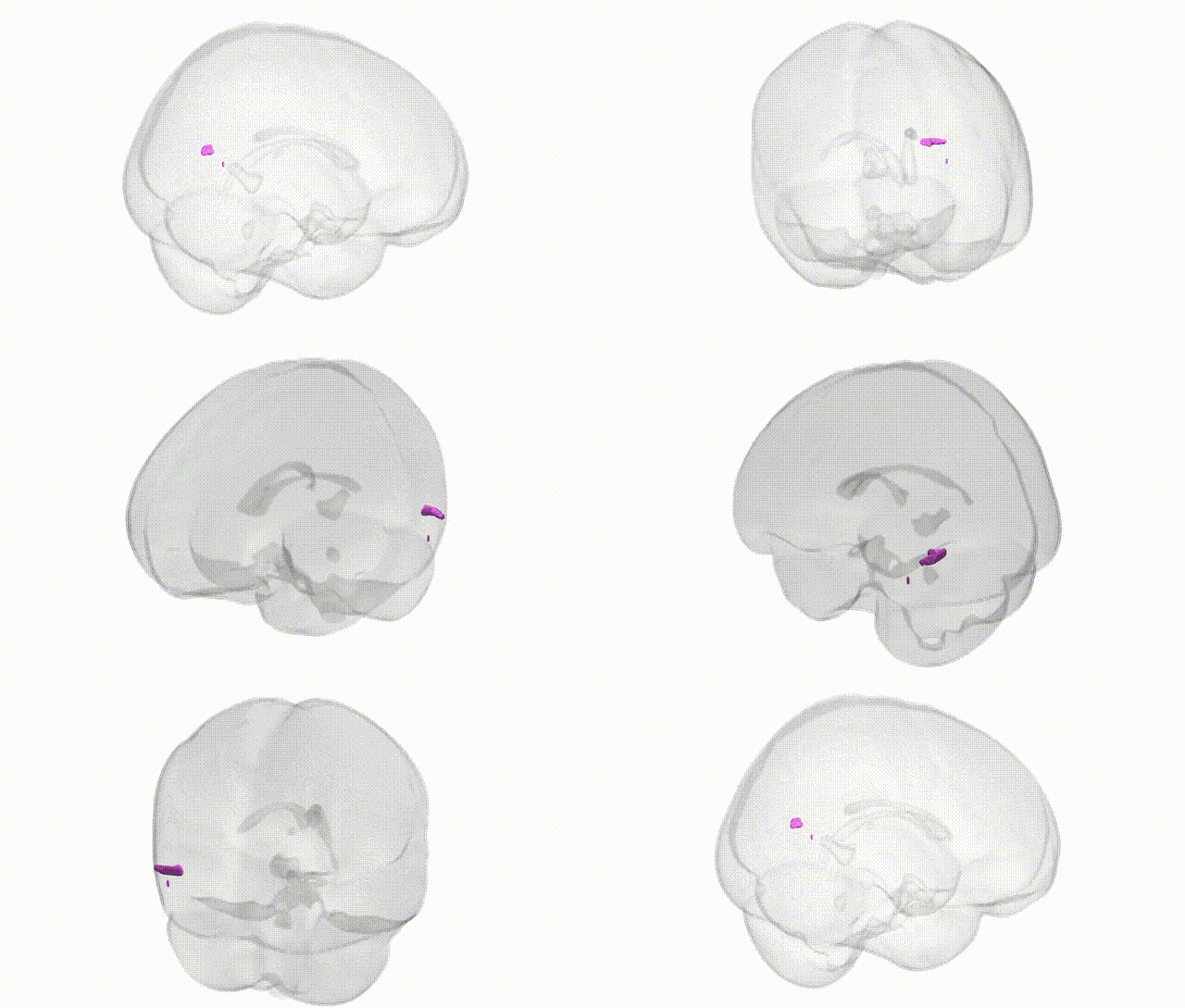
Full Quality Version: Download MP4
Wali Sidiqyar*, Gaurav Rudravaram*, Elyssa M. McMaster, Trent M. Schwartz, Adam M. Saunders, Kurt G. Schilling, Bennett A. Landman "Introducing SPINS: A Shared Public Visualization Library of Neuroanatomical Structures." Medical Imaging with Deep Learning- short paper
This resource is licensed under CC0 1.0 Universal (Public Domain).