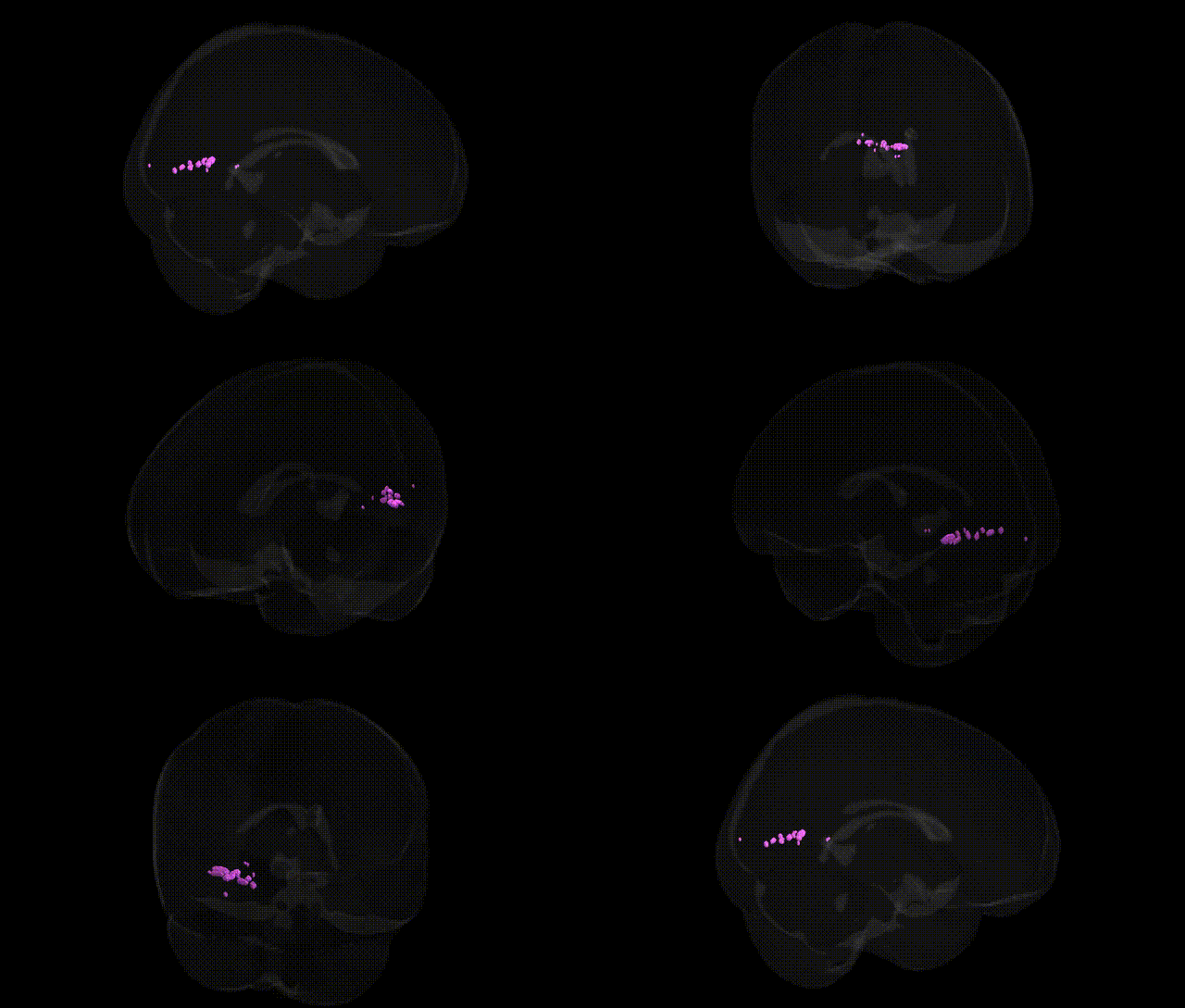
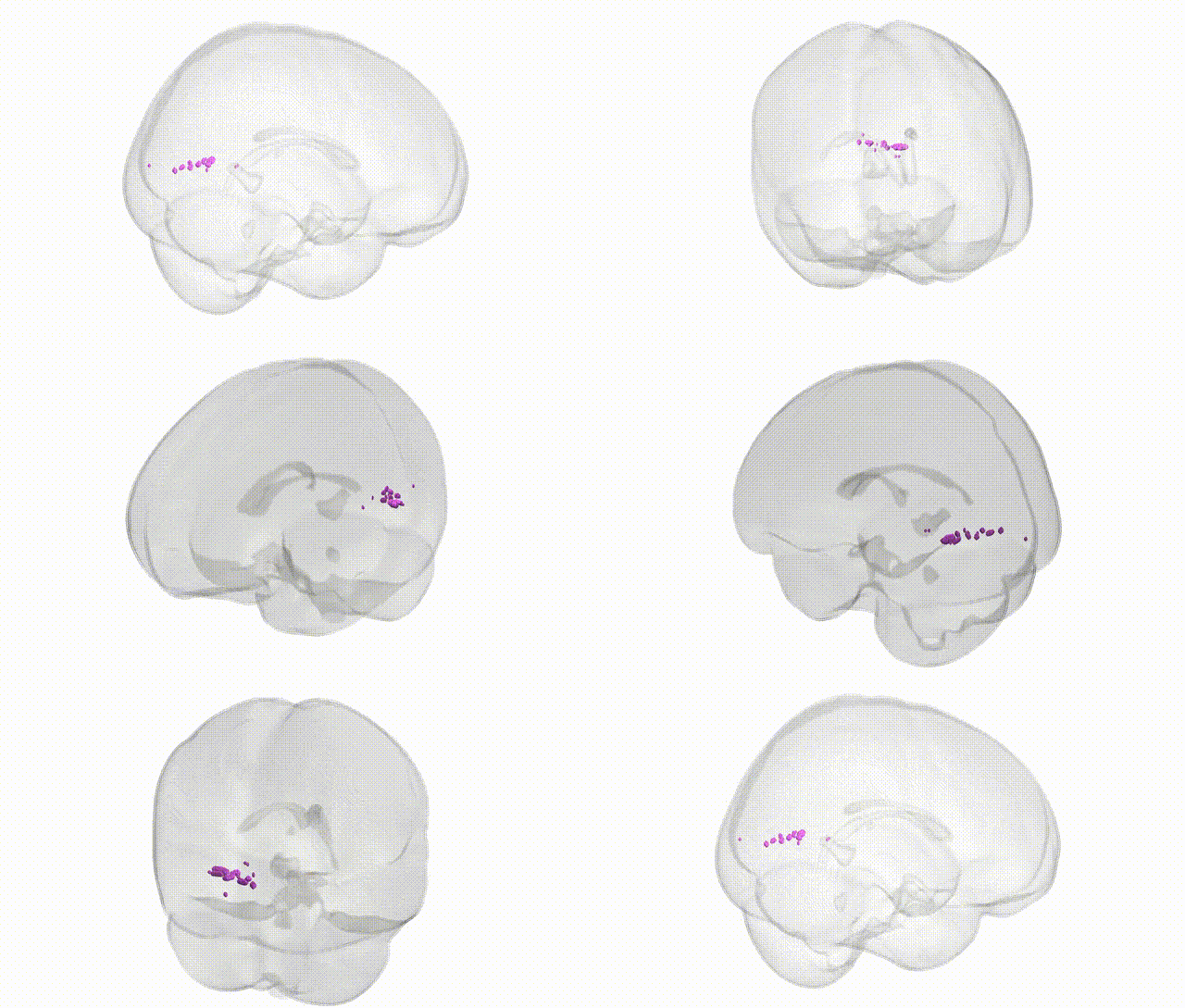
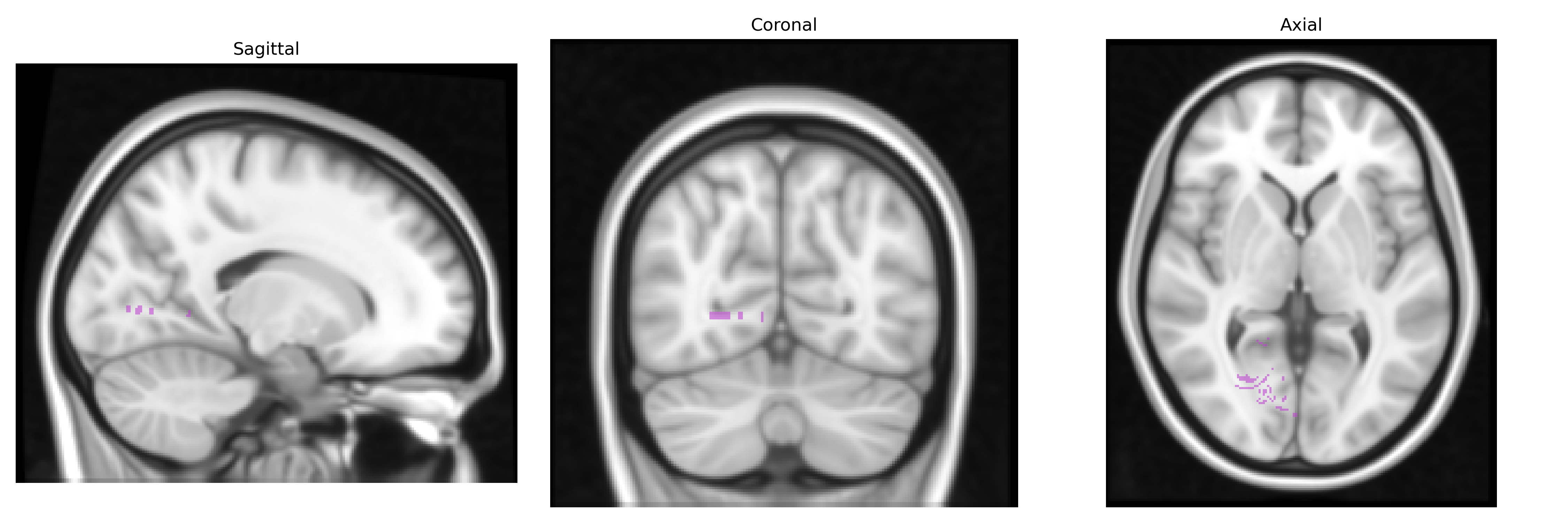
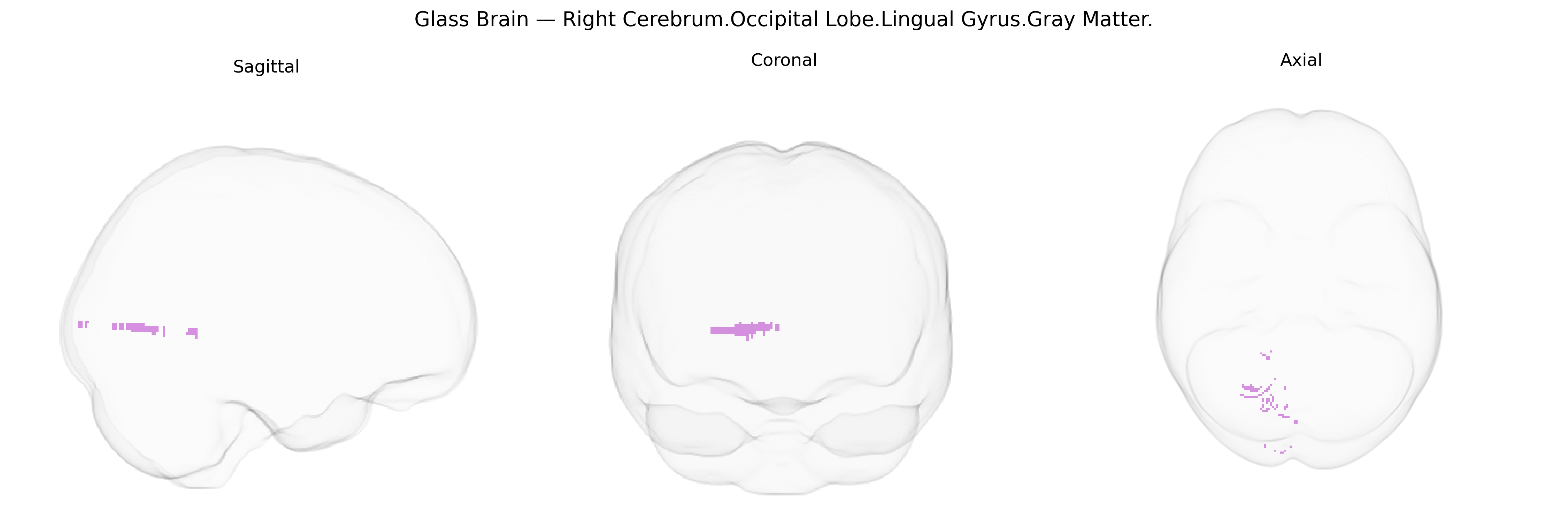
The bilateral Right Cerebrum.Occipital Lobe.Lingual Gyrus.Gray Matter corresponds to cortical gray matter within the lingual gyrus of the occipital lobe, a ventromedial occipital structure extending from the calcarine sulcus toward the posterior fusiform region and lying on the medial and inferior surface of the occipital lobe. This region is heavily involved in early and intermediate stages of visual processing, including analysis of complex shapes, letters, and words, as well as aspects of color and scene perception, and often participates in visual memory and imagery. Functionally, it forms part of the ventral visual stream, connecting primary visual areas with higher-order temporal and parietal regions, and shows robust activation in tasks involving visual word recognition and processing of detailed visual patterns.
The bilateral right lingual gyrus gray matter (Talairach: Right Cerebrum.Occipital Lobe.Lingual Gyrus.Gray Matter) has been implicated in genetic studies primarily through its roles in visual processing, reading, and higher-order cognition. Twin and SNP-based heritability work shows moderate to high heritability of lingual gyrus volume and cortical thickness, with common variants in genes affecting neurodevelopment (e.g., BDNF, NRG1, and genes in glutamatergic and GABAergic pathways) contributing to individual differences in occipital and ventral visual cortex structure. Large-scale neuroimaging GWAS, such as those from ENIGMA and UK Biobank, have identified genome-wide significant loci near genes involved in axon guidance, synaptic plasticity, and cortical patterning that associate with occipital/lingual gray matter measures, though findings are usually reported for combined or hemispheric occipital parcels rather than this exact bilateral right label. Functionally, genetic risk for neuropsychiatric and neurodevelopmental disorders—including schizophrenia, bipolar disorder, major depression, autism spectrum disorder, and dyslexia—has been associated with structural and functional alterations in the lingual gyrus, with polygenic risk scores for these conditions correlating with variation in occipital and ventral visual regions. Additionally, GWAS of traits such as visual processing, migraine, and intelligence have implicated overlapping loci that show enrichment for expression in occipital cortex, including lingual regions, suggesting that genetic influences on this area contribute to visual perception, reading and language-related processing, and vulnerability to certain psychiatric and neurological conditions.
Overview generated by GPT-4o (2026).
Region ID: 525
Hemisphere: bilateral
Atlas: Talairach labels 1mm
Full Quality Version: Download MP4
Full Quality Version: Download MP4
Wali Sidiqyar*, Gaurav Rudravaram*, Elyssa M. McMaster, Trent M. Schwartz, Adam M. Saunders, Kurt G. Schilling, Bennett A. Landman "Introducing SPINS: A Shared Public Visualization Library of Neuroanatomical Structures." Medical Imaging with Deep Learning- short paper
This resource is licensed under CC0 1.0 Universal (Public Domain).