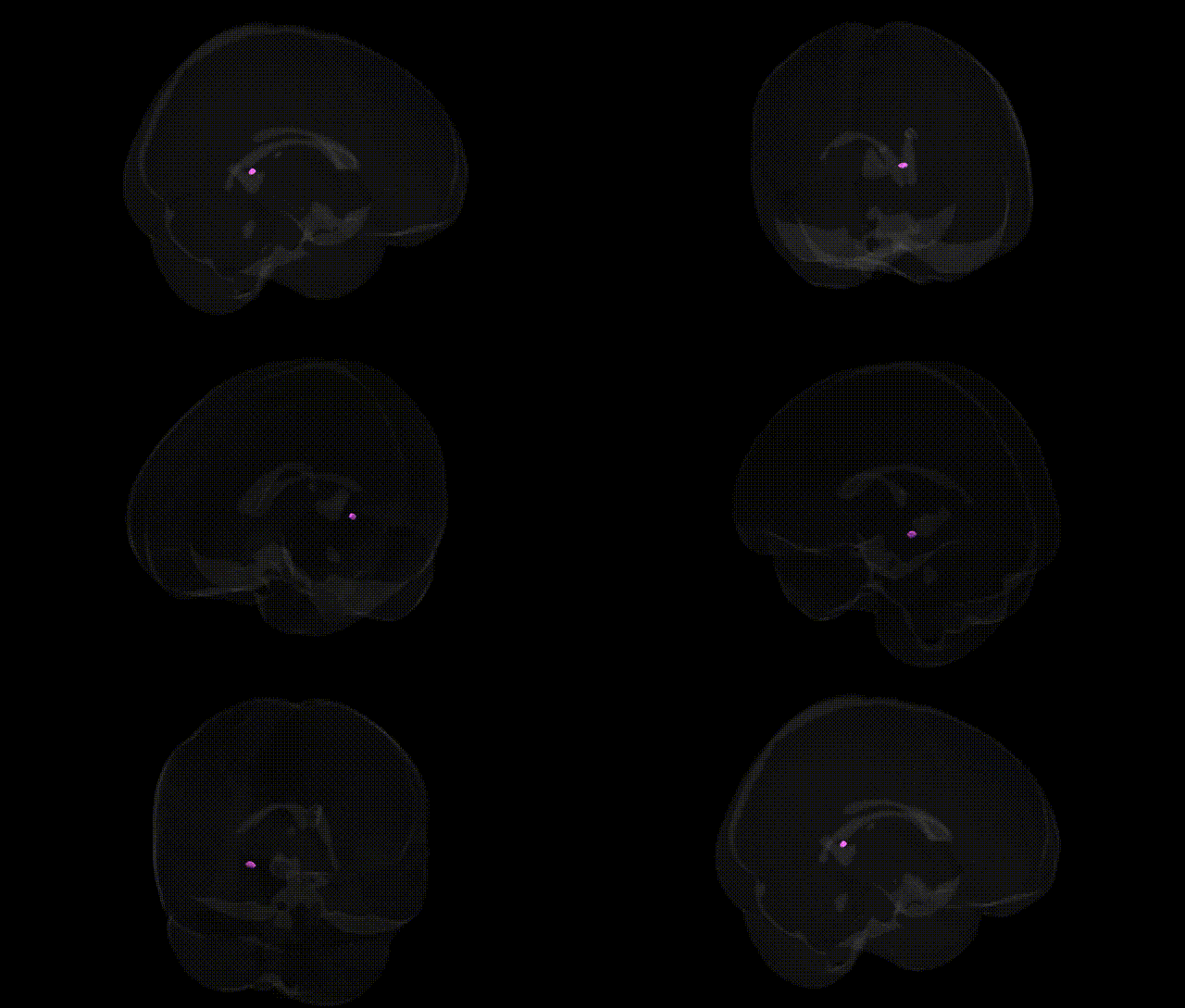
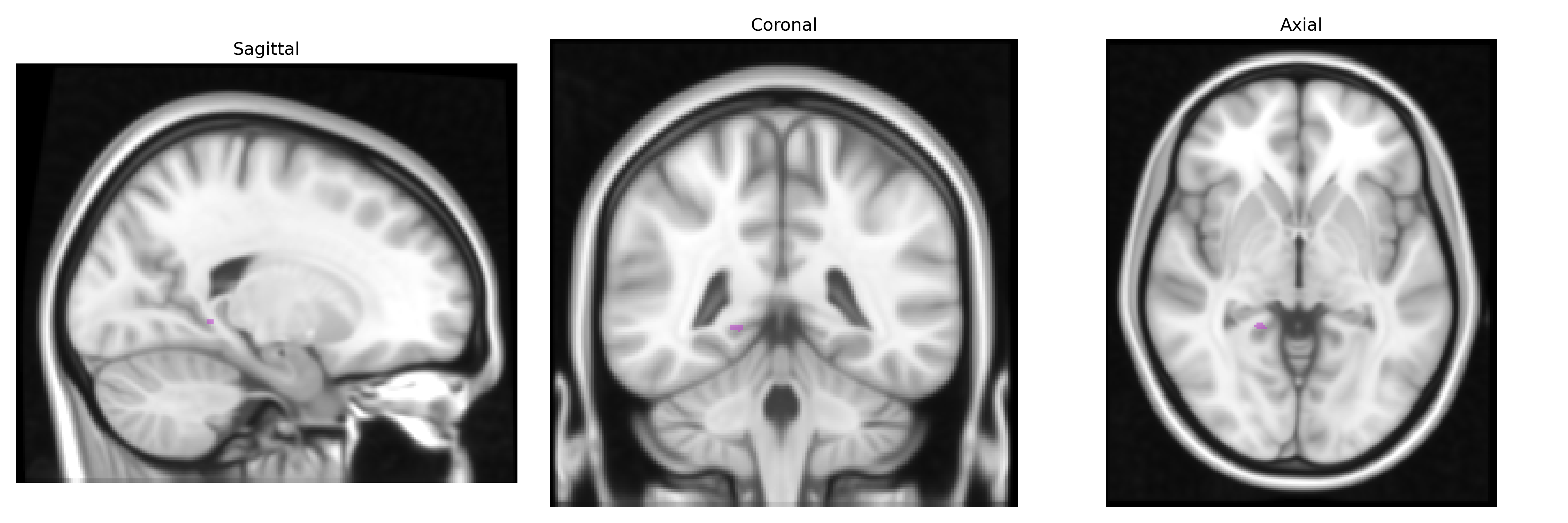
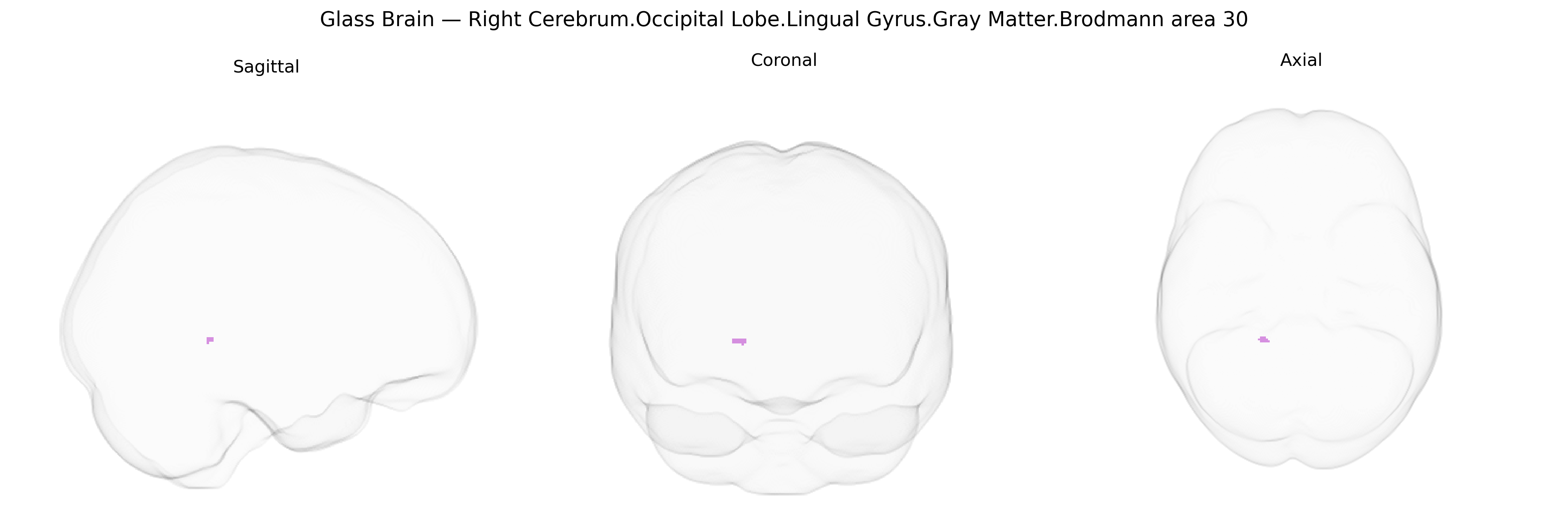
The bilateral Right Cerebrum.Occipital Lobe.Lingual Gyrus.Gray Matter.Brodmann area 30 corresponds to a retrosplenial portion of the lingual gyrus in the occipital lobe, belonging to the ventral visual processing stream and situated near the parahippocampal and posterior cingulate regions. Histologically, Brodmann area 30 is a limbic-associated cortical field characterized by transitional agranular to dysgranular cytoarchitecture, reflecting its integrative role between primary visual areas and medial temporal/limbic structures. Functionally, this region participates in higher-order visual processing, visuospatial memory, scene recognition, and contextual association of visual stimuli, and it is frequently engaged in networks supporting episodic memory, navigation, and visual imagery. There is no direct link for Brodmann area 30 in the lingual gyrus; a related structure is Retrosplenial cortex.
Genetic associations involving the bilateral right cerebrum occipital lobe lingual gyrus gray matter Brodmann area 30 (Talairach 1 mm atlas) arise mainly from imaging–genetics and GWAS of brain structure and function rather than direct locus-specific studies, as BA30 is often grouped with the lingual gyrus or ventral occipitotemporal cortex. Variants in genes influencing cortical thickness, surface area, or volume of the lingual gyrus and adjacent cuneus—such as those implicated in large ENIGMA and UK Biobank MRI-GWAS consortia (e.g., loci near HMGA2, IGF1, WNT signaling and neurodevelopmental genes)—have been associated with general occipital and ventral visual cortex morphology that spans BA30. Functionally, the lingual gyrus and BA30 participate in visual memory, scene processing, and emotional/episodic memory networks, and genetic risk variants for disorders including schizophrenia, major depressive disorder, bipolar disorder, autism spectrum disorder, and Alzheimer’s disease show enrichment in networks and structural measures that include this region, although not typically in a BA30-specific manner. Polygenic risk scores for psychiatric disorders and neurodegeneration have been linked to altered lingual/occipital gray matter volume and functional activation, implicating widespread neurodevelopmental and synaptic genes (e.g., those involved in glutamatergic signaling, calcium channels, and microtubule/axonal function). Additionally, genetic influences on visual perception, reading, and face/scene recognition traits overlap with occipitotemporal regions including the lingual gyrus, and some GWAS of visual or cognitive performance report associations near genes affecting myelination and cortical development that modulate activation in this area. Overall, current evidence supports polygenic and network-level genetic effects on BA30/lingual gyrus structure and function, rather than discrete single-gene associations uniquely tied to this specific Talairach-defined region.
Overview generated by GPT-4o (2026).
Region ID: 482
Hemisphere: bilateral
Atlas: Talairach labels 1mm
Full Quality Version: Download MP4
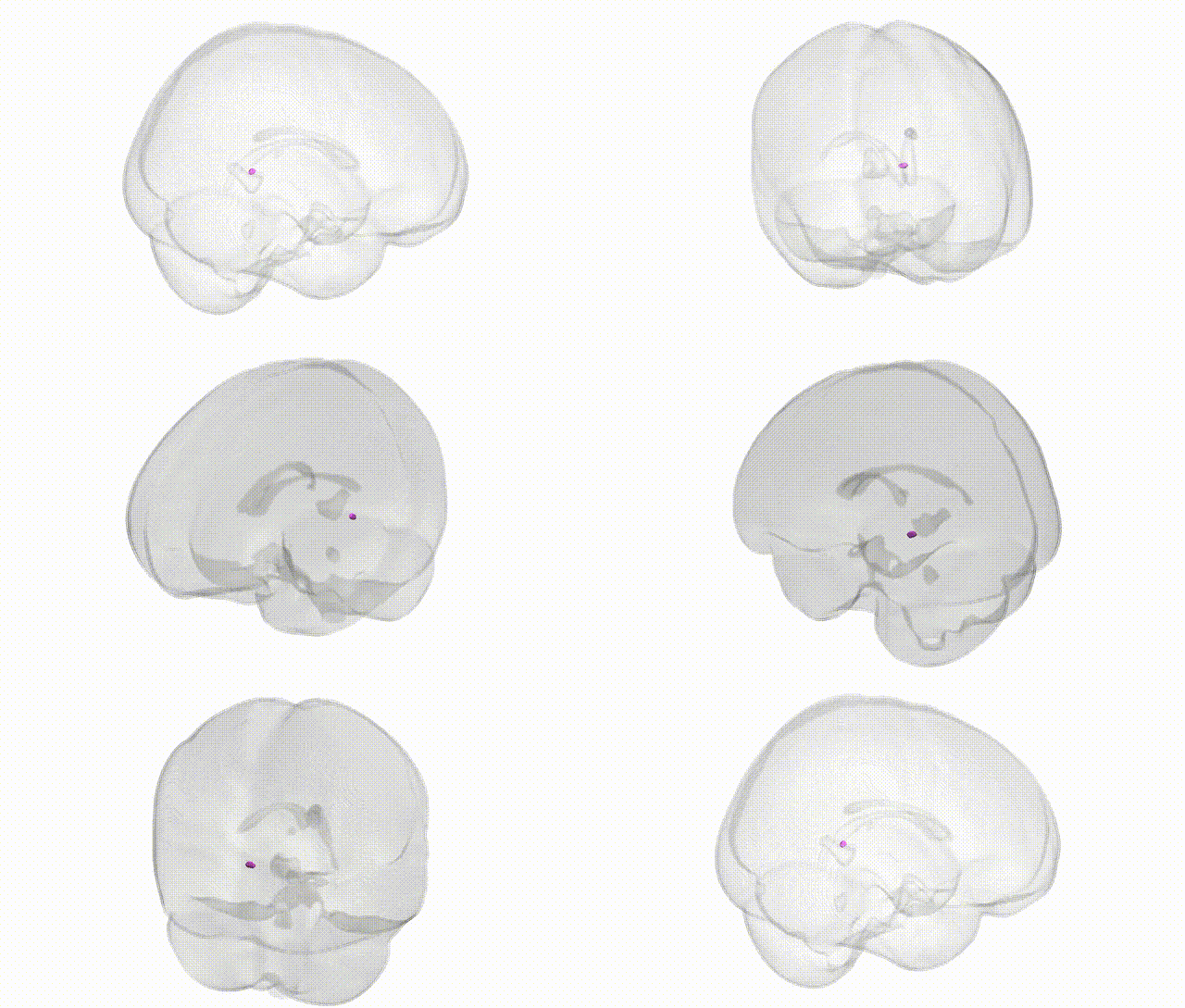
Full Quality Version: Download MP4
Wali Sidiqyar*, Gaurav Rudravaram*, Elyssa M. McMaster, Trent M. Schwartz, Adam M. Saunders, Kurt G. Schilling, Bennett A. Landman "Introducing SPINS: A Shared Public Visualization Library of Neuroanatomical Structures." Medical Imaging with Deep Learning- short paper
This resource is licensed under CC0 1.0 Universal (Public Domain).