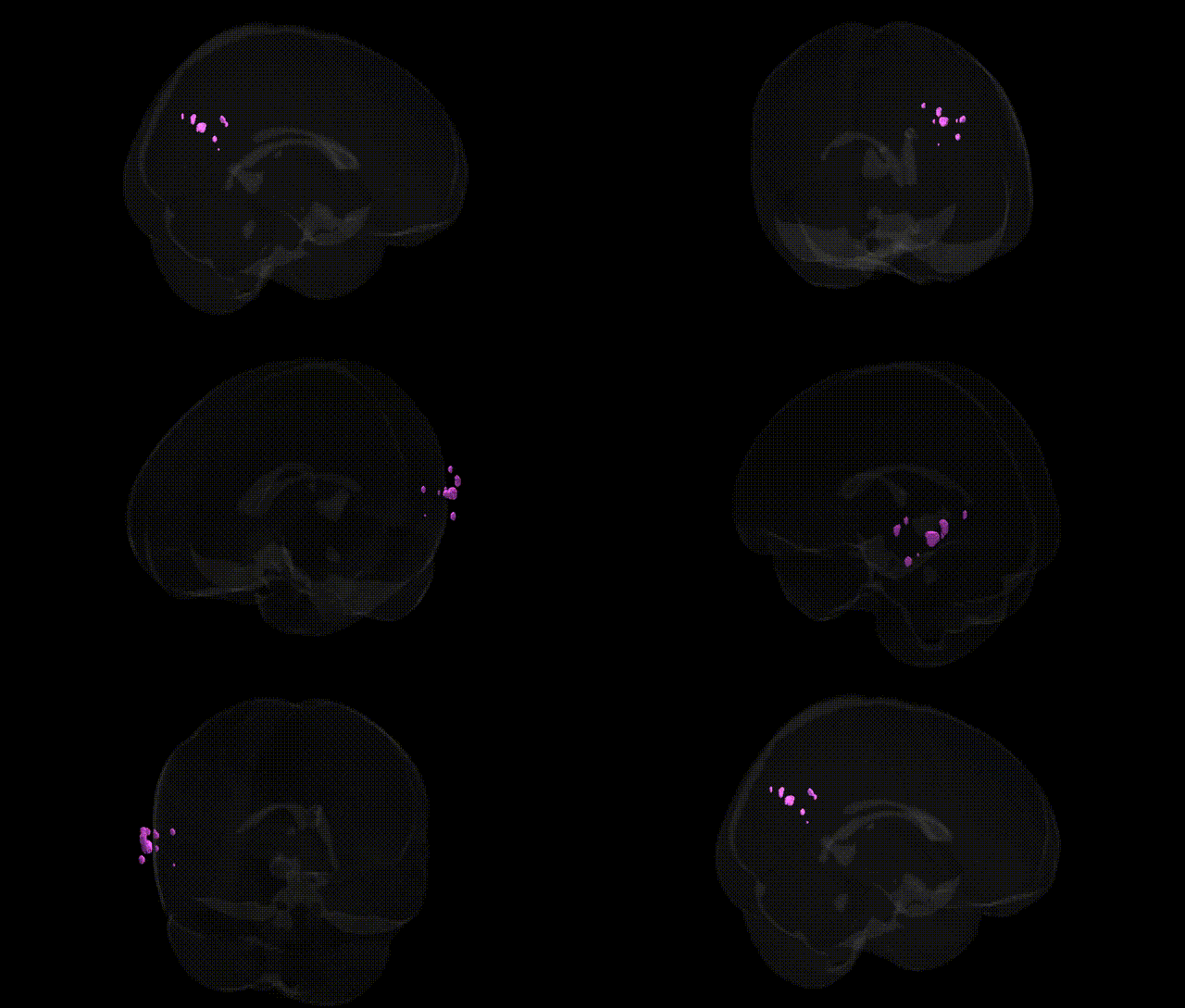
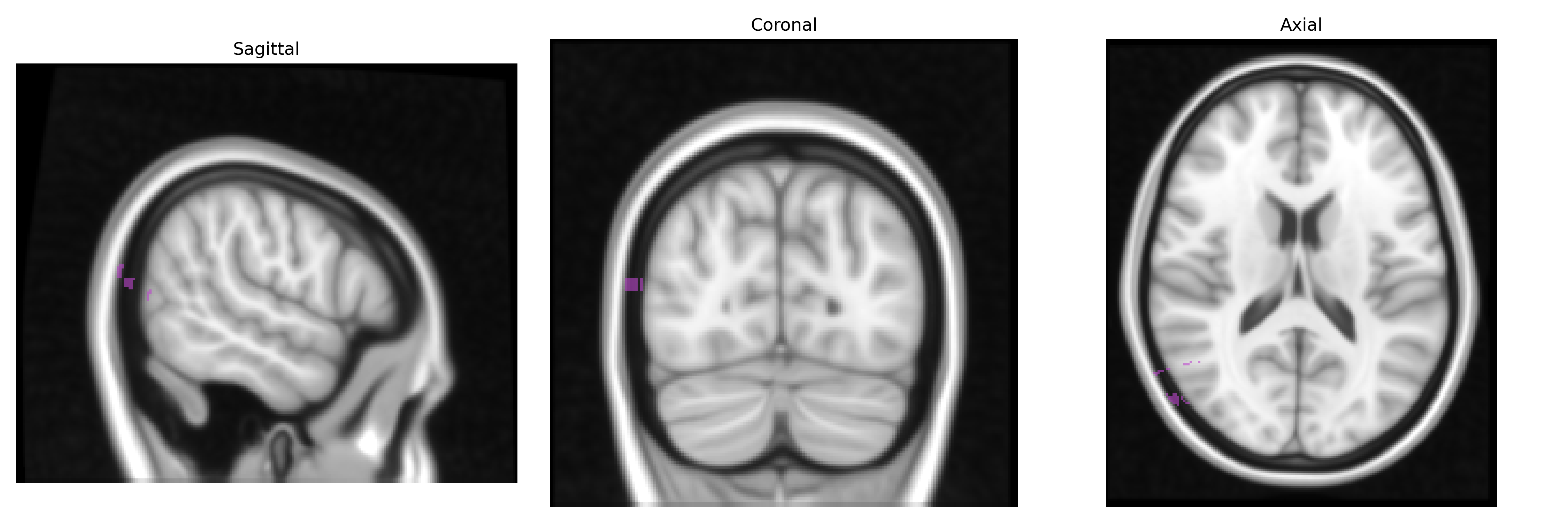
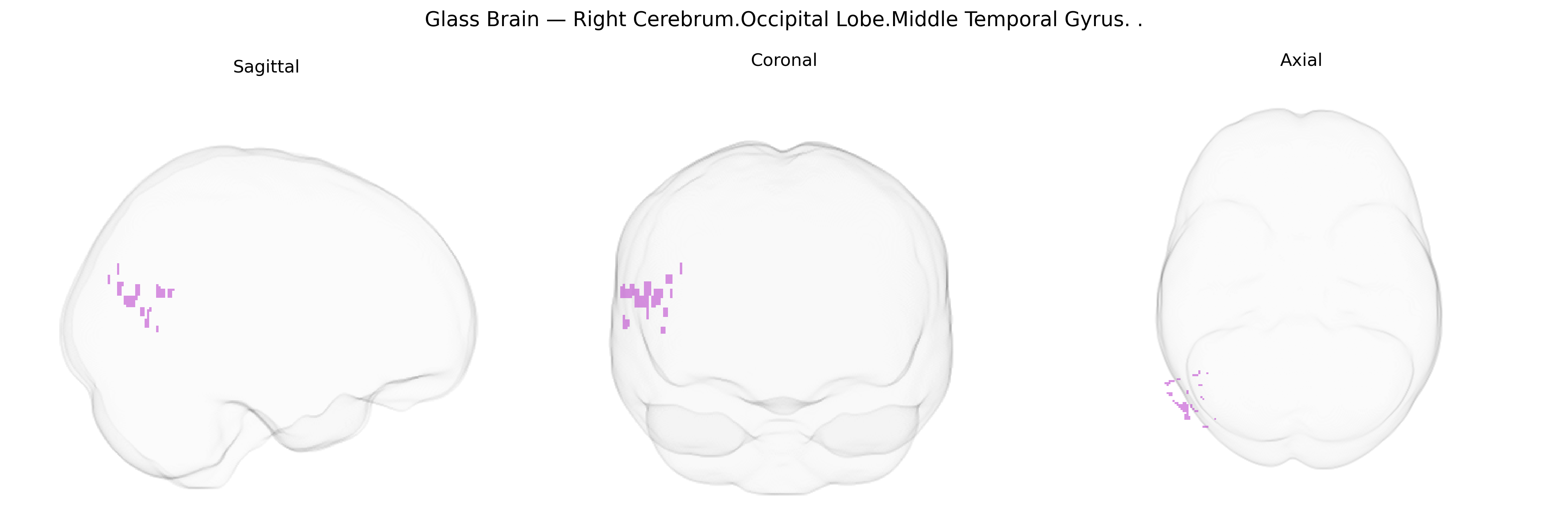
The bilateral Right Cerebrum.Occipital Lobe.Middle Temporal Gyrus, as labeled in the Talairach 1 mm atlas, refers to occipital extensions or posterior portions of the middle temporal gyrus that border or overlap occipital cortex, typically encompassing higher-order visual association areas involved in motion processing, form perception, and the integration of visual information with contextual or semantic content. Functionally, this region participates in the ventral and lateral visual streams, contributing to object recognition, interpretation of complex scenes, and possibly aspects of visual memory and language-related semantic processing, through its connectivity with temporal, parietal, and frontal association areas. There is no direct link for this specific composite label; a closely related structure is the Middle temporal gyrus.
The middle temporal gyrus of the right occipital lobe, as defined in the Talairach 1 mm atlas, has been implicated in genetic studies largely through its roles in visual processing, language, semantic memory, and social cognition, although GWAS and imaging–genetics findings typically reference the middle temporal gyrus more broadly rather than this exact bilateral right-hemisphere label. Large-scale GWAS of cortical structure (e.g., ENIGMA and UK Biobank) have identified common variants in genes such as HMGA2, IGF1, KIAA0586, and regions near 15q14 and 14q23 that influence temporal and occipital cortical thickness, surface area, and volume, with some loci showing effects in lateral and middle temporal cortices. Imaging–genetics studies have linked polygenic risk scores for schizophrenia, major depression, bipolar disorder, and autism spectrum disorder to morphological and functional alterations in the middle temporal gyrus, supporting its genetic involvement in social cognition, language, and hallucination-related networks. Variants in CNTNAP2, FOXP2, and other language- and connectivity-related genes have been associated with functional activation and connectivity changes in middle temporal regions during language and semantic tasks. GWAS of cognitive traits and educational attainment have reported associations between polygenic scores and structural measures in temporal–occipital areas, suggesting that genetic influences on general cognition and reading ability partly act through this region. In summary, genetic associations for this Talairach-defined area are indirect and regionally coarse, but converge on pathways affecting cortical development, synaptic function, and language/social-cognitive networks that encompass the middle temporal gyrus.
Overview generated by GPT-4o (2026).
Region ID: 561
Hemisphere: bilateral
Atlas: Talairach labels 1mm
Full Quality Version: Download MP4
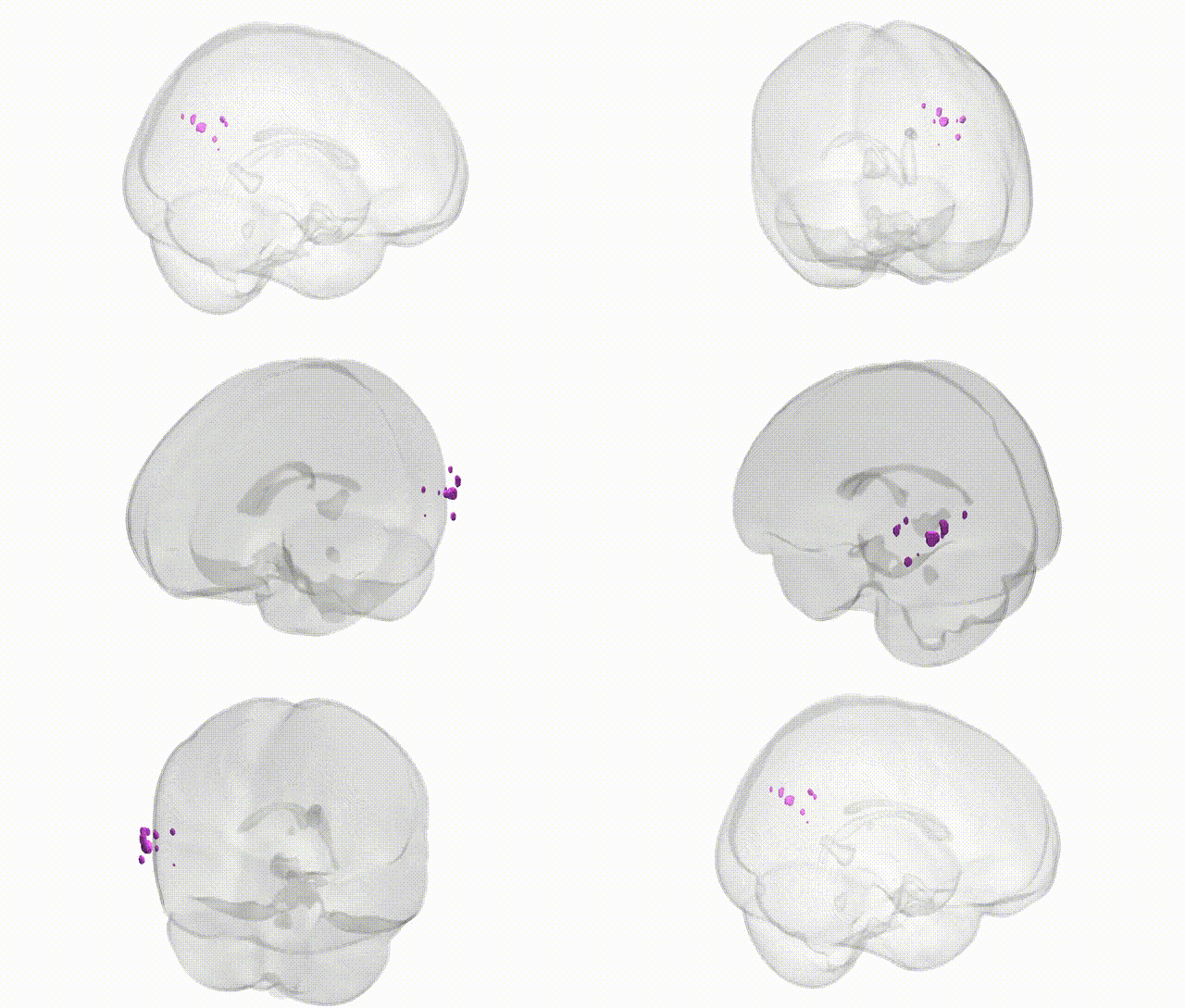
Full Quality Version: Download MP4
Wali Sidiqyar*, Gaurav Rudravaram*, Elyssa M. McMaster, Trent M. Schwartz, Adam M. Saunders, Kurt G. Schilling, Bennett A. Landman "Introducing SPINS: A Shared Public Visualization Library of Neuroanatomical Structures." Medical Imaging with Deep Learning- short paper
This resource is licensed under CC0 1.0 Universal (Public Domain).