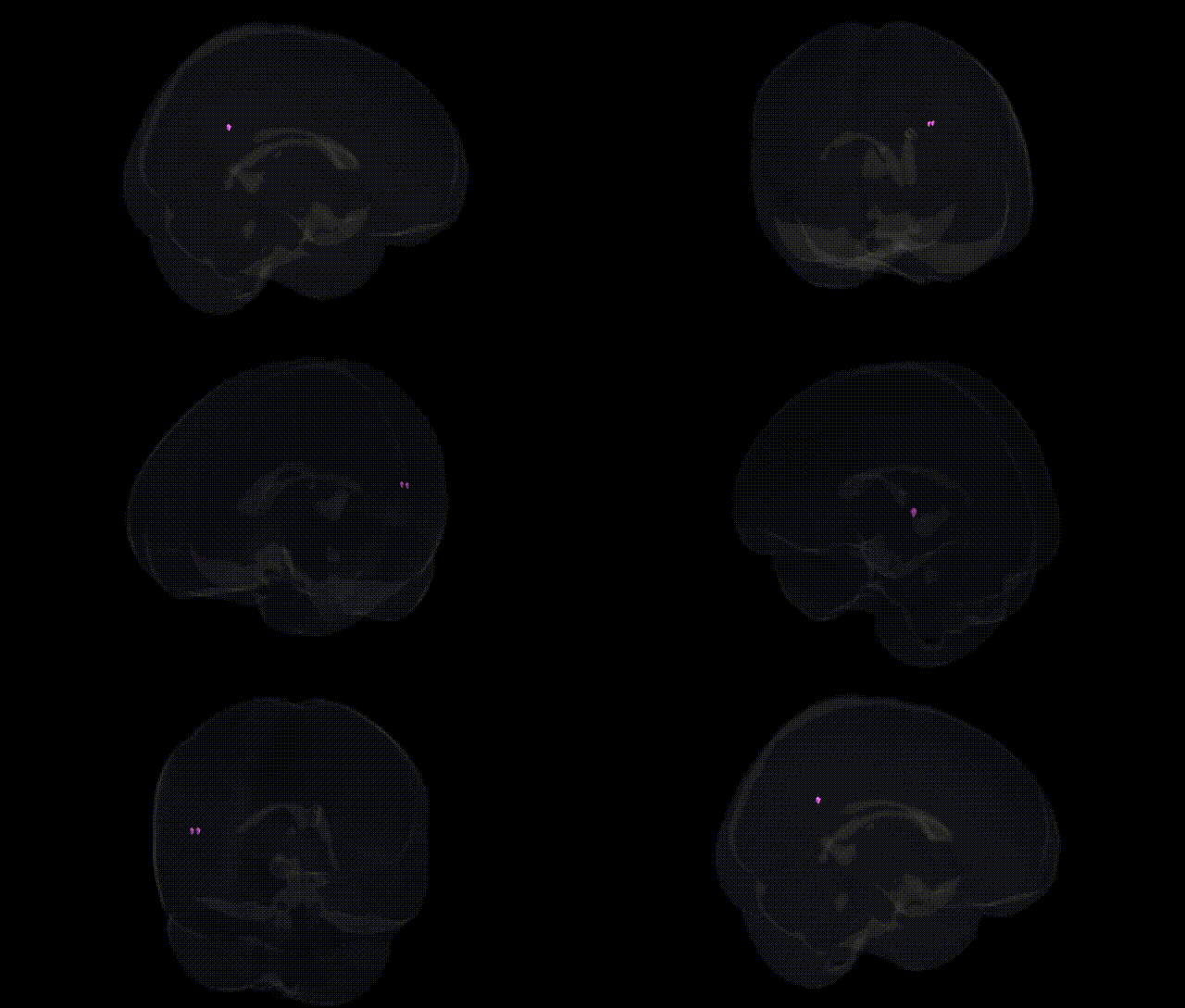
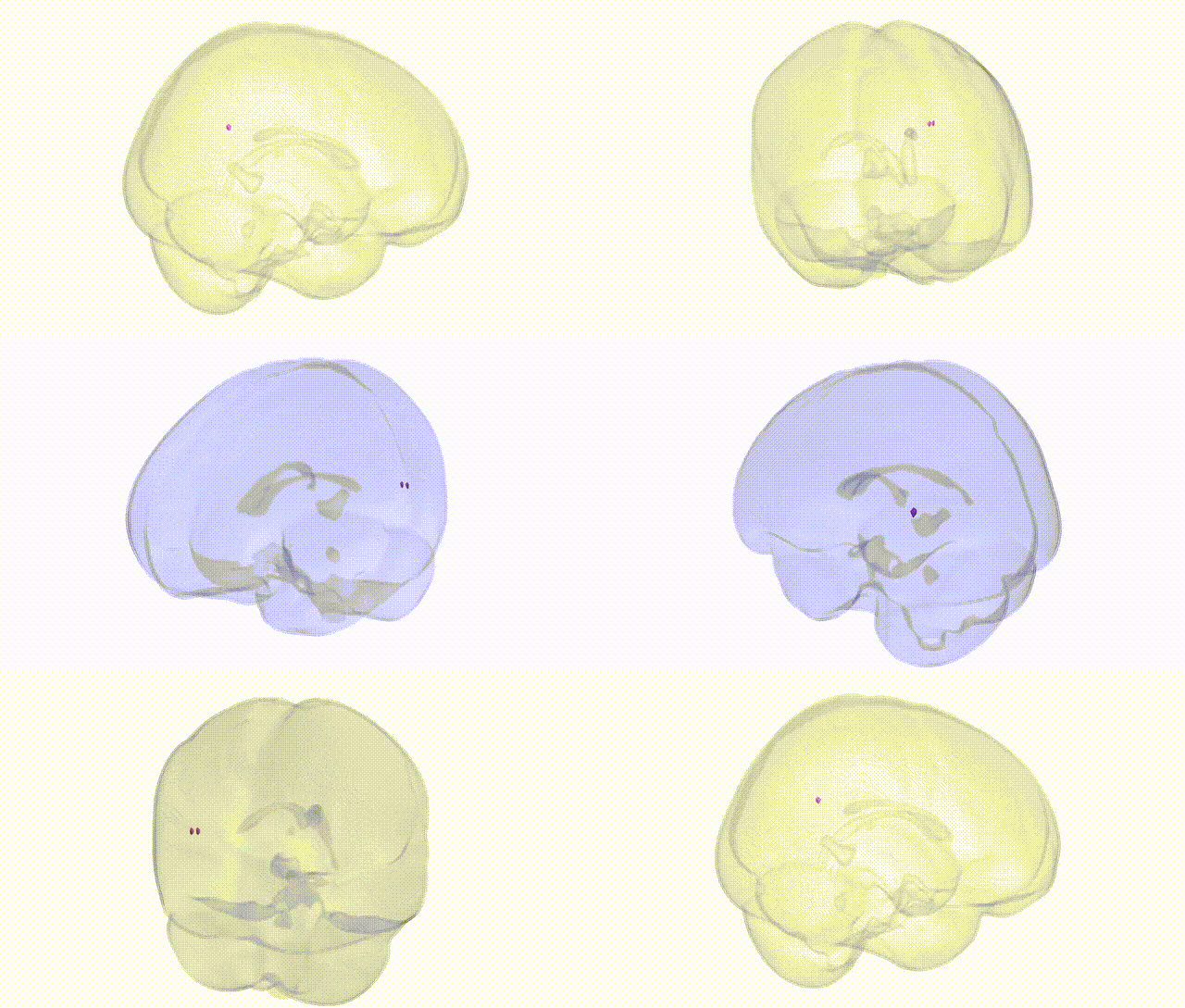
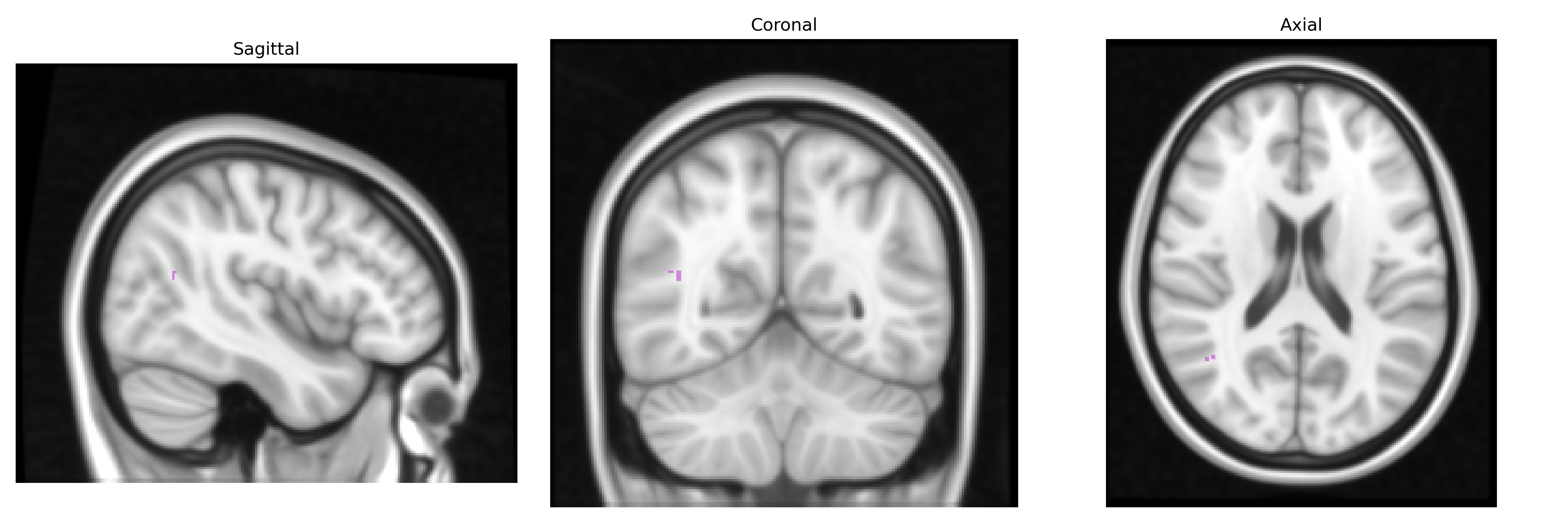
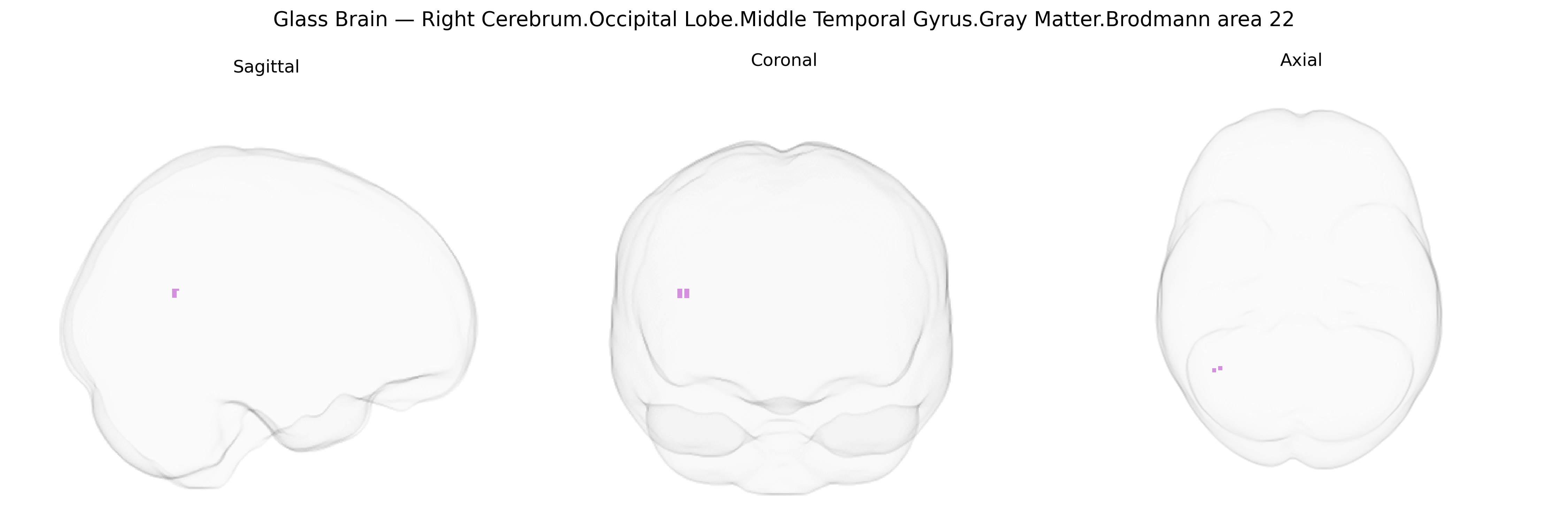
The bilateral Right Cerebrum.Occipital Lobe.Middle Temporal Gyrus.Gray Matter.Brodmann area 22, as defined in the Talairach 1 mm atlas, refers to gray matter in the middle temporal gyrus within the occipital–temporal junction of the right cerebral hemisphere that falls within the cytoarchitectonic boundaries of Brodmann area 22. Brodmann area 22 is classically associated with the superior temporal cortex and auditory association processing, including language-related functions, but atlas-based labeling can extend its coordinate-defined territory into adjacent middle temporal regions involved in higher-order visual, audiovisual, and semantic integration. Neurons in this region participate in complex multimodal processing, contributing to the interpretation of sounds and visual stimuli, higher-level object and motion perception, and the integration of temporal and spatial information, with right-hemisphere specializations often relating to prosody, nonverbal acoustic cues, and aspects of social and scene perception. Brodmann area 22
The bilateral right middle temporal gyrus gray matter in Brodmann area 22 (labeled in the Talairach 1 mm atlas within the occipital/temporal junction region) has been implicated in multiple genetic and GWAS findings, largely through imaging-genetics and neuropsychiatric association studies rather than gene–region specificity in a strict anatomical sense. Variants influencing cortical thickness and surface area in temporal association cortices, including right BA22/middle temporal gyrus, have emerged in large ENIGMA and UK Biobank analyses, with common loci near genes involved in neurodevelopment and synaptic function (for example, MAPT, WNT signaling–related genes, and several glutamatergic and cell-adhesion genes), though effects are typically polygenic and regionally nonspecific. Right superior and middle temporal regions associated with language, social cognition, and auditory processing show altered structure or activation patterns in carriers of risk alleles for schizophrenia (e.g., in or near ZNF804A, MIR137, CACNA1C), autism spectrum disorders (e.g., CNTNAP2, SHANK family genes), and major depression, consistent with broader temporal-lobe vulnerability in these conditions. GWAS of hallucinations, psychosis, and auditory-verbal traits also report temporal-lobe–relevant loci (including genes affecting synaptic plasticity and myelination), while studies of reading, semantic processing, and language lateralization link polygenic scores for educational attainment and cognitive performance to variability in temporal lobe morphology and function. Overall, genetic associations involving right BA22 middle temporal cortex reflect distributed polygenic influences on temporal-lobe development, connectivity, and higher-order auditory–language and social-cognitive functions, rather than single-gene specificity for this precise Talairach-defined parcel.
Overview generated by GPT-4o (2026).
Region ID: 766
Hemisphere: bilateral
Atlas: Talairach labels 1mm
Full Quality Version: Download MP4
Full Quality Version: Download MP4
Wali Sidiqyar*, Gaurav Rudravaram*, Elyssa M. McMaster, Trent M. Schwartz, Adam M. Saunders, Kurt G. Schilling, Bennett A. Landman "Introducing SPINS: A Shared Public Visualization Library of Neuroanatomical Structures." Medical Imaging with Deep Learning- short paper
This resource is licensed under CC0 1.0 Universal (Public Domain).