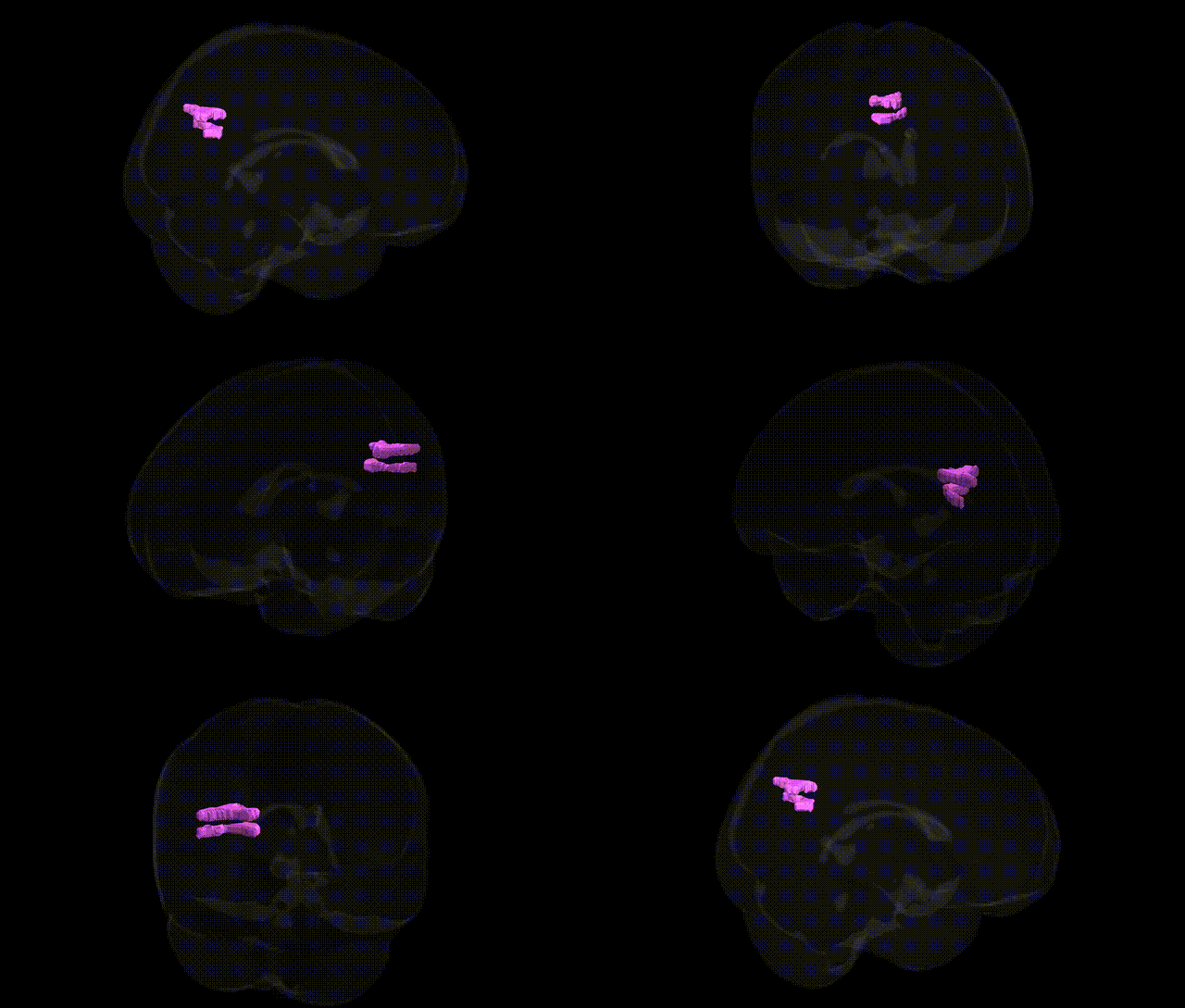
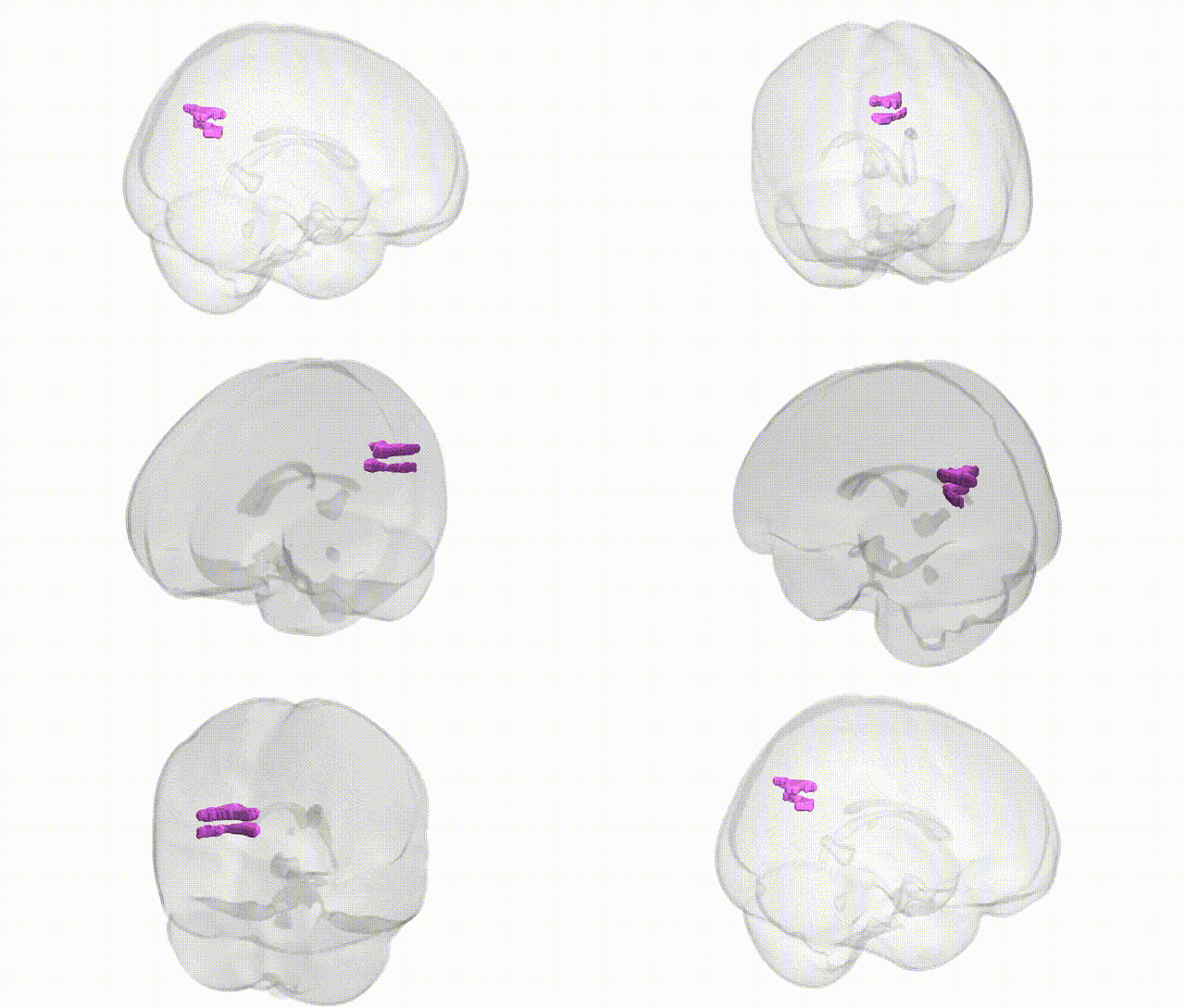
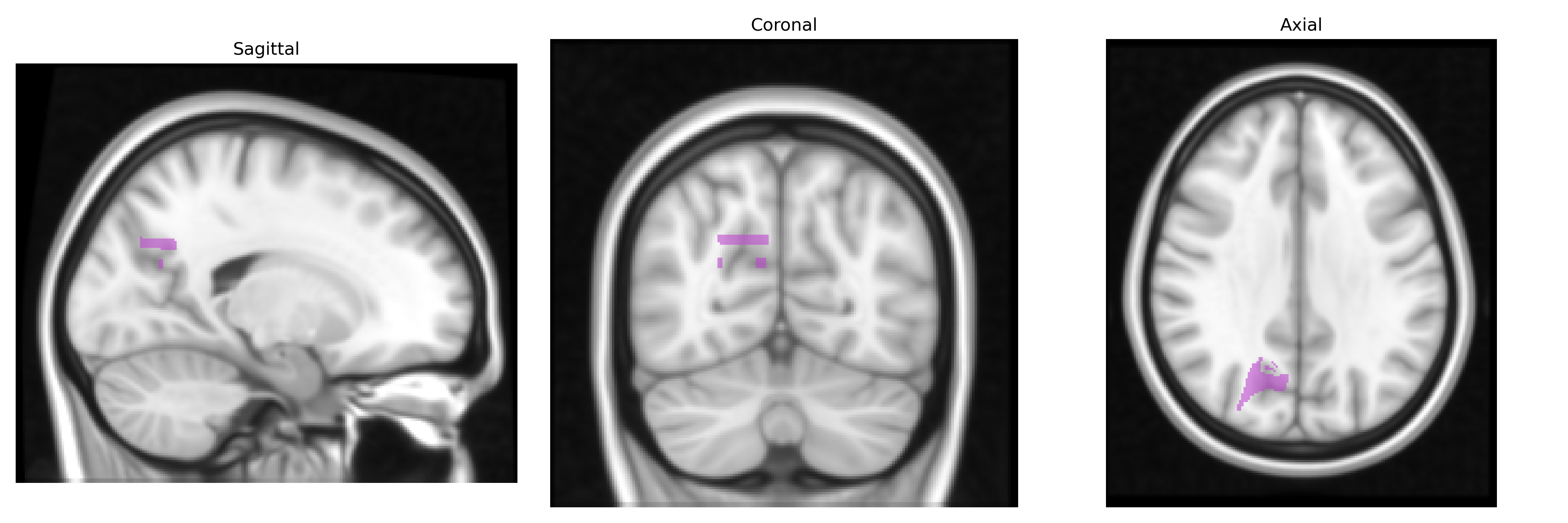
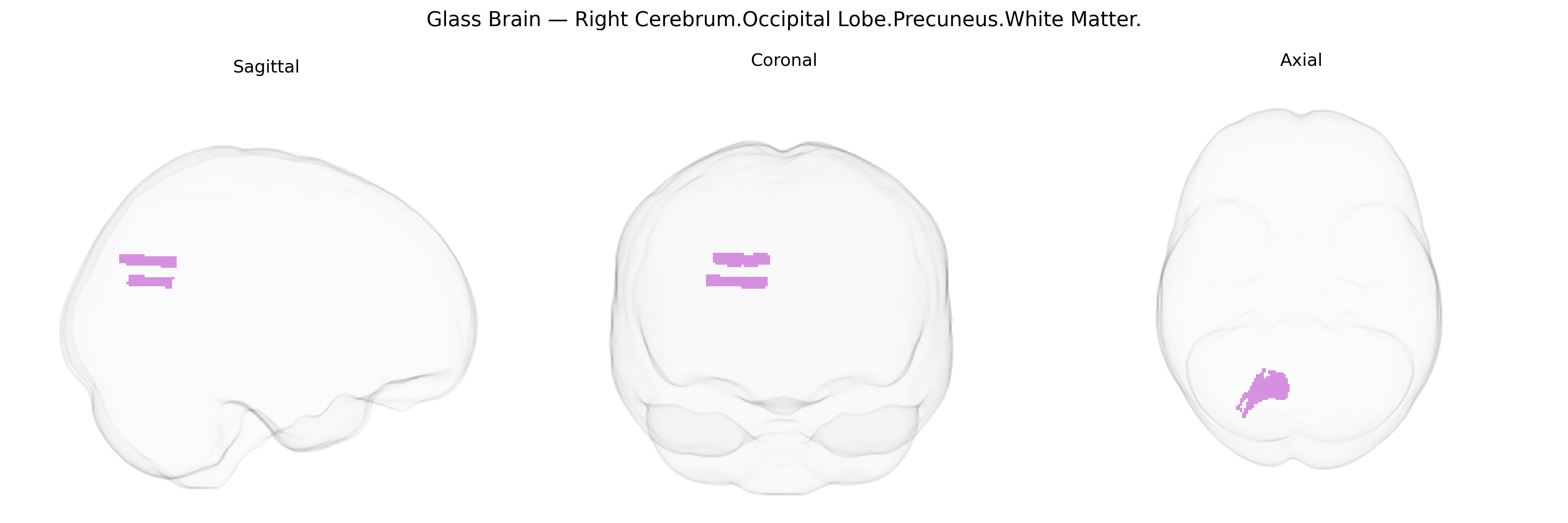
The bilateral Right Cerebrum.Occipital Lobe.Precuneus.White Matter corresponds to the deep myelinated fiber pathways underlying the cortical precuneus region, located on the medial surface of the parietal-occipital junction within the superior parietal lobule and bordering the occipital lobe. These white matter tracts support integration of multimodal sensory information, visuospatial processing, self-referential and default-mode network activity, and higher-order cognitive functions by linking the precuneus cortex with adjacent parietal, occipital, and frontal association areas, as well as subcortical structures such as the thalamus. As part of the larger precuneus network, these fibers contribute to visuomotor coordination, mental imagery, and aspects of consciousness and episodic memory retrieval. There is no direct Wikipedia article for the white matter subdivision of this region; a related cortical structure is the Precuneus.
The bilateral Right Cerebrum.Occipital Lobe.Precuneus.White Matter region, as defined in the Talairach 1 mm atlas, corresponds largely to structural and connectivity components of the precuneus and adjacent occipital association cortex, for which genetic associations have been identified primarily through neuroimaging GWAS of brain structure and connectivity rather than region-specific white matter studies. Large consortia such as ENIGMA and UK Biobank have reported heritable variation in precuneus and occipital lobe cortical thickness, surface area, and white matter microstructure (e.g., fractional anisotropy in posterior thalamic and occipito-parietal tracts), with common variants near genes involved in neurodevelopment, synaptic function, and axon guidance (for example, variants in or near genes like MEF2C, DCC, and CNTN4 in broader parietal–occipital networks), though these are not uniquely tied to this exact Talairach-defined parcel. Genetic correlations have been observed between structural measures in the precuneus/occipital region and psychiatric and cognitive traits, including schizophrenia, major depressive disorder, autism spectrum disorder, general cognitive ability, and educational attainment, suggesting shared polygenic influences on posterior cortical morphology and connectivity. Disorders featuring disrupted default-mode and visuospatial networks, such as Alzheimer’s disease, schizophrenia, and ADHD, show GWAS-supported polygenic risk that is partly expressed in altered precuneus and occipital white matter integrity, but the associations are diffuse and network-level rather than specific to this single atlas label. Overall, current genetic evidence supports moderate heritability and polygenic influences on structural and microstructural variation in the broader precuneus–occipital white matter, with links to neurodevelopmental, neuropsychiatric, and cognitive phenotypes, but there are no well-established, uniquely locus-specific GWAS findings restricted to the bilateral Right Cerebrum.Occipital Lobe.Precuneus.White Matter region as defined in the Talairach labels.
Overview generated by GPT-4o (2026).
Region ID: 822
Hemisphere: bilateral
Atlas: Talairach labels 1mm
Full Quality Version: Download MP4
Full Quality Version: Download MP4
Wali Sidiqyar*, Gaurav Rudravaram*, Elyssa M. McMaster, Trent M. Schwartz, Adam M. Saunders, Kurt G. Schilling, Bennett A. Landman "Introducing SPINS: A Shared Public Visualization Library of Neuroanatomical Structures." Medical Imaging with Deep Learning- short paper
This resource is licensed under CC0 1.0 Universal (Public Domain).