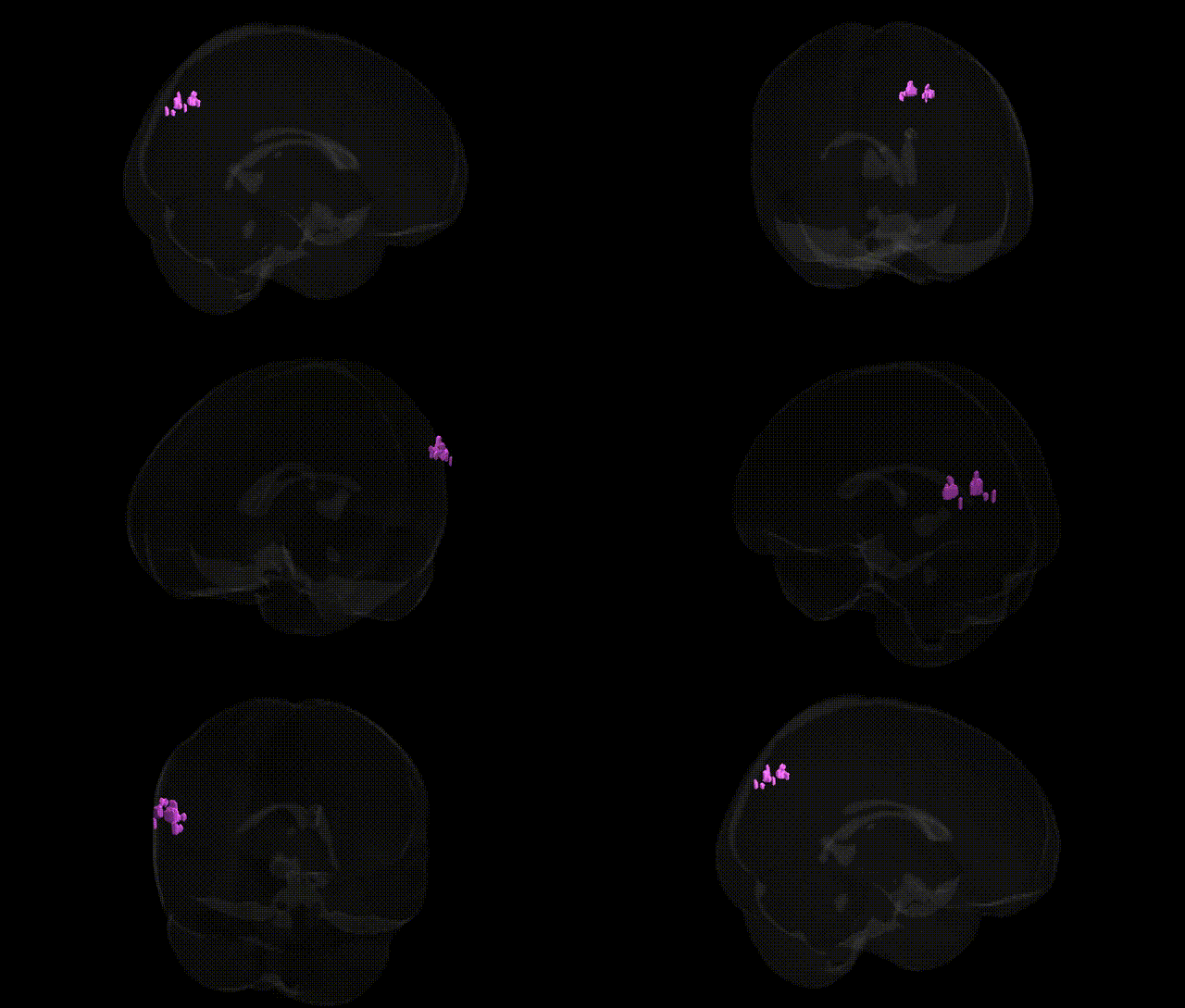
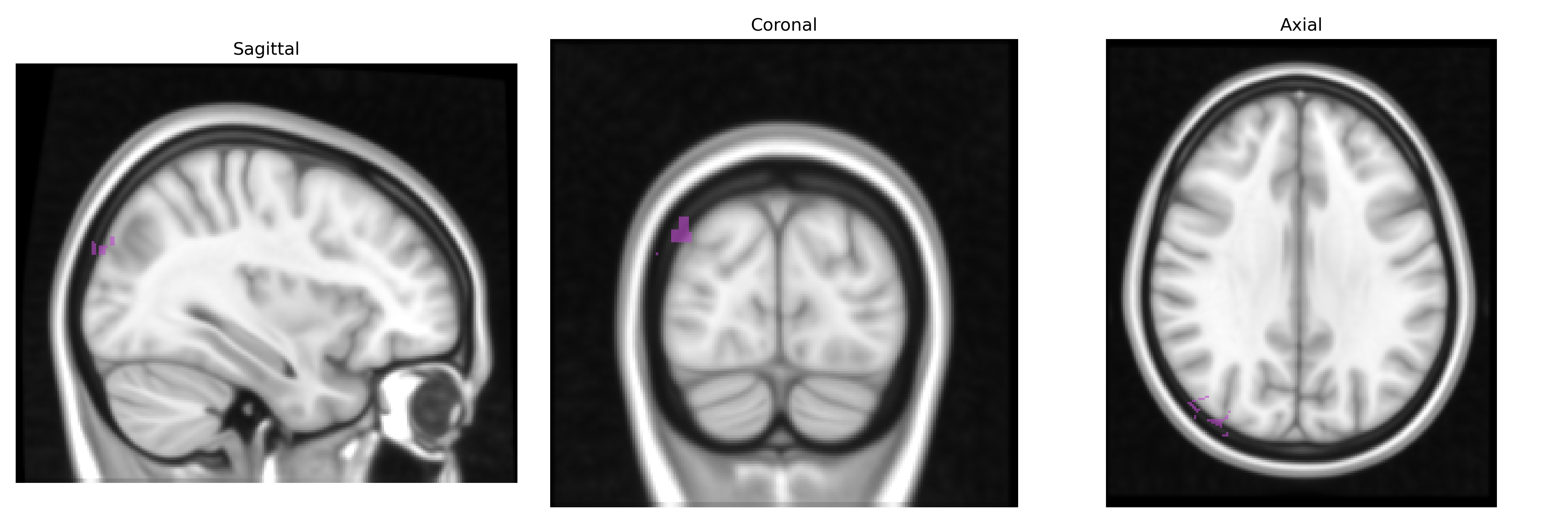
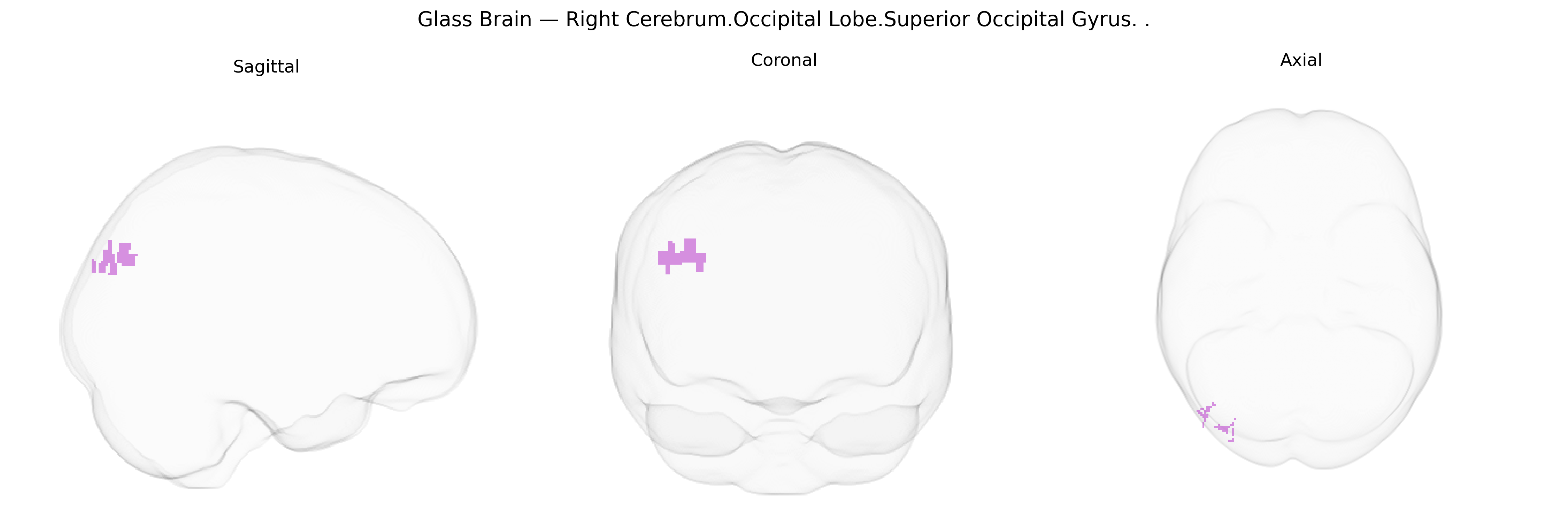
The bilateral Right Cerebrum.Occipital Lobe.Superior Occipital Gyrus is a cortical region located in the dorsal portion of the occipital lobe, extending along the superior aspect of the lateral surface of the hemisphere and bordering parietal-occipital territories. It is primarily involved in higher-order visual processing, including integration of motion, spatial orientation, and aspects of visuospatial attention, and contributes to the dorsal visual stream that connects occipital areas with parietal cortex for visually guided actions. Cytoarchitectonically, this gyrus encompasses portions of secondary visual areas (extrastriate cortex) rather than primary visual cortex (V1), and its bilateral organization supports coordinated processing of visual information from both hemifields. There is no direct Wikipedia article for the superior occipital gyrus; a closely related structure is the Occipital lobe.
The bilateral right superior occipital gyrus, part of the dorsal visual processing stream, has been implicated indirectly in genetic studies of visual cognition, perception, and neuropsychiatric disorders that show altered occipital cortex structure or function. Large GWAS of brain imaging phenotypes (e.g., ENIGMA, UK Biobank) have identified multiple loci influencing occipital cortical thickness and surface area—often near or within genes involved in neurodevelopment and synaptic function (such as variants in or near PAX6, TCF4, KIAA0319, and other neurodevelopmental regulators)—though these findings generally map to broader occipital regions rather than specifically to the superior occipital gyrus. Genetic associations with visual acuity, refractive error, and cortical visual processing have highlighted pathways related to axon guidance, myelination, and synaptic plasticity, which likely contribute to structural variation in this region. Occipital lobe morphology, including superior occipital areas, has also been linked in imaging-genetics studies to polygenic risk for schizophrenia, bipolar disorder, major depression, autism spectrum disorder, and attention-deficit/hyperactivity disorder, with risk variants converging on genes involved in glutamatergic signaling and cortical development. In addition, genetic risk scores for migraine and visual aura show modest associations with occipital cortex activation patterns, hinting at genetically mediated excitability differences that may involve the superior occipital gyrus. Overall, existing genetic evidence addresses the occipital lobe at a relatively coarse spatial resolution, so associations are robust at the lobe or visual-network level but remain incomplete and nonspecific for the bilateral right superior occipital gyrus as defined in the Talairach 1 mm atlas.
Overview generated by GPT-4o (2026).
Region ID: 847
Hemisphere: bilateral
Atlas: Talairach labels 1mm
Full Quality Version: Download MP4
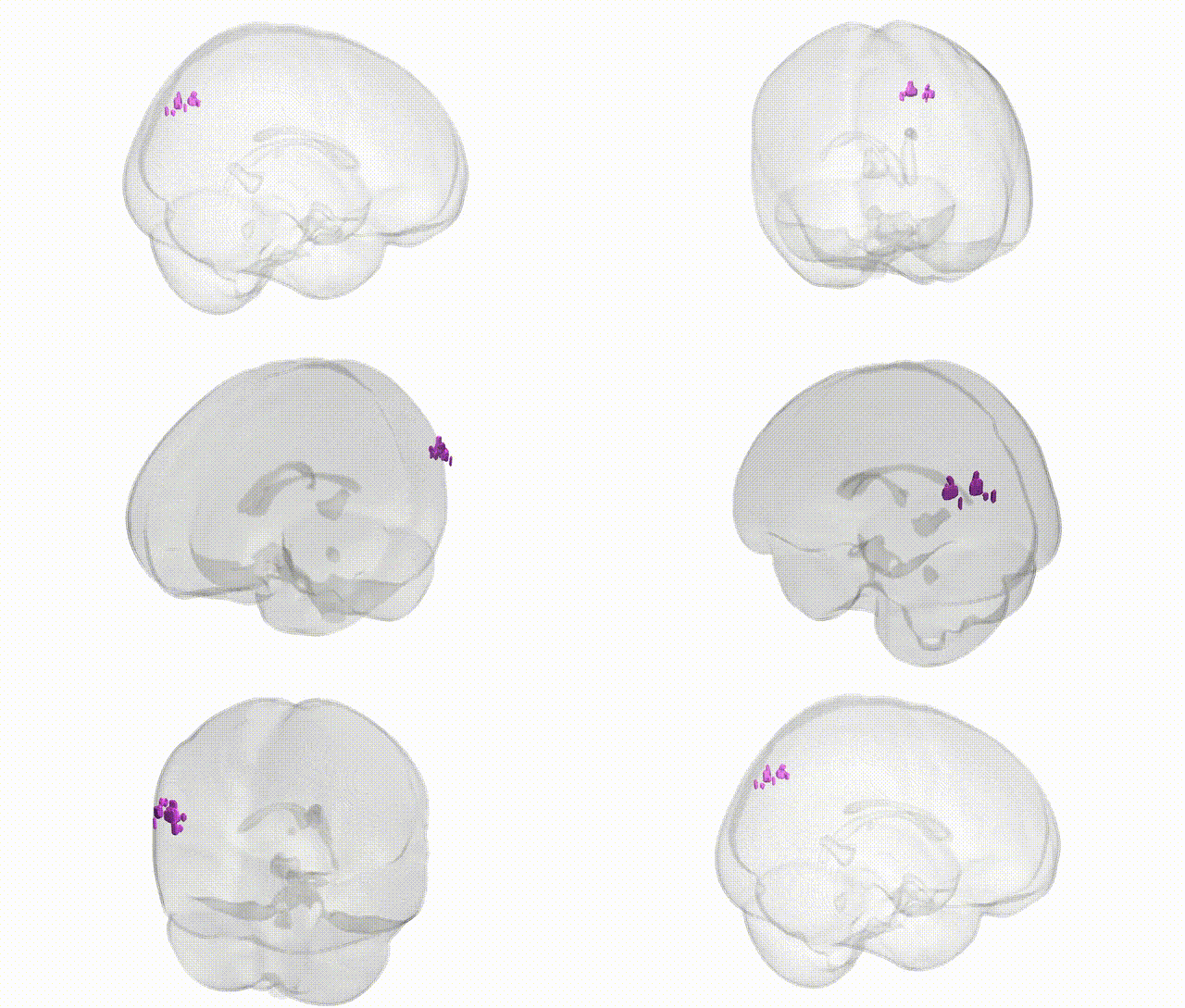
Full Quality Version: Download MP4
Wali Sidiqyar*, Gaurav Rudravaram*, Elyssa M. McMaster, Trent M. Schwartz, Adam M. Saunders, Kurt G. Schilling, Bennett A. Landman "Introducing SPINS: A Shared Public Visualization Library of Neuroanatomical Structures." Medical Imaging with Deep Learning- short paper
This resource is licensed under CC0 1.0 Universal (Public Domain).