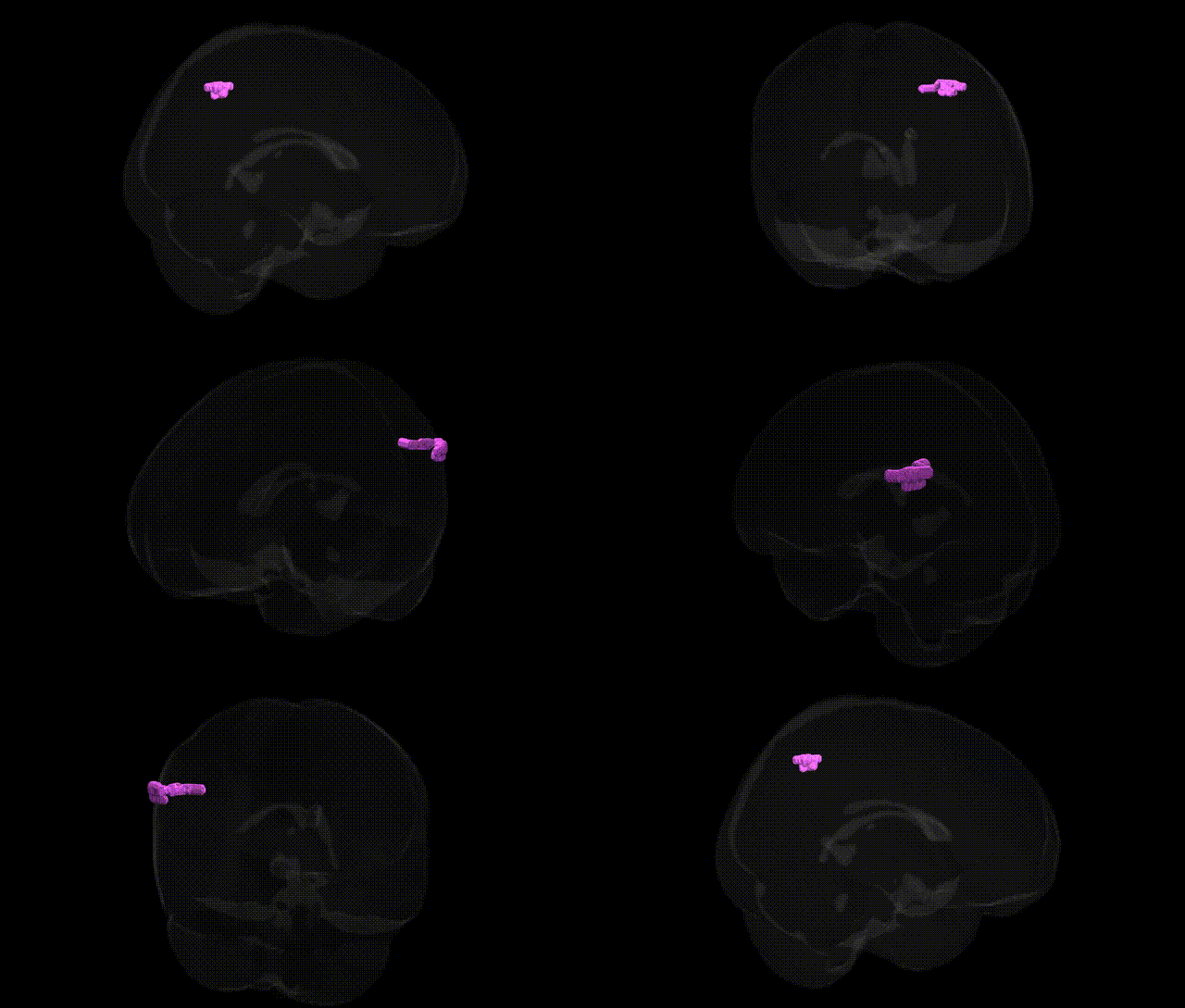
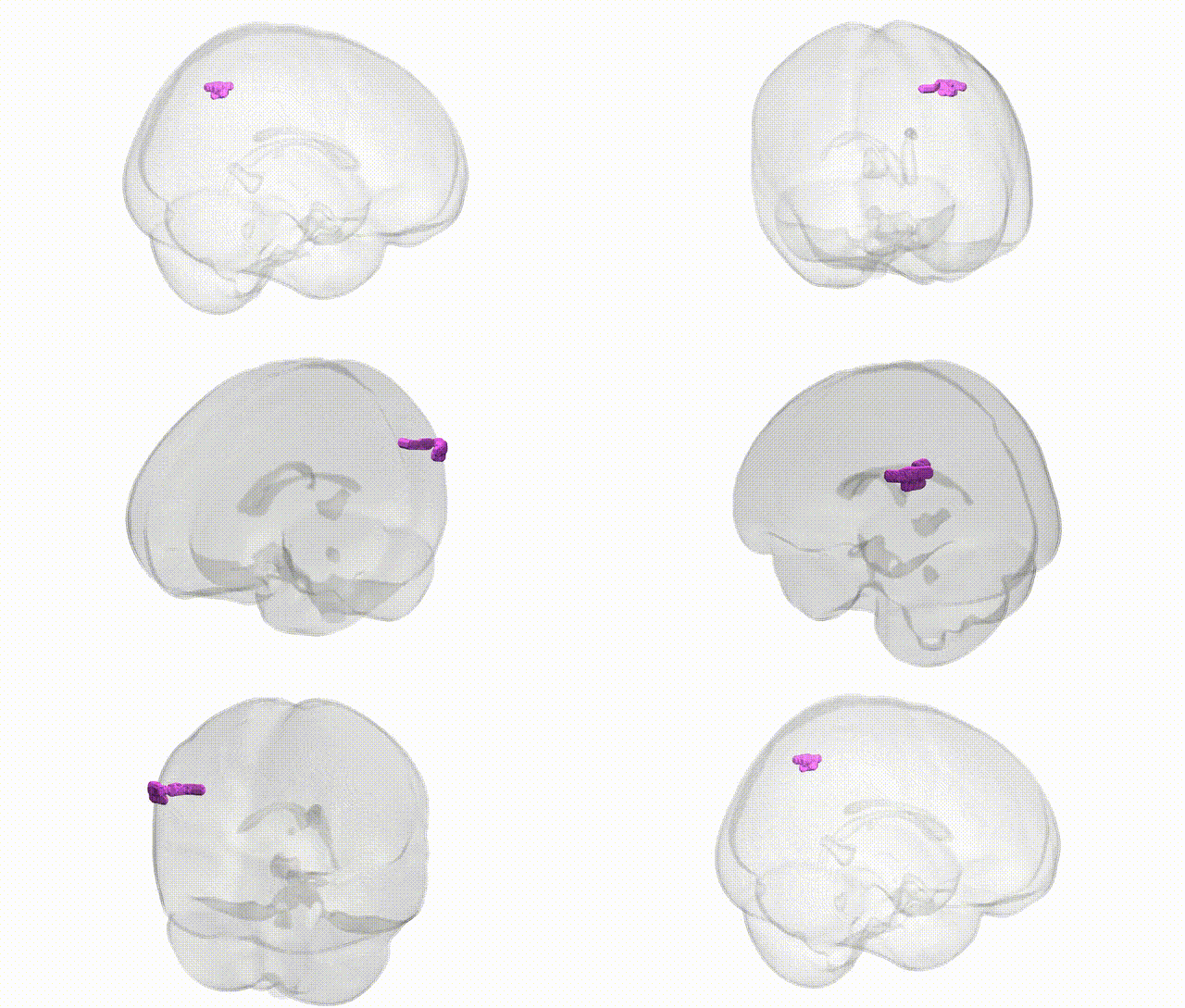
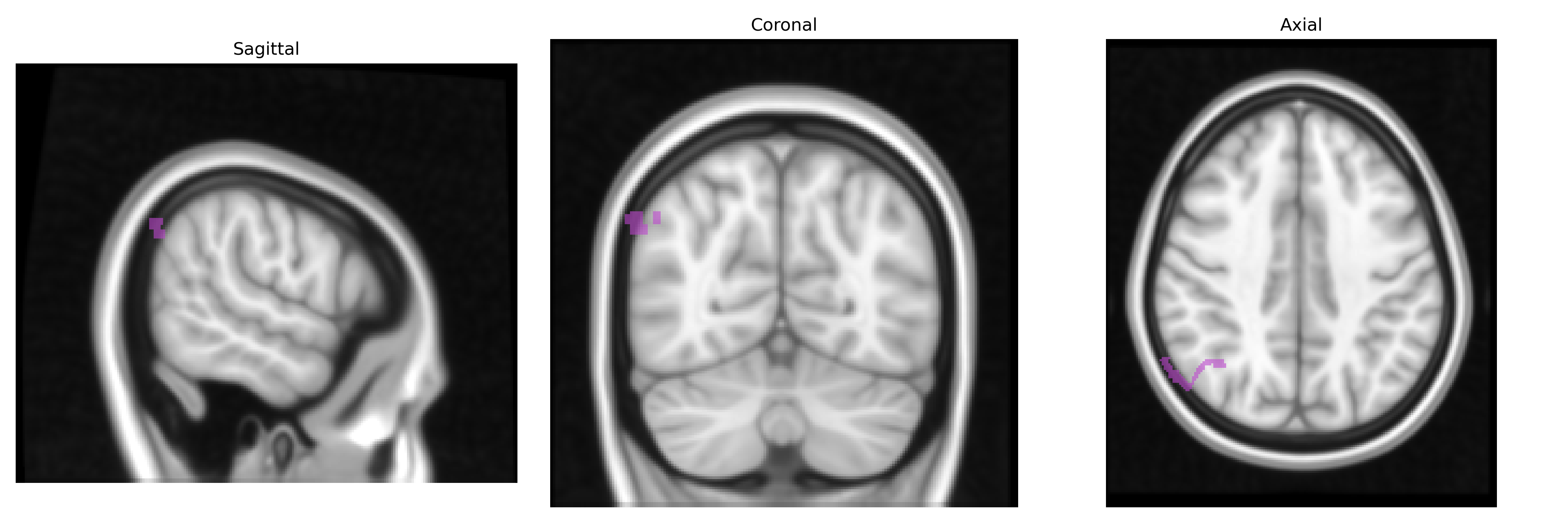
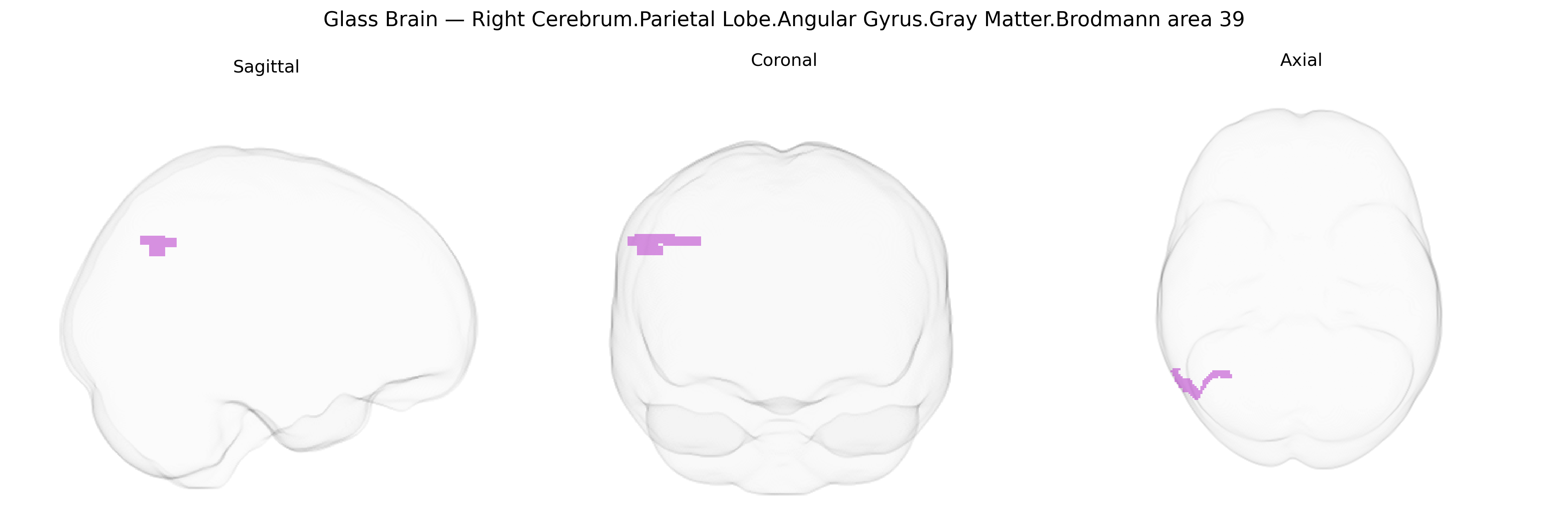
The bilateral Right Cerebrum.Parietal Lobe.Angular Gyrus.Gray Matter.Brodmann area 39 corresponds to cortical gray matter in the angular gyrus of the inferior parietal lobule, localized to Brodmann area 39 within the Talairach coordinate system. This region lies near the junction of the parietal, temporal, and occipital lobes and is implicated in high-level association processes, including aspects of language comprehension (particularly reading and semantic processing), number processing, spatial cognition, and multimodal integration of visual, auditory, and somatosensory inputs. Functionally, it participates in networks supporting attention, theory of mind, and memory retrieval, and is often engaged during tasks requiring the integration of contextual information and symbolic processing. Lesions in this area can contribute to syndromes such as Gerstmann’s syndrome and certain forms of aphasia, reflecting its role in linking perceptual data with linguistic and conceptual representations. Angular gyrus
The bilateral angular gyrus (right cerebrum, parietal lobe, Brodmann area 39) is a multimodal association region genetically implicated in higher cognitive functions and several neuropsychiatric conditions, with many findings emerging from GWAS and imaging–genetics studies that map variants to cortical thickness, surface area, and functional connectivity in this area. Common variants near genes involved in neurodevelopment, synaptic plasticity, and axon guidance (for example, DCC, ROBO family genes, and loci on chromosomes 3p, 6p, and 17q identified in large cortical GWAS consortia) have been associated with angular gyrus structure or function, which in turn correlates with individual differences in intelligence, reading and language abilities, numerical processing, and default mode network activity. Polygenic risk for schizophrenia, autism spectrum disorder, major depressive disorder, and attention-deficit/hyperactivity disorder shows robust associations with altered gray matter metrics and connectivity in angular gyrus–containing networks, consistent with convergent evidence from case–control MRI and transcriptomic studies that highlight this region in social cognition, theory of mind, and self-referential processing. GWAS of educational attainment, general cognitive ability, and mathematical performance also report enriched effects on parietal association cortex, including BA39, where genetically driven variation in cortical morphology partially mediates the relationship between polygenic scores and cognitive phenotypes. Additionally, risk loci for Alzheimer’s disease and other dementias, including variants in APOE and genes regulating amyloid and tau pathways, are linked to atrophy patterns and hypometabolism involving the angular gyrus, a key hub of the default mode network that is vulnerable to neurodegenerative processes, thereby connecting specific genetic architectures to regionally selective brain vulnerability and cognitive decline.
Overview generated by GPT-4o (2026).
Region ID: 970
Hemisphere: bilateral
Atlas: Talairach labels 1mm
Full Quality Version: Download MP4
Full Quality Version: Download MP4
Wali Sidiqyar*, Gaurav Rudravaram*, Elyssa M. McMaster, Trent M. Schwartz, Adam M. Saunders, Kurt G. Schilling, Bennett A. Landman "Introducing SPINS: A Shared Public Visualization Library of Neuroanatomical Structures." Medical Imaging with Deep Learning- short paper
This resource is licensed under CC0 1.0 Universal (Public Domain).