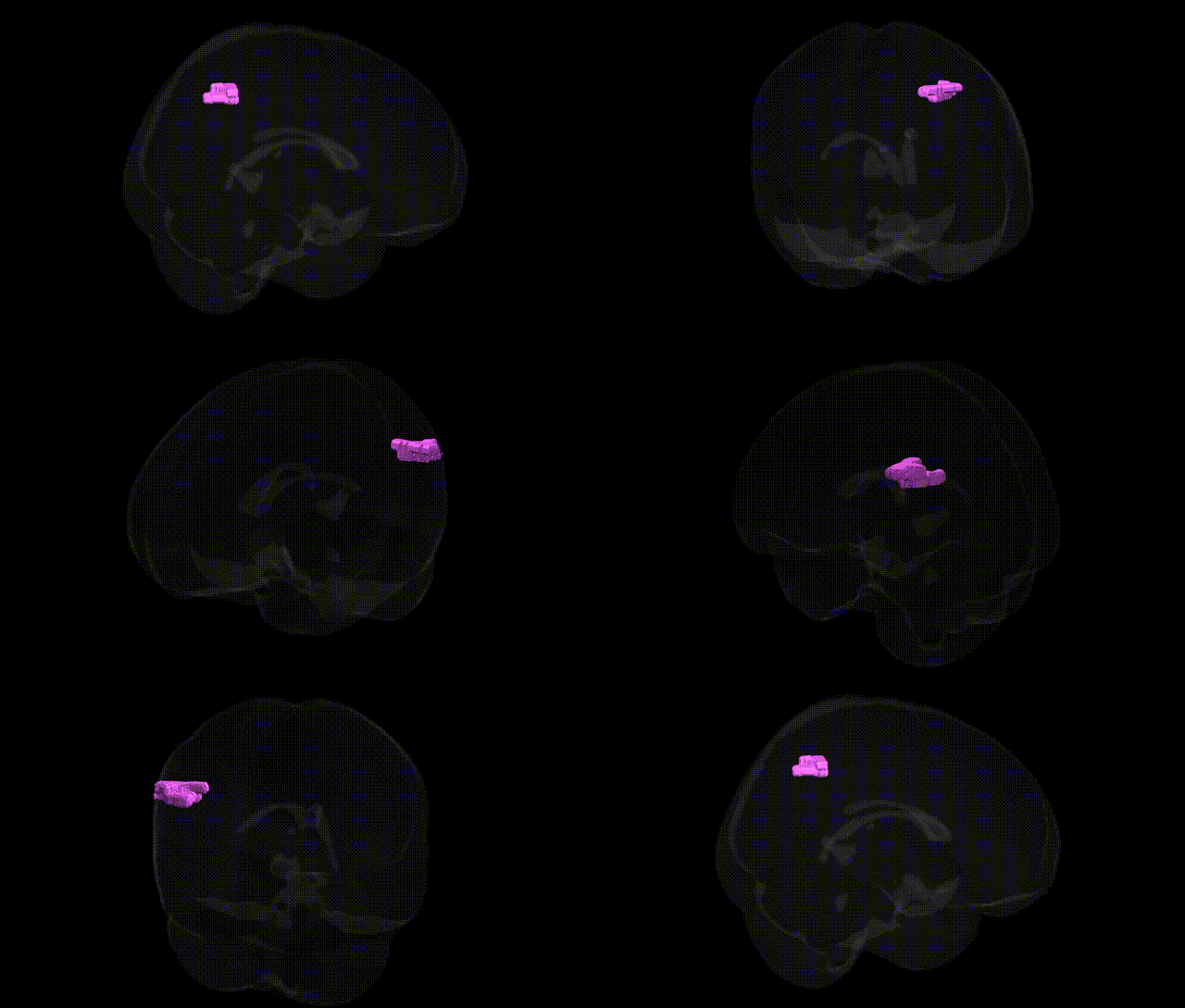
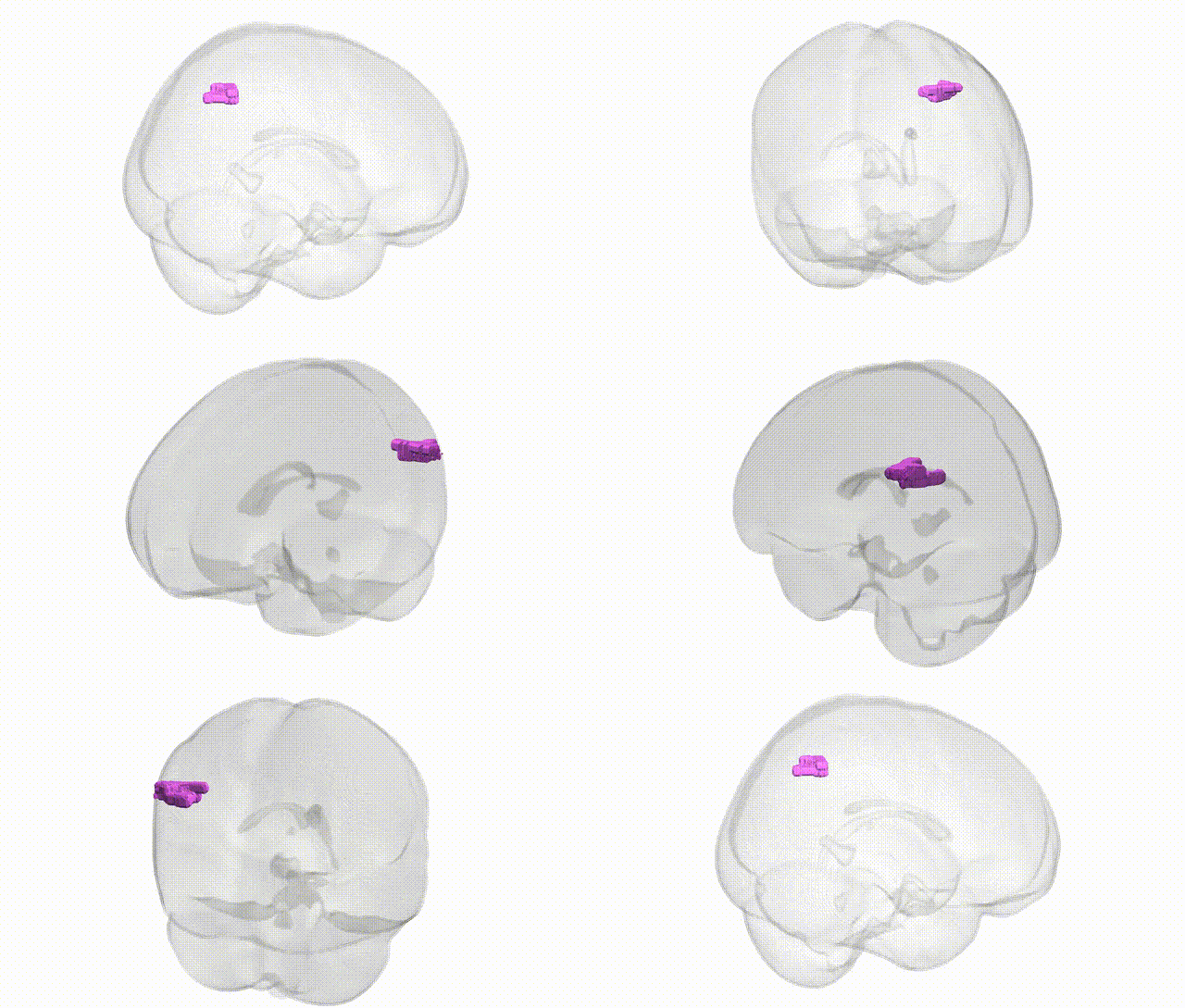
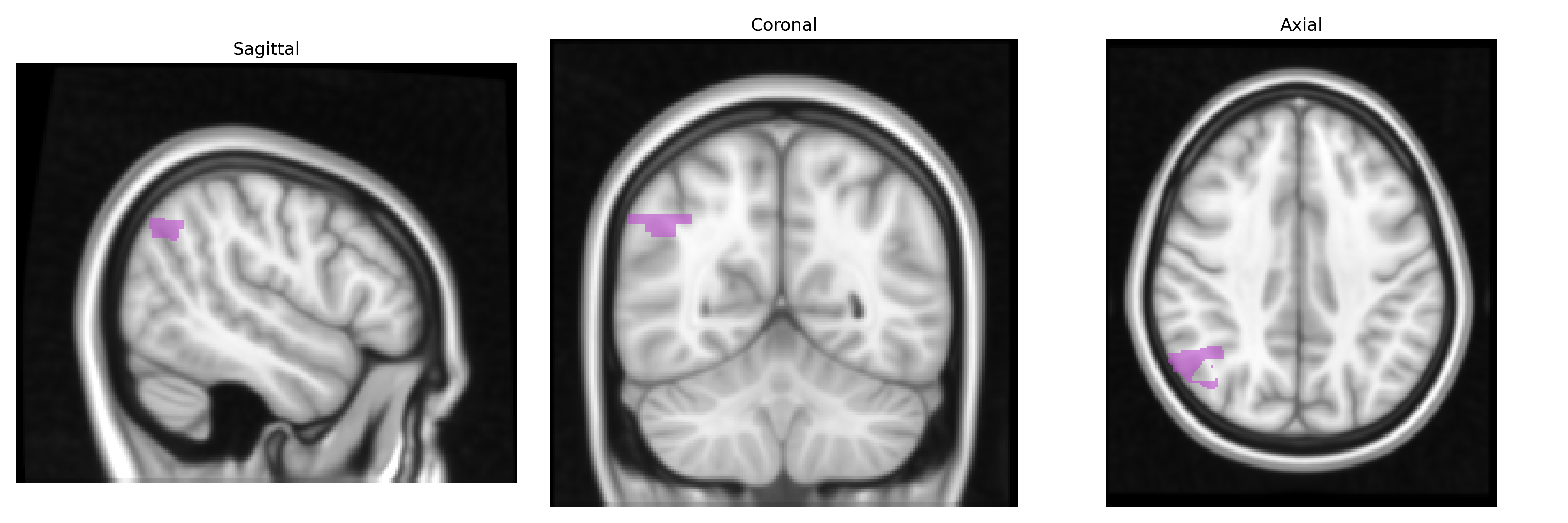
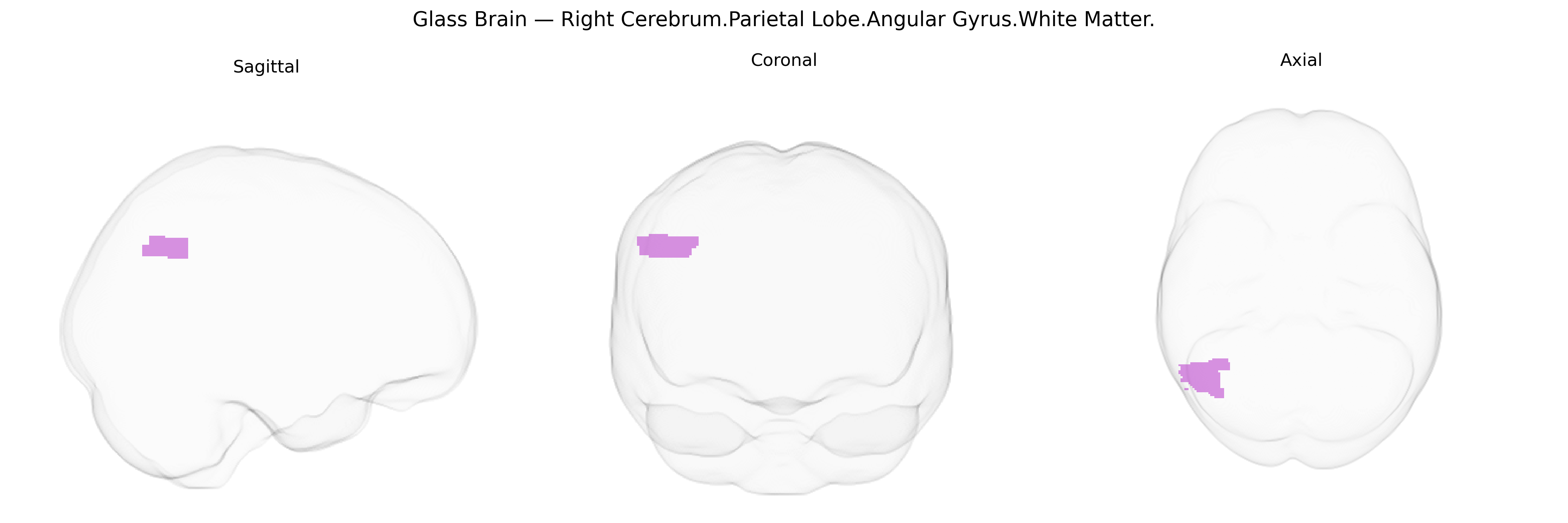
The bilateral Right Cerebrum.Parietal Lobe.Angular Gyrus.White Matter corresponds to the subcortical myelinated fiber pathways underlying the angular gyrus of the right inferior parietal lobule. These white matter tracts interconnect the angular gyrus with adjacent parietal association areas, superior temporal regions, and frontal language- and attention-related cortices, contributing to large-scale networks involved in language processing, reading and writing, number processing, spatial cognition, and multimodal integration. As part of the dorsal and ventral associative pathways, these fibers help support higher-order functions such as semantic processing, conceptual integration, and aspects of visuospatial attention and memory. There is no direct Wikipedia article for this specific white matter subdivision; see the related cortical region: Angular gyrus.
The bilateral right angular gyrus white matter, as defined in the Talairach 1 mm atlas, lies within the inferior parietal lobule’s association pathways (notably superior longitudinal and temporo‑parietal fibers), and genetic associations involving this region emerge largely from imaging‑genetics and GWAS of structural connectivity and cognition rather than from region‑specific single‑gene findings; polygenic influences on frontoparietal white‑matter microstructure (e.g., via diffusion MRI measures such as FA and MD) implicate genes involved in axon guidance, myelination, and synaptic plasticity (including pathways related to NRG1/ErbB, oligodendrocyte function, and cytoskeletal regulation), while large‑scale ENIGMA and UK Biobank studies have identified common variants in loci such as 3p21, 5q14–15, 12q24, and 17q21 as contributing to interindividual variability in parietal and inferior parietal white‑matter integrity; functionally, this right angular gyrus territory participates in higher‑order language, number processing, and default‑mode/salience integration, and its white‑matter characteristics have been genetically correlated with general cognitive ability, educational attainment, and reading‑related traits, as well as with risk for neurodevelopmental and psychiatric conditions—including autism spectrum disorder, attention‑deficit/hyperactivity disorder, schizophrenia, and major depressive disorder—through shared polygenic architectures that influence temporo‑parietal connectivity, although no single disorder‑specific genetic variant is uniquely or consistently localized to this particular Talairach‑defined white‑matter parcel.
Overview generated by GPT-4o (2026).
Region ID: 966
Hemisphere: bilateral
Atlas: Talairach labels 1mm
Full Quality Version: Download MP4
Full Quality Version: Download MP4
Wali Sidiqyar*, Gaurav Rudravaram*, Elyssa M. McMaster, Trent M. Schwartz, Adam M. Saunders, Kurt G. Schilling, Bennett A. Landman "Introducing SPINS: A Shared Public Visualization Library of Neuroanatomical Structures." Medical Imaging with Deep Learning- short paper
This resource is licensed under CC0 1.0 Universal (Public Domain).