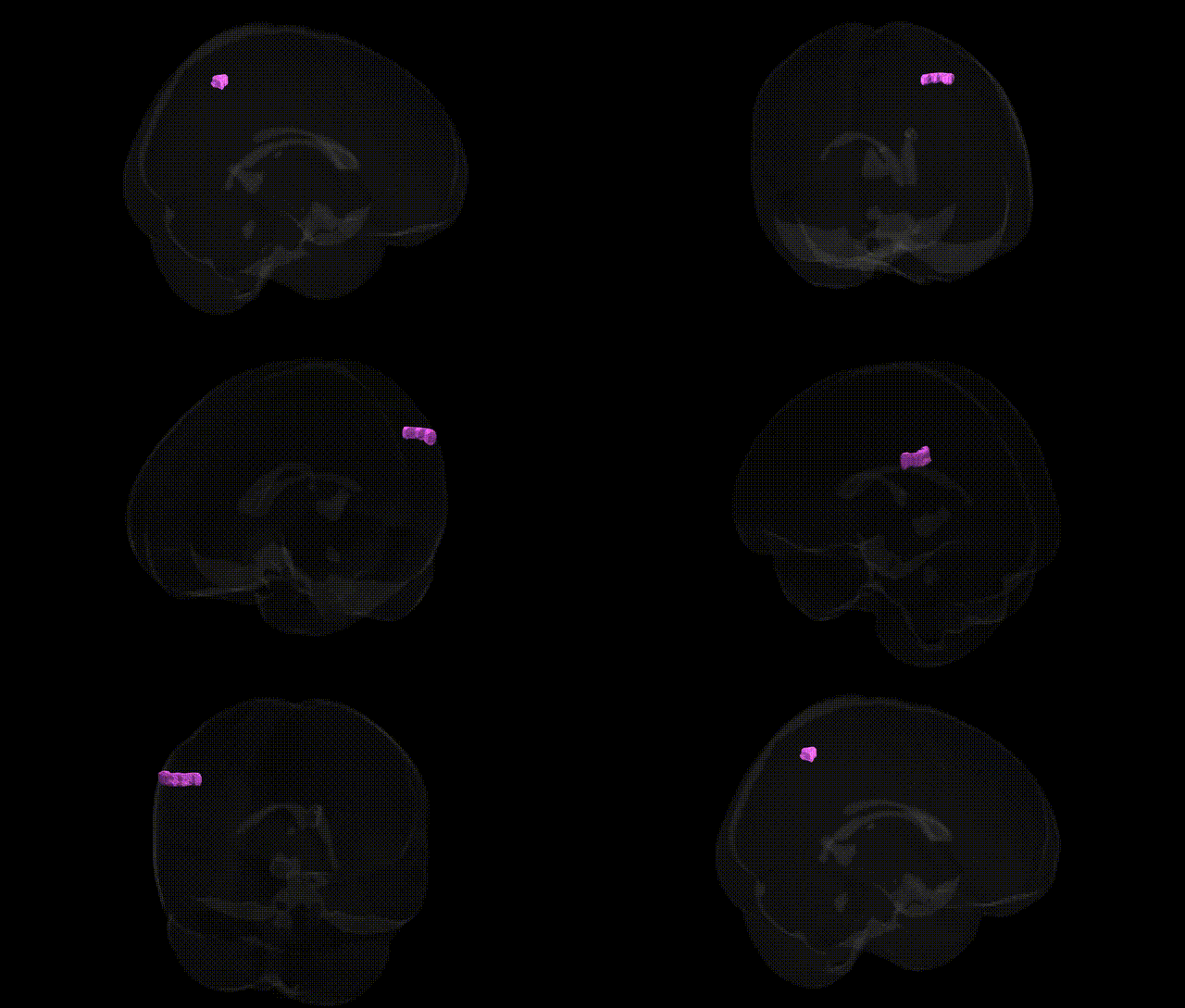
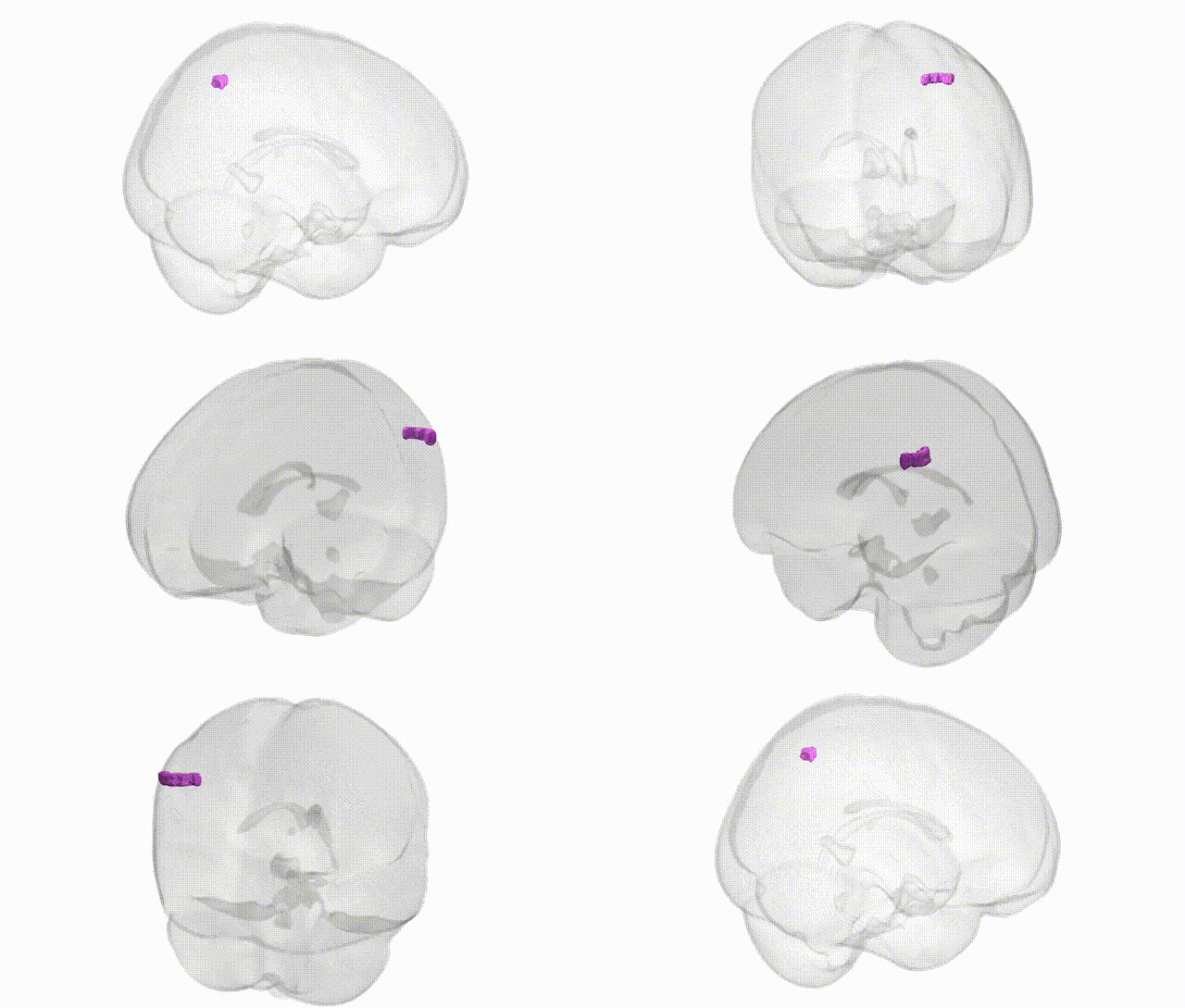
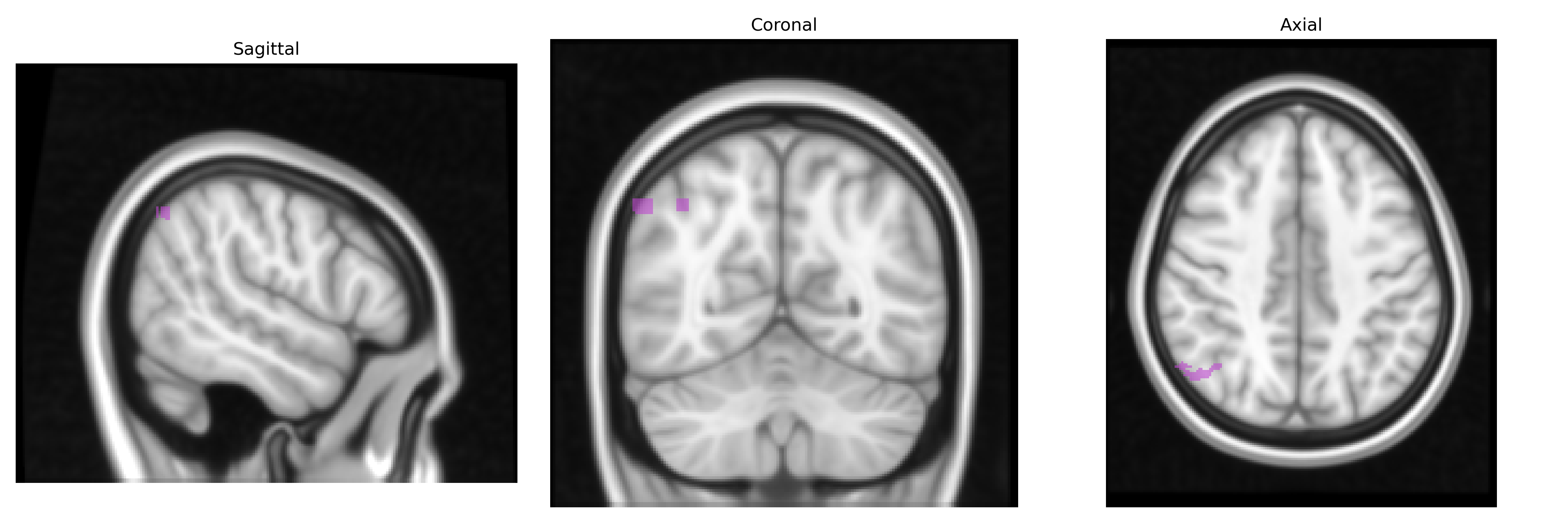
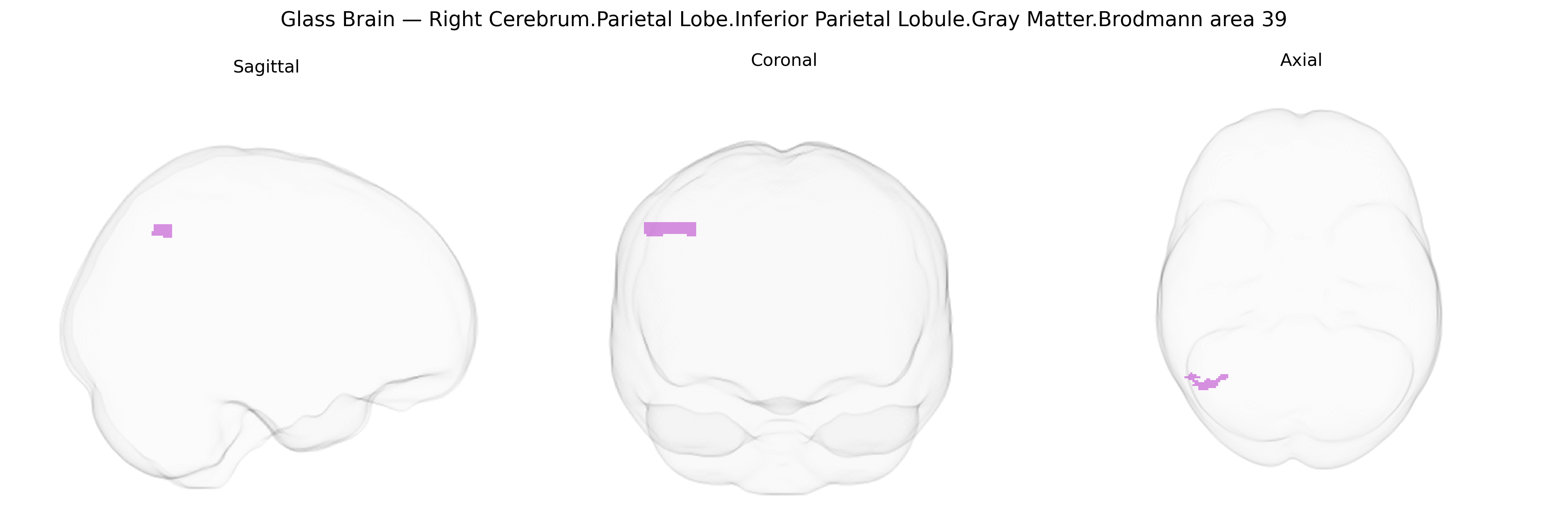
The bilateral Right Cerebrum.Parietal Lobe.Inferior Parietal Lobule.Gray Matter.Brodmann area 39 corresponds primarily to the angular gyrus, a heteromodal association cortex situated at the posterior portion of the inferior parietal lobule near the parieto-temporo-occipital junction. This region is strongly implicated in higher-order cognitive functions, including language comprehension and semantic processing, number processing, reading and writing, spatial cognition, and aspects of theory of mind and social cognition. Neural networks involving Brodmann area 39 integrate multimodal sensory input (visual, auditory, and somatosensory) and support the transformation of perceptual information into abstract, symbolic representations, contributing to complex behaviors such as calculation, metaphor comprehension, and narrative integration. Lesions in this area are classically associated with Gerstmann syndrome (including acalculia and agraphia) and other language-related deficits. No direct Wikipedia page exists for “Brodmann area 39” in this exact labeling context, but it closely corresponds to the Angular gyrus.
The bilateral right inferior parietal lobule (IPL), particularly Brodmann area 39 (angular gyrus), has been implicated in genetic studies of cognition, language, and neuropsychiatric disorders, though most GWAS and imaging‑genetics findings refer to broader parietal or temporoparietal regions rather than Talairach-defined BA39 specifically. Variants in genes involved in synaptic development and plasticity (e.g., BDNF, COMT, CNTNAP2, FOXP2) have been associated with structural and functional differences in IPL/BA39 that relate to language processing, reading ability, and verbal intelligence, including links to developmental dyslexia and specific language impairment. Large-scale GWAS of cortical thickness and surface area have identified loci (e.g., near genes such as KIAA0586, HMGA2, and others) associated with parietal lobe morphology, with downstream effects on regions that encompass BA39; these morphological variations have in turn been correlated with general cognitive ability, educational attainment, and arithmetic skills. Imaging genetics work in schizophrenia, autism spectrum disorder, and attention-deficit/hyperactivity disorder has reported genetically influenced alterations in IPL activation and connectivity, especially in right temporoparietal and angular gyrus regions involved in social cognition, theory of mind, and attentional reorienting. Additionally, risk alleles in APOE and other Alzheimer’s disease–related genes have been linked to hypometabolism and atrophy in posterior parietal regions, including BA39, consistent with the role of this area in episodic memory retrieval and default mode network function. Overall, the genetic architecture associated with BA39 reflects polygenic influences on higher-order cognitive and language networks, with many signals detected at the level of parietal or temporoparietal cortex rather than the specific Talairach 1 mm label.
Overview generated by GPT-4o (2026).
Region ID: 1015
Hemisphere: bilateral
Atlas: Talairach labels 1mm
Full Quality Version: Download MP4
Full Quality Version: Download MP4
Wali Sidiqyar*, Gaurav Rudravaram*, Elyssa M. McMaster, Trent M. Schwartz, Adam M. Saunders, Kurt G. Schilling, Bennett A. Landman "Introducing SPINS: A Shared Public Visualization Library of Neuroanatomical Structures." Medical Imaging with Deep Learning- short paper
This resource is licensed under CC0 1.0 Universal (Public Domain).