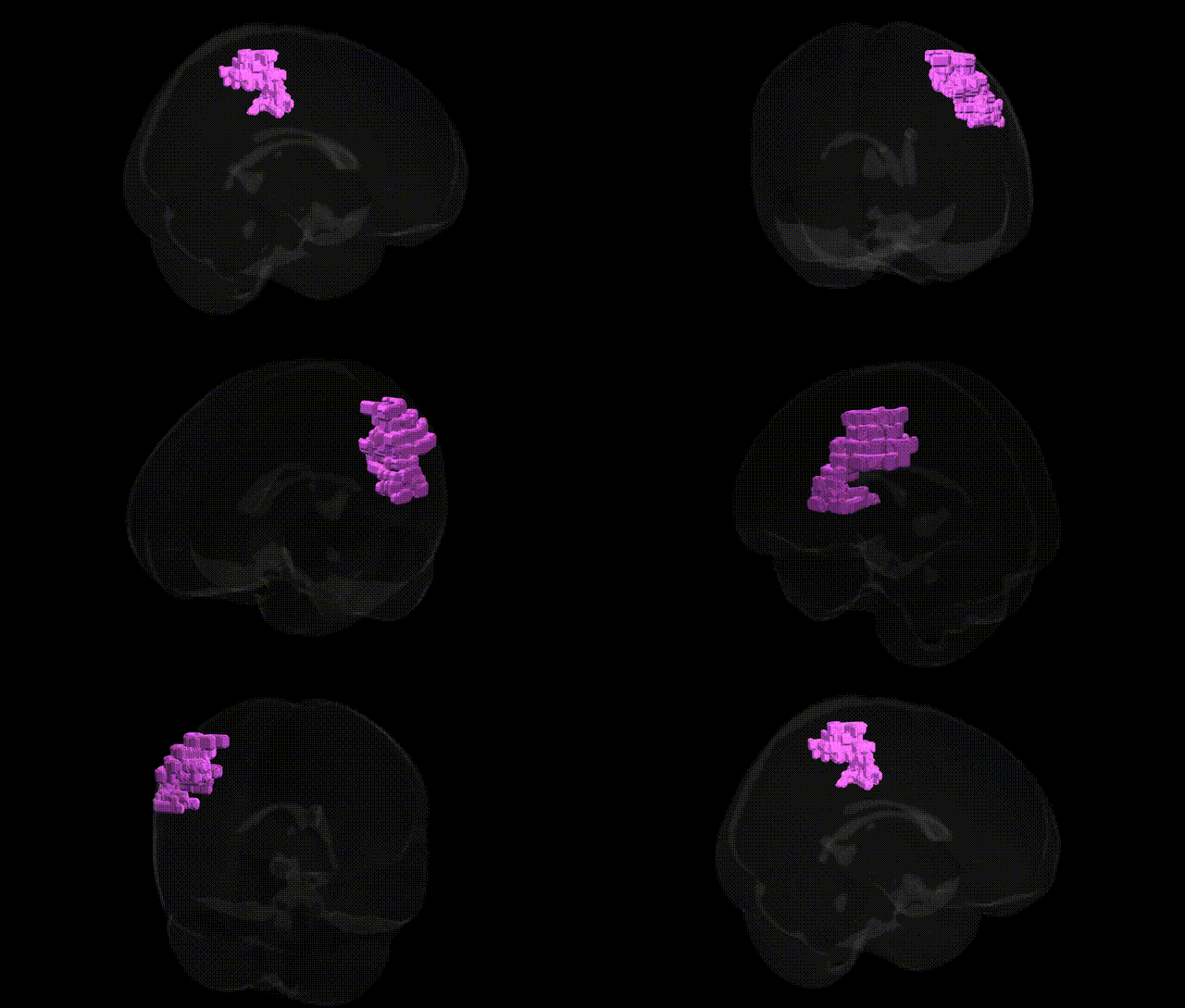
The bilateral Right Cerebrum.Parietal Lobe.Inferior Parietal Lobule.Gray Matter.Brodmann area 40 corresponds to a cortical territory in the supramarginal gyrus of the inferior parietal lobule, implicated in multimodal sensory integration, phonological processing, and aspects of spatial attention and praxis. This region plays a key role in language-related functions such as speech perception and articulation planning, as well as in the integration of somatosensory, visual, and auditory inputs for higher-order cognitive operations including working memory and tool use. Damage to Brodmann area 40 is frequently associated with deficits such as conduction aphasia, ideomotor apraxia, and impaired phonological short-term memory, reflecting its importance as a hub linking perisylvian language and sensorimotor networks. There is no direct link; related article: Supramarginal gyrus.
The bilateral right inferior parietal lobule (IPL; Brodmann area 40) has been implicated in multiple genetic and GWAS findings linking structural and functional variation in this region to neurodevelopmental, cognitive, and psychiatric phenotypes. Twin and imaging-genetics studies show high heritability of IPL gray-matter volume and cortical thickness, with polygenic influences from general brain-structure loci (e.g., variants near HMGA2, IGF1, and other growth/neuronal genes) and from genome-wide “brain morphology” and “cortical surface area/thickness” signals that include parietal clusters. Large neuroimaging GWAS consortia (e.g., ENIGMA, UK Biobank–based analyses) report associations between parietal and specifically inferior parietal morphology and polygenic scores for educational attainment, general cognitive ability, and reading-related traits, consistent with the IPL’s role in language, numerical processing, and attention. Genetic risk for neurodevelopmental disorders such as autism spectrum disorder and attention-deficit/hyperactivity disorder has been linked to altered activation or structure in right IPL in imaging-genetics and polygenic-risk studies, although no single locus is uniquely specific to this region. In schizophrenia and bipolar disorder, common-variant burden and disorder-related polygenic scores show associations with widespread cortical thinning and gray-matter loss that prominently involve parietal association cortex, including Brodmann area 40. Additionally, GWAS of traits such as spatial/working memory, attentional control, and social cognition frequently identify polygenic architectures whose brain–behavior mediation analyses highlight right IPL as a key intermediate phenotype, indicating that the genetic architecture of higher cognition and several psychiatric conditions exerts part of its effect through structural and functional variation in this parietal region rather than through a single, region-specific genetic variant.
Overview generated by GPT-4o (2026).
Region ID: 881
Hemisphere: bilateral
Atlas: Talairach labels 1mm
Full Quality Version: Download MP4
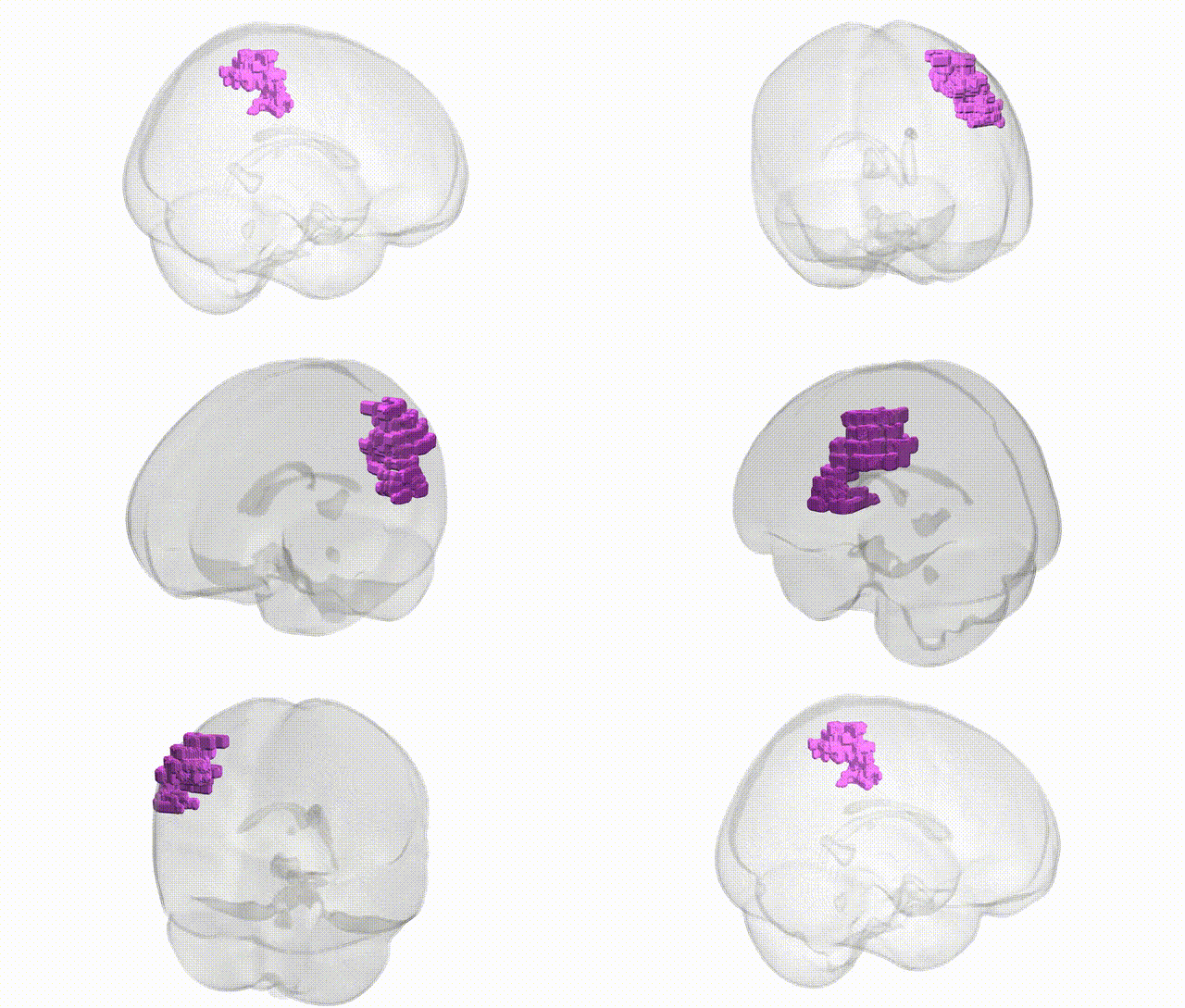
Full Quality Version: Download MP4
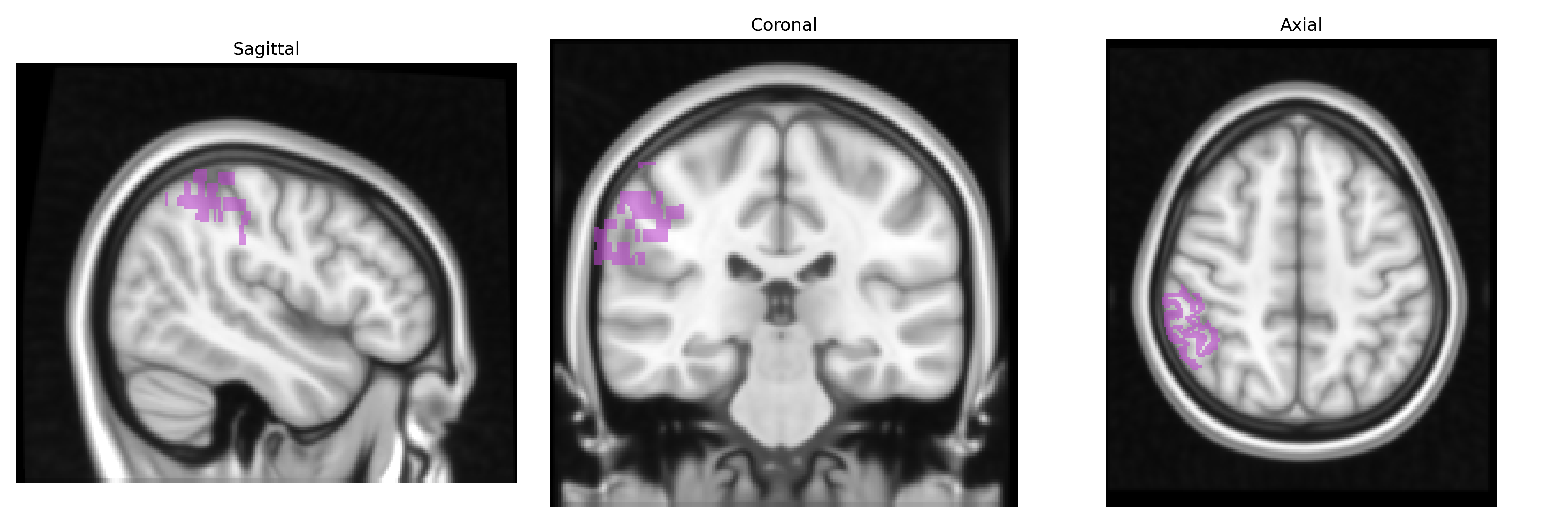
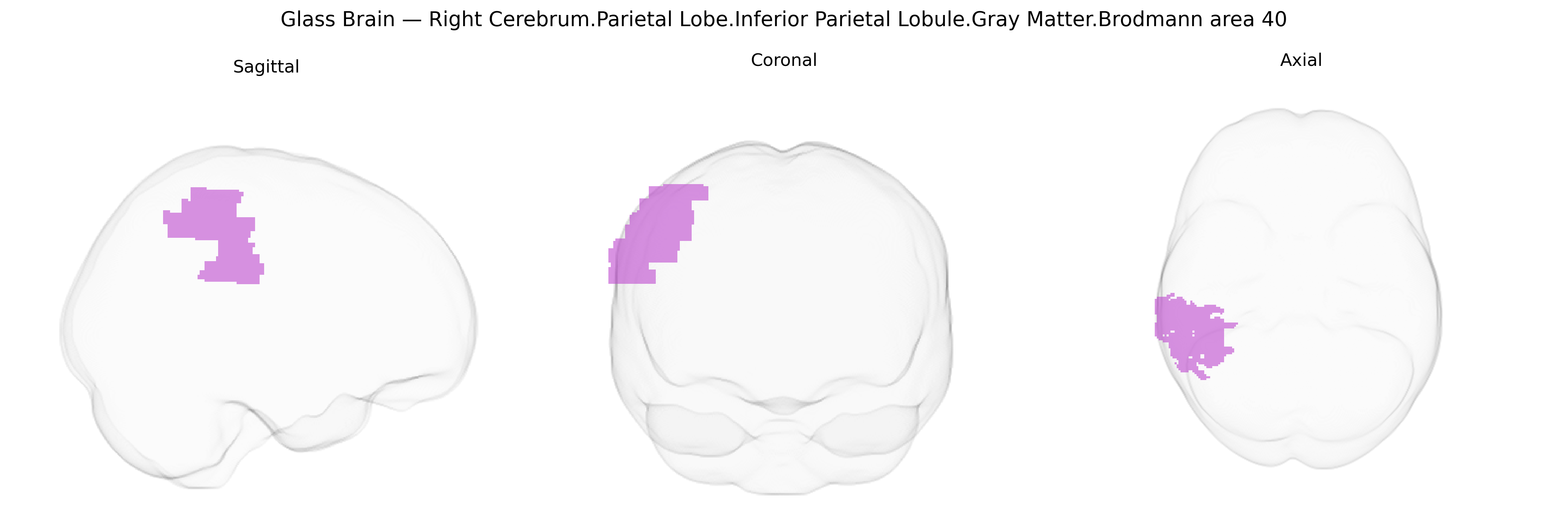
Wali Sidiqyar*, Gaurav Rudravaram*, Elyssa M. McMaster, Trent M. Schwartz, Adam M. Saunders, Kurt G. Schilling, Bennett A. Landman "Introducing SPINS: A Shared Public Visualization Library of Neuroanatomical Structures." Medical Imaging with Deep Learning- short paper
This resource is licensed under CC0 1.0 Universal (Public Domain).