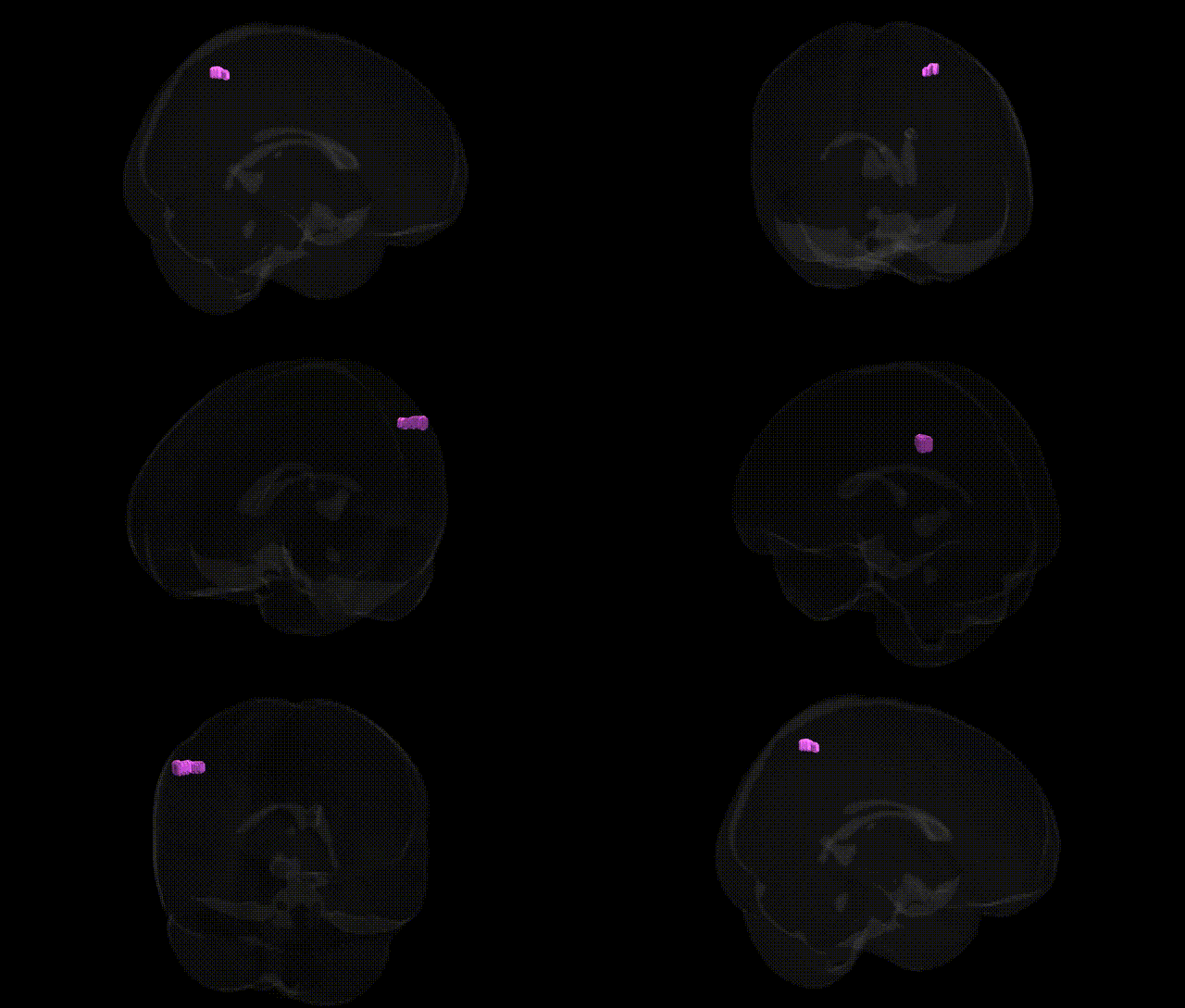
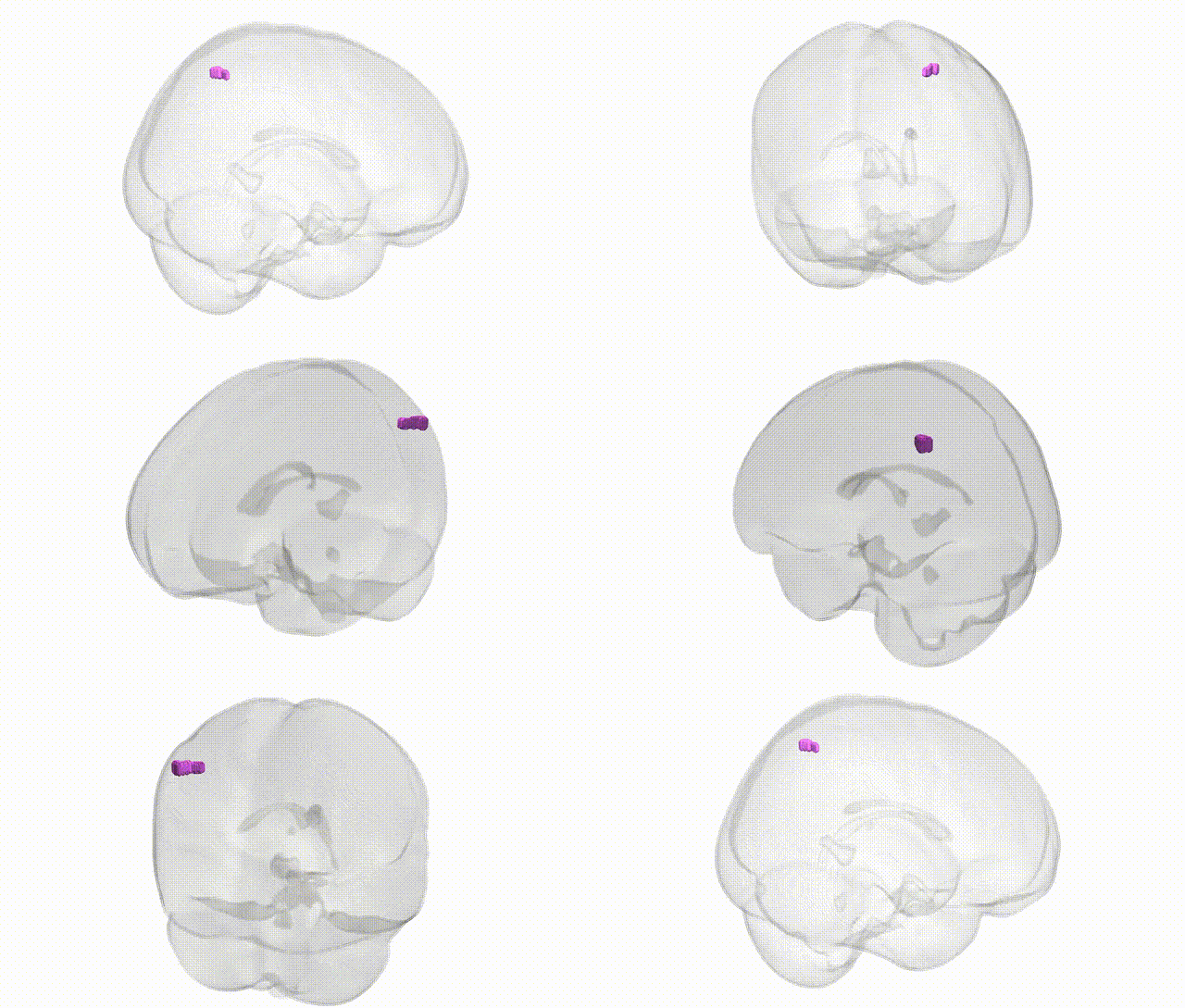
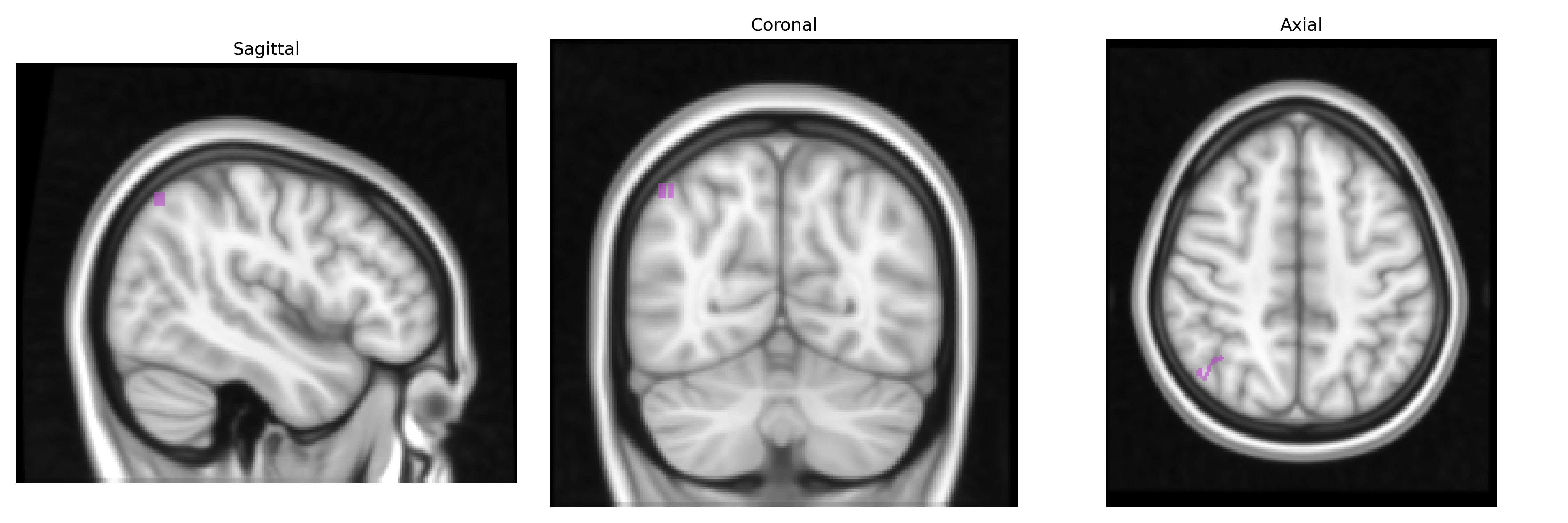
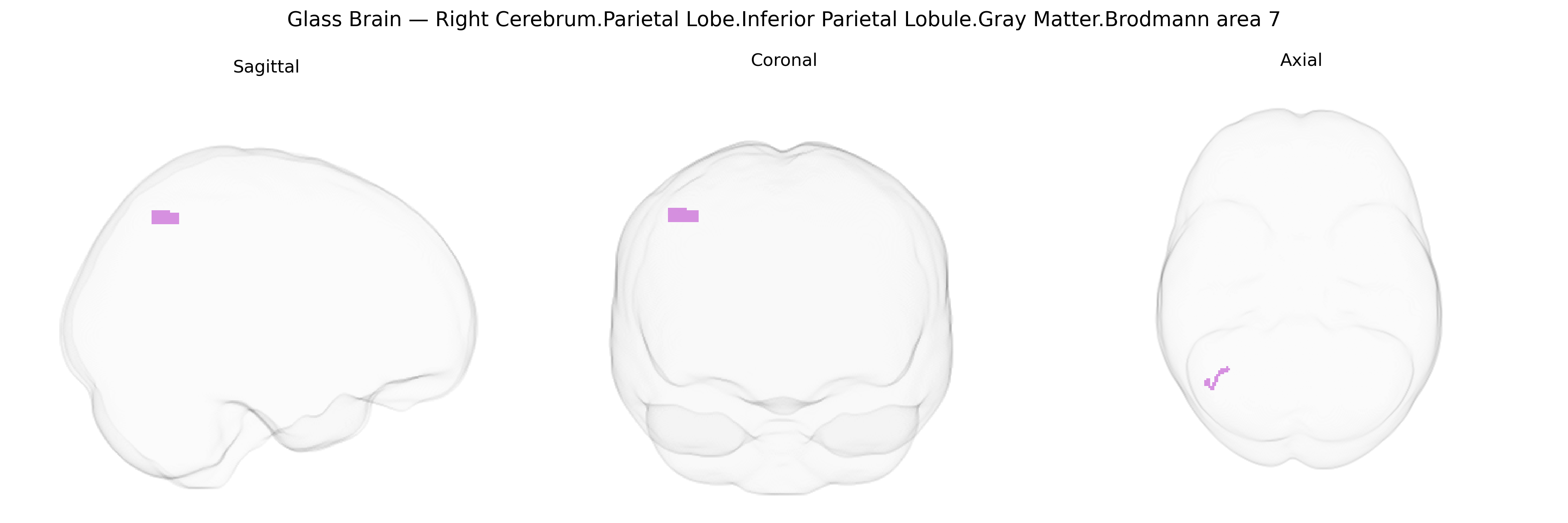
The bilateral Right Cerebrum.Parietal Lobe.Inferior Parietal Lobule.Gray Matter.Brodmann area 7 corresponds to a posterior parietal association region situated primarily on the superior portion of the inferior parietal lobule, bordering the superior parietal lobule and adjoining visual and somatosensory cortices. This area participates in higher-order integration of visual, somatosensory, and proprioceptive inputs, contributing to visuomotor coordination, spatial attention, body schema, and the transformation of sensory information into action-related representations; it plays a key role in tasks such as reaching, grasping, and spatial perception. Functionally, Brodmann area 7 is part of the dorsal visual stream and parietal association cortex, with extensive connections to premotor, frontal, and occipital areas, supporting coordinated sensorimotor and cognitive operations. There is no direct Wikipedia article for this exact Talairach label; a related structure is Brodmann area 7.
The bilateral Right Cerebrum Parietal Lobe Inferior Parietal Lobule (IPL) gray matter in Brodmann area 7, as defined in the Talairach 1 mm atlas, has been implicated in multiple genetic and GWAS findings related to higher-order cognition, attention, visuo-spatial processing, and neuropsychiatric risk. Imaging genetics and large-scale GWAS of cortical structure (e.g., ENIGMA, UK Biobank) have identified common variants in genes involved in neurodevelopment and synaptic plasticity—such as BDNF, CNTNAP2, DISC1, and various glutamatergic and GABAergic pathway genes—associated with IPL cortical thickness, surface area, or gray matter volume. The IPL/BA7 region shows structural and functional alterations with polygenic risk for schizophrenia, autism spectrum disorder, ADHD, and major depression, and has been repeatedly implicated in GWAS of general cognitive ability, educational attainment, and mathematical skills, with loci in genes such as KIAA0319, FOXP2-related networks, and other neurodevelopmental regulators influencing parietal structural and functional metrics. Parietal BA7 has also been tied to genetic risk for Alzheimer’s disease and other dementias, where APOE and additional GWAS loci for amyloid and tau processing correlate with IPL atrophy and connectivity changes, as well as to chronic pain and somatosensory traits through variants in ion channel and inflammatory pathway genes. Overall, genetic studies converge on BA7 IPL as a heritable hub for visuospatial integration, attention, and multimodal association, whose morphology and activation patterns serve as intermediates linking polygenic architecture to a spectrum of cognitive and psychiatric phenotypes.
Overview generated by GPT-4o (2026).
Region ID: 1044
Hemisphere: bilateral
Atlas: Talairach labels 1mm
Full Quality Version: Download MP4
Full Quality Version: Download MP4
Wali Sidiqyar*, Gaurav Rudravaram*, Elyssa M. McMaster, Trent M. Schwartz, Adam M. Saunders, Kurt G. Schilling, Bennett A. Landman "Introducing SPINS: A Shared Public Visualization Library of Neuroanatomical Structures." Medical Imaging with Deep Learning- short paper
This resource is licensed under CC0 1.0 Universal (Public Domain).