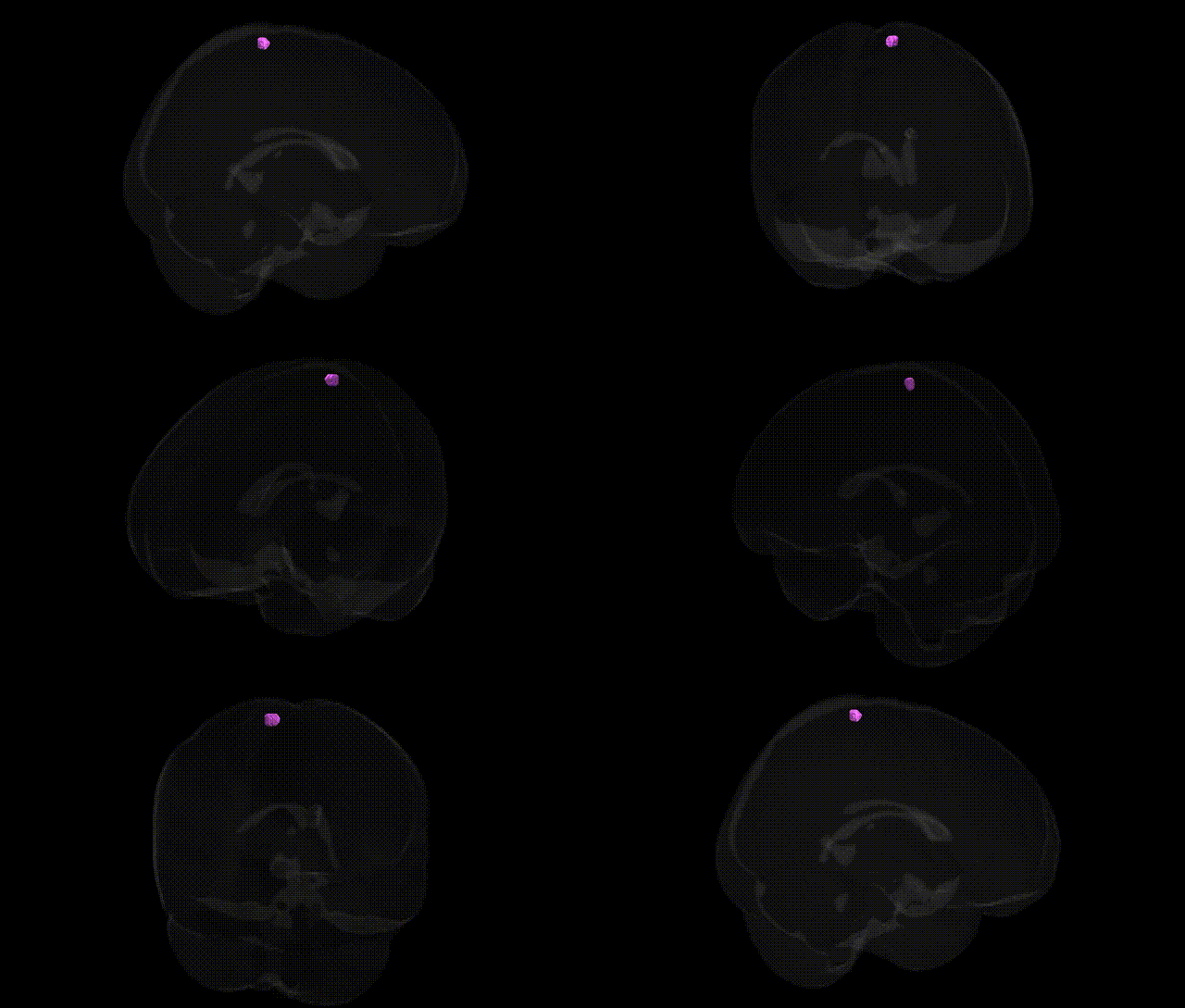
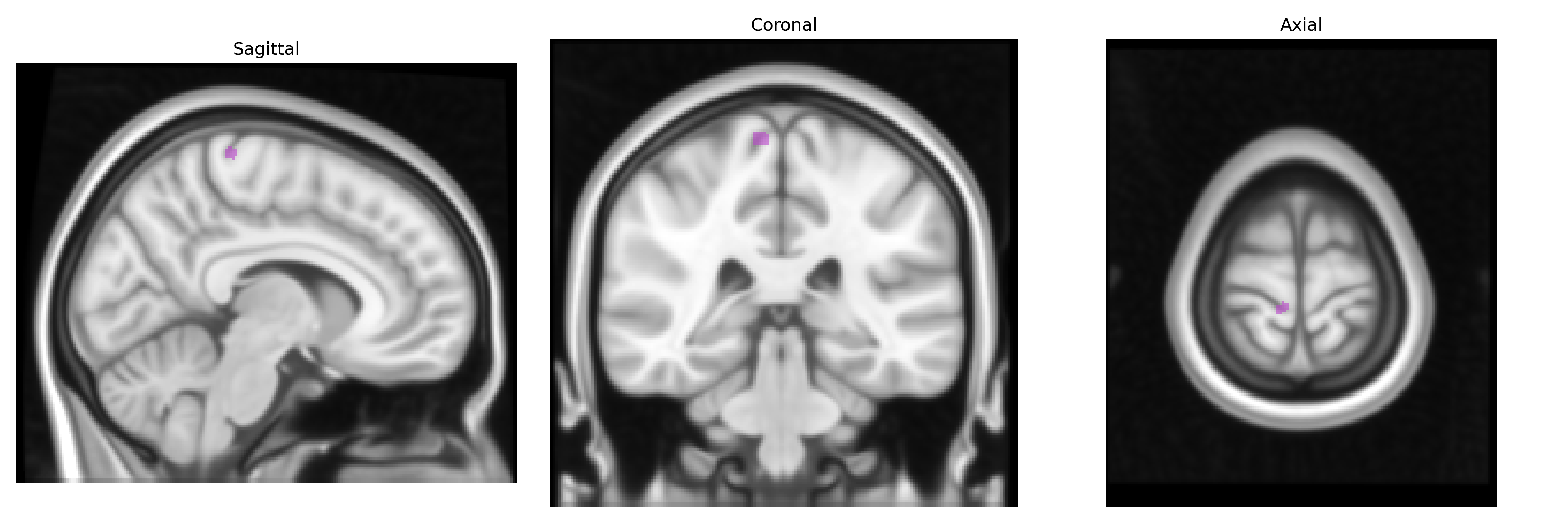
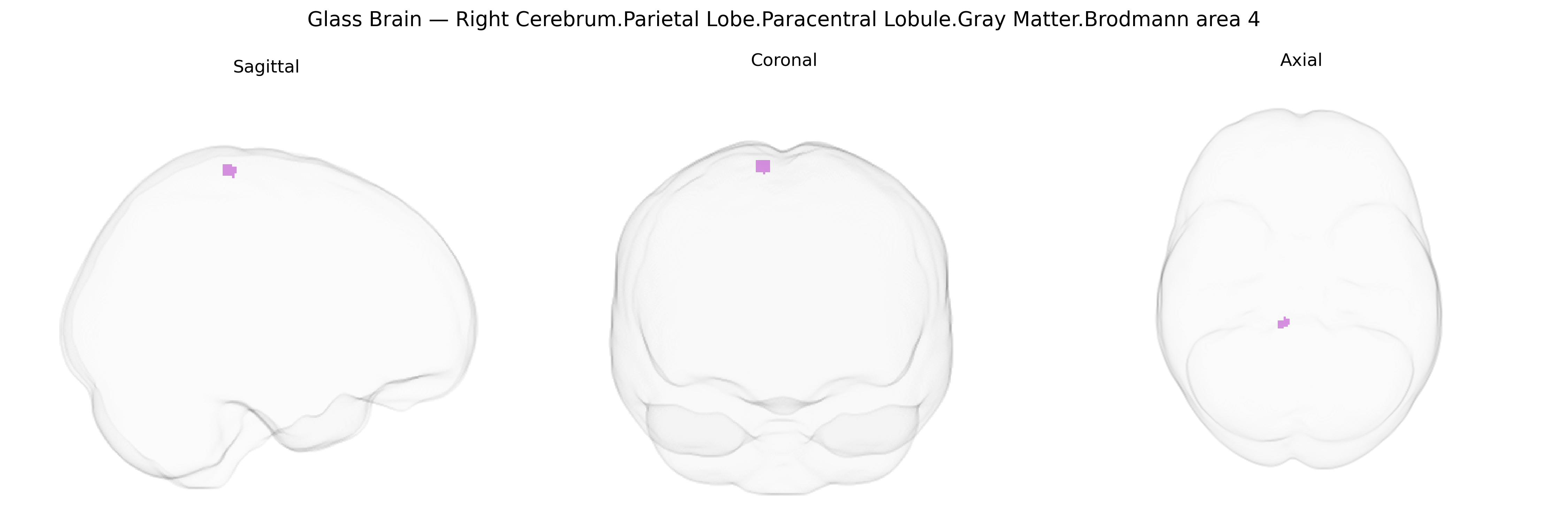
The bilateral Right Cerebrum.Parietal Lobe.Paracentral Lobule.Gray Matter.Brodmann area 4 corresponds to primary motor cortex located within the paracentral lobule along the medial wall of the hemisphere, bordering the frontal and parietal lobes. This agranular cortical field is critical for voluntary motor control, particularly for movements of the lower extremities and parts of the trunk represented somatotopically along the medial aspect of the precentral gyrus and paracentral lobule. Neurons in this region give rise to major descending motor pathways, including contributions to the corticospinal tract, and are characterized by large pyramidal cells (Betz cells) in layer V. Functionally, Brodmann area 4 is essential for execution of fine, precise movements and for integration of motor commands with sensory feedback from adjacent somatosensory regions. There is no direct Wikipedia article for this exact composite Talairach label; a closely related structure is Primary motor cortex.
Genetic associations involving the bilateral right paracentral lobule (gray matter, Brodmann area 4) implicate this primary motor region in diverse motor, sensory, and neuropsychiatric phenotypes, although most findings derive from parcel-based or network analyses rather than the Talairach 1 mm atlas specifically. GWAS and imaging-genetics studies of cortical thickness, surface area, and gyrification consistently identify common variants—often in neurodevelopmental and synaptic genes such as those in the WNT signaling pathway, cell-adhesion families, and microtubule/axon-guidance genes—as influencing morphometric measures in or near the paracentral lobule; ENIGMA and UK Biobank–based analyses frequently highlight loci with pleiotropic effects on motor cortex and adjacent medial sensorimotor areas. Structural or functional alterations in this region show genetic correlations with traits such as Parkinson’s disease, amyotrophic lateral sclerosis, and multiple sclerosis, where susceptibility loci (e.g., in HLA, immune-regulation, and axonal-maintenance genes) have been linked to degeneration or dysfunction of motor cortex, including medial BA4. Polygenic risk scores for schizophrenia, major depressive disorder, and autism spectrum disorder also correlate with paracentral lobule cortical measures in large cohorts, suggesting shared genetic influences on motor and higher-order networks, while rare variant and familial studies in primary hereditary spastic paraplegias and some monogenic movement disorders implicate genes affecting corticospinal neurons that originate in medial BA4. Collectively, current evidence supports a polygenic architecture in which common and rare variants affecting neurodevelopment, synaptic plasticity, myelination, and immune signaling contribute to individual differences and disease-related changes in the right paracentral BA4 region, though locus-level specificity for this exact Talairach-defined parcel remains limited.
Overview generated by GPT-4o (2026).
Region ID: 1105
Hemisphere: bilateral
Atlas: Talairach labels 1mm
Full Quality Version: Download MP4
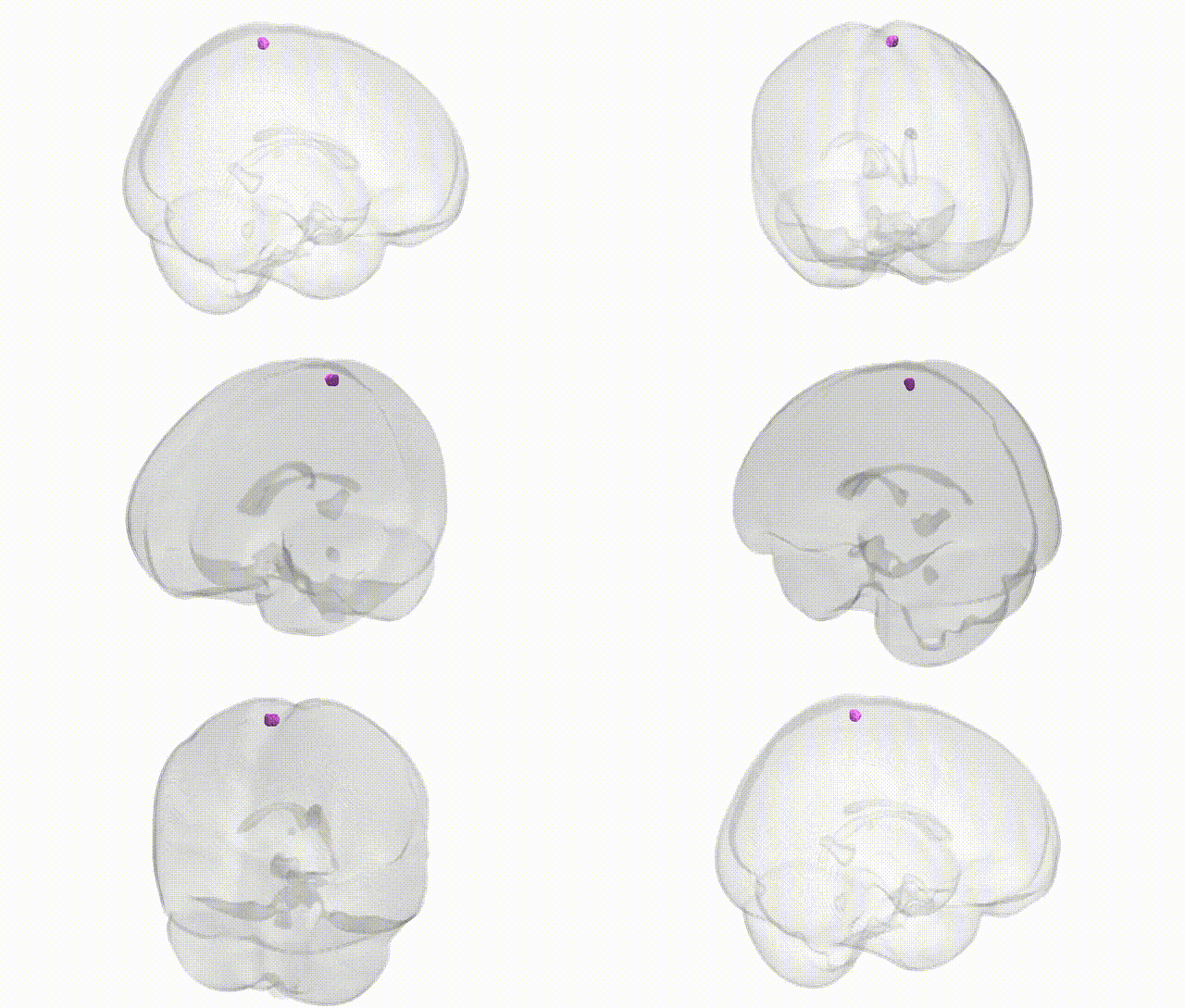
Full Quality Version: Download MP4
Wali Sidiqyar*, Gaurav Rudravaram*, Elyssa M. McMaster, Trent M. Schwartz, Adam M. Saunders, Kurt G. Schilling, Bennett A. Landman "Introducing SPINS: A Shared Public Visualization Library of Neuroanatomical Structures." Medical Imaging with Deep Learning- short paper
This resource is licensed under CC0 1.0 Universal (Public Domain).