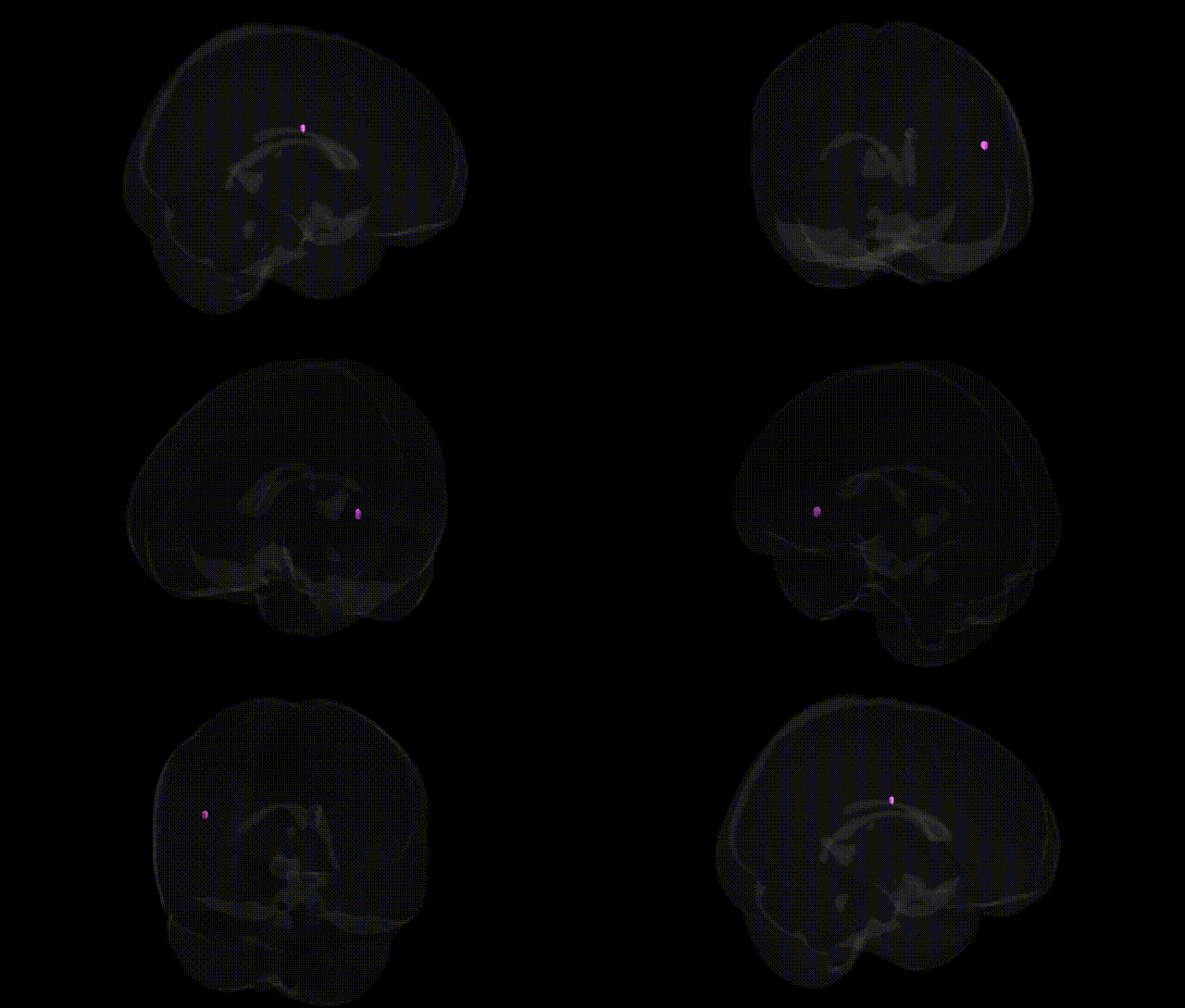
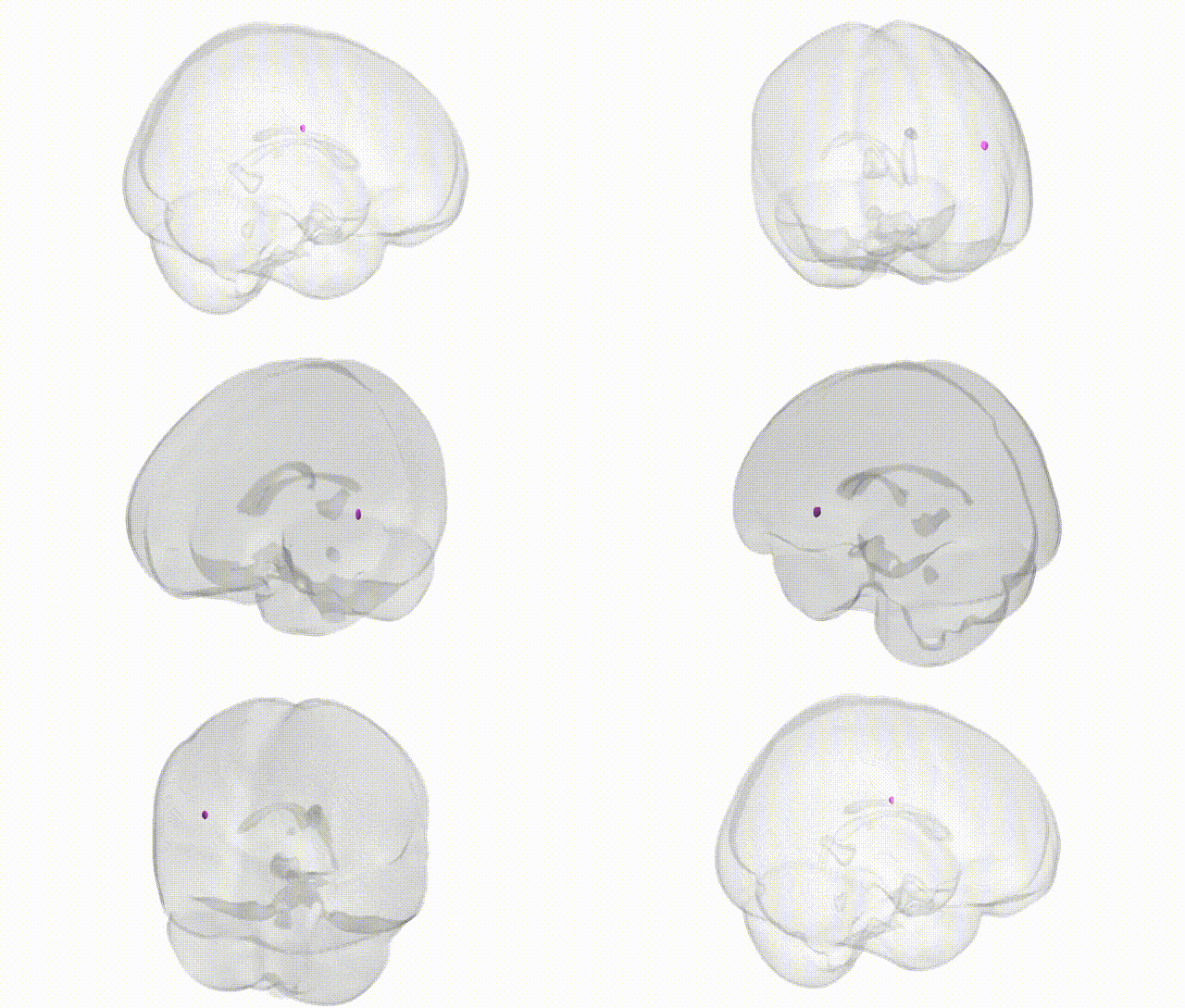
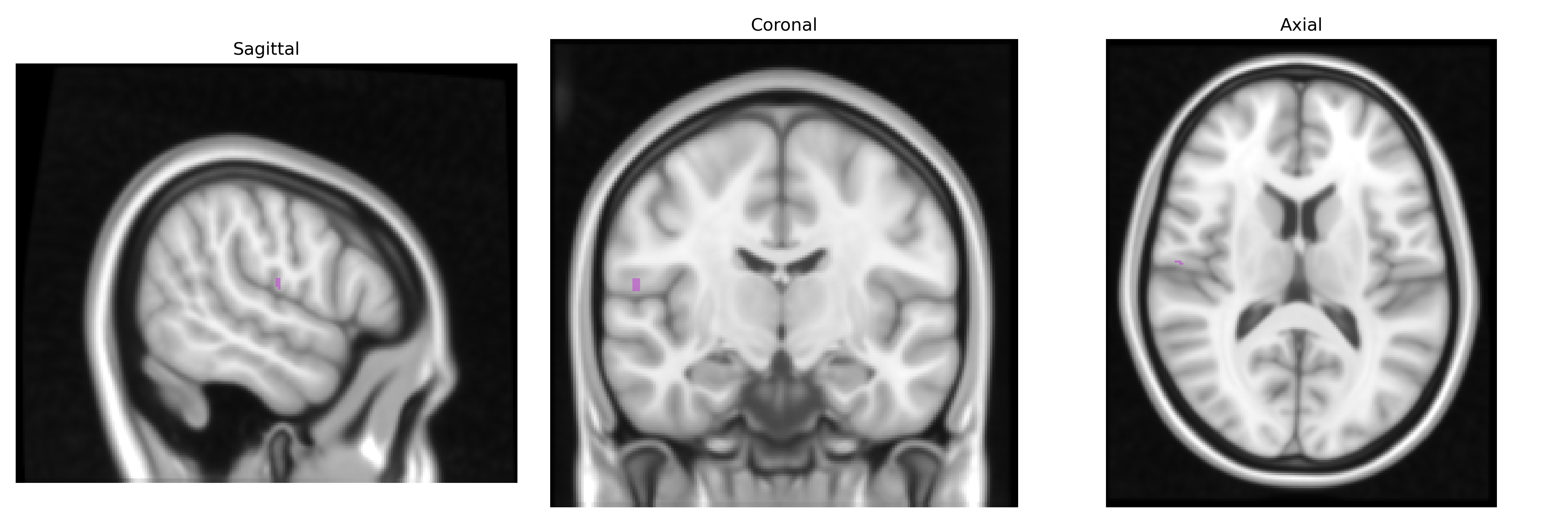
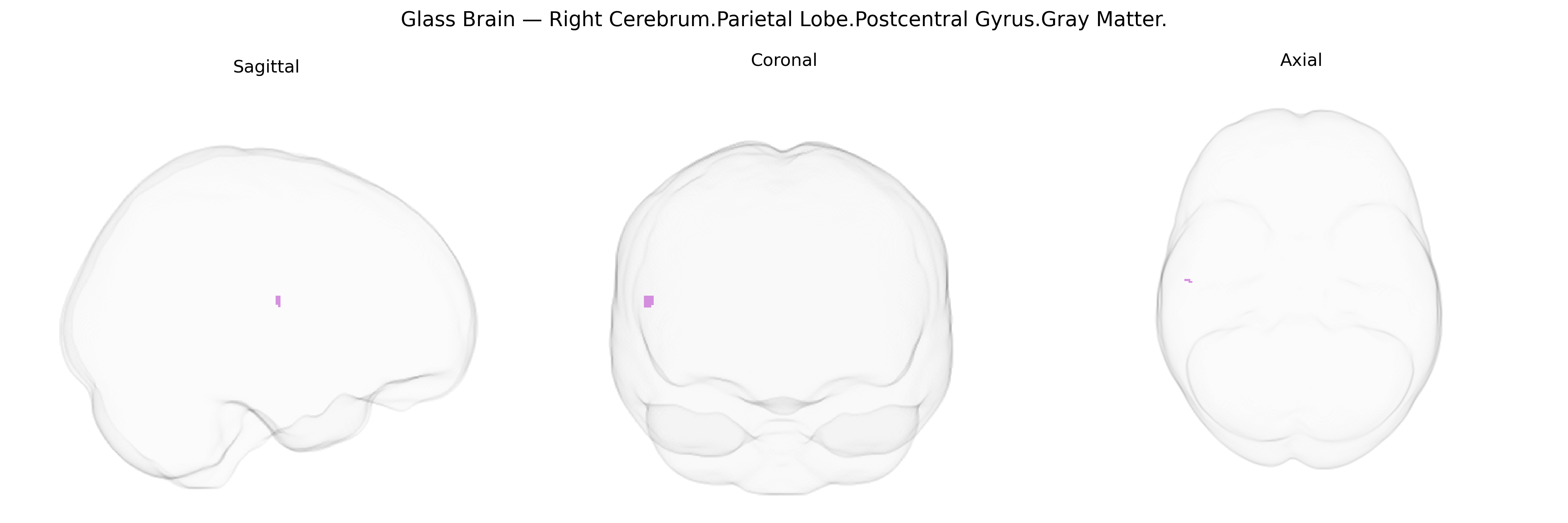
The bilateral Right Cerebrum.Parietal Lobe.Postcentral Gyrus.Gray Matter corresponds to the primary somatosensory cortex (mainly Brodmann areas 3, 1, and 2) located in the postcentral gyrus of the parietal lobe, immediately posterior to the central sulcus. This cortical region receives dense thalamocortical input from the ventral posterior nuclei of the thalamus and is organized somatotopically, forming the sensory homunculus that maps tactile, proprioceptive, nociceptive, and temperature information from the contralateral side of the body. Neuronal populations here are involved in the discrimination of stimulus location, intensity, and modality, and contribute to higher-order integration with secondary somatosensory and posterior parietal areas for perception and sensorimotor coordination. In the Talairach 1 mm atlas, this label specifically denotes gray matter of the postcentral gyrus within the right parietal lobe, considered bilaterally in the functional grouping of primary somatosensory cortex. Primary somatosensory cortex
The bilateral Right Cerebrum.Parietal Lobe.Postcentral Gyrus.Gray Matter corresponds primarily to primary somatosensory cortex (Brodmann areas 1–3), for which genetic association studies implicate pathways involved in neurodevelopment, synaptic function, and myelination. Large-scale brain MRI GWAS (e.g., ENIGMA and UK Biobank–based studies) have identified multiple loci influencing cortical thickness, surface area, and volume of postcentral/parietal regions, including common variants in genes related to axonal guidance (e.g., ROBO family), chromatin remodeling (e.g., MAPT region on 17q21), neuronal differentiation (e.g., TBR1/EMX2-related networks), and general morphogenesis loci such as HMGA2 and microtubule-associated genes. Polygenic overlap has been reported between parietal/postcentral metrics and neurodevelopmental or psychiatric disorders, including autism spectrum disorder, ADHD, schizophrenia, and major depression, where risk variants partially map onto regions with altered somatosensory cortical structure or connectivity. GWAS and candidate-gene work in chronic pain, migraine, tactile sensitivity, and somatosensory processing traits show convergent evidence that variants in ion channels (e.g., SCN family), nociception-related genes (e.g., OPRM1, TRP channels), and inflammatory/immune genes modulate postcentral gyrus activation and morphology. In motor and sensory-related disorders—such as hereditary spastic paraplegia, dystonia, certain epilepsies, and neurodegenerative diseases—risk or causal genes (e.g., SPG genes, PRRT2, GRIN2A, and Alzheimer’s-associated loci like APOE and CLU) are frequently associated with structural or functional abnormalities encompassing the postcentral gyrus, although these effects are typically distributed across broader sensorimotor and parietal networks rather than confined to this region alone.
Overview generated by GPT-4o (2026).
Region ID: 795
Hemisphere: bilateral
Atlas: Talairach labels 1mm
Full Quality Version: Download MP4
Full Quality Version: Download MP4
Wali Sidiqyar*, Gaurav Rudravaram*, Elyssa M. McMaster, Trent M. Schwartz, Adam M. Saunders, Kurt G. Schilling, Bennett A. Landman "Introducing SPINS: A Shared Public Visualization Library of Neuroanatomical Structures." Medical Imaging with Deep Learning- short paper
This resource is licensed under CC0 1.0 Universal (Public Domain).