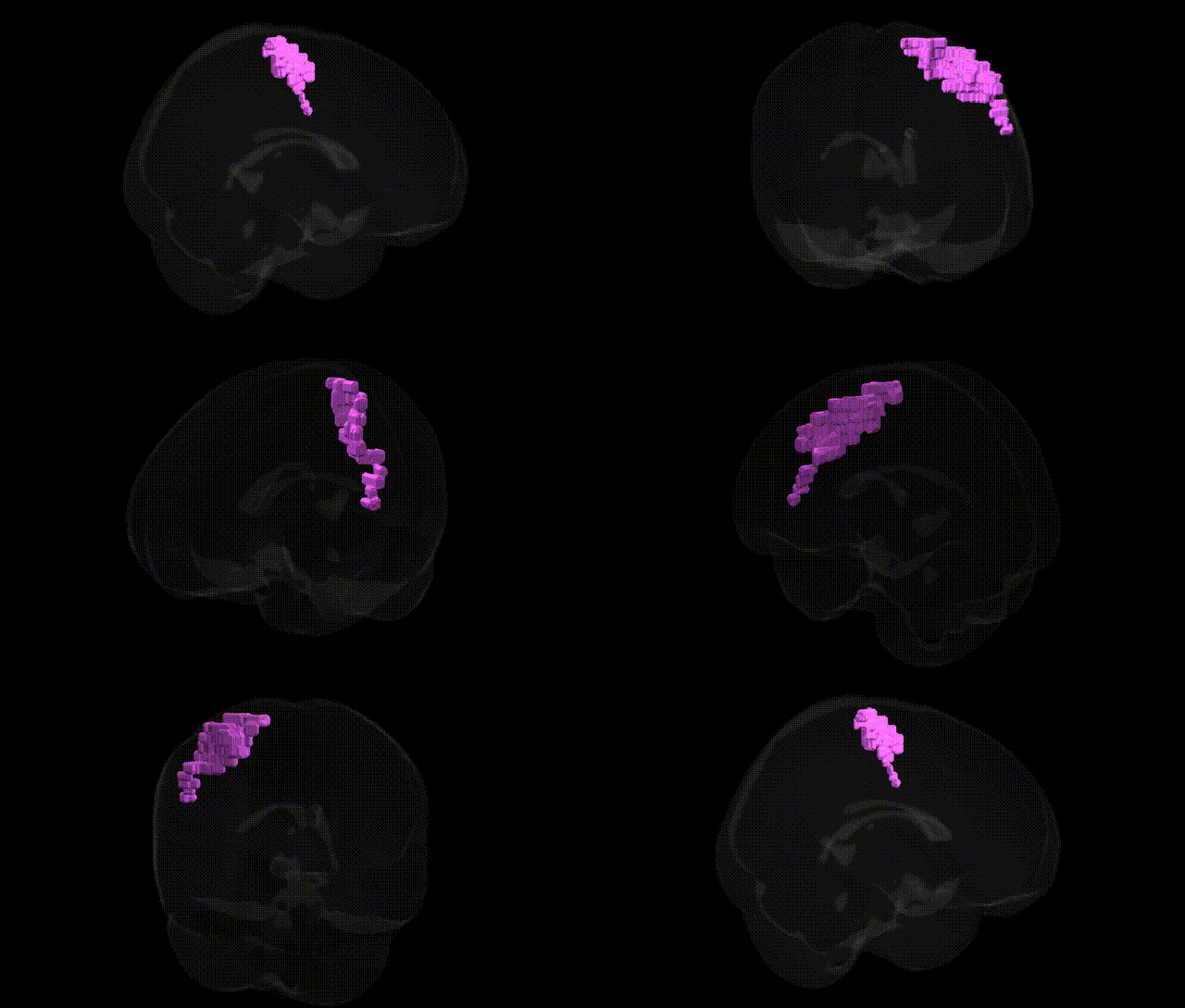
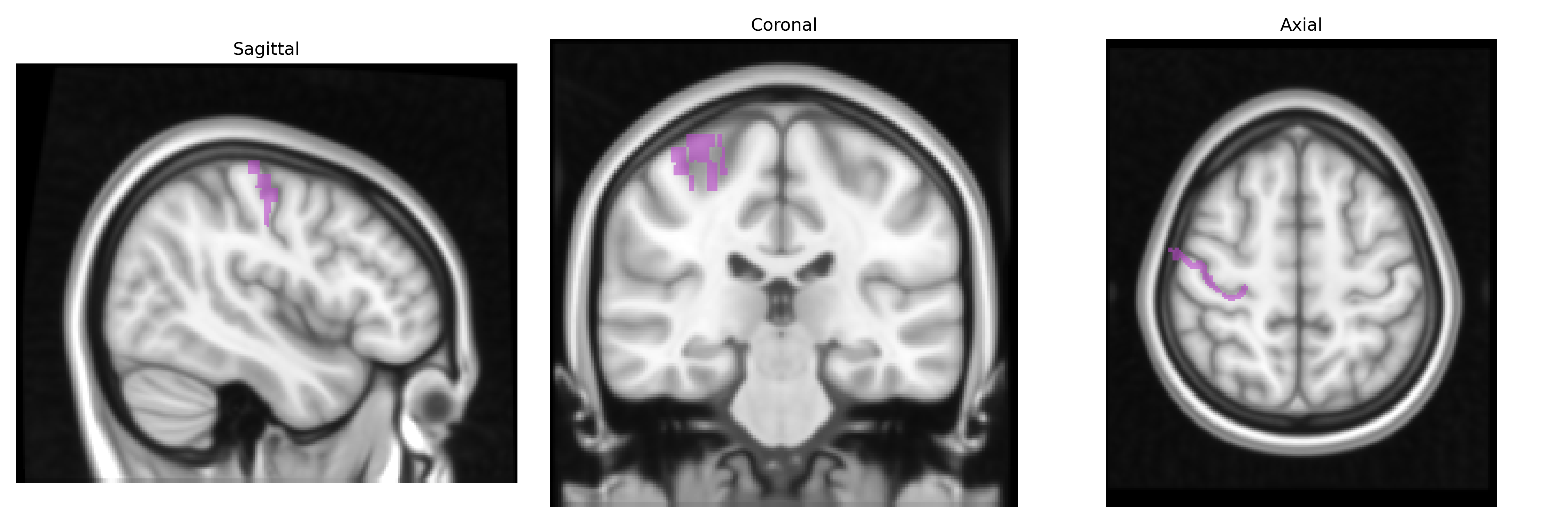
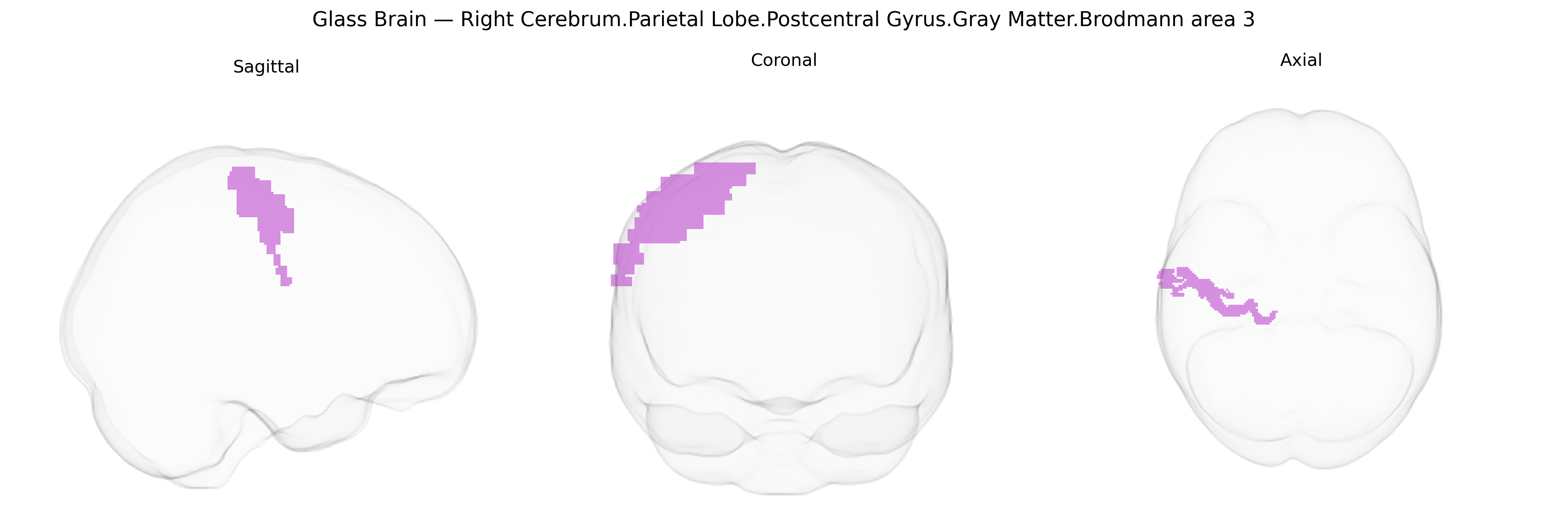
The bilateral Right Cerebrum.Parietal Lobe.Postcentral Gyrus.Gray Matter.Brodmann area 3 corresponds to the primary somatosensory cortex (S1) located in the anterior portion of the postcentral gyrus of the parietal lobe, immediately posterior to the central sulcus. Brodmann area 3 is subdivided into 3a and 3b, which preferentially process proprioceptive (deep) and cutaneous (surface) sensory inputs, respectively, received via the thalamus (primarily the ventral posterior nucleus). Neurons in this region exhibit somatotopic organization, contributing to the sensory homunculus that represents contralateral body parts with high spatial resolution, particularly for the hand and face. Functionally, this area is critical for the initial cortical processing of tactile discrimination, vibration, pressure, and joint position sense, and serves as a major input source to adjacent somatosensory areas (Brodmann areas 1 and 2) and higher-order parietal regions involved in sensorimotor integration and perception.
Primary somatosensory cortex
The bilateral right postcentral gyrus gray matter in Brodmann area 3, a primary somatosensory cortex region from the Talairach labels 1 mm atlas, has been implicated in several genetic and GWAS-based associations, though often as part of broader parietal or sensorimotor networks rather than as an isolated locus. Neuroimaging genetics studies have linked common variants in genes involved in neurodevelopment, synaptic plasticity, and cortical patterning—such as BDNF, CNTNAP2, NRG1, and various glutamatergic and GABAergic pathway genes—to individual differences in cortical thickness, surface area, and activation of the postcentral gyrus during tactile and sensorimotor tasks. Large-scale GWAS of brain structural phenotypes (e.g., ENIGMA and UK Biobank) have reported associations between loci on chromosomes including 3, 6, and 15 and parietal/postcentral cortical measures, overlapping with genes related to neuronal migration and axon guidance. Clinically, genetic risk variants for neurodevelopmental and psychiatric conditions—such as autism spectrum disorder, schizophrenia, and ADHD—have been associated with altered structure or function of the postcentral gyrus, while genes implicated in focal epilepsy, particularly those affecting cortical excitability (e.g., SCN-family sodium channel genes), have been linked to sensory cortex involvement in somatosensory seizures. Additionally, genetic factors contributing to chronic pain, migraine, and somatosensory processing traits have been associated with functional and structural variation in this region, although these findings typically reflect distributed cortical networks rather than a unique, region-specific genetic signature for Brodmann area 3 alone.
Overview generated by GPT-4o (2026).
Region ID: 896
Hemisphere: bilateral
Atlas: Talairach labels 1mm
Full Quality Version: Download MP4
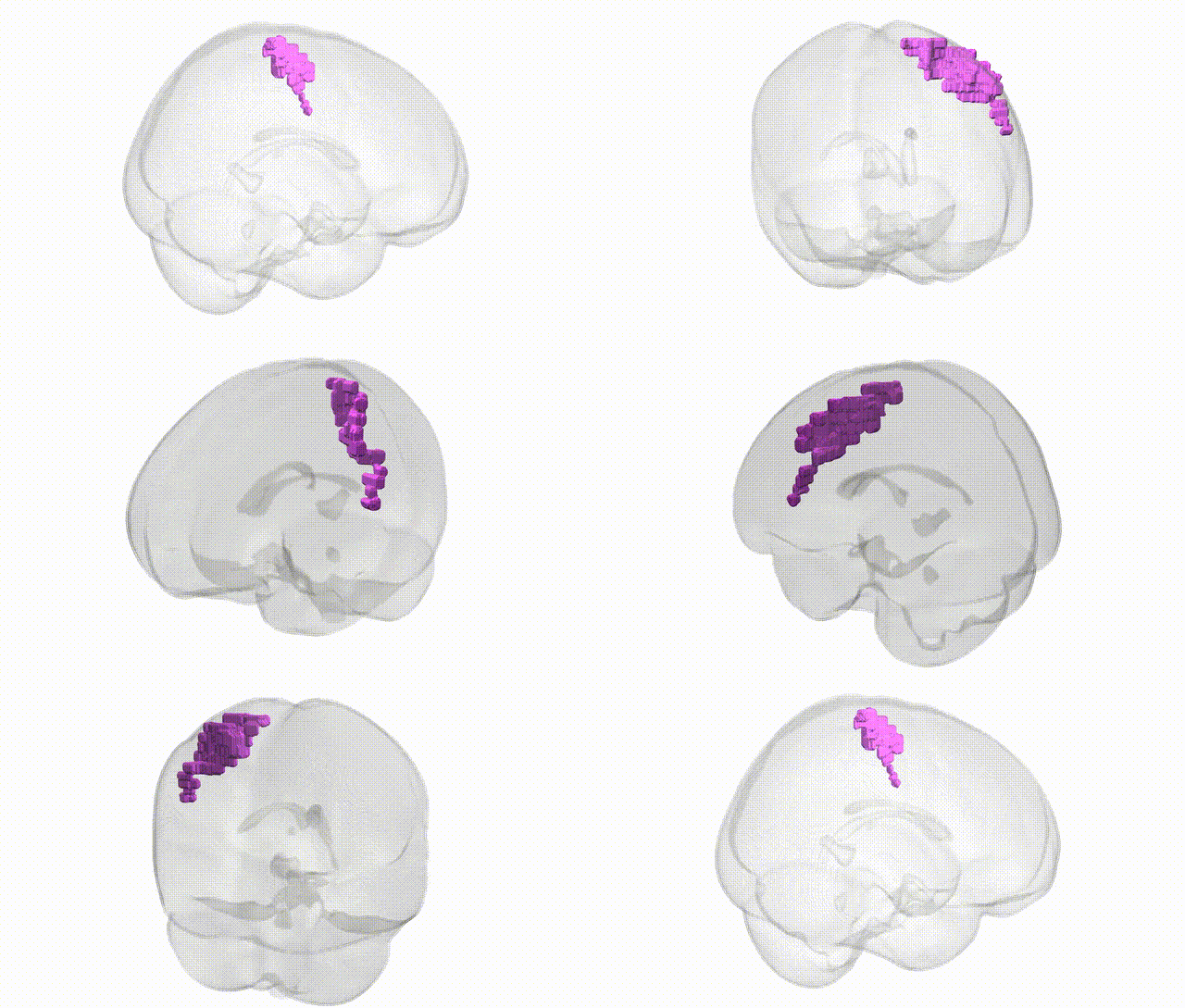
Full Quality Version: Download MP4
Wali Sidiqyar*, Gaurav Rudravaram*, Elyssa M. McMaster, Trent M. Schwartz, Adam M. Saunders, Kurt G. Schilling, Bennett A. Landman "Introducing SPINS: A Shared Public Visualization Library of Neuroanatomical Structures." Medical Imaging with Deep Learning- short paper
This resource is licensed under CC0 1.0 Universal (Public Domain).