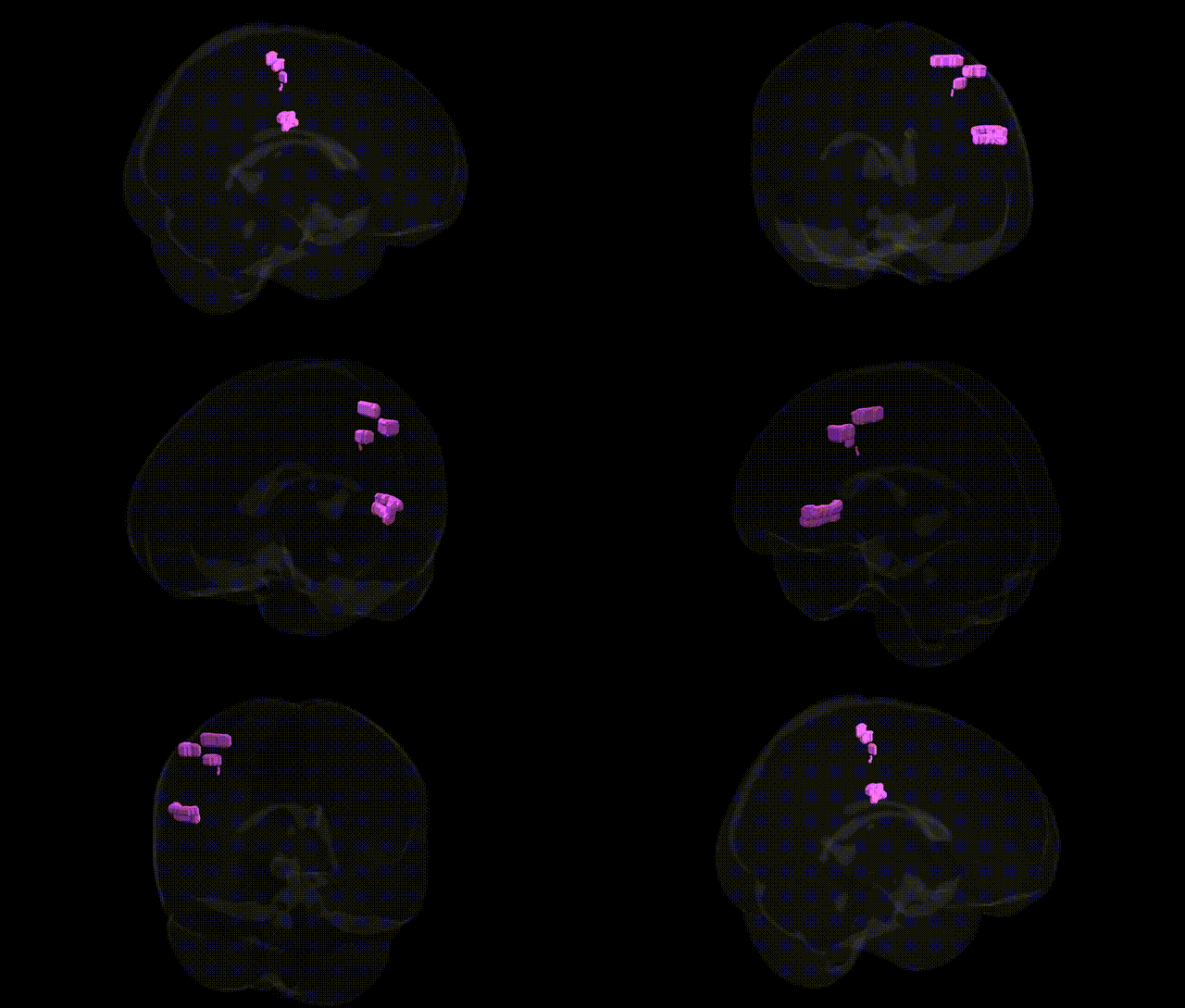
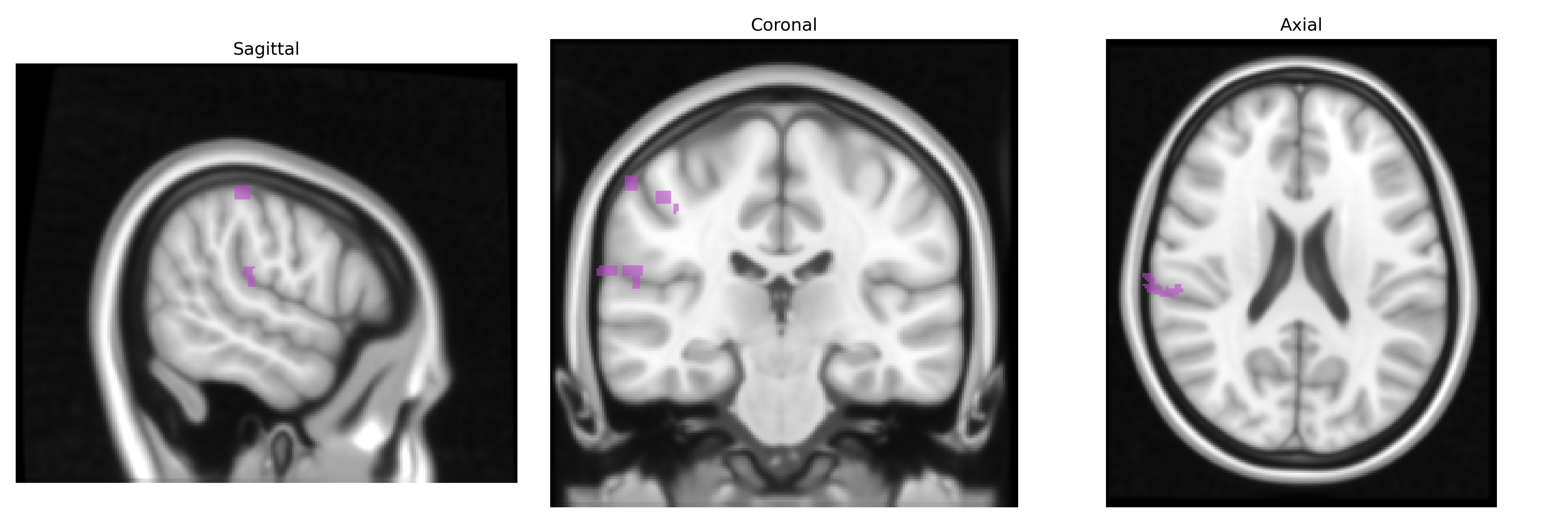
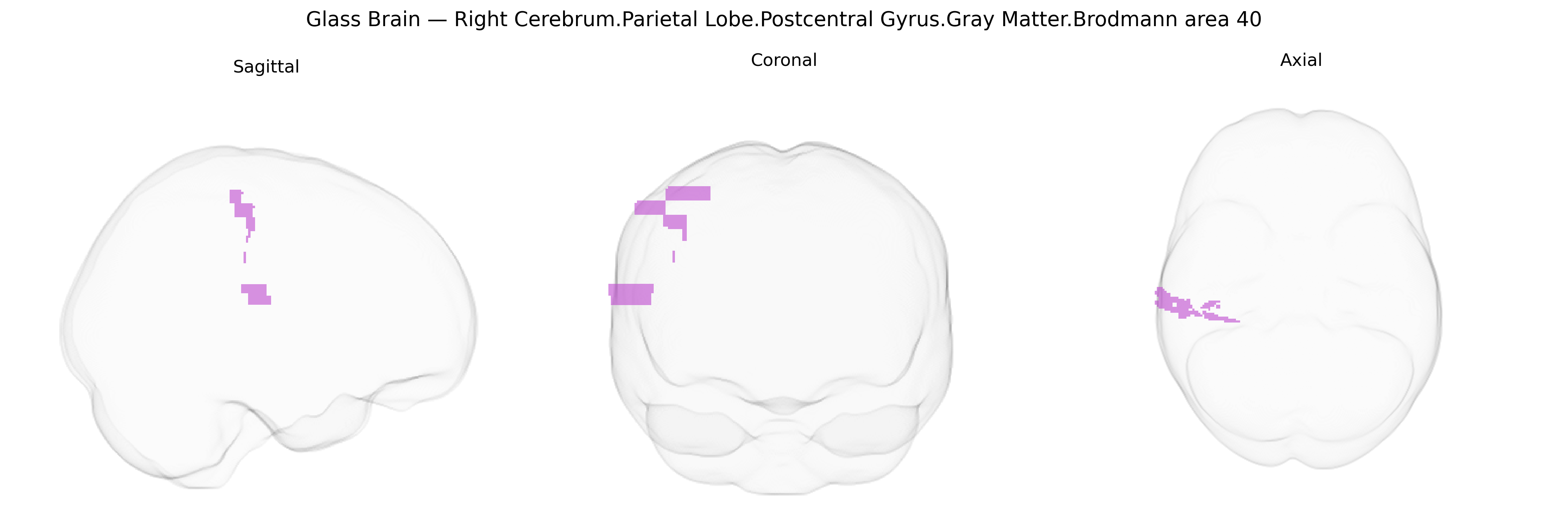
The bilateral Right Cerebrum.Parietal Lobe.Postcentral Gyrus.Gray Matter.Brodmann area 40 corresponds primarily to the supramarginal gyrus region of the inferior parietal lobule, a multimodal association cortex implicated in language processing, phonological decoding, somatosensory integration, and aspects of praxis and spatial attention. Cytoarchitectonically, Brodmann area 40 exhibits a well-developed granular layer IV and prominent pyramidal neurons in layers III and V, reflecting its role in integrating inputs from primary sensory cortices and higher-order association areas. Functionally, this region participates in the dorsal language stream, sensorimotor mapping for speech, and the integration of tactile and proprioceptive information, and it contributes to complex cognitive operations such as working memory, tool use, and body schema representation. There is no direct link for the full Talairach label string; a closely related structure is Brodmann area 40.
The bilateral right postcentral gyrus gray matter in Brodmann area 40 (classically overlapping inferior parietal regions such as supramarginal/angular cortex in the Talairach 1 mm atlas) has been implicated in several genetic and GWAS-based associations, particularly for cognitive, language, and neuropsychiatric traits. Large imaging–genetics consortia (e.g., ENIGMA, UK Biobank) have reported SNP heritability and specific loci influencing cortical thickness and surface area in inferior parietal/postcentral regions, including common variants near genes such as HMGA2, TBR1, MIR2113, WNT3, IGF1, and others involved in neurodevelopment, synaptic plasticity, and cortical patterning; these structural metrics in turn correlate genetically with general cognitive ability, educational attainment, and reading-related skills. GWAS of neurodevelopmental disorders (e.g., autism spectrum disorder, ADHD, and dyslexia) and language phenotypes show convergent effects in networks encompassing BA40, where risk variants in genes like CNTNAP2, FOXP2-related pathways, and DCDC2/KIAA0319 (reading) influence functional activation and connectivity in inferior parietal/postcentral regions during phonological processing, working memory, and sensorimotor integration. Schizophrenia and bipolar disorder risk loci—particularly those affecting synaptic and calcium-signaling genes (e.g., CACNA1C, GRIN2A) and complement-related pathways (e.g., C4)—have also been linked via imaging genetics to altered gray-matter volume, cortical thickness, and functional responses in right parietal/postcentral cortex, consistent with this region’s role in multisensory integration and higher-order association processing. Collectively, these findings indicate that right BA40/postcentral parietal cortex is a heritable, genetically modulated node whose structure and function are shaped by polygenic influences related to neurodevelopment, language and cognition, and vulnerability to neuropsychiatric and neurodevelopmental disorders.
Overview generated by GPT-4o (2026).
Region ID: 778
Hemisphere: bilateral
Atlas: Talairach labels 1mm
Full Quality Version: Download MP4
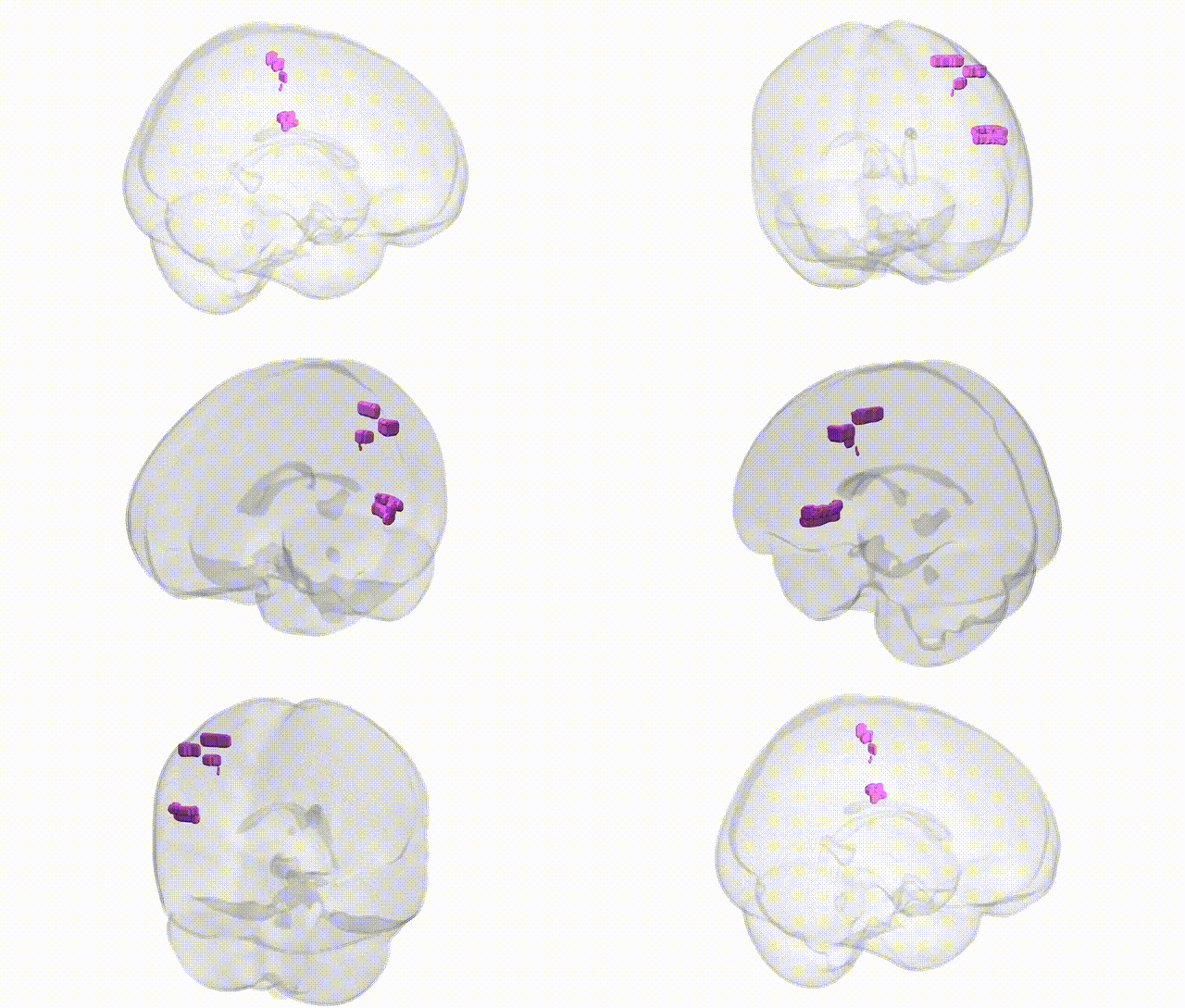
Full Quality Version: Download MP4
Wali Sidiqyar*, Gaurav Rudravaram*, Elyssa M. McMaster, Trent M. Schwartz, Adam M. Saunders, Kurt G. Schilling, Bennett A. Landman "Introducing SPINS: A Shared Public Visualization Library of Neuroanatomical Structures." Medical Imaging with Deep Learning- short paper
This resource is licensed under CC0 1.0 Universal (Public Domain).