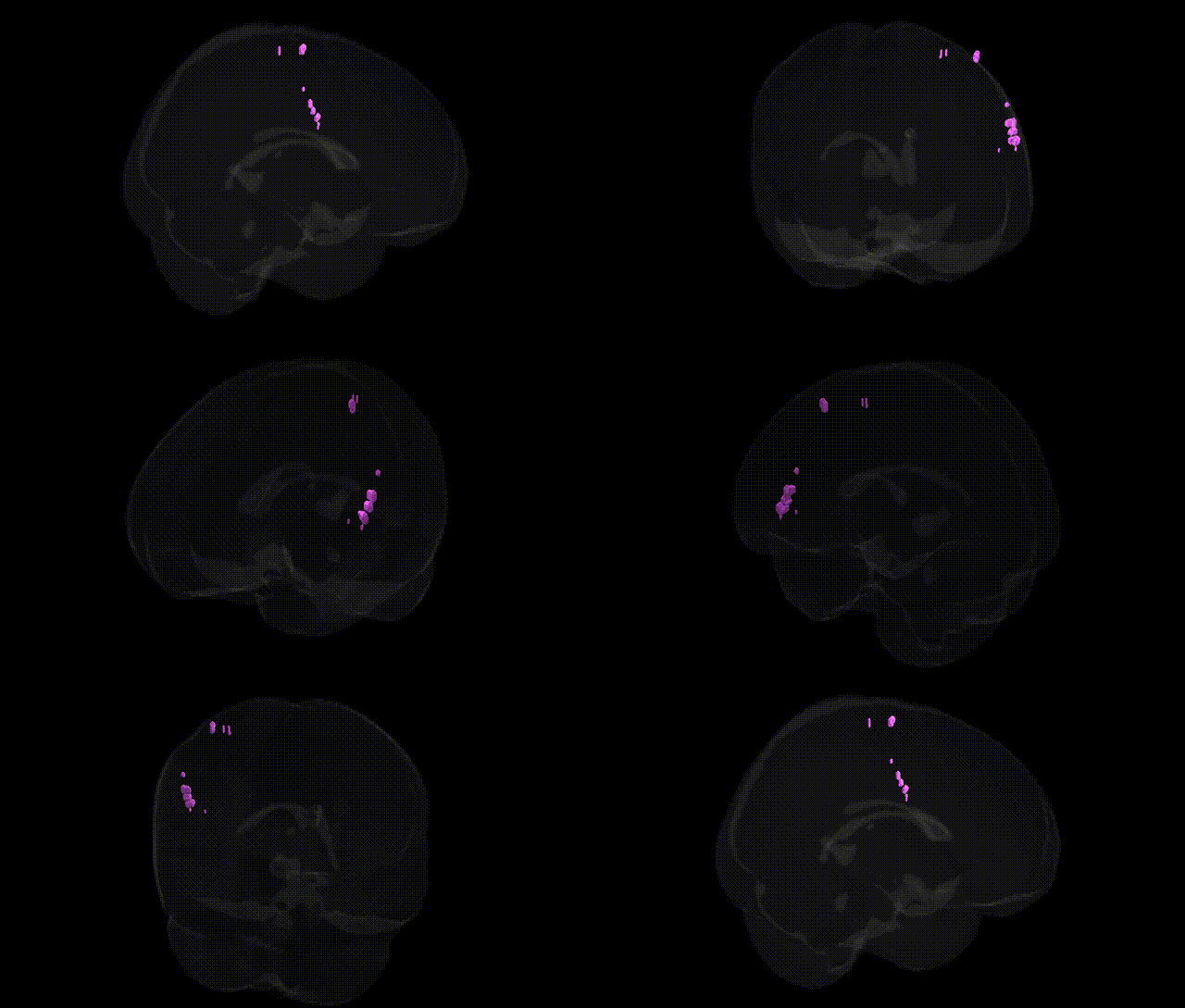
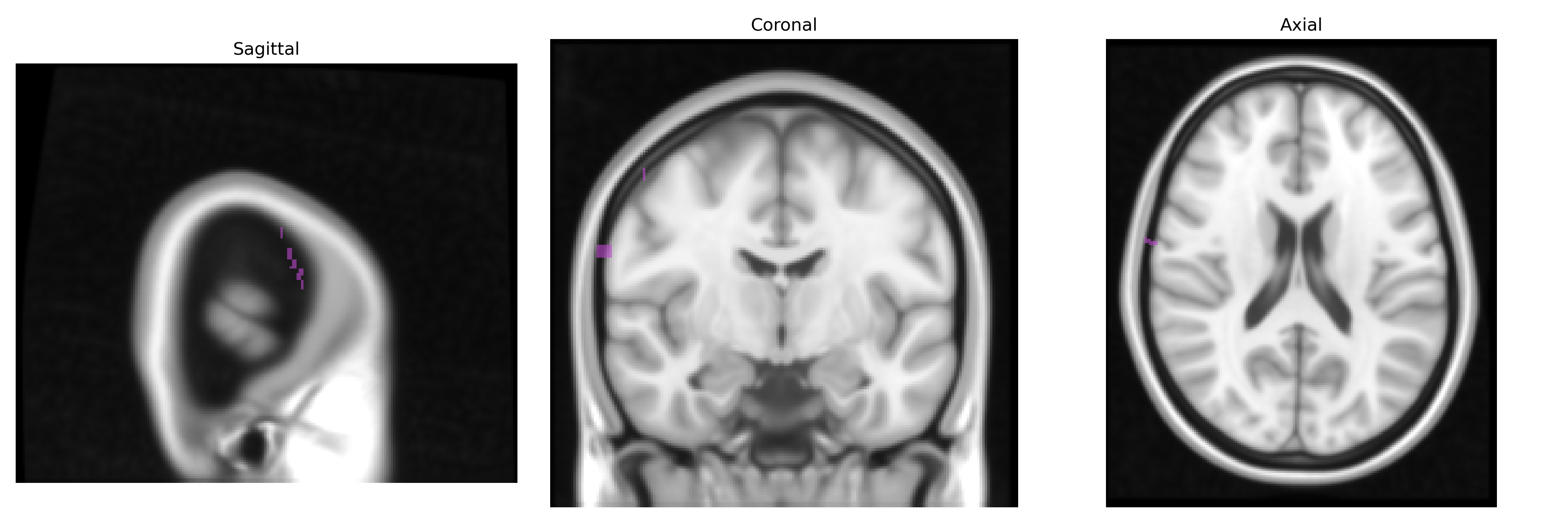
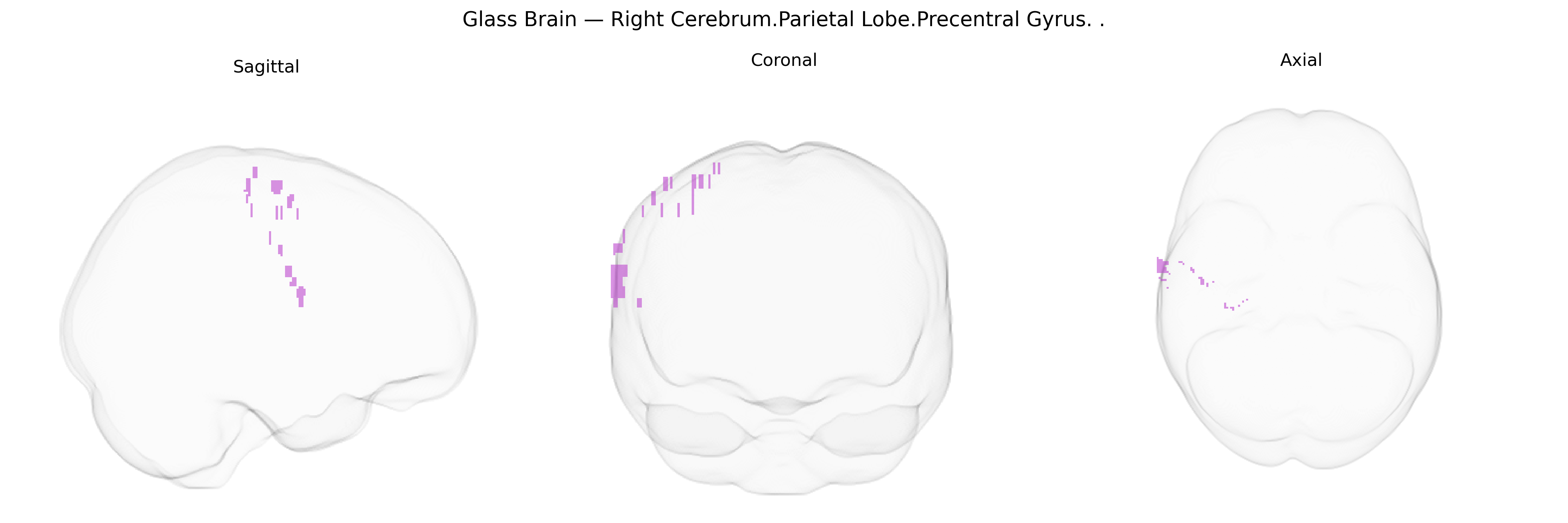
The bilateral Right Cerebrum.Parietal Lobe.Precentral Gyrus, as labeled in the Talairach 1 mm atlas, refers to activation or labeling that spans both hemispheres but is localized to the right-hemisphere portion of the precentral gyrus, a cortical strip immediately anterior to the central sulcus that traditionally belongs to the frontal lobe rather than the parietal lobe. This region corresponds largely to the primary motor cortex (Brodmann area 4), which is crucial for the planning and execution of voluntary movements, organized somatotopically to control contralateral body musculature (with the right precentral gyrus primarily controlling movements of the left side of the body). Functionally, it is involved in fine motor control, force production, and coordination of complex, goal-directed actions, and it integrates inputs from premotor and somatosensory areas to refine motor output. There is no direct Wikipedia article titled with the full Talairach label; a closely related and encompassing structure is the precentral gyrus: Precentral gyrus.
The bilateral right precentral gyrus (primary motor cortex) has been implicated in genetic studies primarily through its role in motor control, motor learning, and related neuropsychiatric and neurodevelopmental traits rather than through region-exclusive variants, with many associations emerging from imaging genetics and GWAS of brain structure and function. Large-scale ENIGMA and UK Biobank studies have identified common variants in genes such as MAPT, MSRB3, KTN1, HMGA2, and loci near IGF1 and FGFR3 that influence cortical thickness, surface area, or volume in precentral or adjacent sensorimotor/parietal regions, indicating polygenic architecture shared with global brain measures and height. Polygenic scores for schizophrenia, bipolar disorder, and major depressive disorder have been linked to altered precentral or broader sensorimotor cortical metrics, while GWAS of handedness and motor skill learning point to variants in microtubule- and axon-related genes (e.g., TUBB, MAP2, ROBO1/2) that modulate asymmetry or efficiency of precentral circuitry. Motor and movement-related disorders—such as dystonia, essential tremor, Parkinson’s disease, and amyotrophic lateral sclerosis—show risk variants (e.g., in LRRK2, GBA, C9orf72, SOD1, ATXN2) that, though not specific to the precentral gyrus, are associated with structural and functional changes in this region, consistent with its central role in corticospinal output. Autism spectrum disorder and ADHD polygenic liability have also been associated with atypical morphology and activation of precentral and adjoining parietal areas, implicating genes involved in synaptic development and cortical patterning (e.g., CNTNAP2, SHANK family, cell-adhesion and guidance genes), while GWAS of cognitive and educational traits reveal overlapping loci that subtly influence precentral structure as part of distributed networks supporting motor aspects of cognition and speech.
Overview generated by GPT-4o (2026).
Region ID: 807
Hemisphere: bilateral
Atlas: Talairach labels 1mm
Full Quality Version: Download MP4
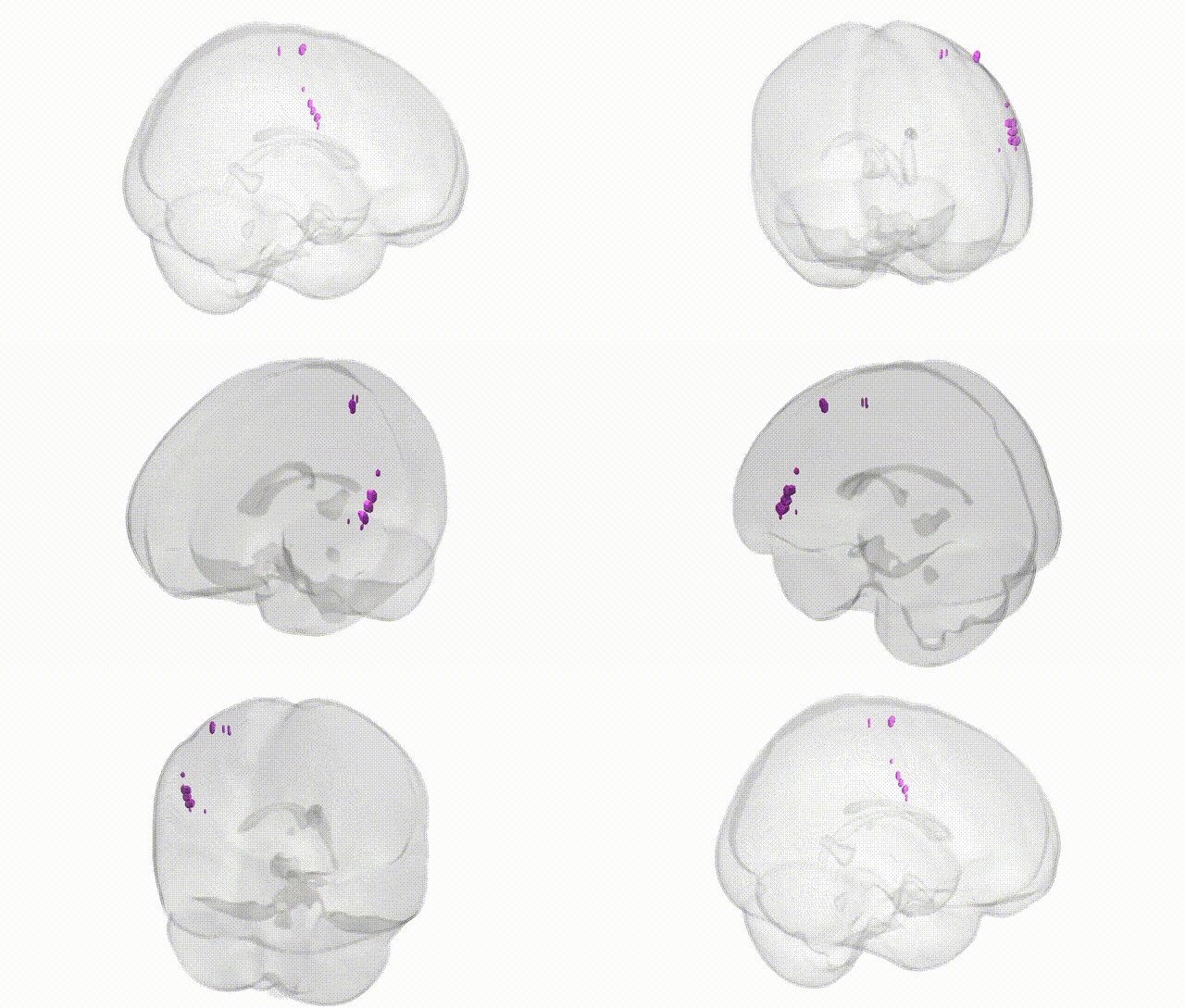
Full Quality Version: Download MP4
Wali Sidiqyar*, Gaurav Rudravaram*, Elyssa M. McMaster, Trent M. Schwartz, Adam M. Saunders, Kurt G. Schilling, Bennett A. Landman "Introducing SPINS: A Shared Public Visualization Library of Neuroanatomical Structures." Medical Imaging with Deep Learning- short paper
This resource is licensed under CC0 1.0 Universal (Public Domain).