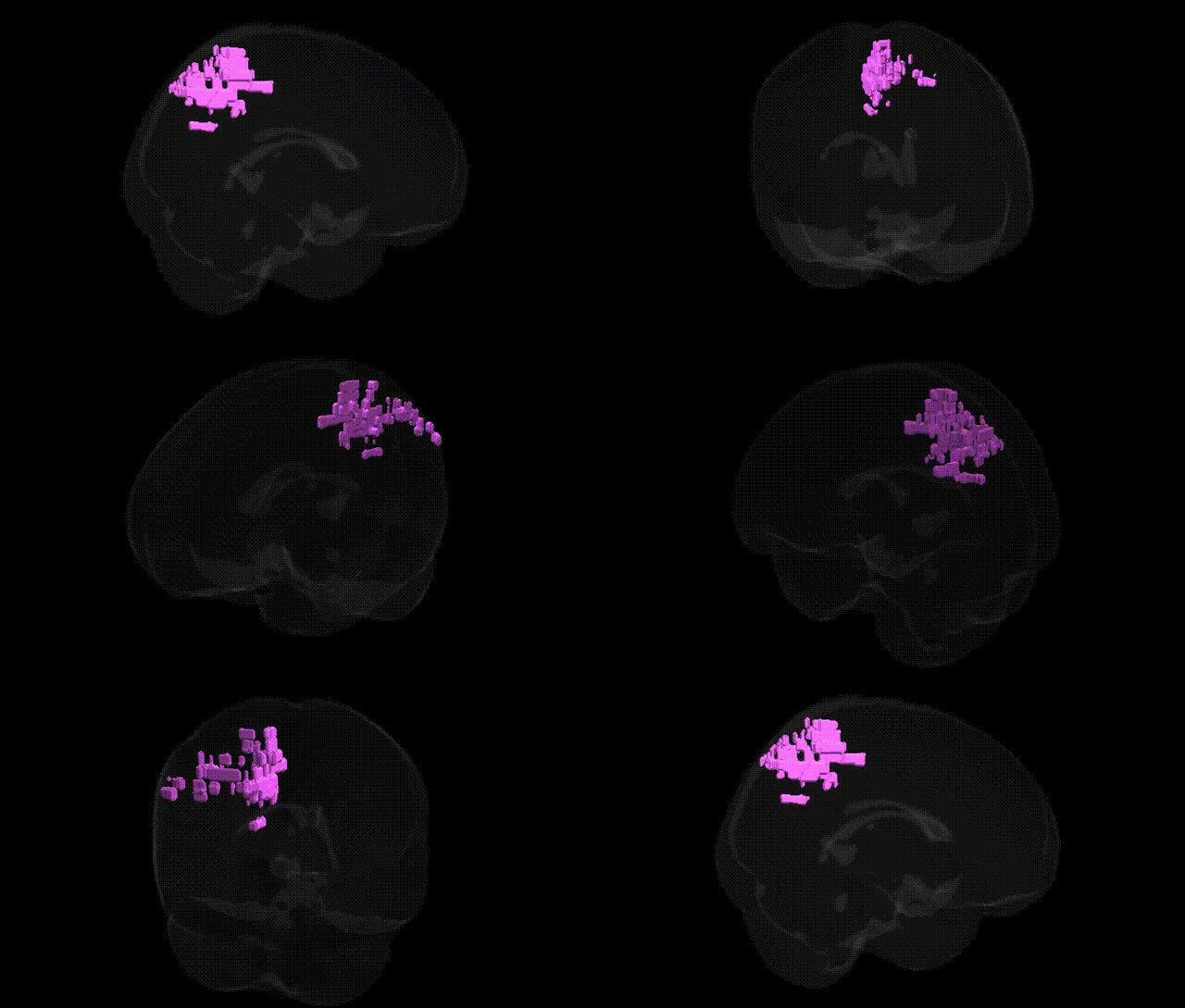
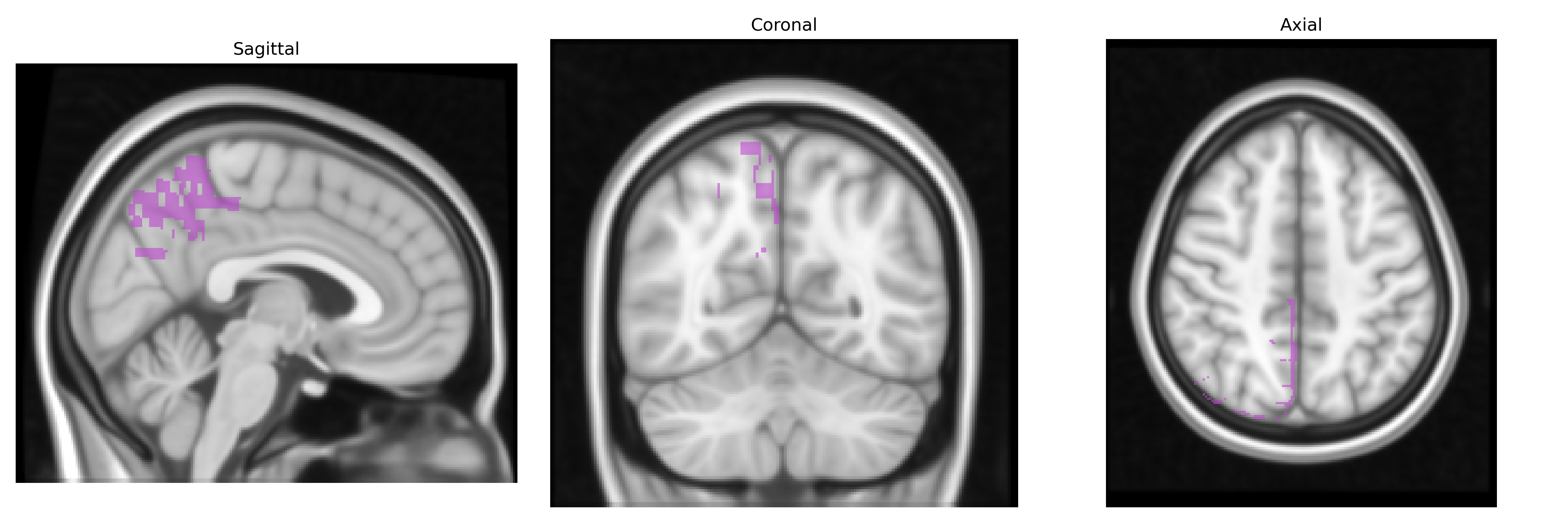
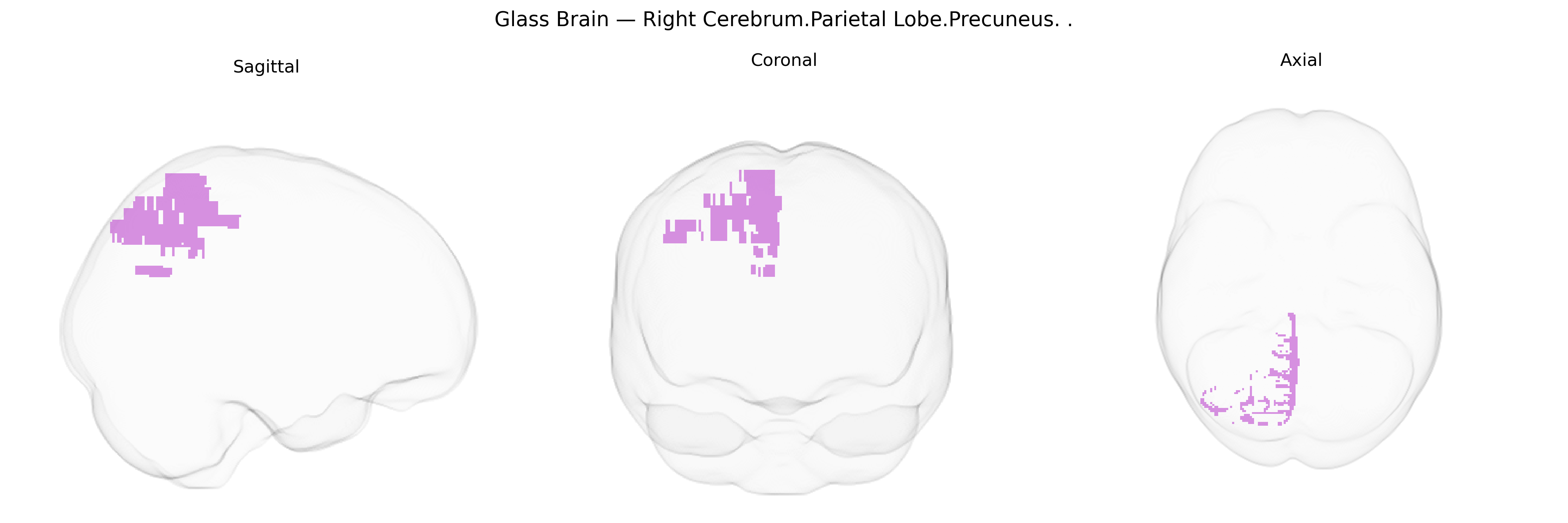
The bilateral Right Cerebrum.Parietal Lobe.Precuneus, as defined in the Talairach 1 mm atlas, refers to the precuneus region located on the medial aspect of the parietal lobe within the right cerebral hemisphere, mirrored bilaterally for analysis across hemispheres. This cortical area lies posterior to the posterior cingulate cortex and anterior to the occipital lobe, roughly within Brodmann area 7, and is implicated in high-level integrative functions. The precuneus contributes to visuospatial processing, self-referential and autobiographical memory, aspects of consciousness and awareness, and is a key node of the default mode network, showing high metabolic activity at rest and deactivation during goal-directed tasks. Structurally and functionally, it interfaces with frontal, parietal, and limbic regions, supporting the integration of sensory information with internal cognitive states.
Precuneus
The bilateral right precuneus (Right Cerebrum.Parietal Lobe.Precuneus) has been implicated in numerous imaging-genetics and GWAS-based endophenotype studies rather than direct “precuneus-specific” gene findings, with common associations emerging through large-scale cortical thickness, surface area, and functional connectivity GWAS. Variants in genes involved in synaptic plasticity, neurodevelopment, and myelination (for example, pathways including MAPT, APOE, GRIN2B, and CNTNAP2, among others) have been linked to structural and functional variation in parietal and default-mode network regions that prominently include the precuneus. Imaging-genetics studies in schizophrenia, autism spectrum disorder, major depression, Alzheimer’s disease, and ADHD repeatedly identify altered precuneus morphology or connectivity associated with polygenic risk scores and specific loci (e.g., APOE-ε4 and other Alzheimer’s risk variants linked to default-mode/precuneus hypometabolism and atrophy; schizophrenia and autism PRS linked to altered precuneus connectivity and cortical thickness). Large consortia such as ENIGMA and UK Biobank report that multiple genome-wide significant loci influencing global and regional cortical measures show effects in the precuneus region, although these effects are typically shared with broader parietal or default-mode territories rather than being confined to the right precuneus alone. Overall, genetic associations for this region predominantly arise via pleiotropic neurodevelopmental and neurodegeneration-related variants whose effects manifest in precuneus structure and function as part of distributed brain networks involved in self-referential processing, episodic memory, and visuospatial integration.
Overview generated by GPT-4o (2026).
Region ID: 862
Hemisphere: bilateral
Atlas: Talairach labels 1mm
Full Quality Version: Download MP4
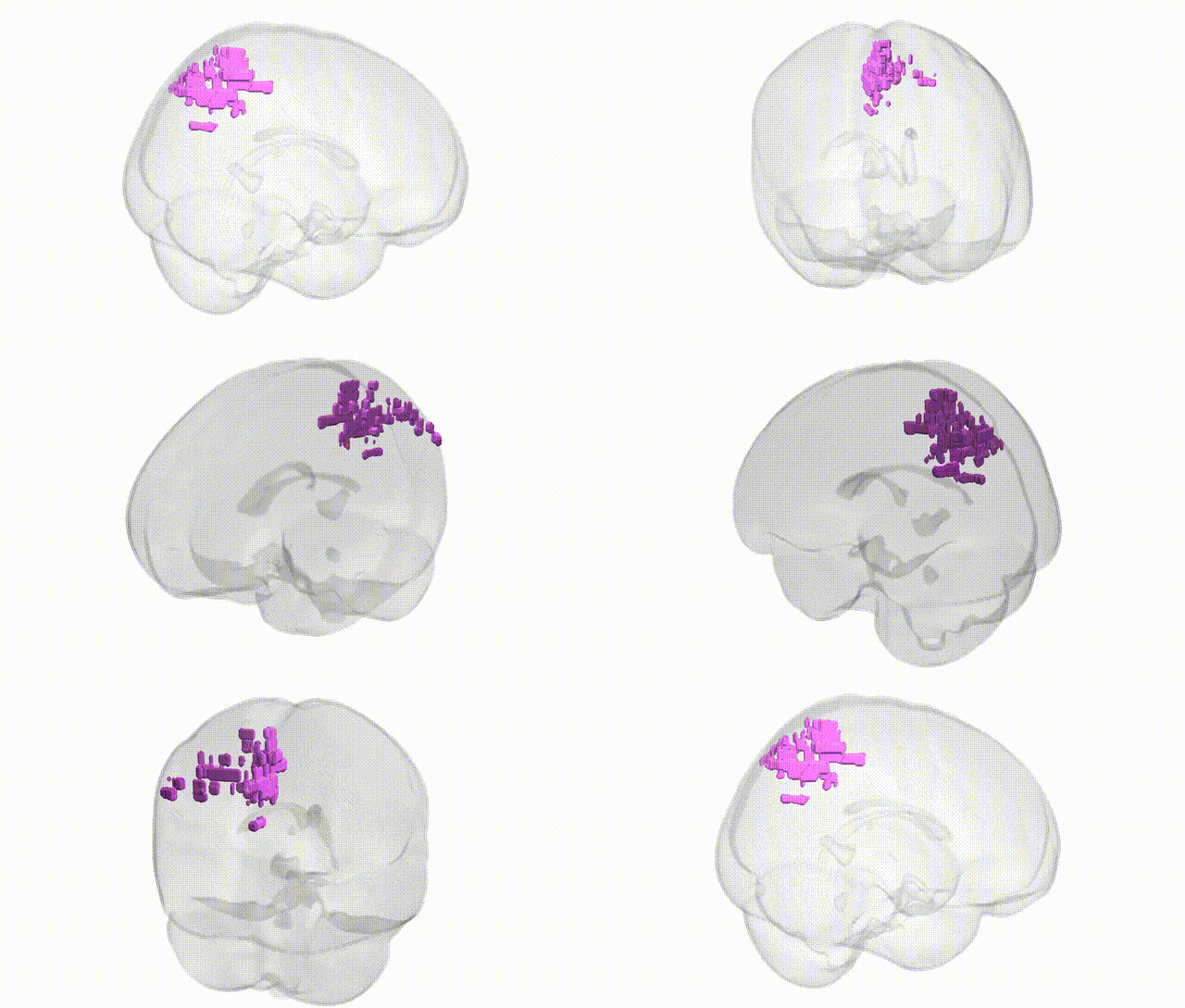
Full Quality Version: Download MP4
Wali Sidiqyar*, Gaurav Rudravaram*, Elyssa M. McMaster, Trent M. Schwartz, Adam M. Saunders, Kurt G. Schilling, Bennett A. Landman "Introducing SPINS: A Shared Public Visualization Library of Neuroanatomical Structures." Medical Imaging with Deep Learning- short paper
This resource is licensed under CC0 1.0 Universal (Public Domain).