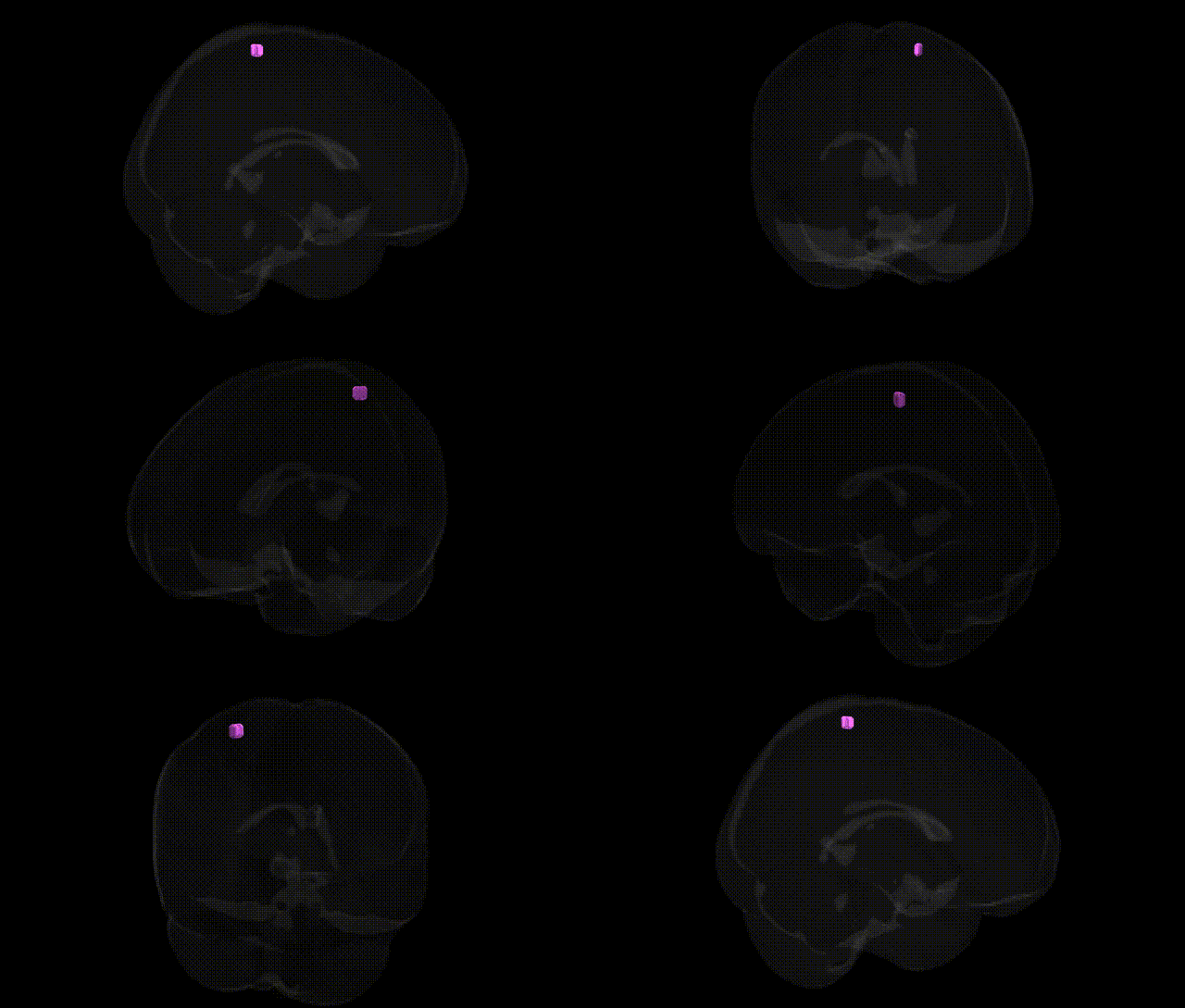
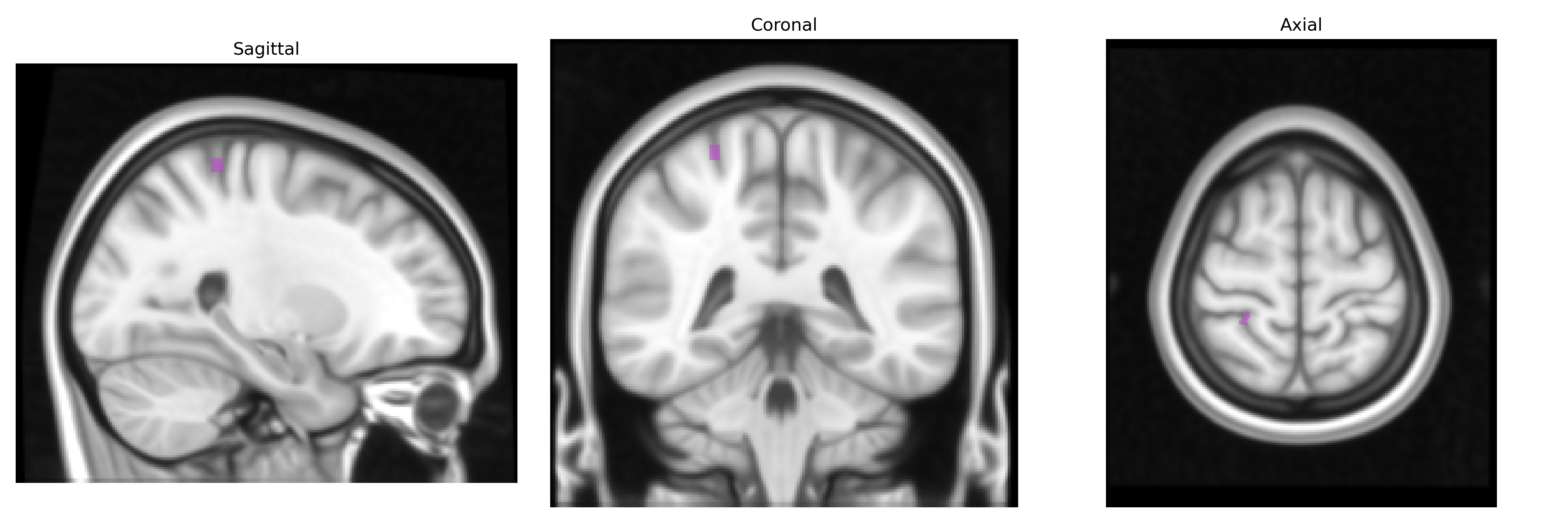
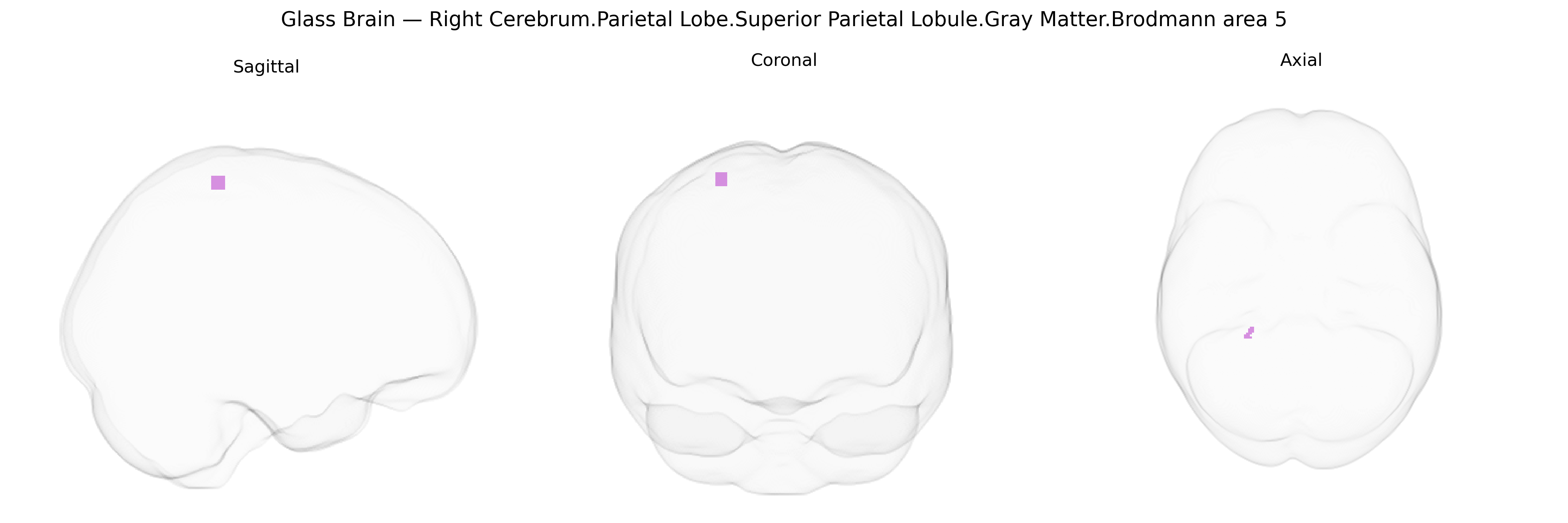
Bilateral Right Cerebrum.Parietal Lobe.Superior Parietal Lobule.Gray Matter.Brodmann area 5 corresponds to a somatosensory association cortex region situated in the dorsal parietal lobe, immediately posterior to the primary somatosensory cortex (Brodmann areas 3, 1, and 2). This region integrates tactile, proprioceptive, and kinesthetic information from the body to support higher-order functions such as spatial perception, body schema formation, and the guidance of visually and somatosensorily informed movements. Neuronal populations in Brodmann area 5 participate in constructing internal representations of limb position and movement, contributing to sensorimotor coordination and complex manual actions. Lesions in this territory can lead to deficits in tactile discrimination, impaired integration of somatosensory input, and disturbances of spatial orientation. There is no direct Wikipedia article for “Brodmann area 5” as a standalone entry; a closely related and encompassing structure is the Superior parietal lobule.
Genetic associations involving the bilateral right superior parietal lobule (Brodmann area 5) primarily emerge from imaging genetics and GWAS of cortical morphology and cognitive traits, as well as disorder-focused studies implicating parietal networks. Large-scale cortical GWAS (e.g., ENIGMA, UK Biobank) have linked variants in genes involved in neurodevelopment and synaptic function—such as those in Wnt signaling, axon guidance, and neuronal differentiation pathways—to regional parietal cortical thickness or surface area, with several loci showing effects that extend to or peak in superior parietal regions. Polygenic scores for general cognitive ability, educational attainment, and working memory often correlate with structure and activation within superior parietal cortex, consistent with this region’s role in visuospatial processing, attention, and integration of sensory information. In neurodevelopmental and psychiatric GWAS, risk variants for disorders such as schizophrenia, autism spectrum disorder, and attention-deficit/hyperactivity disorder have been associated with altered parietal morphology or connectivity, including superior parietal involvement, although these effects are typically distributed across large networks rather than confined to Brodmann area 5. Neurodegenerative GWAS (e.g., Alzheimer’s disease) have identified variants (such as those in APOE and other lipid/metabolic genes) that relate to parietal atrophy patterns and posterior cortical vulnerability encompassing superior parietal areas. Overall, current genetic findings implicate the superior parietal lobule as part of broader polygenic networks influencing cortical development, cognitive function, and susceptibility to neuropsychiatric and neurodegenerative conditions, but no single gene or locus has been uniquely and specifically attributed to Brodmann area 5 in the Talairach 1 mm atlas.
Overview generated by GPT-4o (2026).
Region ID: 1098
Hemisphere: bilateral
Atlas: Talairach labels 1mm
Full Quality Version: Download MP4
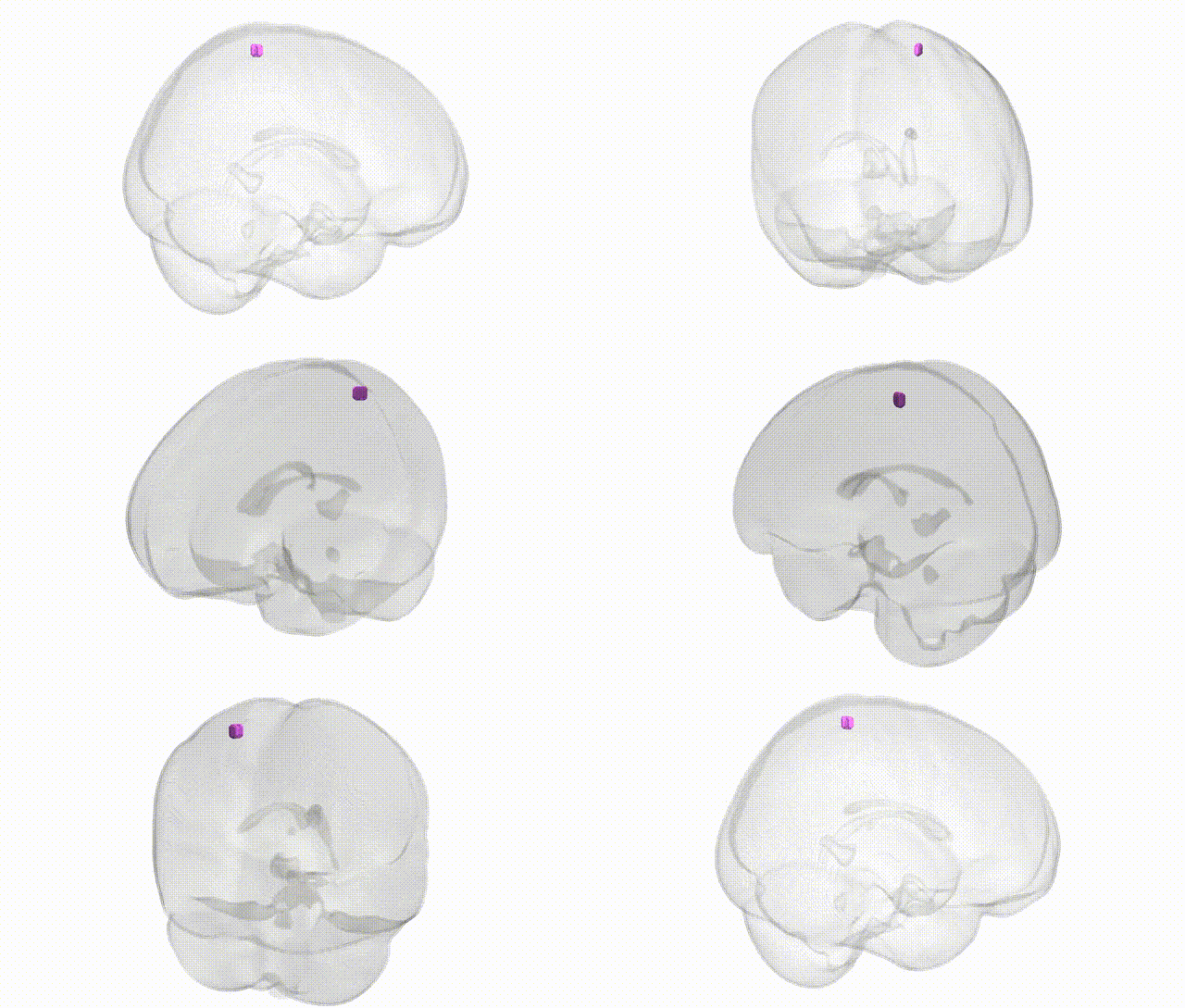
Full Quality Version: Download MP4
Wali Sidiqyar*, Gaurav Rudravaram*, Elyssa M. McMaster, Trent M. Schwartz, Adam M. Saunders, Kurt G. Schilling, Bennett A. Landman "Introducing SPINS: A Shared Public Visualization Library of Neuroanatomical Structures." Medical Imaging with Deep Learning- short paper
This resource is licensed under CC0 1.0 Universal (Public Domain).