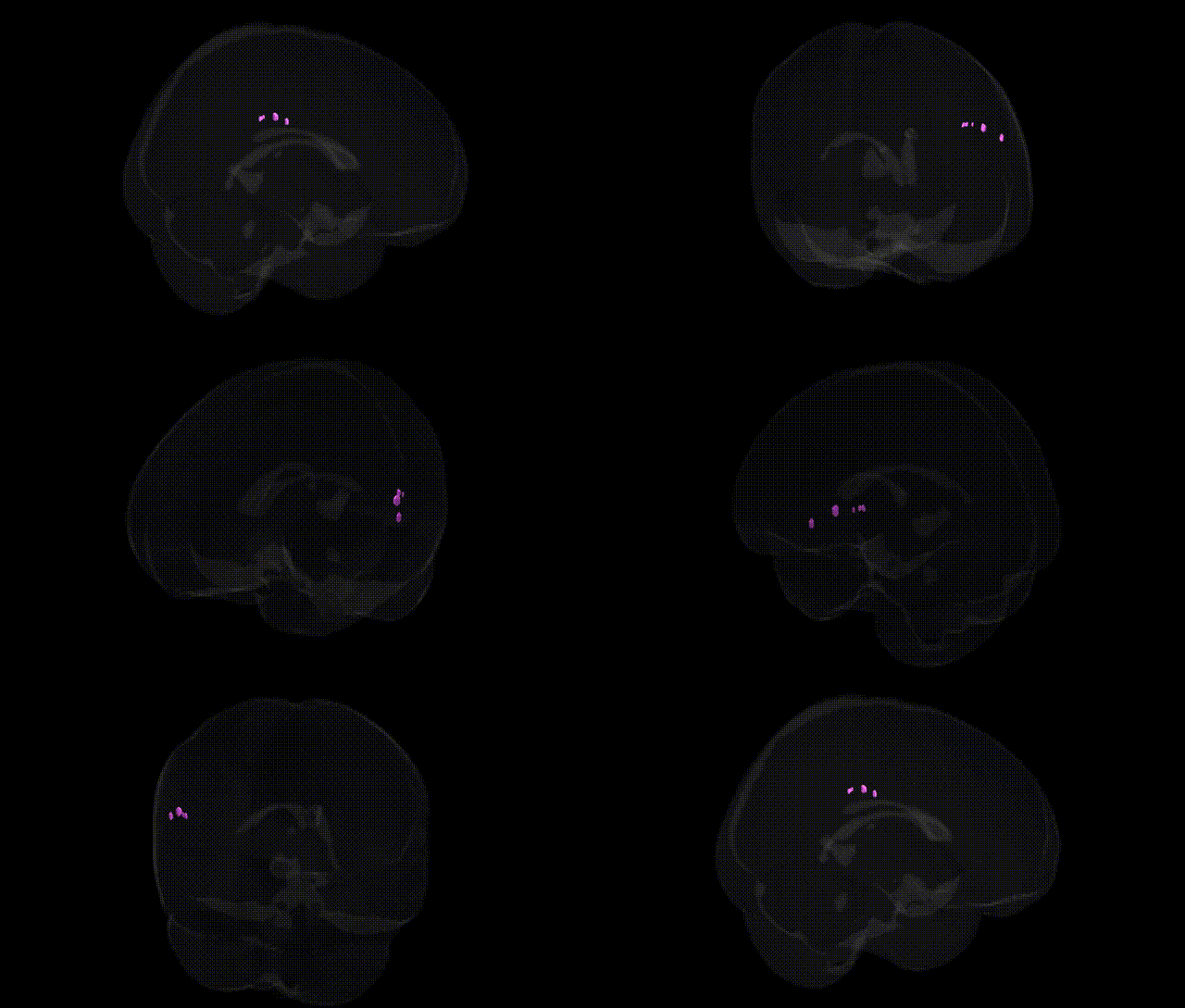
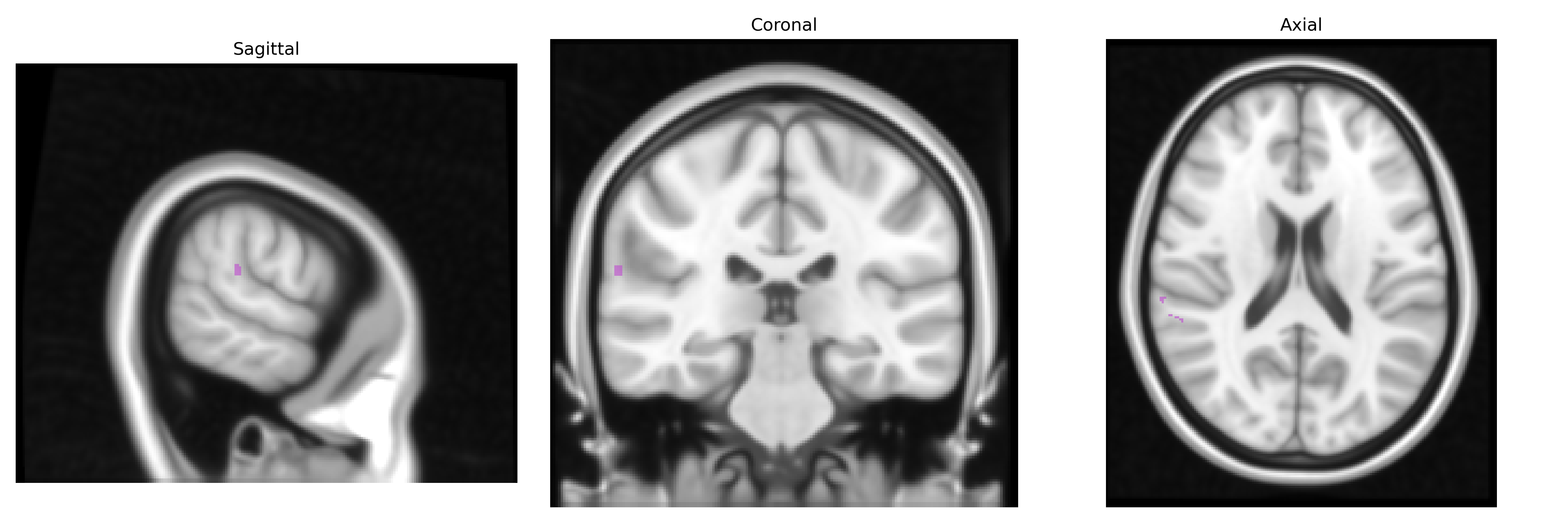
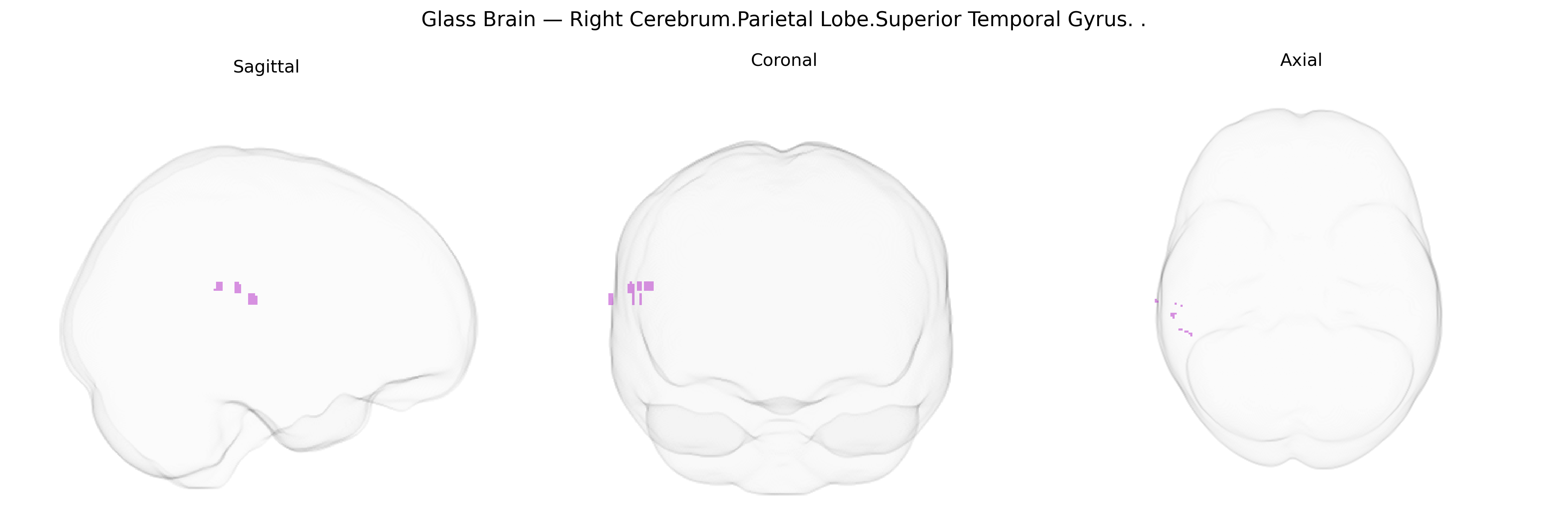
The bilateral Right Cerebrum.Parietal Lobe.Superior Temporal Gyrus region, as labeled in the Talairach 1 mm atlas, corresponds primarily to the superior temporal gyrus (STG), a convoluted cortical structure bordering the lateral sulcus and lying at the junction of the temporal and parietal lobes. The STG participates in early auditory processing, including sound feature analysis and aspects of speech perception, and contributes to higher-order integrative functions such as language comprehension (especially in the dominant hemisphere), audiovisual integration, and social cognition (e.g., processing vocal prosody and aspects of social communication). Anatomically, it lies superior to the middle temporal gyrus and inferior to the supramarginal gyrus of the parietal lobe, with cytoarchitectonic areas that include primary and secondary auditory cortex.
Superior temporal gyrus
The bilateral right superior temporal gyrus in the parietal/temporal junction, as defined in the Talairach 1 mm atlas, is implicated by genetic and imaging-genetics studies in language, social cognition, and auditory processing traits, as well as several neuropsychiatric and neurodevelopmental disorders. GWAS and related approaches using structural and functional MRI have linked interindividual variation in superior temporal gyrus volume, cortical thickness, and activation to common variants in genes involved in synaptic function and neurodevelopment (for example, CNTNAP2, NRXN1, DCDC2, FOXP2-related pathways, and glutamatergic and GABAergic signaling genes), often in the context of language ability, reading and dyslexia, and autism spectrum conditions. Large consortia such as ENIGMA have reported heritable effects on temporal lobe and superior temporal gyrus morphology and have associated specific loci with temporal cortical measures, some overlapping with schizophrenia, bipolar disorder, and major depression risk loci, suggesting shared genetic influences on temporal lobe structure and psychiatric vulnerability. Imaging-genetics work in schizophrenia and bipolar disorder has repeatedly implicated risk variants in genes such as CACNA1C, ZNF804A, and GRM3 in altered activation or connectivity of the superior temporal gyrus during auditory, language, and social cognition tasks, consistent with this region’s role in auditory hallucinations and thought disorder. In autism, rare and common variants in synaptic and neurodevelopmental genes (e.g., SHANK3, NLGN3/4, SCN2A) have been associated with atypical superior temporal responses to speech and social stimuli, while GWAS for empathy, social communication, and theory-of-mind traits point to polygenic effects that modulate activity in right-hemisphere temporoparietal regions including the superior temporal gyrus. Additionally, polygenic risk scores for educational attainment, cognitive performance, and musical aptitude show associations with superior temporal and adjacent auditory cortex structure and function, indicating that this region’s genetic architecture contributes to higher-order cognitive and sensory traits, though specific locus-to-region mappings remain incomplete and highly polygenic.
Overview generated by GPT-4o (2026).
Region ID: 780
Hemisphere: bilateral
Atlas: Talairach labels 1mm
Full Quality Version: Download MP4
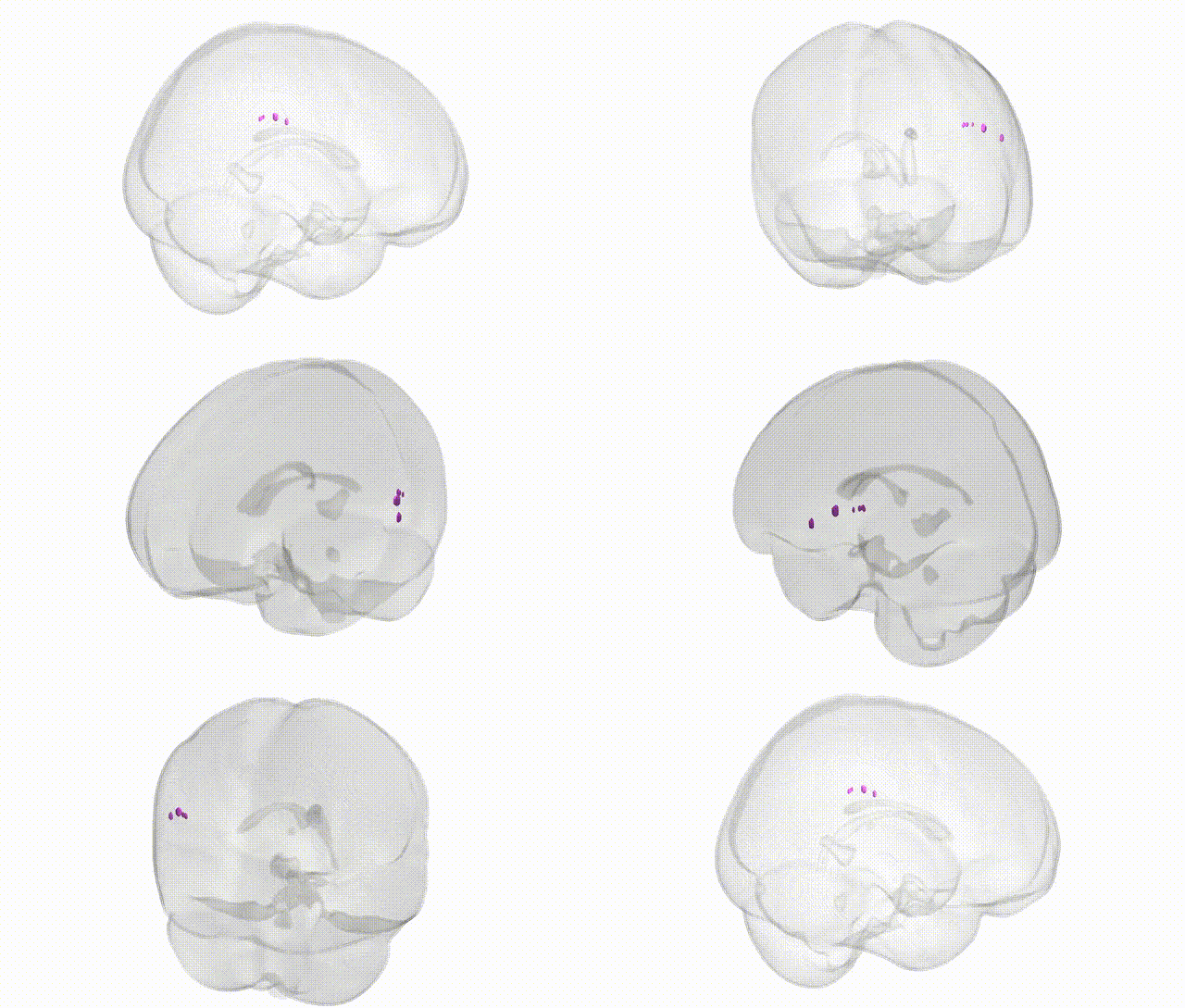
Full Quality Version: Download MP4
Wali Sidiqyar*, Gaurav Rudravaram*, Elyssa M. McMaster, Trent M. Schwartz, Adam M. Saunders, Kurt G. Schilling, Bennett A. Landman "Introducing SPINS: A Shared Public Visualization Library of Neuroanatomical Structures." Medical Imaging with Deep Learning- short paper
This resource is licensed under CC0 1.0 Universal (Public Domain).