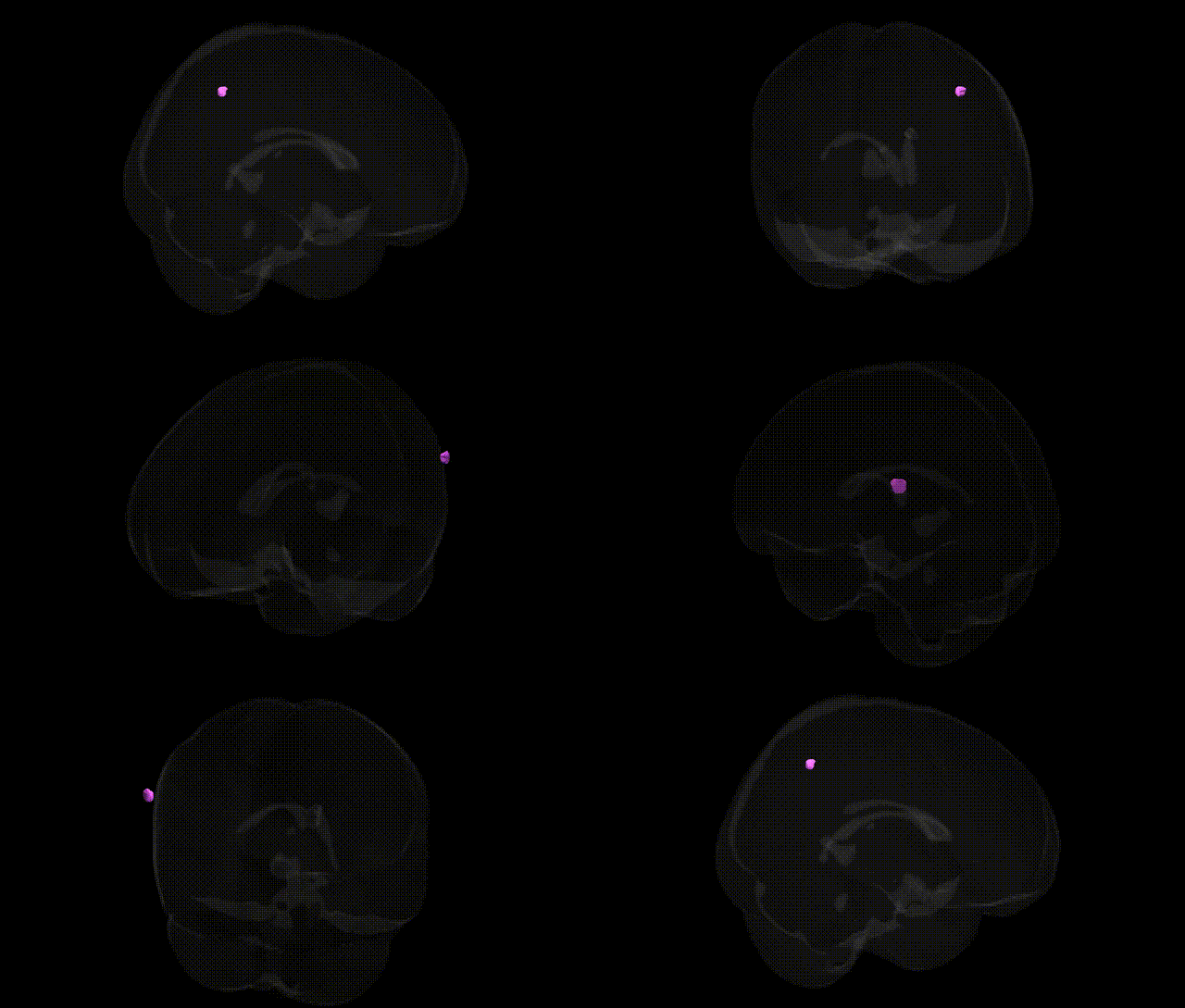
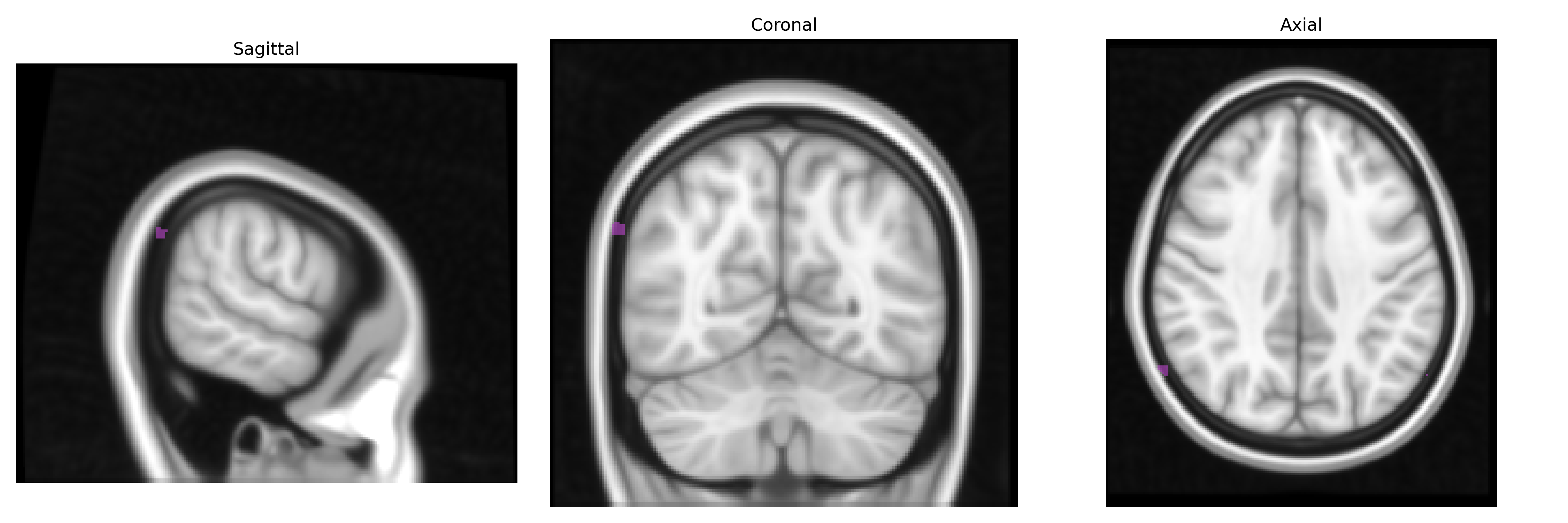
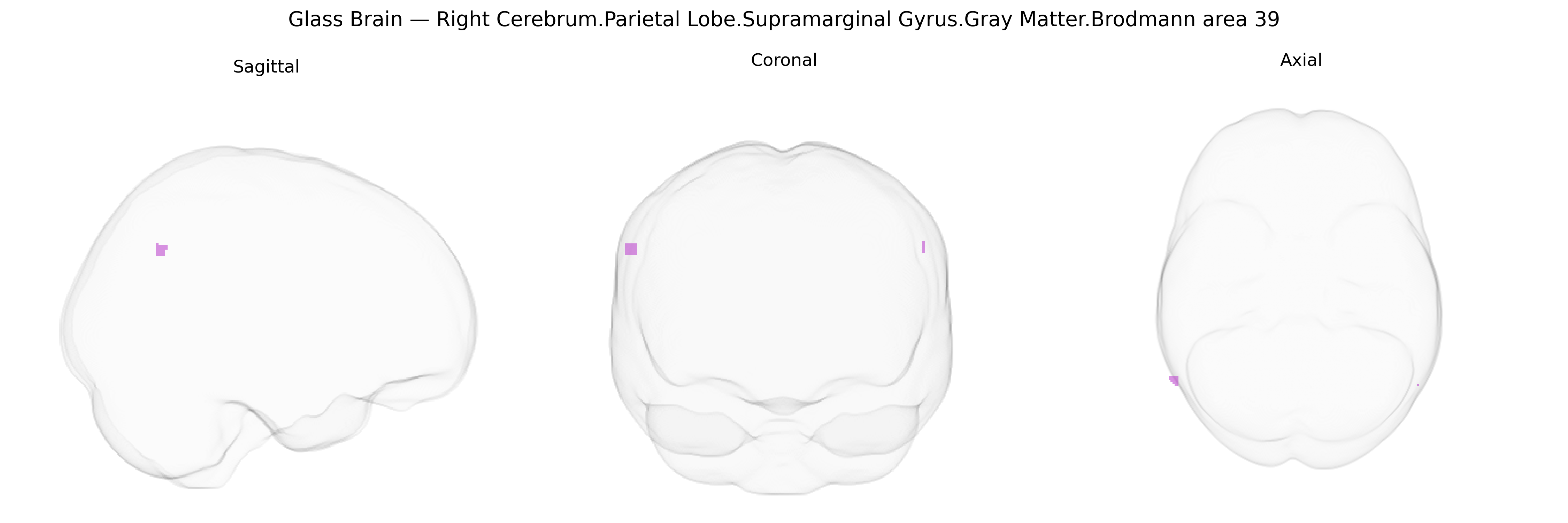
The bilateral Right Cerebrum.Parietal Lobe.Supramarginal Gyrus.Gray Matter.Brodmann area 39 corresponds primarily to the angular gyrus region of the inferior parietal lobule, situated at the junction of the parietal, temporal, and occipital lobes. In the Talairach 1 mm atlas, this area is implicated in multimodal integration of visual, auditory, and somatosensory information and is strongly associated with language-related processes (such as reading, semantic processing, and comprehension), number processing, spatial cognition, and aspects of theory of mind and social cognition. Brodmann area 39 contributes to higher-order associative functions, including the integration of symbolic information and the construction of complex conceptual relationships, supporting tasks like sentence-level understanding, metaphor, and abstract reasoning. There is no direct link for this exact Talairach label; a closely related and overlapping structure is the Angular gyrus.
The supramarginal gyrus (SMG; Brodmann area 39 in the inferior parietal lobule) shows convergent genetic associations from GWAS and imaging-genetics studies, particularly for language, reading, social cognition, and neuropsychiatric risk. Variants in FOXP2, DCDC2, KIAA0319, CNTNAP2, and ROBO1 have been linked to altered structure or function of the SMG in developmental language disorder and dyslexia, often via reduced gray matter volume or atypical activation during phonological and reading tasks. Polygenic risk for autism spectrum disorder and schizophrenia correlates with SMG morphology and connectivity, with specific loci in genes such as CACNA1C, GRIN2A, and MIR137-implicated networks showing effects on parietal language and association regions, including BA39. Large-scale ENIGMA and UK Biobank imaging-GWAS have identified heritable variation in supramarginal gyrus thickness and surface area, implicating genes involved in synaptic function, neuronal migration, and myelination (e.g., TBR1-related networks and loci near PHACTR1 and RSPO3) and linking these structural metrics to cognitive traits such as educational attainment, working memory, and general intelligence. The SMG has also emerged as a node where Alzheimer’s disease and frontotemporal dementia risk loci (e.g., APOE, CLU, BIN1, and C9orf72-related pathways) influence cortical atrophy patterns and language deficits, while addiction- and impulsivity-associated variants (e.g., in DRD2 and SLC6A3 pathways) have been related to altered activation in right parietal attention and control networks overlapping BA39.
Overview generated by GPT-4o (2026).
Region ID: 975
Hemisphere: bilateral
Atlas: Talairach labels 1mm
Full Quality Version: Download MP4
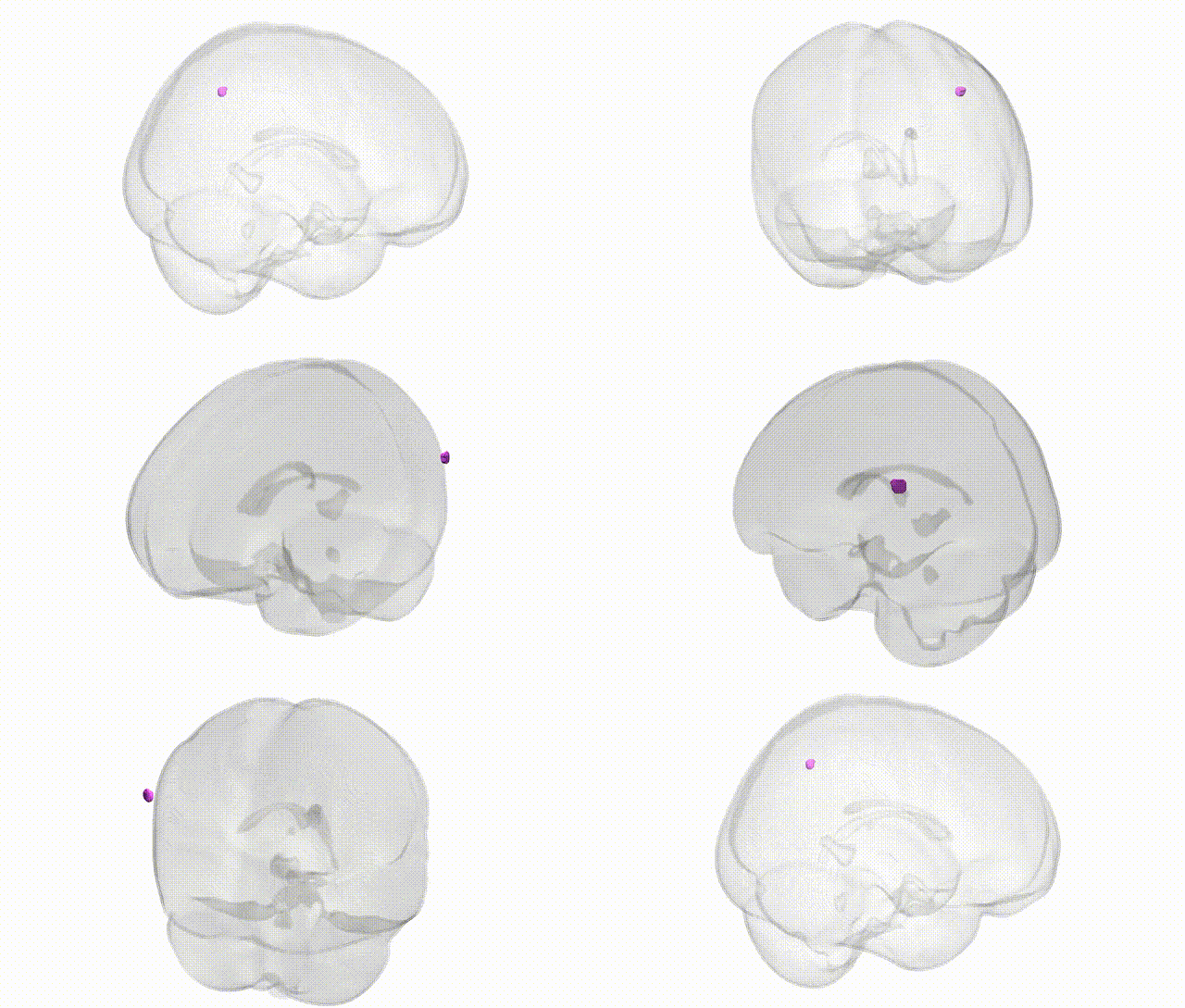
Full Quality Version: Download MP4
Wali Sidiqyar*, Gaurav Rudravaram*, Elyssa M. McMaster, Trent M. Schwartz, Adam M. Saunders, Kurt G. Schilling, Bennett A. Landman "Introducing SPINS: A Shared Public Visualization Library of Neuroanatomical Structures." Medical Imaging with Deep Learning- short paper
This resource is licensed under CC0 1.0 Universal (Public Domain).