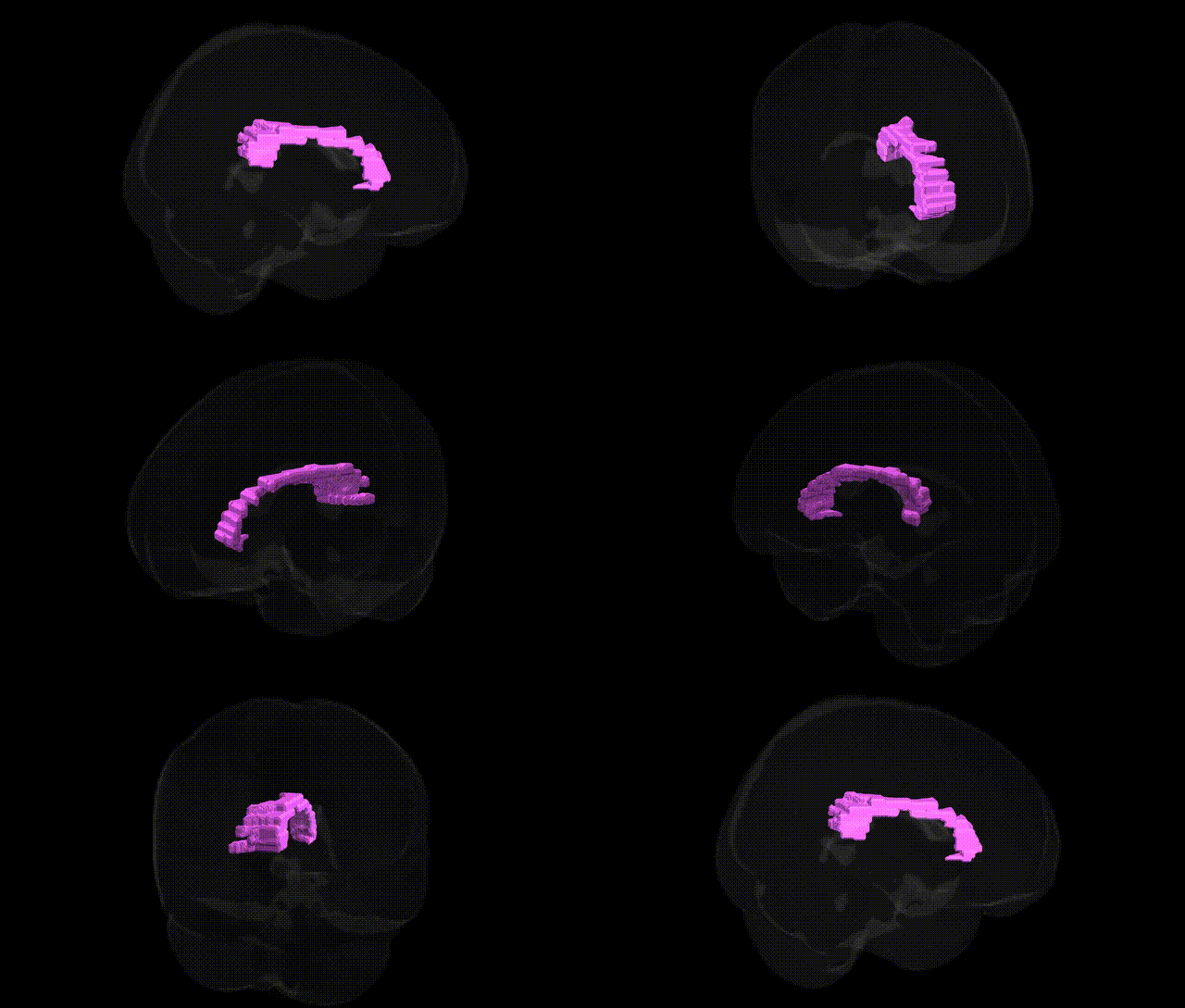
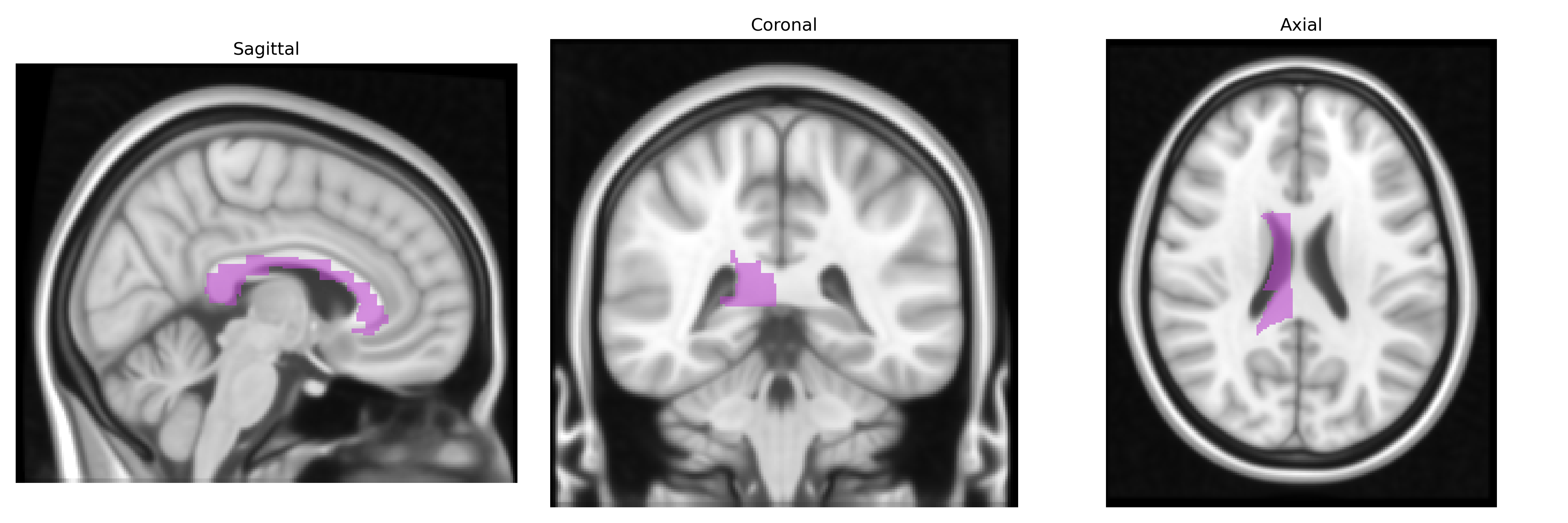
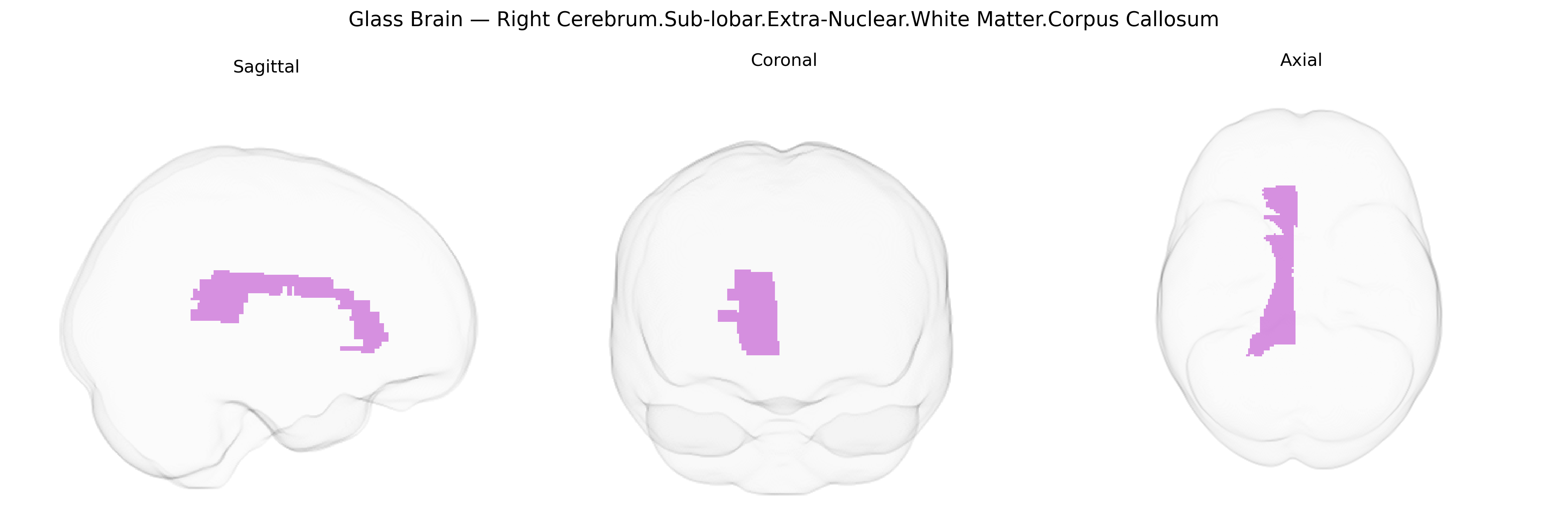
The bilateral Right Cerebrum.Sub-lobar.Extra-Nuclear.White Matter.Corpus Callosum region, as defined in the Talairach 1 mm atlas, corresponds to the major midline white matter commissure interconnecting homologous and heterologous cortical areas of both cerebral hemispheres. Composed predominantly of densely myelinated axons, it provides rapid interhemispheric transfer of sensory, motor, and associative information, supporting integrated bilateral processing of functions such as language, visuospatial cognition, motor coordination, and higher-order executive operations. Within this labeling scheme, the “extra-nuclear” designation situates the corpus callosum outside the basal nuclei, and the white-matter classification emphasizes its role as a long-range fiber pathway rather than a neuronal soma–rich gray matter structure. Damage or developmental anomalies in this tract can lead to disconnection syndromes, illustrating its critical role in functional hemispheric integration. Corpus callosum
Genetic associations with the bilateral Right Cerebrum.Sub-lobar.Extra-Nuclear.White Matter.Corpus Callosum region, as defined in the Talairach 1 mm atlas, primarily emerge from GWAS of corpus callosum volume, microstructure (e.g., fractional anisotropy), and related white-matter integrity measures rather than from this exact parcellation label. Multiple large-scale imaging-genetics studies (e.g., ENIGMA, UK Biobank) have identified common variants in genes involved in axon guidance, myelination, and cytoskeletal organization—such as those in or near CNTN4, ROBO1/2, LINGO1, MAG, and loci harboring oligodendrocyte-related genes—that influence callosal size and diffusivity metrics. These callosal traits, including regional callosal thickness and integrity, show significant heritability and have been genetically correlated with cognitive performance, educational attainment, and general intelligence, as well as with neurodevelopmental and psychiatric disorders such as autism spectrum disorder, ADHD, schizophrenia, and bipolar disorder, in which altered corpus callosum morphology is frequently reported. Rare, high-penetrance mutations and copy number variants (e.g., affecting genes like L1CAM, ARX, or large CNVs at 1q21.1, 22q11.2) can produce agenesis or marked dysgenesis of the corpus callosum, further linking genetic disruption of callosal development to intellectual disability, epilepsy, and global neurodevelopmental anomalies.
Overview generated by GPT-4o (2026).
Region ID: 510
Hemisphere: bilateral
Atlas: Talairach labels 1mm
Full Quality Version: Download MP4
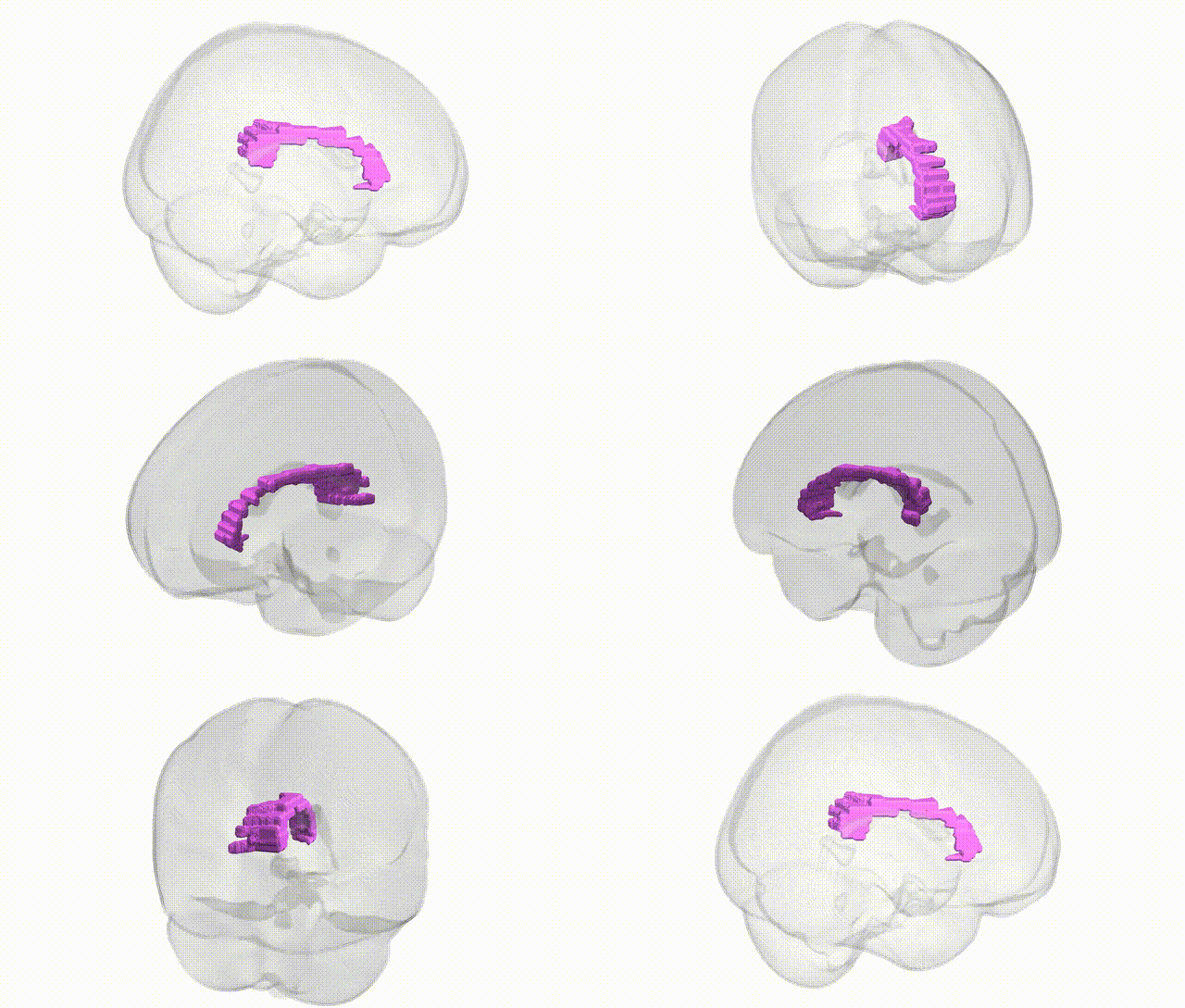
Full Quality Version: Download MP4
Wali Sidiqyar*, Gaurav Rudravaram*, Elyssa M. McMaster, Trent M. Schwartz, Adam M. Saunders, Kurt G. Schilling, Bennett A. Landman "Introducing SPINS: A Shared Public Visualization Library of Neuroanatomical Structures." Medical Imaging with Deep Learning- short paper
This resource is licensed under CC0 1.0 Universal (Public Domain).