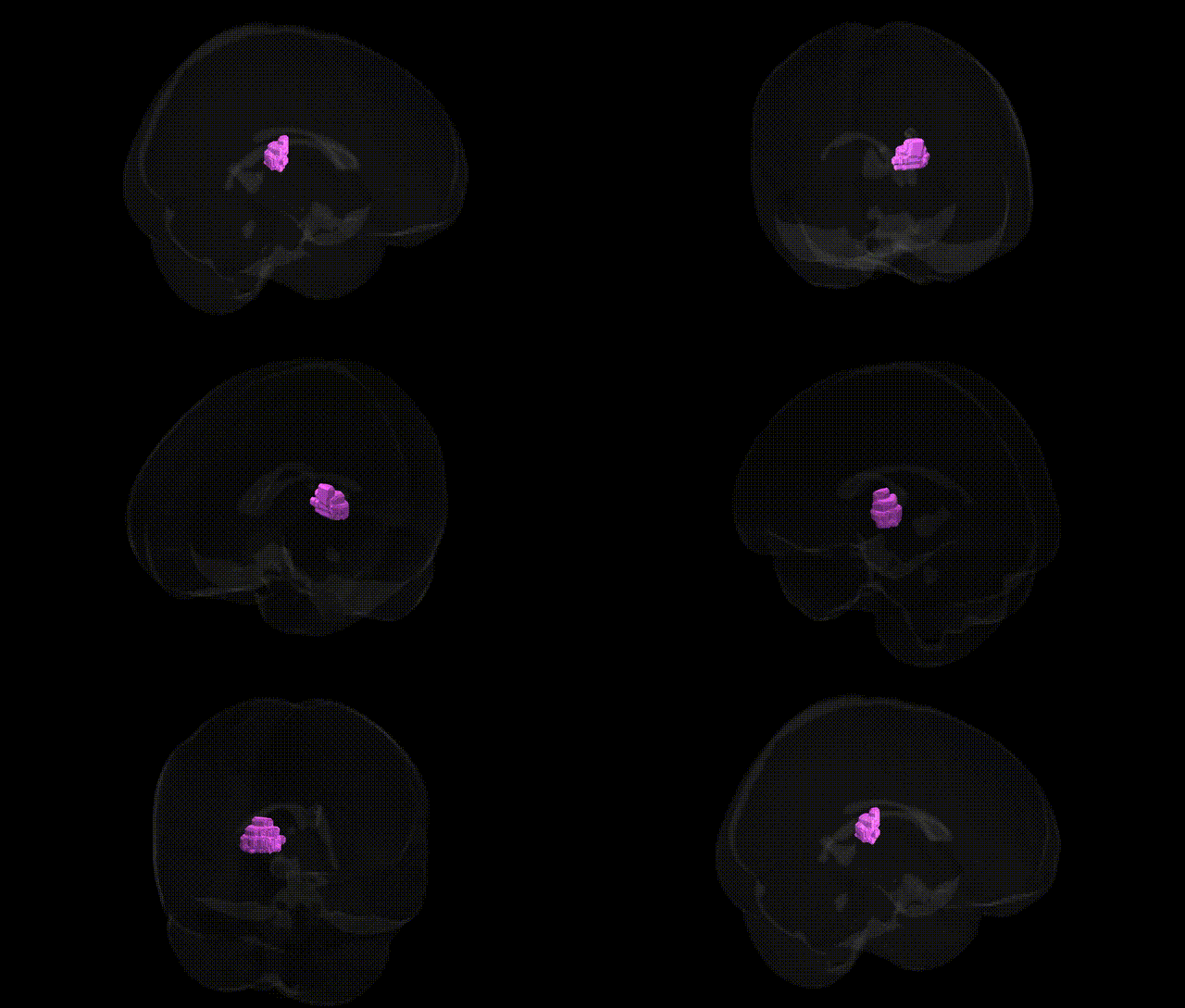
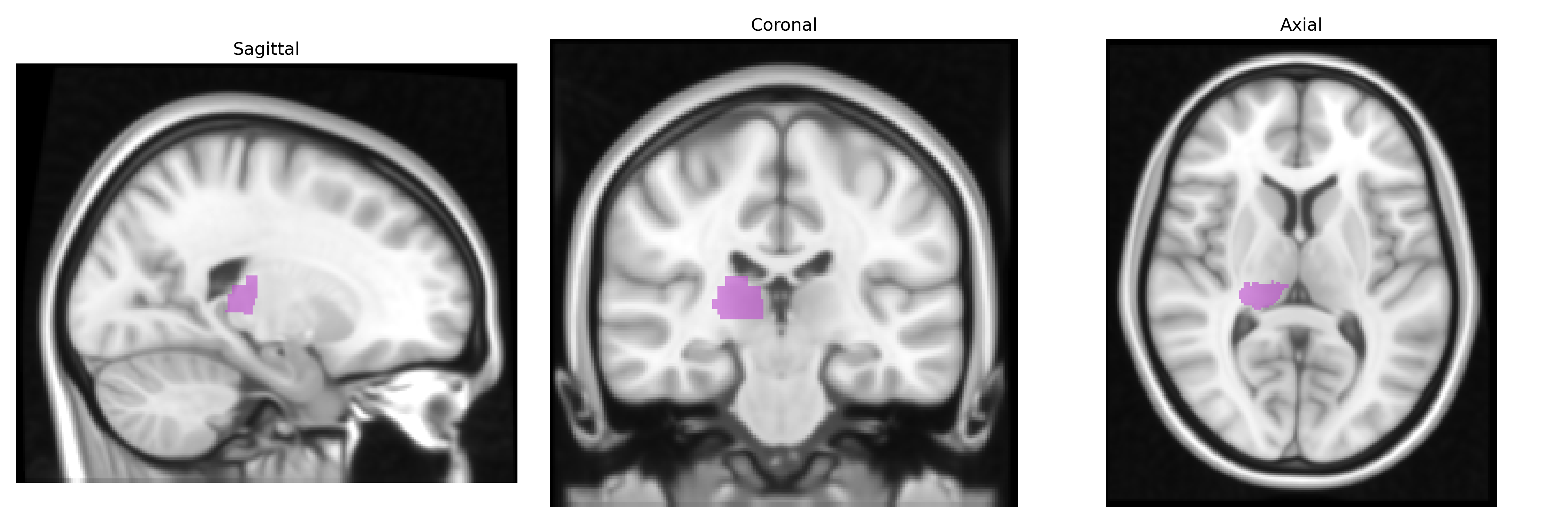
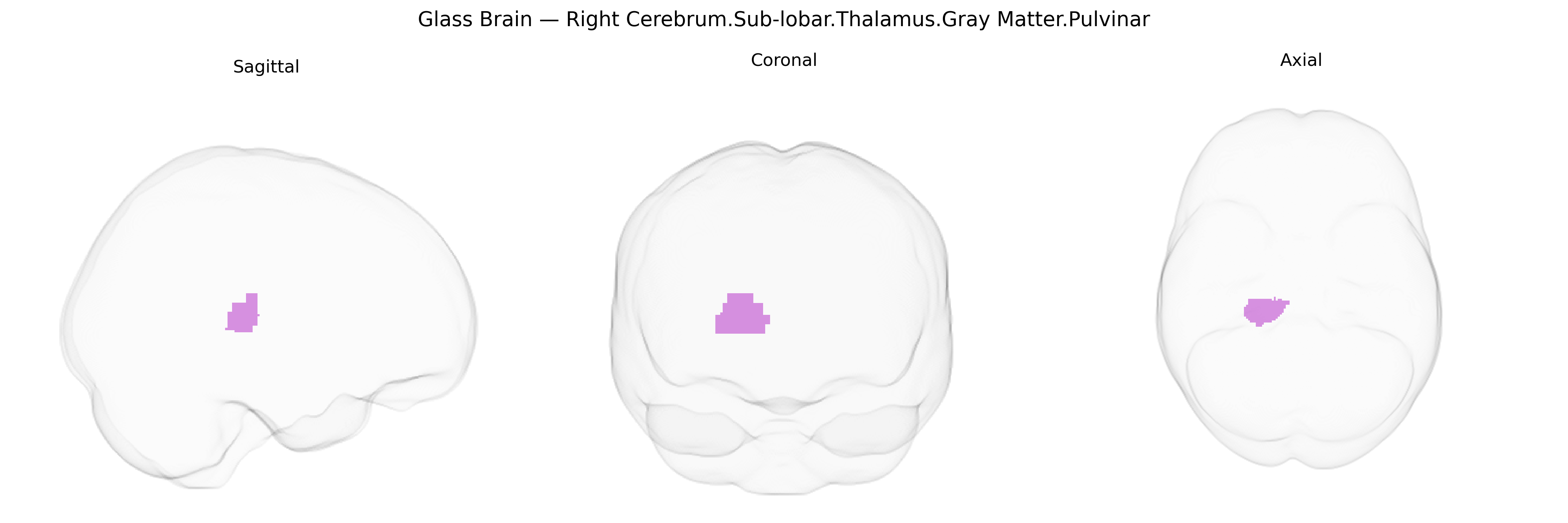
The bilateral Right Cerebrum.Sub-lobar.Thalamus.Gray Matter.Pulvinar corresponds to the pulvinar nucleus of the thalamus, a large posterior thalamic complex composed of multiple subnuclei that integrate and relay visual, multimodal sensory, and higher-order associative information. It is heavily interconnected with occipital, parietal, temporal, and frontal cortices, particularly regions involved in visual attention, spatial processing, and saccadic eye movements, and is thought to contribute to the coordination of attention, visual salience, and the integration of sensory inputs with cognitive context. The pulvinar also participates in cortico-thalamo-cortical loops that modulate information flow and synchrony between cortical areas, supporting functions such as orienting, filtering of distracting stimuli, and possibly aspects of conscious perception. Pulvinar nucleus
The pulvinar nucleus of the thalamus, as defined in the Talairach 1 mm atlas under Right Cerebrum.Sub-lobar.Thalamus.Gray Matter.Pulvinar (with largely symmetric bilateral correspondence), has been implicated in several genetic and genome-wide association study (GWAS) findings through its roles in visual attention, sensory integration, and higher-order cognitive and affective networks. Imaging–genetics and subcortical volumetric GWAS (e.g., ENIGMA, UK Biobank) have shown that thalamic and pulvinar volume, microstructure, and connectivity exhibit heritability and are associated with variants in genes involved in neurodevelopment, synaptic function, and myelination (such as those within MAPT, GRIN2B, and broader neurodevelopmental loci), though specific pulvinar-only hits are rare due to resolution and parcellation limits. Pulvinar alterations have been linked genetically and structurally to schizophrenia, autism spectrum disorder, major depressive disorder, ADHD, and anxiety-related traits, often via genes affecting thalamo–cortical circuits and glutamatergic or GABAergic signaling, while polygenic risk scores for these disorders correlate with thalamic (including pulvinar) volume and connectivity differences in large cohorts. GWAS of cognitive performance, educational attainment, sleep and circadian traits, and pain sensitivity have also implicated thalamic regions encompassing the pulvinar, highlighting genetic influences on attention, sensory processing, and arousal systems; however, most associations are reported at the level of the whole thalamus or posterior thalamic nuclei rather than the pulvinar label in isolation, and direct, pulvinar-specific genetic associations remain relatively coarse and inferred from broader thalamic or subcortical analyses.
Overview generated by GPT-4o (2026).
Region ID: 623
Hemisphere: bilateral
Atlas: Talairach labels 1mm
Full Quality Version: Download MP4
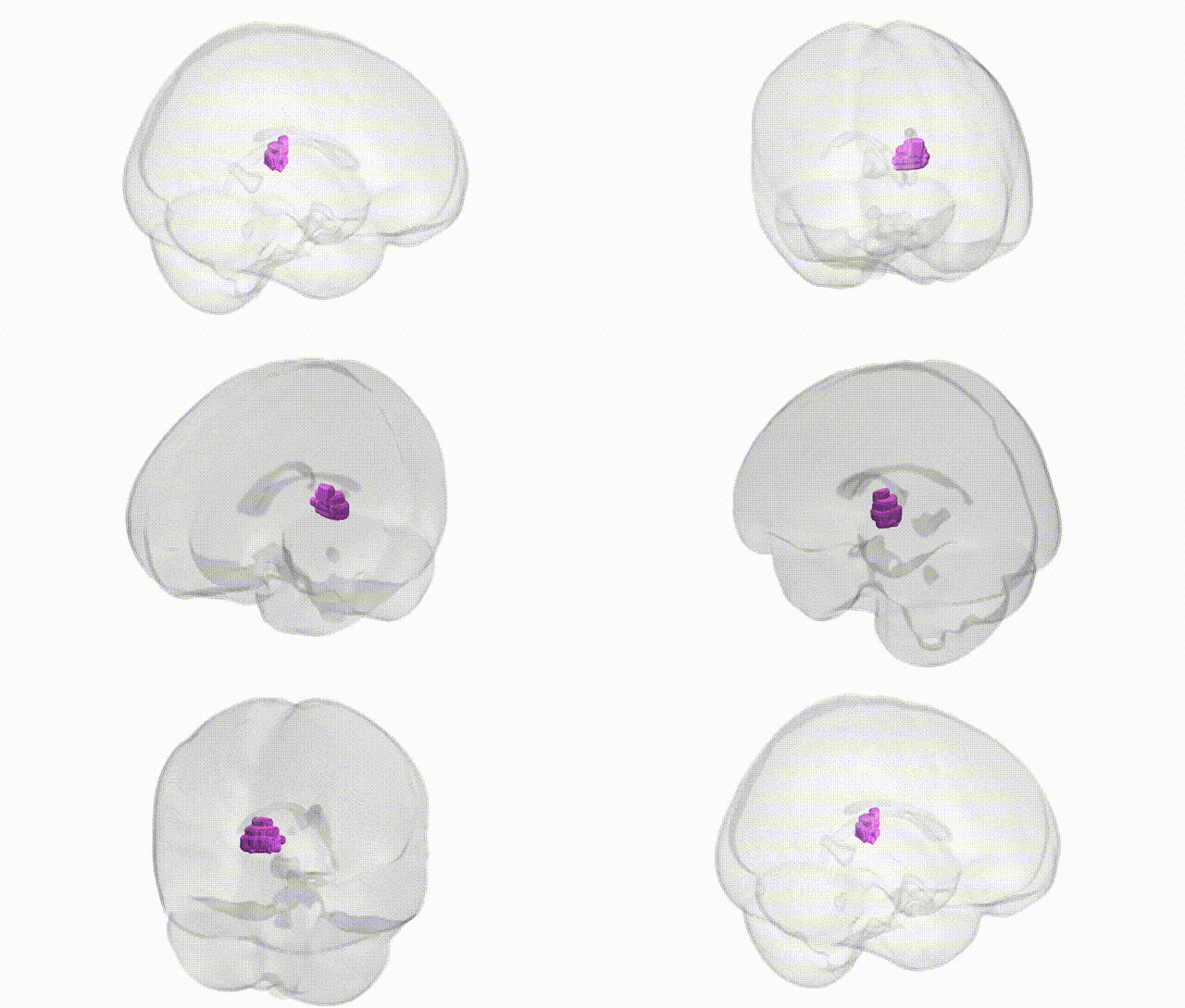
Full Quality Version: Download MP4
Wali Sidiqyar*, Gaurav Rudravaram*, Elyssa M. McMaster, Trent M. Schwartz, Adam M. Saunders, Kurt G. Schilling, Bennett A. Landman "Introducing SPINS: A Shared Public Visualization Library of Neuroanatomical Structures." Medical Imaging with Deep Learning- short paper
This resource is licensed under CC0 1.0 Universal (Public Domain).