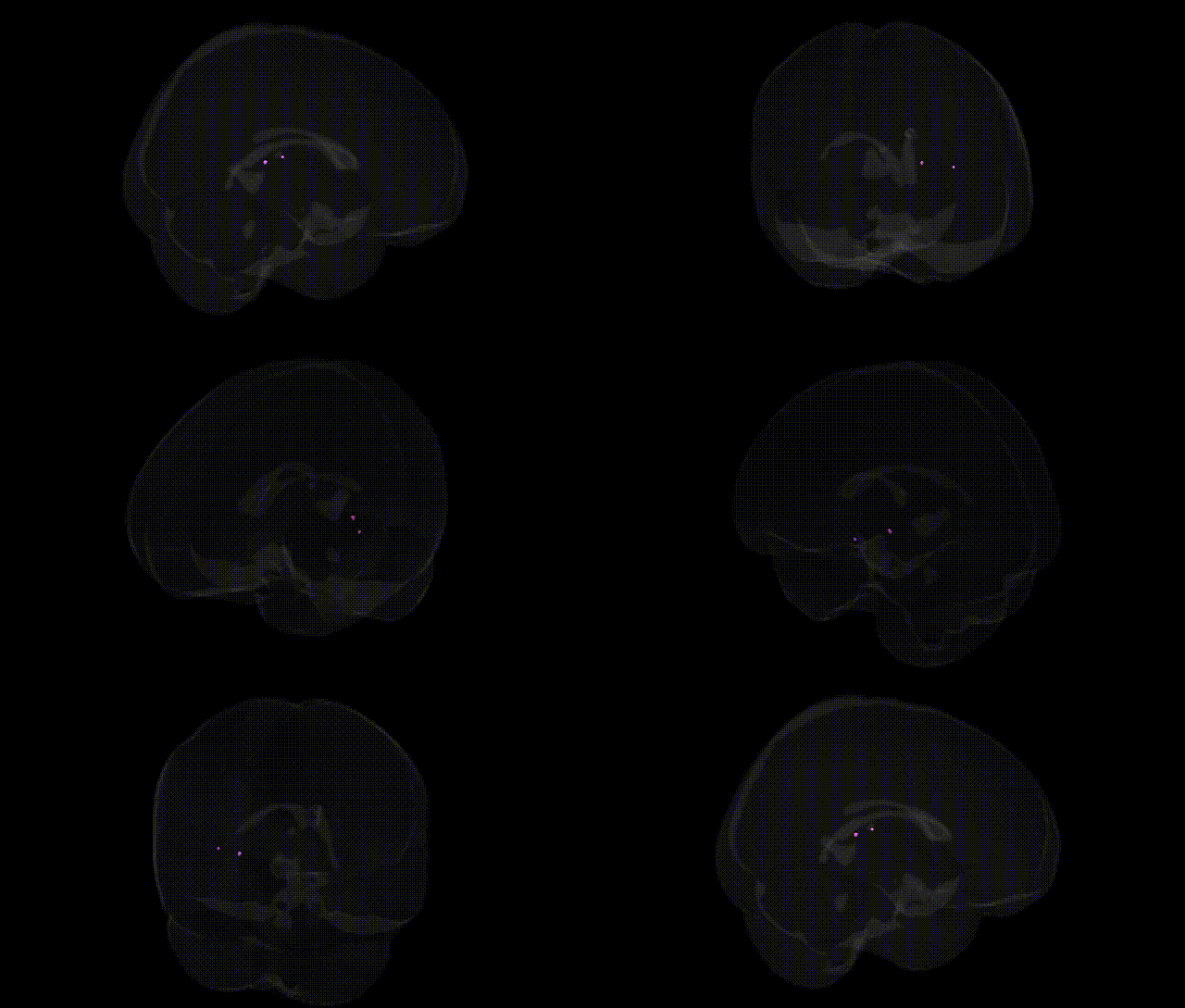
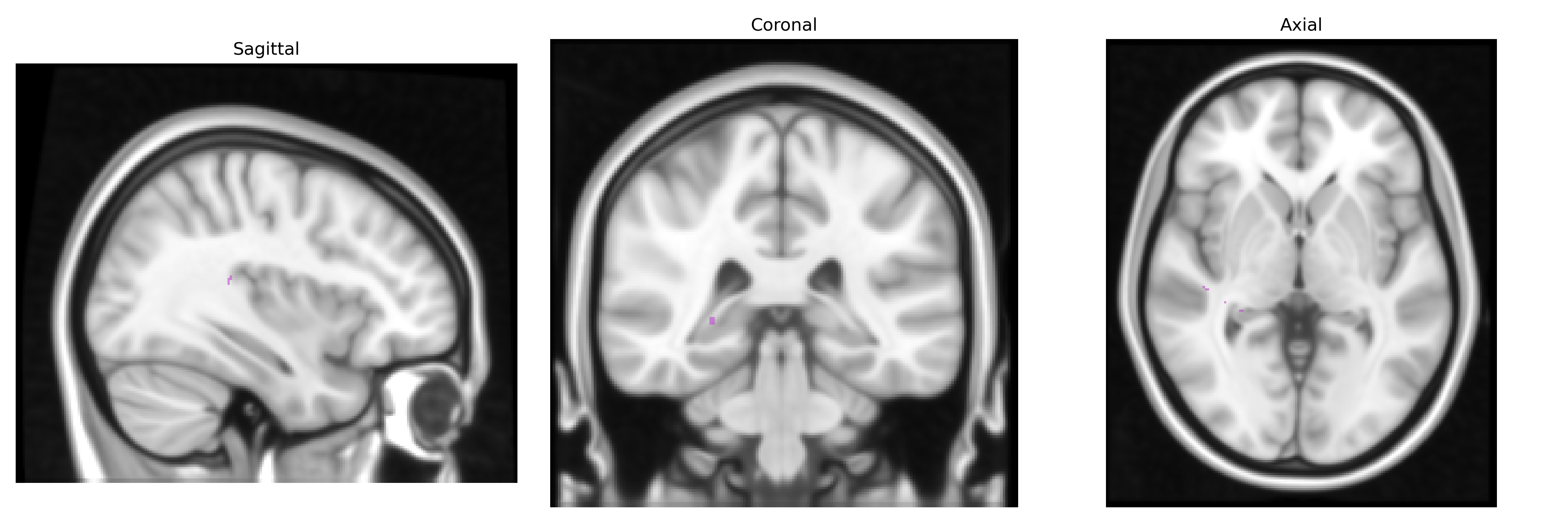
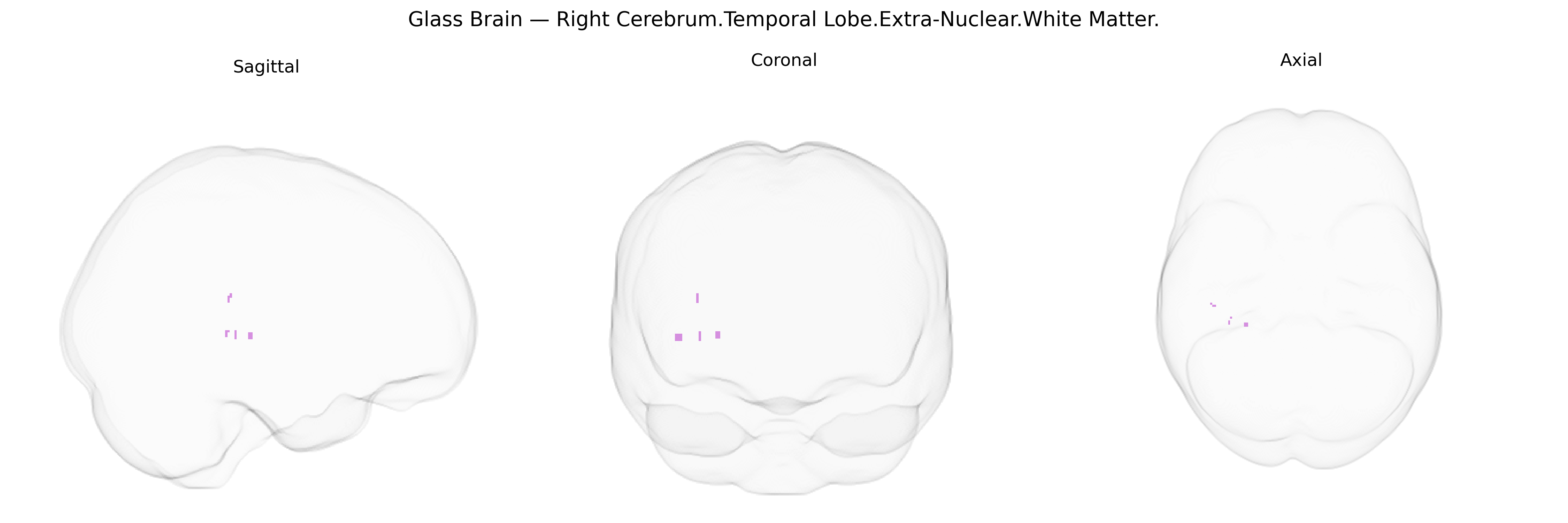
The bilateral Right Cerebrum.Temporal Lobe.Extra-Nuclear.White Matter region, as defined in the Talairach 1 mm Atlas, encompasses association and projection white matter tracts coursing through the right temporal lobe outside the nuclear (deep gray) structures, including fibers connecting temporal neocortex with frontal, parietal, limbic, and subcortical regions. These tracts include portions of major pathways such as the inferior longitudinal fasciculus, uncinate fasciculus, and inferior fronto-occipital fasciculus, which support functions like auditory and language processing, visual object recognition, memory, and multimodal integration by linking temporal cortical areas with hippocampal, amygdalar, and frontal networks. As “extra-nuclear white matter” refers broadly to subcortical myelinated fibers rather than a single discrete structure, there is no direct Wikipedia article; a related entry describing the overarching anatomical region is Temporal lobe.
The bilateral right temporal extra-nuclear white matter (periventricular and deep temporal association fibers) has been implicated indirectly in genetic studies that examine white-matter microstructure rather than this precise Talairach label, with diffusion tensor imaging (DTI) GWAS and imaging–genetics consortia (e.g., ENIGMA, UK Biobank) showing that common variants in genes involved in myelination and axon integrity—such as those in pathways including myelin basic protein (MBP), neuregulin/ErbB signaling, and oligodendrocyte function—contribute to interindividual differences in temporal-lobe white-matter integrity. Polygenic risk scores for schizophrenia, bipolar disorder, and major depression show associations with reduced fractional anisotropy and altered connectivity in right temporal and periventricular white matter, consistent with broader distributed network effects rather than a region-specific locus. Rare copy number variants (e.g., 22q11.2 deletions) and mutations in neurodevelopmental genes (such as DISC1 and NRG1 pathway genes) have been associated with temporal white-matter abnormalities in schizophrenia and related psychotic disorders, while Alzheimer’s disease and frontotemporal dementia risk alleles (including APOE ε4 and MAPT haplotypes) relate to white-matter degeneration that prominently involves temporal associative fibers. Large-scale GWAS of white-matter hyperintensities and small vessel disease (e.g., implicating genes like COL4A1/2 and HTRA1) also highlight genetic susceptibility to microvascular pathology in periventricular and deep white matter, which encompasses the temporal extra-nuclear region, linking this area to vascular cognitive impairment, stroke risk, and age-related decline in network connectivity.
Overview generated by GPT-4o (2026).
Region ID: 573
Hemisphere: bilateral
Atlas: Talairach labels 1mm
Full Quality Version: Download MP4
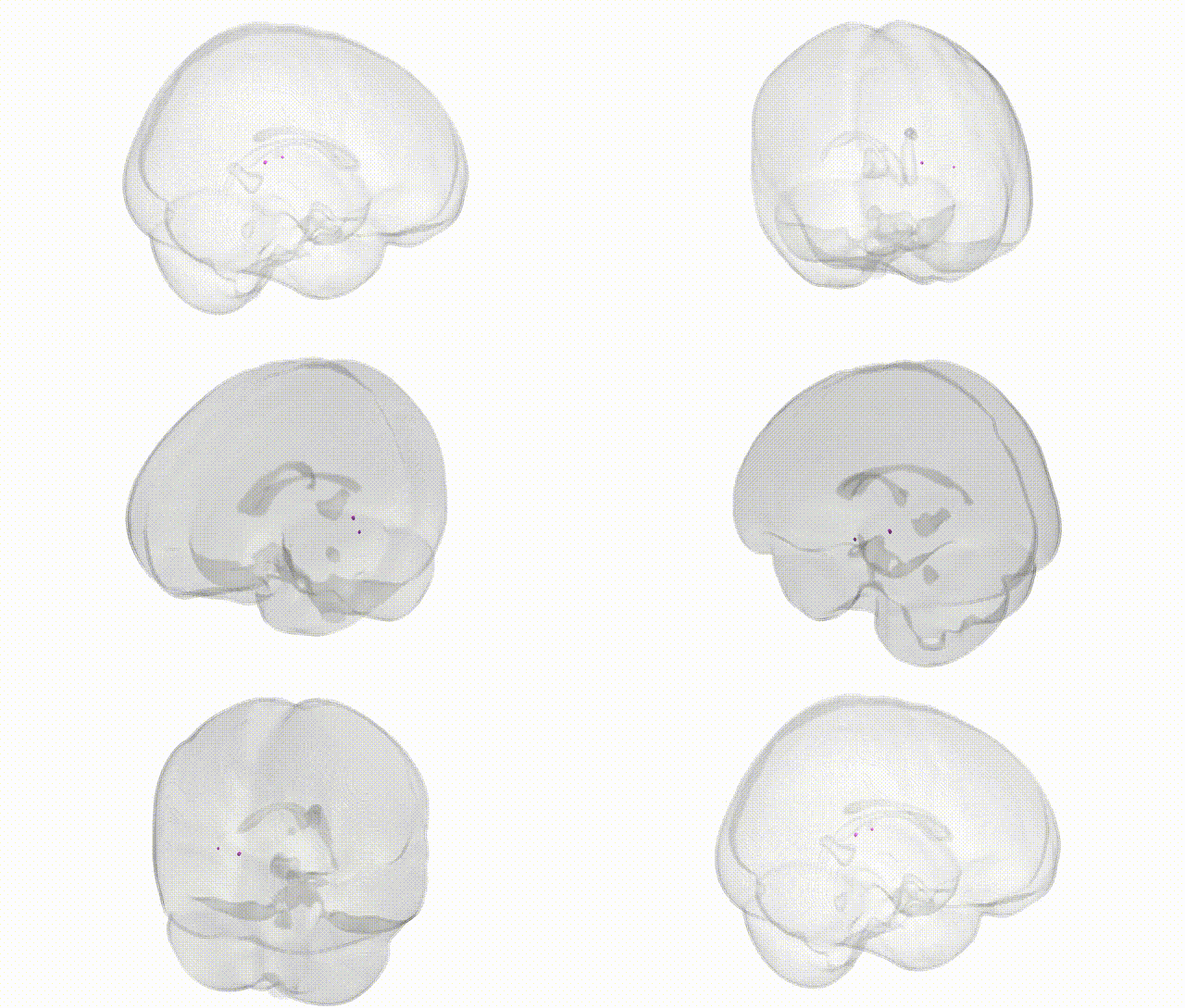
Full Quality Version: Download MP4
Wali Sidiqyar*, Gaurav Rudravaram*, Elyssa M. McMaster, Trent M. Schwartz, Adam M. Saunders, Kurt G. Schilling, Bennett A. Landman "Introducing SPINS: A Shared Public Visualization Library of Neuroanatomical Structures." Medical Imaging with Deep Learning- short paper
This resource is licensed under CC0 1.0 Universal (Public Domain).