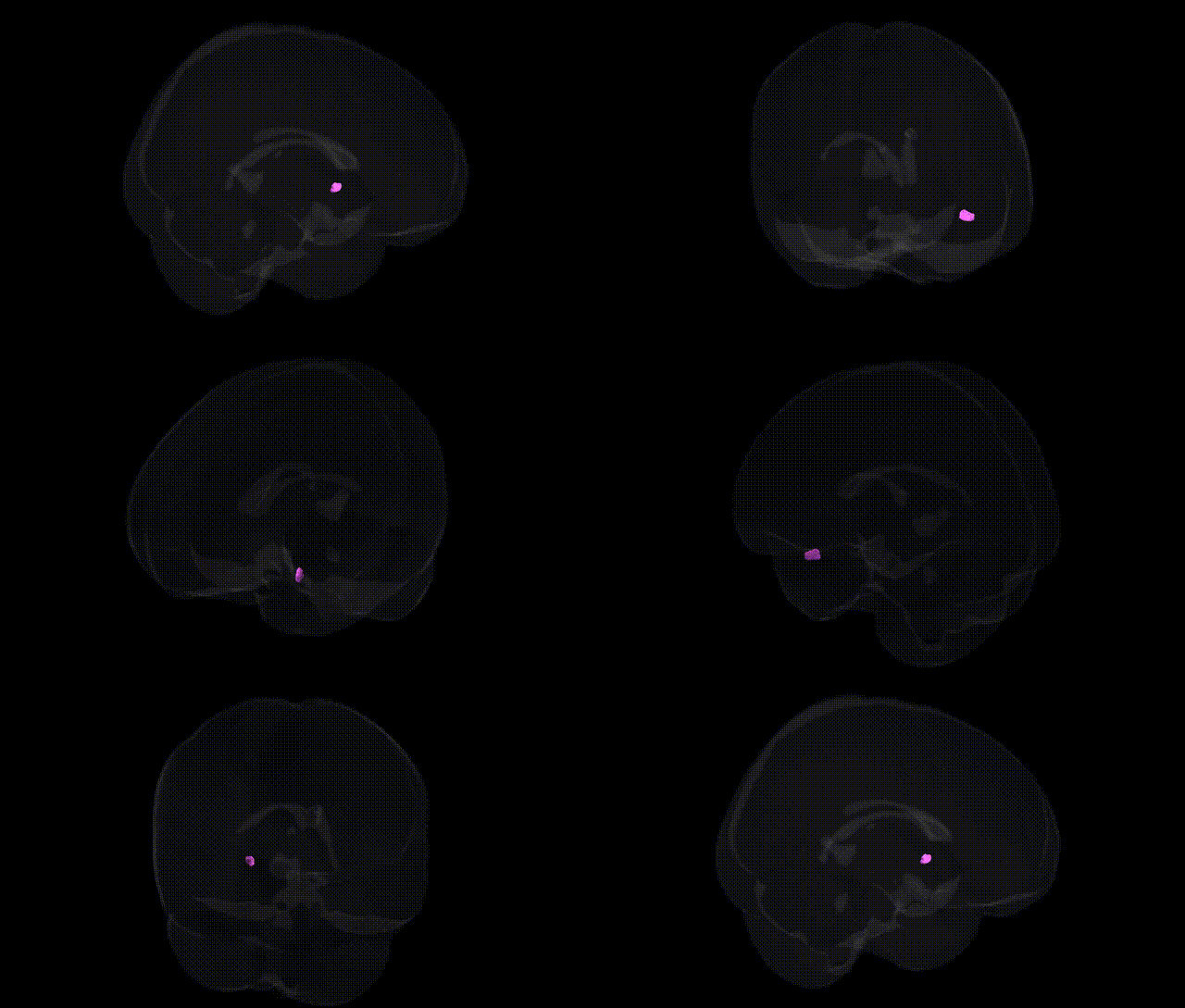
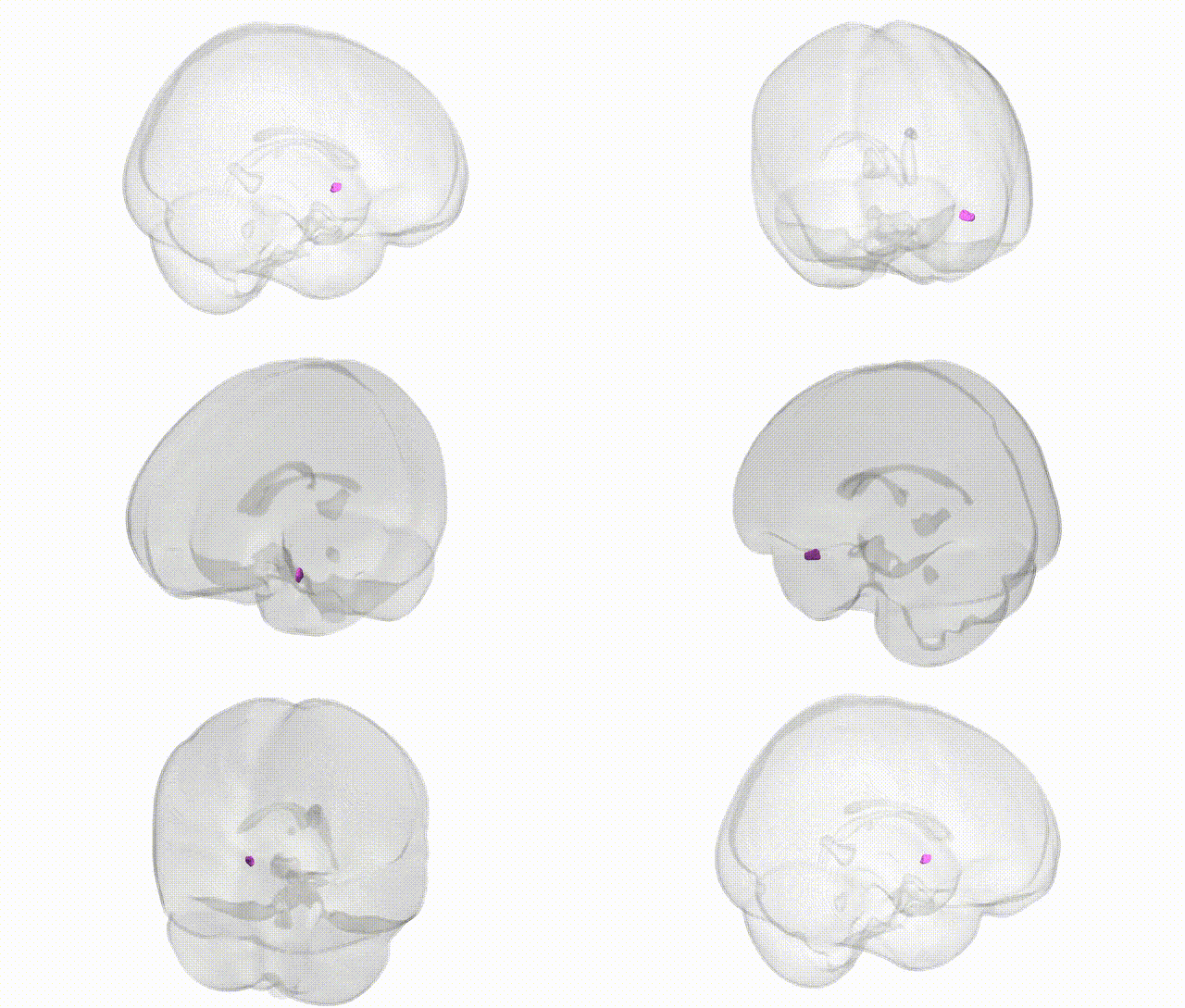
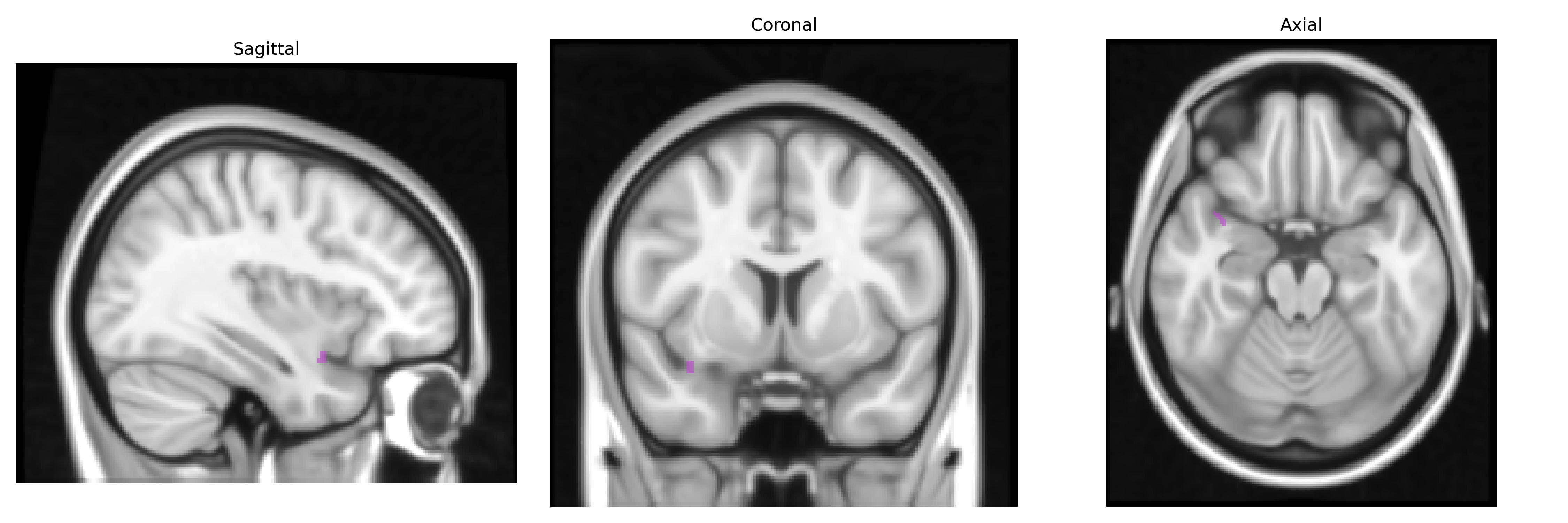
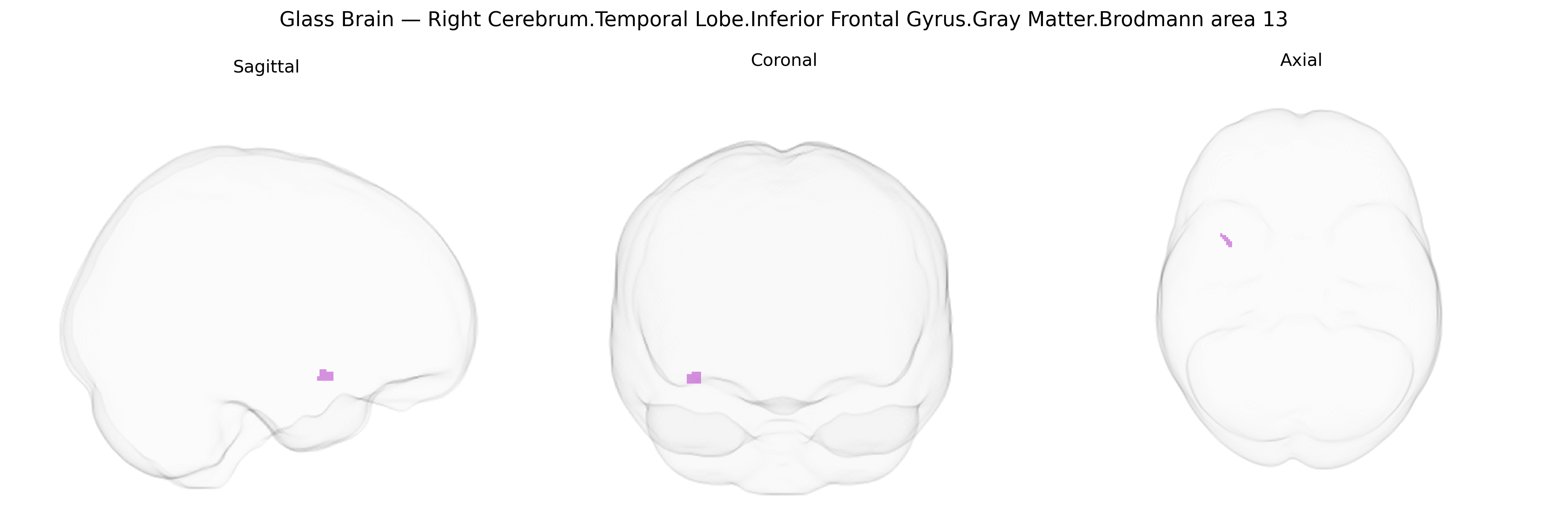
The bilateral Right Cerebrum.Temporal Lobe.Inferior Frontal Gyrus.Gray Matter.Brodmann area 13 corresponds primarily to the insular cortex region classified by Korbinian Brodmann as area 13, a granular to dysgranular cortical field buried within the lateral sulcus and structurally associated with both the inferior frontal gyrus and adjacent temporal lobe opercular regions in the Talairach 1 mm atlas. Brodmann area 13 forms part of the insula and is implicated in multimodal integration of visceral, somatosensory, and affective signals, including roles in interoception, autonomic regulation, emotional processing, and aspects of decision-making and awareness of bodily states. Cytoarchitectonically, it exhibits a layered neocortical organization with specialized connectivity to limbic, frontal, and temporal association areas, supporting participation in salience detection and integration of internal and external sensory information. There is no direct Wikipedia article specifically for Brodmann area 13 in this context; a related structure is the Insular cortex.
The bilateral right cerebrum temporal lobe / inferior frontal gyrus gray matter region approximated by Brodmann area 13 (often mapped to anterior insula / ventral frontal-opercular cortex in Talairach-based atlases) has been implicated in several genetically informed studies, though typically as part of broader networks rather than in highly focal, region-specific GWAS signals. Imaging–genetics and GWAS meta-analyses of cortical thickness, surface area, and gray-matter volume (e.g., ENIGMA, UK Biobank) have reported associations between variants in genes related to neurodevelopment and synaptic function—such as MIR137, GRIN2A, TCF4, and multiple loci in 3p21, 6p22, and 17q21—and structural variation in anterior insula/inferior frontal–temporal regions that include BA13-like territory. Polygenic risk for schizophrenia, bipolar disorder, major depression, and autism spectrum disorder has been associated with altered volume or thickness in this ventral frontal–temporal/insular region, consistent with its role in salience, interoception, and affective regulation. GWAS of traits such as risk-taking, anxiety, and pain sensitivity, as well as alcohol and nicotine use, have also reported that polygenic scores and specific loci (for example, in CADM2, DRD2, and OPRM1 regions) correlate with gray-matter measures and functional activation in BA13-adjacent insular–inferior frontal areas, linking genetic variation to reward, interoceptive, and emotional-processing functions subserved by this region.
Overview generated by GPT-4o (2026).
Region ID: 292
Hemisphere: bilateral
Atlas: Talairach labels 1mm
Full Quality Version: Download MP4
Full Quality Version: Download MP4
Wali Sidiqyar*, Gaurav Rudravaram*, Elyssa M. McMaster, Trent M. Schwartz, Adam M. Saunders, Kurt G. Schilling, Bennett A. Landman "Introducing SPINS: A Shared Public Visualization Library of Neuroanatomical Structures." Medical Imaging with Deep Learning- short paper
This resource is licensed under CC0 1.0 Universal (Public Domain).