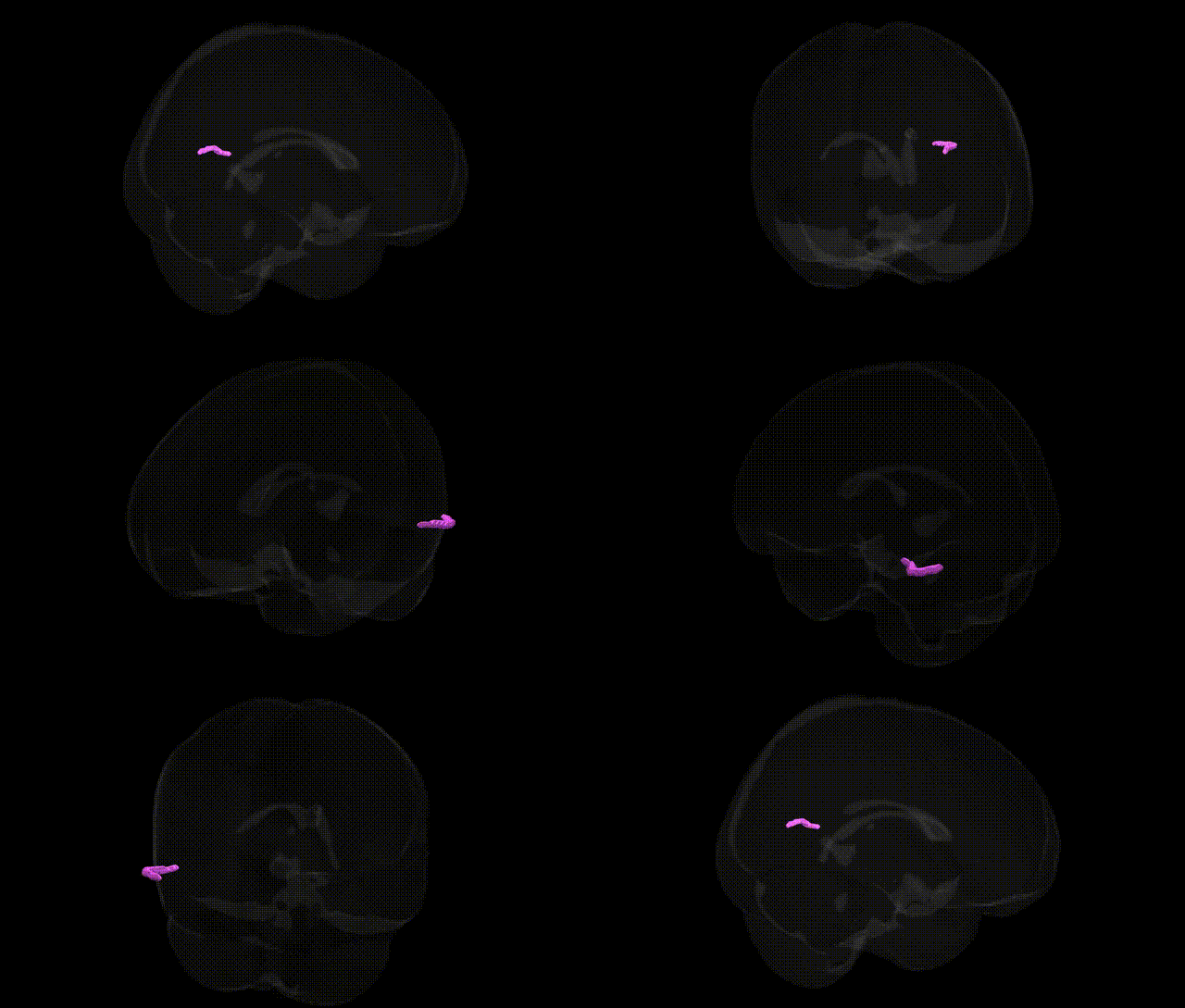
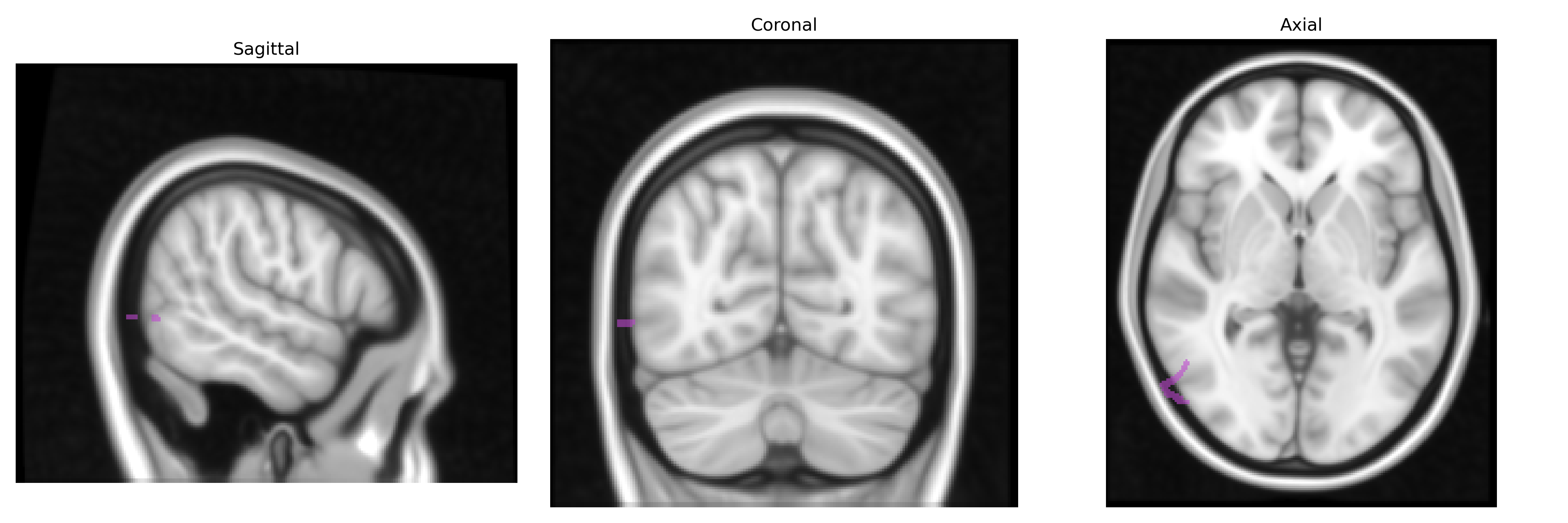
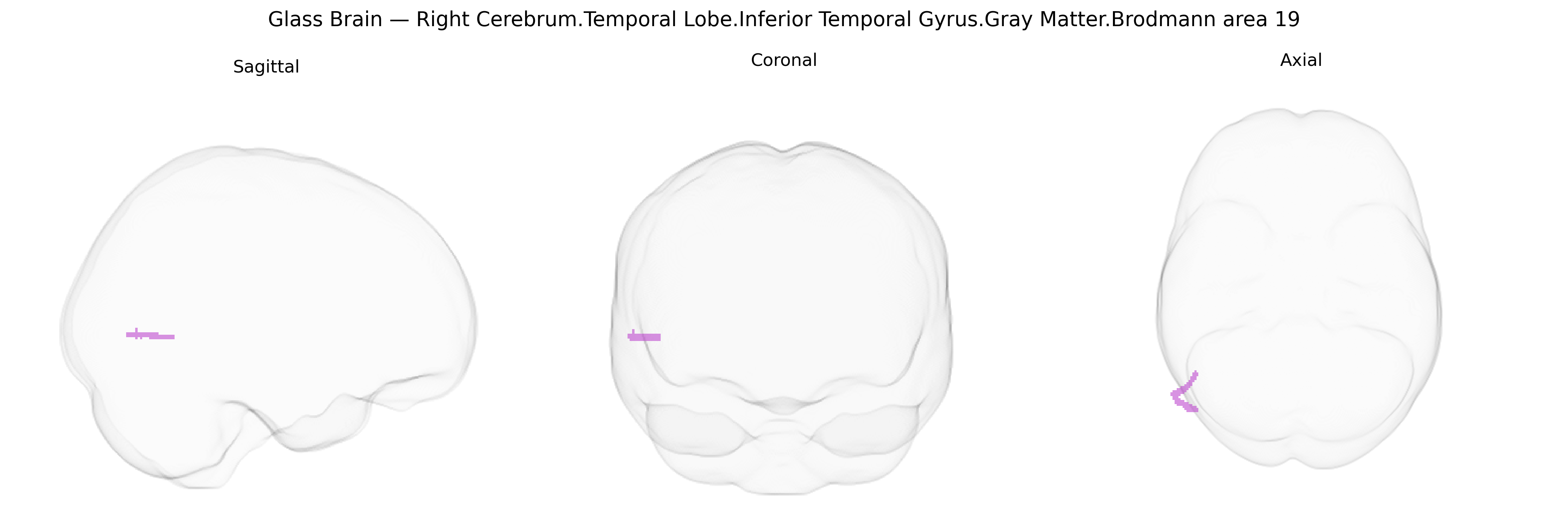
The bilateral Right Cerebrum.Temporal Lobe.Inferior Temporal Gyrus.Gray Matter.Brodmann area 19 corresponds to higher-order visual association cortex located at the junction of the occipital and temporal regions, participating in complex processing of visual information beyond primary and secondary visual areas. As part of the ventral visual stream, this region is involved in object recognition, shape and form analysis, and integration of visual features with stored representations, contributing to perception of complex stimuli such as faces, objects, and scenes. Its position in the inferior temporal gyrus links it functionally to multimodal association networks that connect visual inputs with memory and semantic information. There is no direct link for this exact composite label; a related area is Brodmann area 19.
The bilateral right temporal lobe inferior temporal gyrus gray matter corresponding to Brodmann area 19 (a higher-order visual association region overlapping ventral occipitotemporal cortex) has been implicated in multiple genetically influenced traits by imaging-genetics and GWAS-based neuroimaging studies, though few findings target this exact Talairach-defined parcel in isolation. Variants in genes affecting synaptic plasticity, axonal guidance, and neurodevelopment—such as BDNF, NRG1, DISC1, and CNTNAP2—have been associated with structural or functional alterations in adjacent ventral temporal and occipitotemporal regions implicated in object and face processing. Large-scale GWAS of cortical thickness and surface area (e.g., ENIGMA consortium studies) have reported significant SNP heritability and locus-specific associations for temporal and occipital association cortices that encompass BA19, linking common variants in genes involved in neuronal migration, myelination, and glutamatergic signaling to interindividual differences in gray matter morphology. Genetic risk for neuropsychiatric and neurodevelopmental disorders—including schizophrenia, autism spectrum disorder, major depressive disorder, and Alzheimer’s disease—has been associated with altered structure, connectivity, or activation in inferior and lateral temporal association areas overlapping BA19, with polygenic risk scores for these conditions correlating with temporal lobe cortical thickness and volume in several cohorts. Additionally, GWAS of cognitive traits such as general intelligence, reading ability, and visual recognition memory indicate that polygenic influences on these abilities partly act through variation in ventral temporal and occipital association cortex, including BA19, although specific causal genes and mechanisms for this precise right inferior temporal BA19 region remain incompletely resolved.
Overview generated by GPT-4o (2026).
Region ID: 480
Hemisphere: bilateral
Atlas: Talairach labels 1mm
Full Quality Version: Download MP4
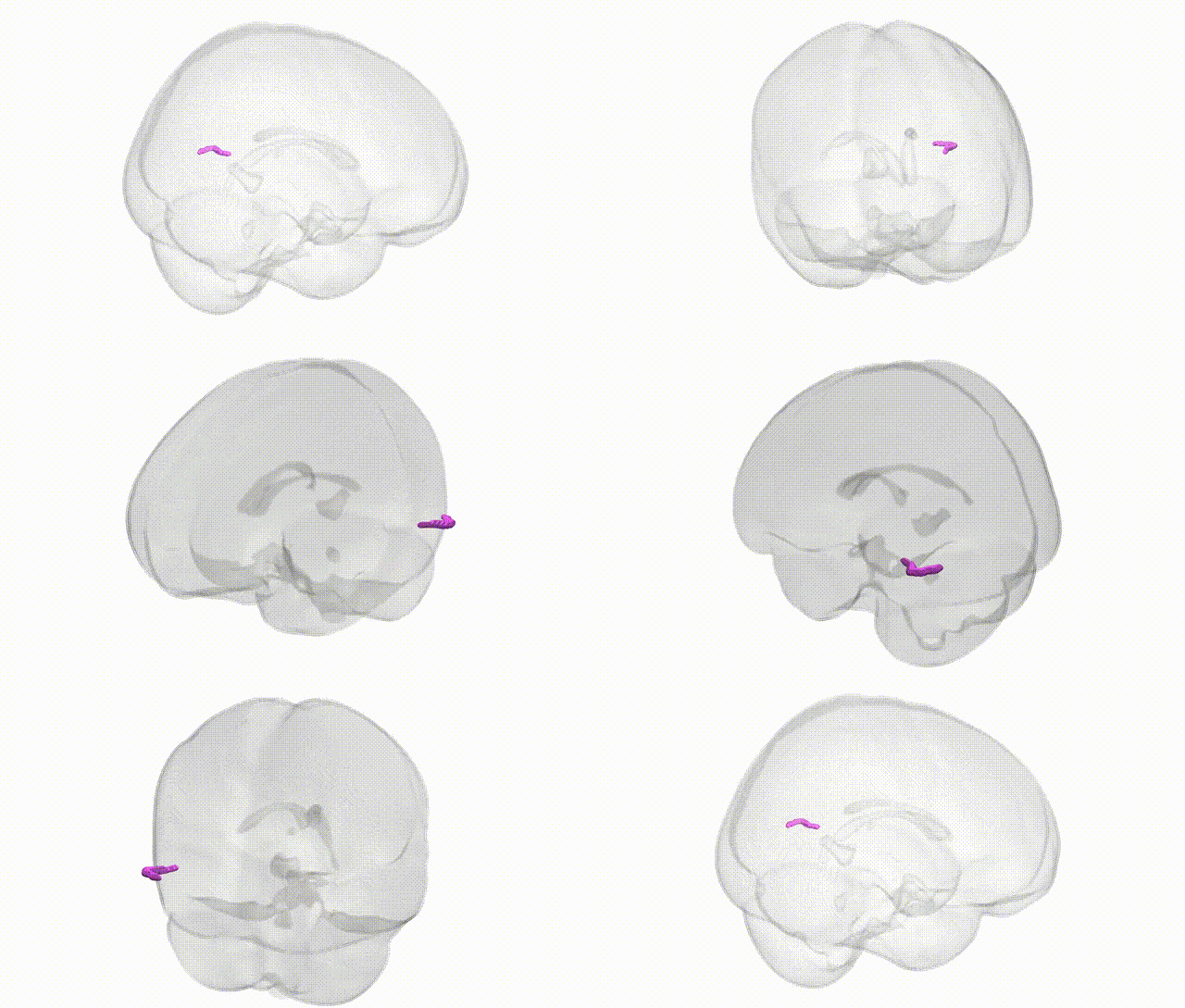
Full Quality Version: Download MP4
Wali Sidiqyar*, Gaurav Rudravaram*, Elyssa M. McMaster, Trent M. Schwartz, Adam M. Saunders, Kurt G. Schilling, Bennett A. Landman "Introducing SPINS: A Shared Public Visualization Library of Neuroanatomical Structures." Medical Imaging with Deep Learning- short paper
This resource is licensed under CC0 1.0 Universal (Public Domain).