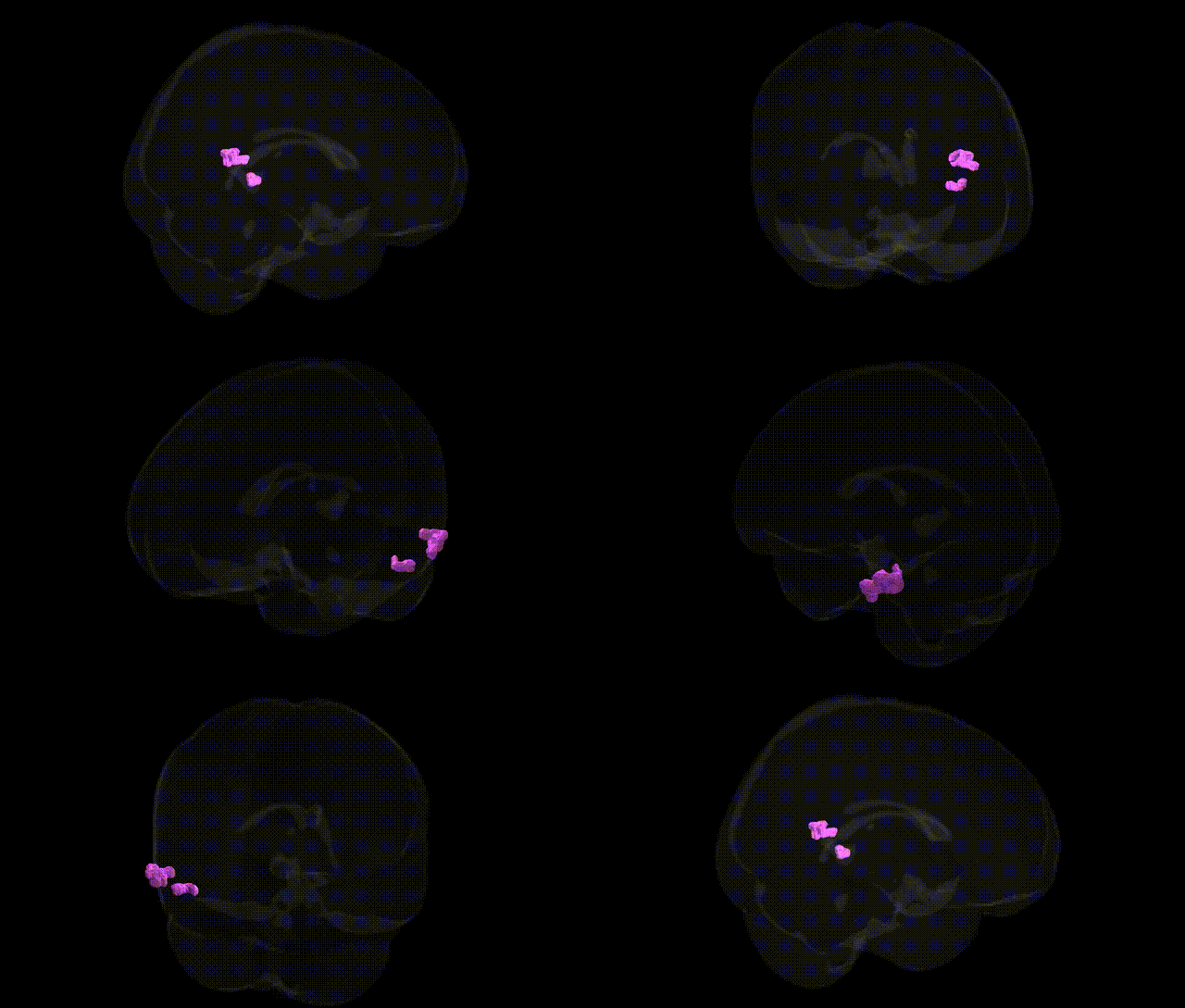
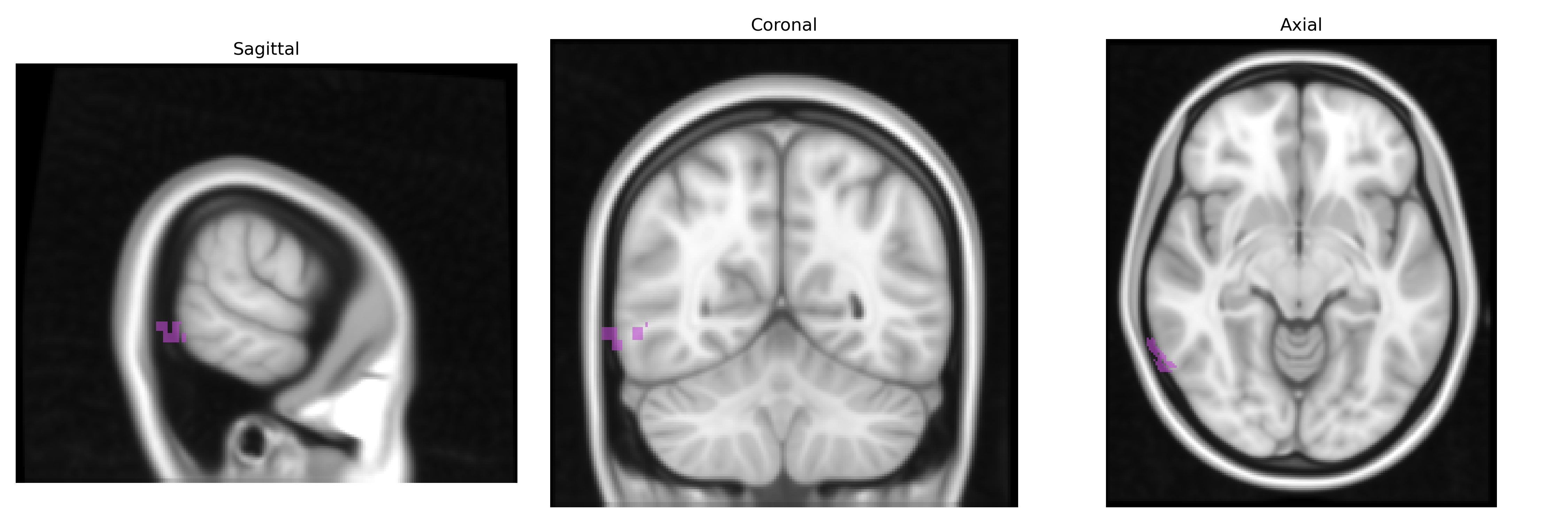
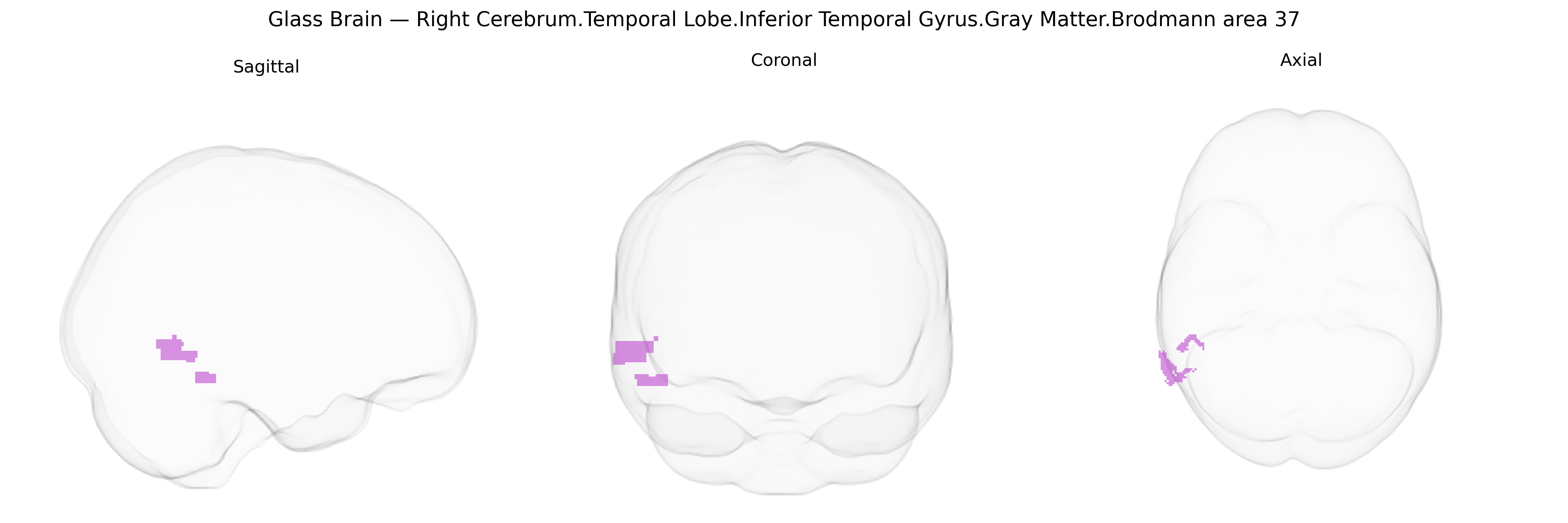
The bilateral Right Cerebrum.Temporal Lobe.Inferior Temporal Gyrus.Gray Matter.Brodmann area 37 corresponds primarily to the fusiform and adjacent portions of the inferior temporal cortex, located on the ventral surface of the temporal lobe near the occipitotemporal junction. Brodmann area 37 is implicated in high-level visual processing, including object and face recognition, reading, and the integration of visual stimuli with semantic memory, and it forms part of the ventral “what” visual pathway. Neuronal populations in this region exhibit category-selective responses (e.g., to faces, words, or complex objects) and participate in multimodal associations by receiving convergent input from visual, auditory, and limbic structures. Functionally, BA37 is linked to the fusiform gyrus (including regions such as the fusiform face area and visual word form area) and shows strong connectivity with occipital visual cortices, other temporal association areas, and prefrontal regions that support recognition, language, and memory processes. Brodmann area 37
Brodmann area 37 (inferior temporal gyrus, bilateral, within the right cerebrum temporal lobe gray matter) is a key part of the ventral visual stream and fusiform/inferior temporal complex, and genetic associations identified through GWAS and imaging-genetics point to roles in higher-order visual recognition, language, and social cognition. Polygenic influences involving synaptic, neurodevelopmental, and axon-guidance genes (for example, variants in CNTNAP2, NRGN, DCC, and others) have been linked to structural variation in inferior temporal and fusiform regions, including surface area and cortical thickness, with large consortia such as ENIGMA and UK Biobank implicating widespread common variants across the genome in temporal lobe morphology. Genetic risk loci for autism spectrum disorder and schizophrenia frequently converge on networks that include BA37/fusiform regions, consistent with altered face and object processing and social perception in these disorders, while dyslexia- and language-related genes (such as KIAA0319, DCDC2, and FOXP2-pathway genes) have been associated with activation and structural differences in temporo-occipital language–visual integration areas overlapping BA37. GWAS of facial recognition ability and prosopagnosia, as well as traits like reading performance and semantic processing, often highlight inferior temporal and fusiform circuitry as intermediate neural phenotypes, and common variants in pathways affecting synaptic plasticity (e.g., BDNF-related signaling) modulate functional responses in BA37 during visual and mnemonic tasks. Together, these findings suggest that BA37’s structure and function are influenced by distributed polygenic architectures that underpin vulnerability to neurodevelopmental and psychiatric disorders, as well as individual variability in face processing, object recognition, reading, and semantic cognition.
Overview generated by GPT-4o (2026).
Region ID: 214
Hemisphere: bilateral
Atlas: Talairach labels 1mm
Full Quality Version: Download MP4
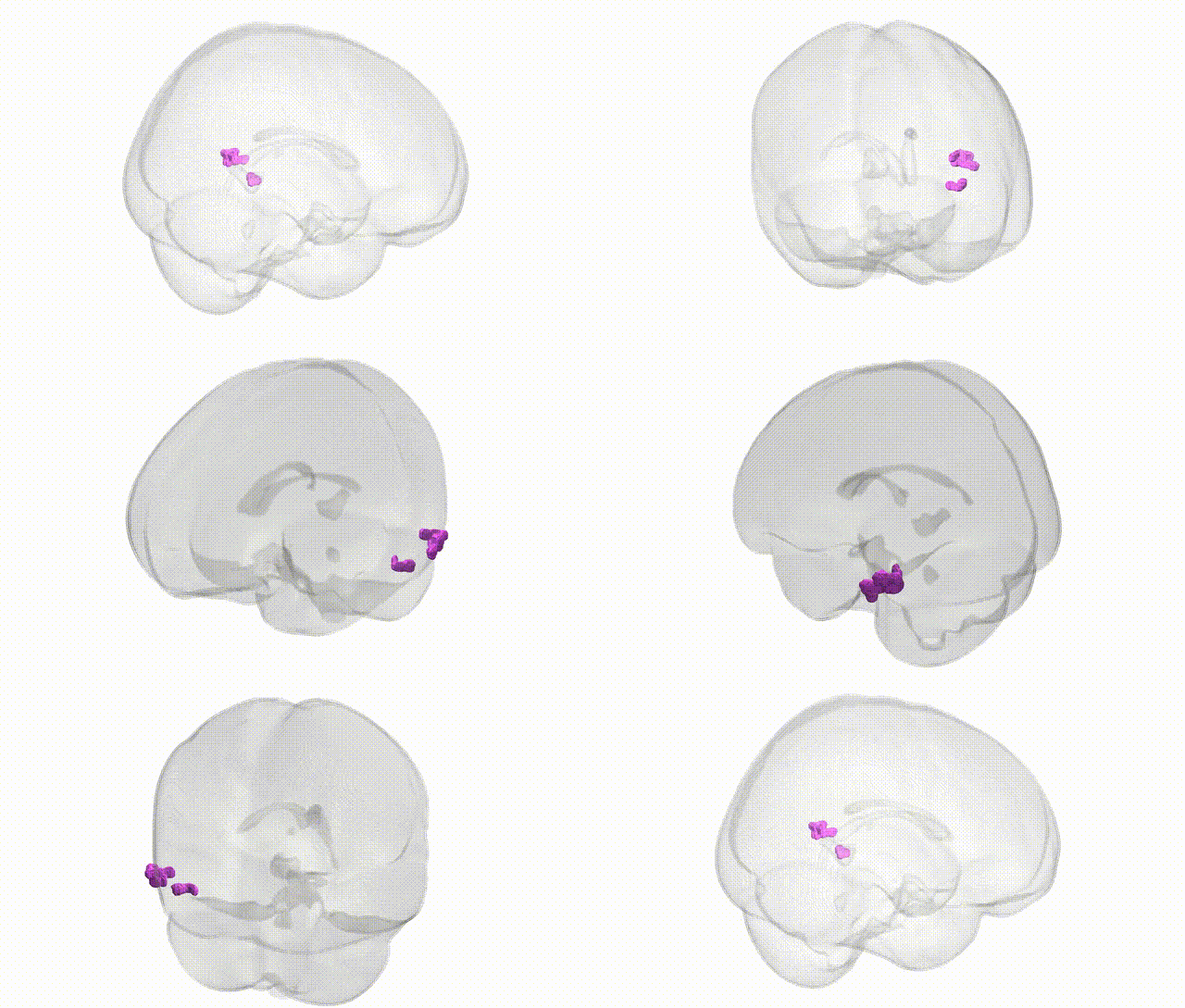
Full Quality Version: Download MP4
Wali Sidiqyar*, Gaurav Rudravaram*, Elyssa M. McMaster, Trent M. Schwartz, Adam M. Saunders, Kurt G. Schilling, Bennett A. Landman "Introducing SPINS: A Shared Public Visualization Library of Neuroanatomical Structures." Medical Imaging with Deep Learning- short paper
This resource is licensed under CC0 1.0 Universal (Public Domain).