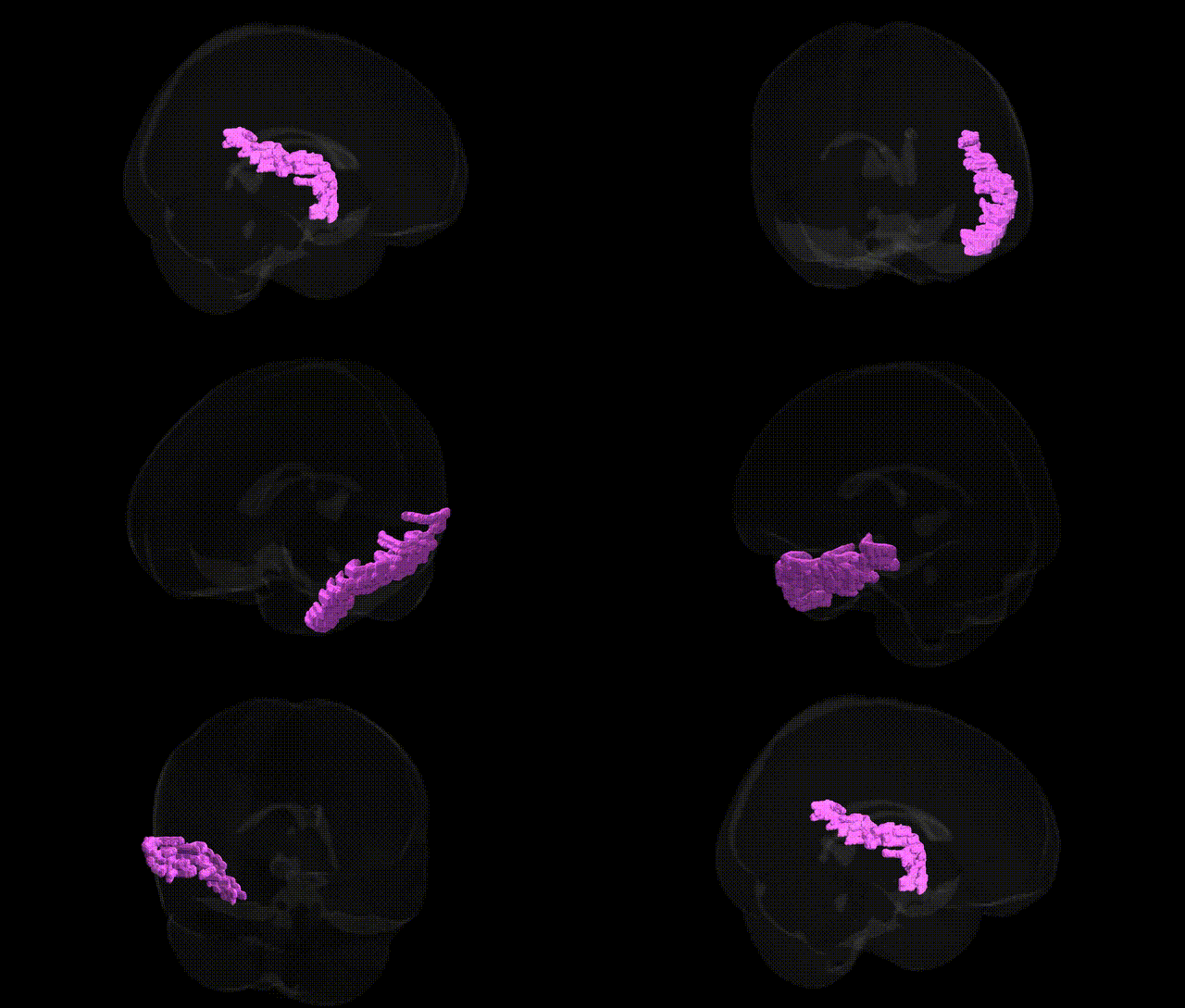
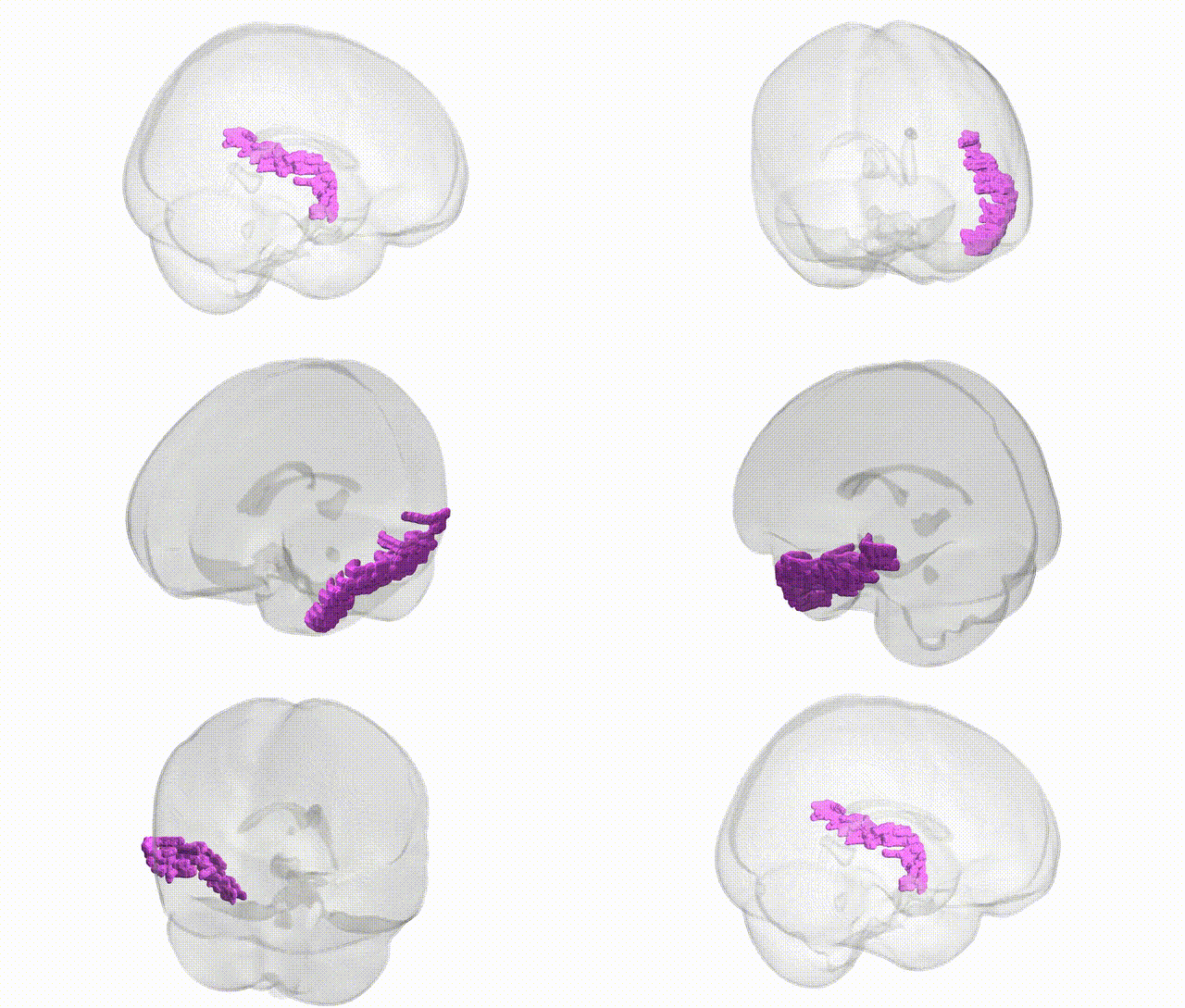
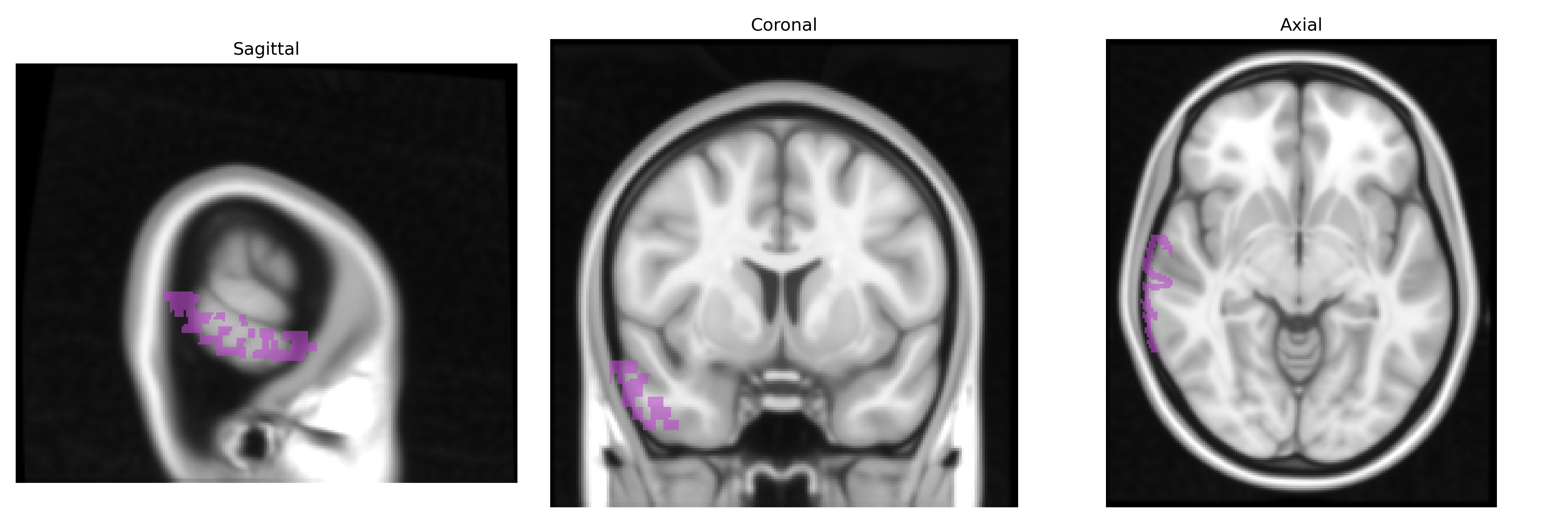
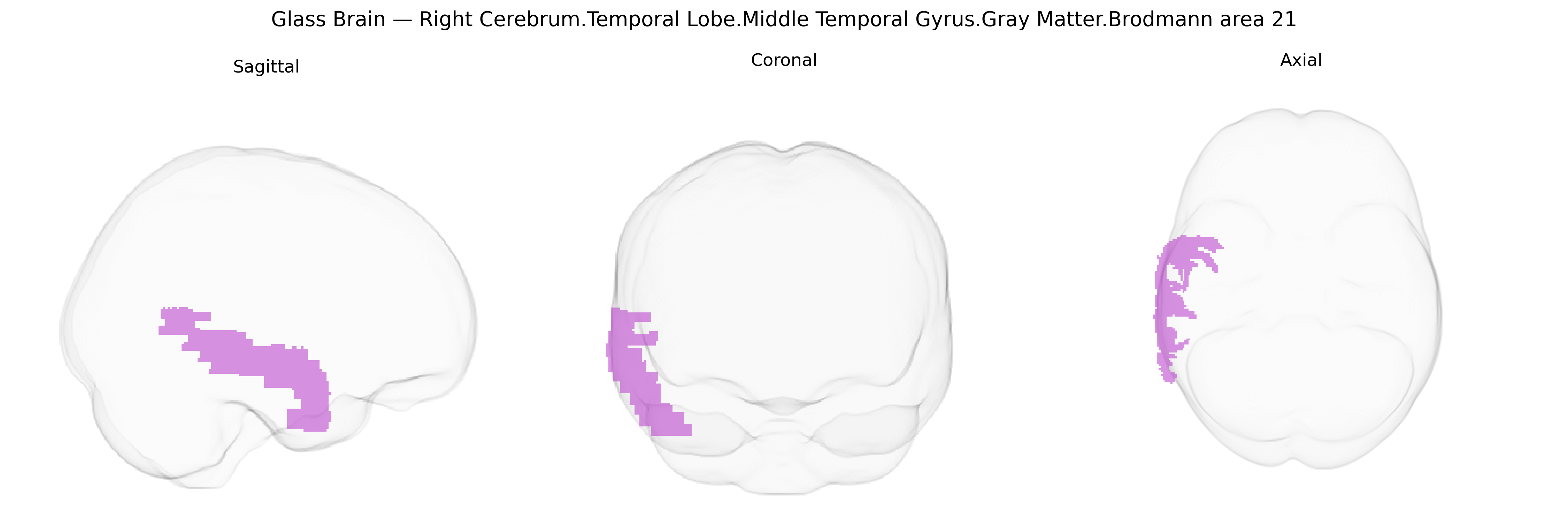
The bilateral Right Cerebrum.Temporal Lobe.Middle Temporal Gyrus.Gray Matter.Brodmann area 21 corresponds to a cytoarchitectonically defined region of association cortex located on the lateral aspect of the middle temporal gyrus, within the temporal lobe of the right cerebral hemisphere, and mapped in the Talairach 1 mm atlas as gray matter belonging to Brodmann area 21. This region is implicated in higher-order auditory and language processing, including semantic processing, lexical access, and aspects of sentence-level comprehension, as well as in multimodal integration of visual and auditory information and participation in social cognition networks. Neuronal architecture is characterized by a well-developed granular layer and prominent pyramidal neurons in layers III and V, typical of association cortex, and it maintains dense reciprocal connections with adjacent temporal regions (e.g., superior and inferior temporal gyri), inferior parietal lobule, and prefrontal cortices. There is no direct link for this exact Talairach-defined label; a related structure encompassing this region is the Middle temporal gyrus.
The bilateral middle temporal gyrus (MTG; Brodmann area 21) has been implicated in multiple genetic and genome-wide association studies, primarily through its roles in language, semantic processing, social cognition, and higher-order association functions. Imaging–genetics and GWAS of cortical thickness, surface area, and gray-matter volume consistently identify heritable variance in MTG structure, with common variants in genes related to neurodevelopment, synaptic function, and axon guidance (such as BDNF, NRG1, and DISC1 pathways) contributing modest effects. Polygenic risk scores for schizophrenia, major depressive disorder, autism spectrum disorder, and Alzheimer’s disease have been associated with structural and functional alterations in BA21, including reduced gray matter or disrupted connectivity, while language-related GWAS and candidate-gene studies (e.g., implicating FOXP2-regulated networks, CNTNAP2, and other neurodevelopmental genes) link this region to speech and language phenotypes, including specific language impairment and dyslexia. Large-scale consortia (e.g., ENIGMA, UK Biobank) show that MTG morphometry is influenced by highly polygenic architectures overlapping with cognitive ability and educational attainment loci, and that risk variants for neuropsychiatric and neurodegenerative disorders converge on BA21-related networks, though no single variant shows a large, region-specific effect.
Overview generated by GPT-4o (2026).
Region ID: 79
Hemisphere: bilateral
Atlas: Talairach labels 1mm
Full Quality Version: Download MP4
Full Quality Version: Download MP4
Wali Sidiqyar*, Gaurav Rudravaram*, Elyssa M. McMaster, Trent M. Schwartz, Adam M. Saunders, Kurt G. Schilling, Bennett A. Landman "Introducing SPINS: A Shared Public Visualization Library of Neuroanatomical Structures." Medical Imaging with Deep Learning- short paper
This resource is licensed under CC0 1.0 Universal (Public Domain).