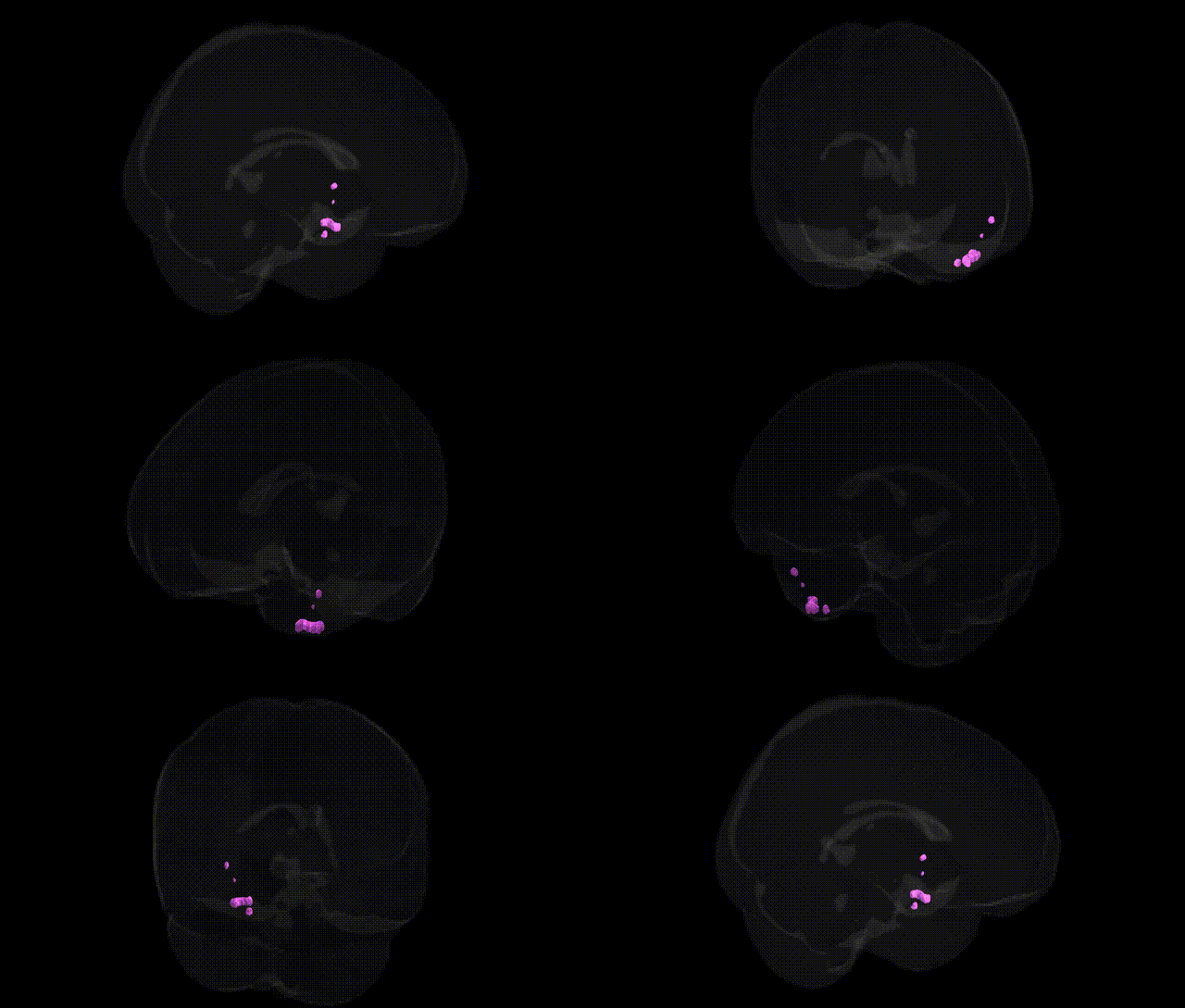
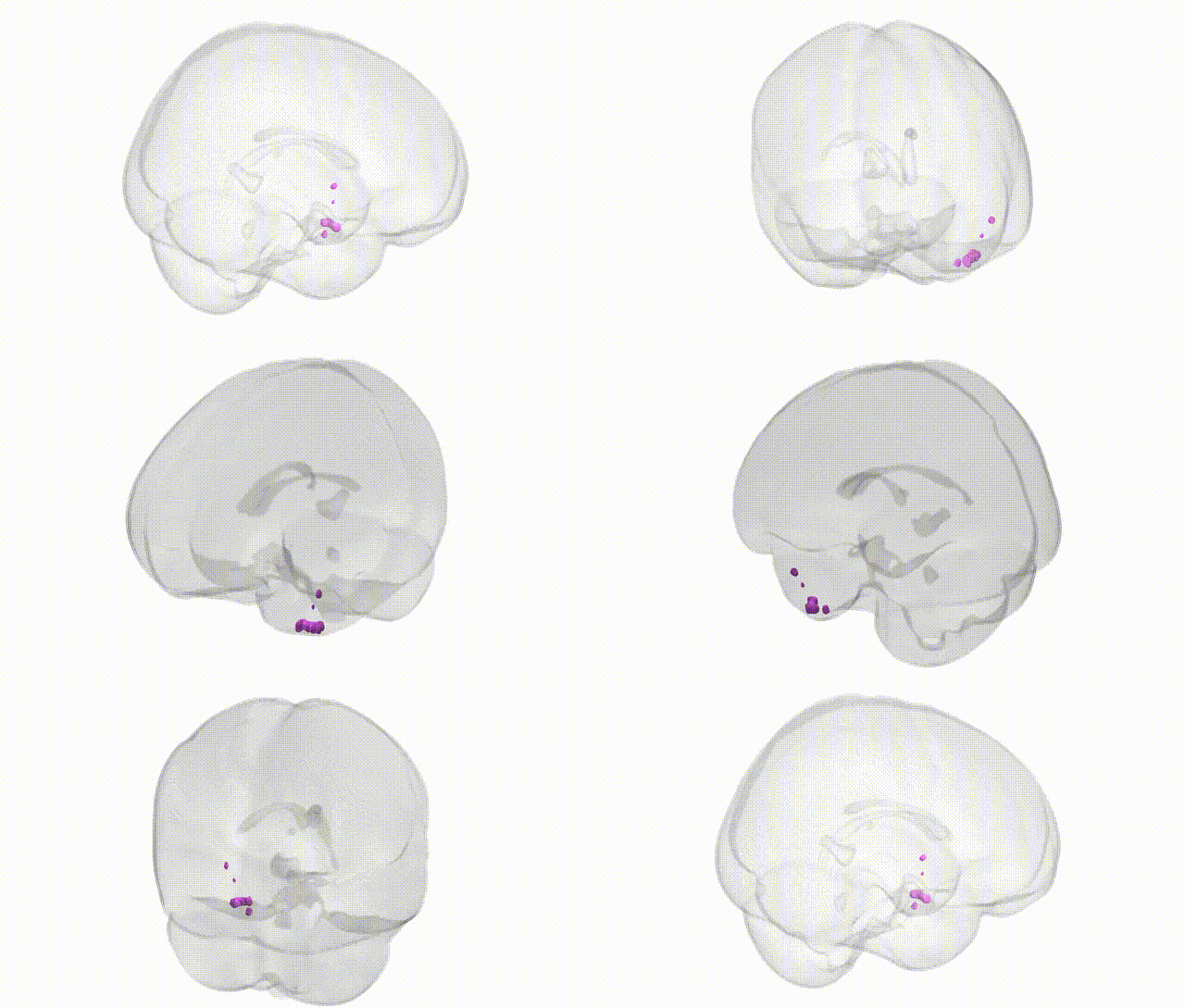
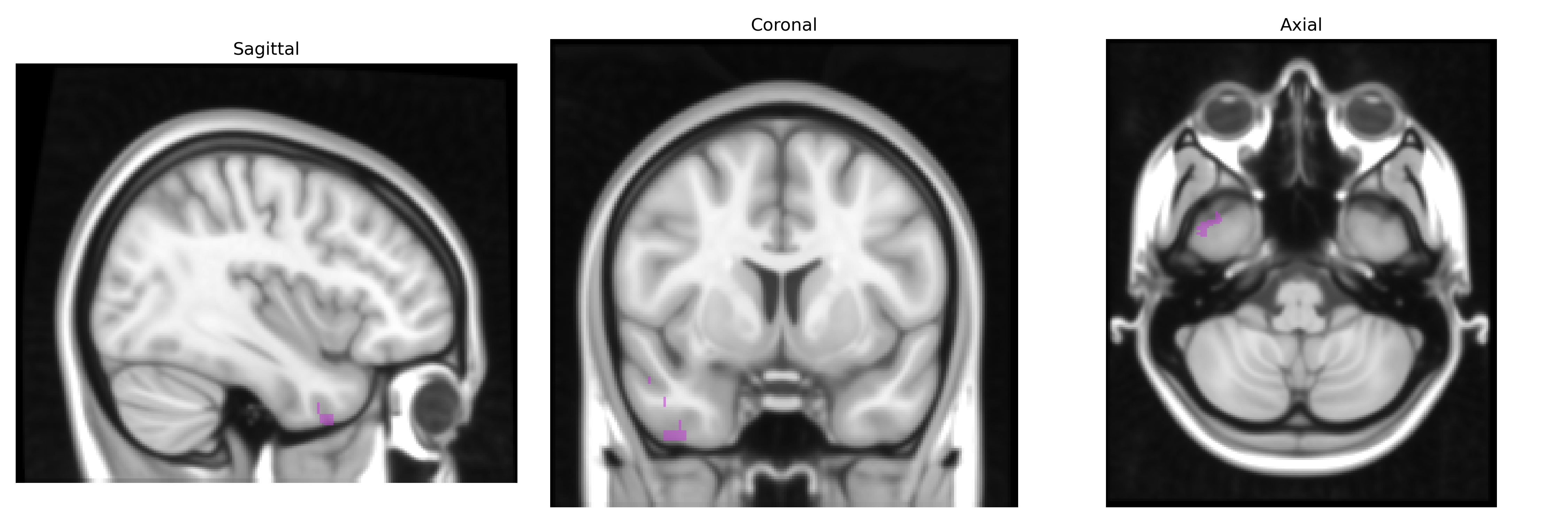
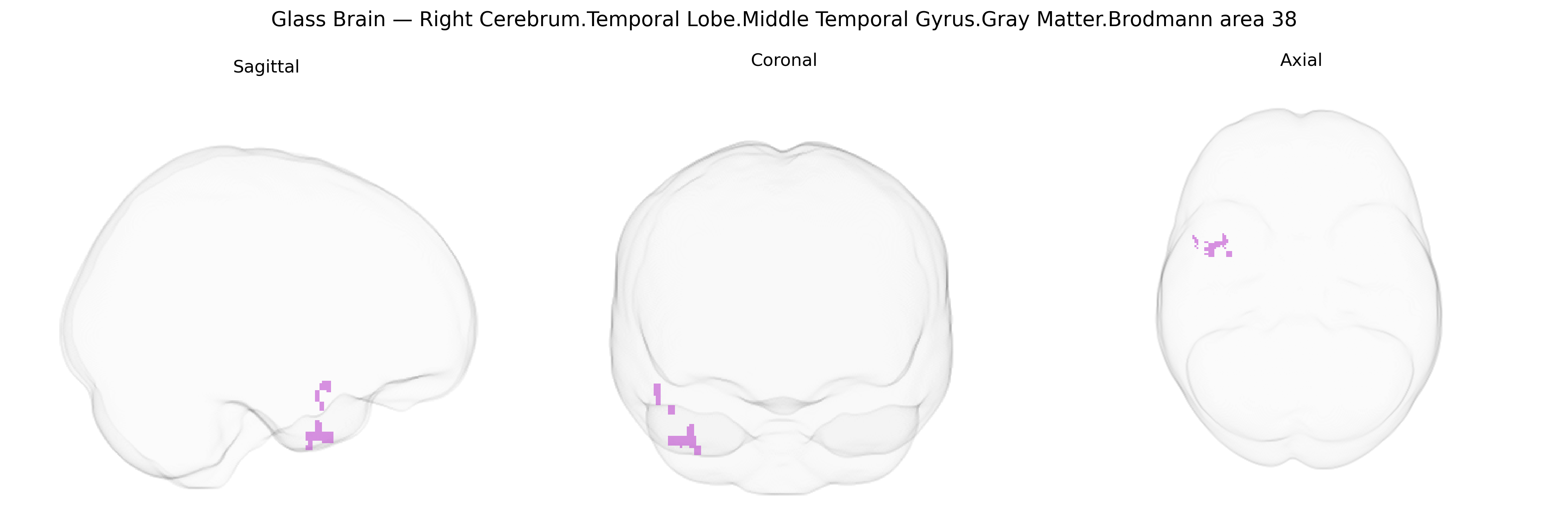
The bilateral Right Cerebrum.Temporal Lobe.Middle Temporal Gyrus.Gray Matter.Brodmann area 38 corresponds to the most anterior portion of the temporal lobe (temporal pole) within the middle temporal gyrus, comprising cortical gray matter assigned to Brodmann area 38. This region is associated with higher-order multimodal integration, including semantic processing, social and emotional cognition, and aspects of autobiographical memory, and it participates in networks related to language comprehension and affective processing. It receives and integrates inputs from auditory, visual, and limbic structures and projects to other temporal, frontal, and limbic regions, thus serving as a hub for linking perceptual information with emotional and contextual meaning. There is no direct link for this exact combined label; a related structure is the Temporal pole.
The bilateral right middle temporal gyrus gray matter in Brodmann area 38 (temporal pole) has been implicated in several genetic and GWAS-based associations, although few studies target this exact Talairach-defined parcel. Imaging genetics and large-scale GWAS of cortical thickness and surface area (e.g., ENIGMA, UK Biobank) have linked variation in temporal pole/middle temporal regions to common variants in genes involved in neurodevelopment, synaptic function, and neuronal differentiation, such as variants near MAPT, TBR1, and genes in glutamatergic and GABAergic pathways. Structural and functional abnormalities in this region are repeatedly reported in genetic risk conditions for frontotemporal dementia (e.g., mutations in MAPT, GRN, C9orf72), with marked temporal pole atrophy in semantic variant primary progressive aphasia, as well as in schizophrenia and autism spectrum disorder polygenic risk, where temporal pole/middle temporal gyrus morphology and activation show correlations with polygenic risk scores. GWAS of language, social cognition, and semantic memory traits have identified loci whose effects on brain morphology or connectivity include temporal pole and adjacent middle temporal areas, while epilepsy genetics (particularly temporal lobe epilepsy) implicates this region in networks influenced by variants in genes affecting excitability (e.g., SCN-related channels). Altogether, genetic findings converge on this region as a hub where variants affecting synaptic plasticity, neurodevelopment, and neurodegeneration modulate risk for semantic and social cognitive dysfunction, frontotemporal lobar degeneration, psychosis-related phenotypes, and temporal lobe epilepsy, though most associations are regional or network-level rather than specific to Brodmann area 38 in the Talairach 1 mm atlas.
Overview generated by GPT-4o (2026).
Region ID: 36
Hemisphere: bilateral
Atlas: Talairach labels 1mm
Full Quality Version: Download MP4
Full Quality Version: Download MP4
Wali Sidiqyar*, Gaurav Rudravaram*, Elyssa M. McMaster, Trent M. Schwartz, Adam M. Saunders, Kurt G. Schilling, Bennett A. Landman "Introducing SPINS: A Shared Public Visualization Library of Neuroanatomical Structures." Medical Imaging with Deep Learning- short paper
This resource is licensed under CC0 1.0 Universal (Public Domain).