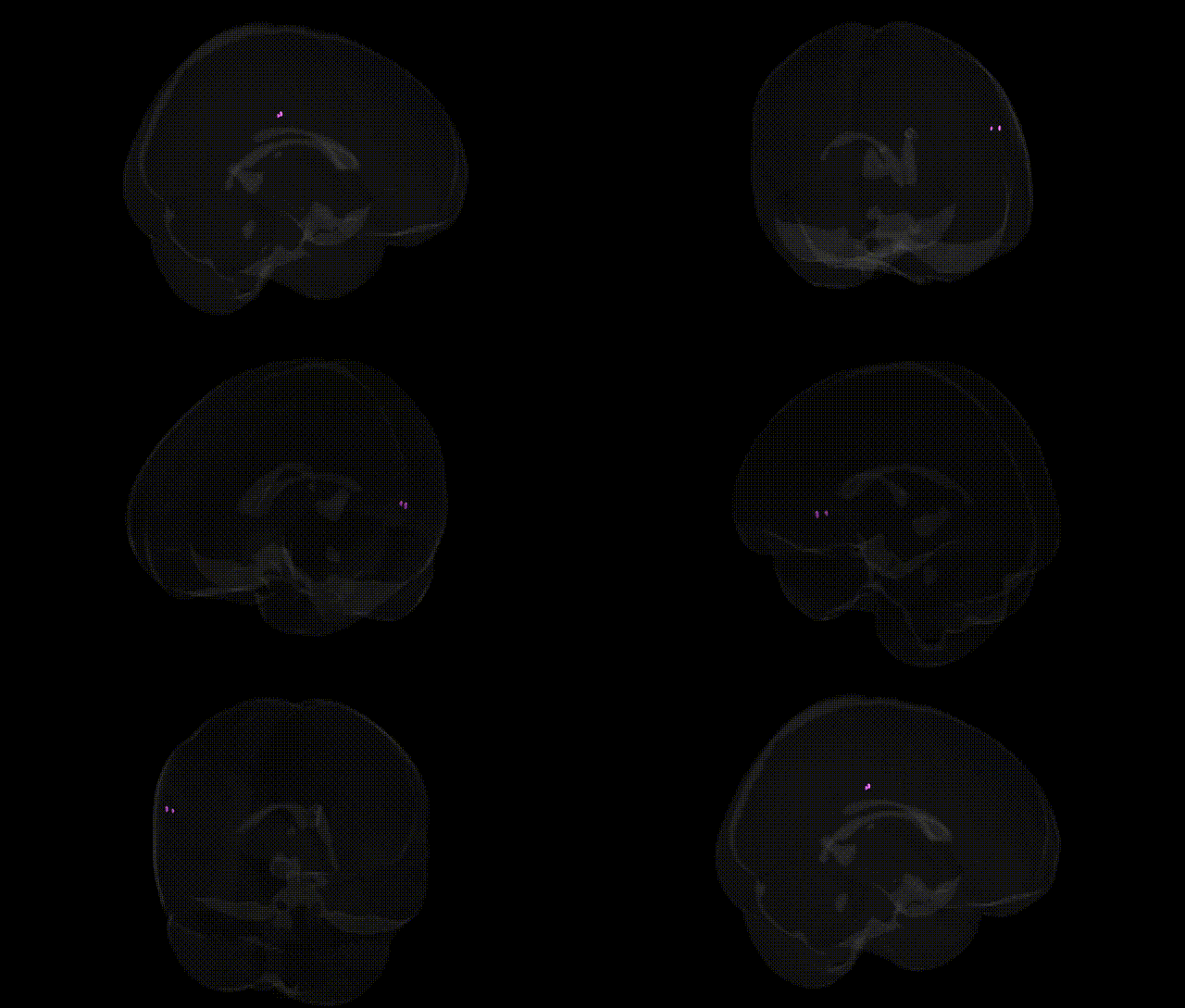
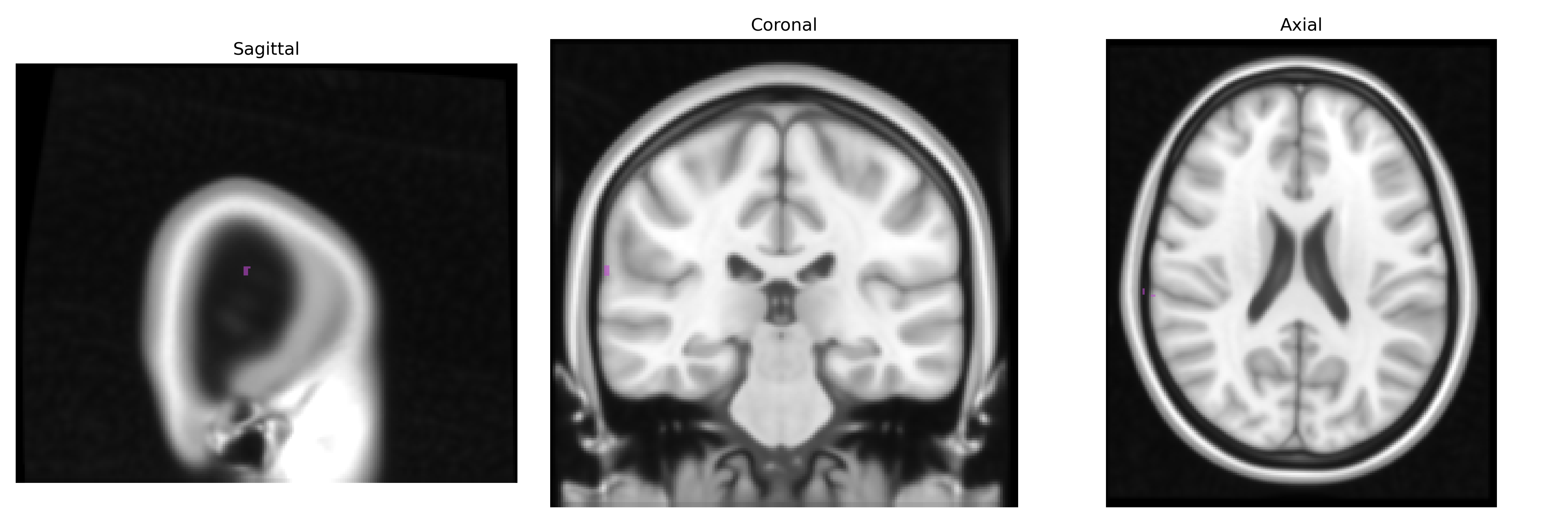
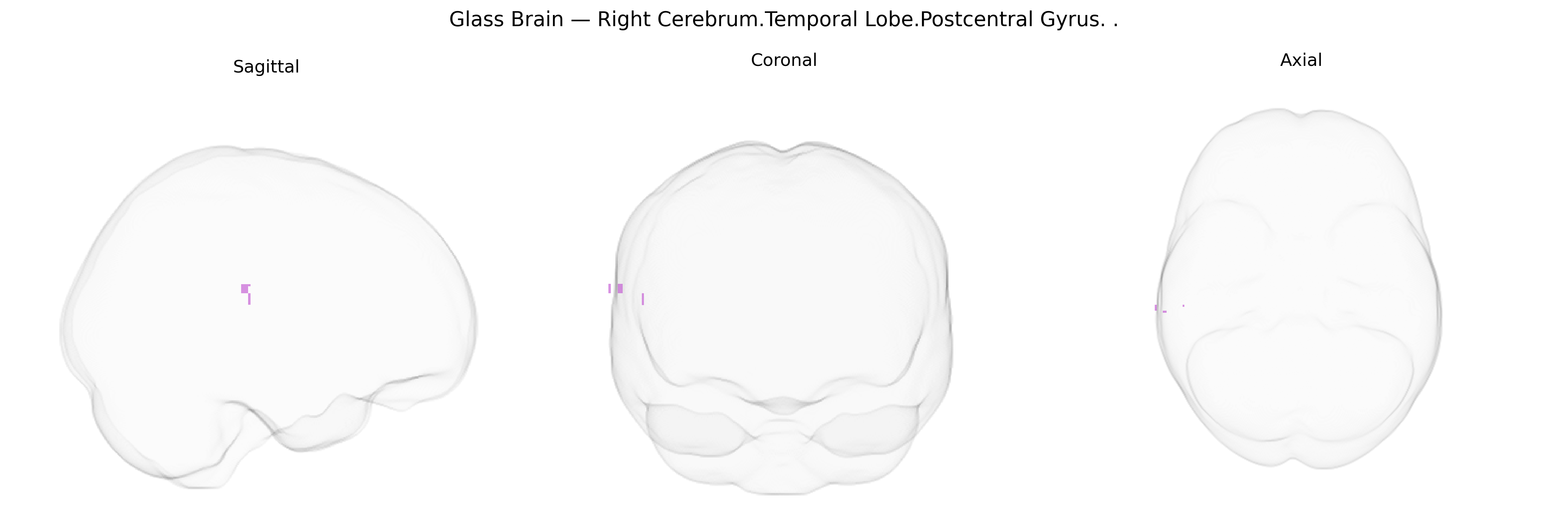
The bilateral Right Cerebrum.Temporal Lobe.Postcentral Gyrus label in the Talairach 1 mm atlas likely reflects a parcellation or mapping artifact, as the postcentral gyrus is classically a parietal lobe structure rather than temporal. The postcentral gyrus corresponds to the primary somatosensory cortex (Brodmann areas 3, 1, and 2), receiving and processing tactile, proprioceptive, and nociceptive information from the contralateral side of the body via thalamic relays. It is somatotopically organized (the sensory homunculus), with distinct regions representing different body parts in a mediolateral sequence. Functionally, this cortex is crucial for conscious perception of touch, body position, and texture discrimination, and for integrating somatic inputs required for fine motor control and interaction with the environment. There is no direct Wikipedia article for “Right Cerebrum.Temporal Lobe.Postcentral Gyrus,” but the closely related structure is the Postcentral gyrus.
The bilateral right temporal lobe “postcentral gyrus” label in the Talairach 1 mm atlas sits at the intersection of primary somatosensory and adjacent temporal-association territories, and genetic associations identified by GWAS and imaging–genetics studies largely reflect this broader sensorimotor and temporal-parietal circuitry rather than the label itself. Variants in genes such as BDNF, NRG1, GRM3, and CACNA1C, along with polygenic schizophrenia and bipolar disorder risk scores, have been linked to altered cortical thickness, surface area, or gyrification in right perisylvian and temporoparietal regions that encompass or border this area, often in the context of psychosis, mood disorders, and cognitive function (e.g., language, working memory). Large consortia (e.g., ENIGMA, UK Biobank) have reported that common variants in loci including HMGA2, IGF1, MIR924HG, and others influence regional brain morphology and overall cortical surface area, with effects observed in temporal and adjacent postcentral regions, and these same loci frequently show pleiotropic associations with intelligence, educational attainment, and neurodevelopmental traits such as autism spectrum disorder and ADHD. Somatosensory cortex–adjacent fields in the right hemisphere have also been implicated in pain sensitivity and chronic pain conditions, with heritable components and GWAS hits in genes related to synaptic plasticity and ion channels (e.g., SCN family genes), although these findings generally localize to broader somatosensory networks. Overall, genetic associations tied specifically and exclusively to the Talairach “Right Cerebrum.Temporal Lobe.Postcentral Gyrus” label are sparse, but convergent imaging–genetics and disorder-focused GWAS implicate this region’s wider network in heritable variation in cortical structure, cognition, psychiatric risk, neurodevelopmental traits, and pain-related phenotypes.
Overview generated by GPT-4o (2026).
Region ID: 779
Hemisphere: bilateral
Atlas: Talairach labels 1mm
Full Quality Version: Download MP4
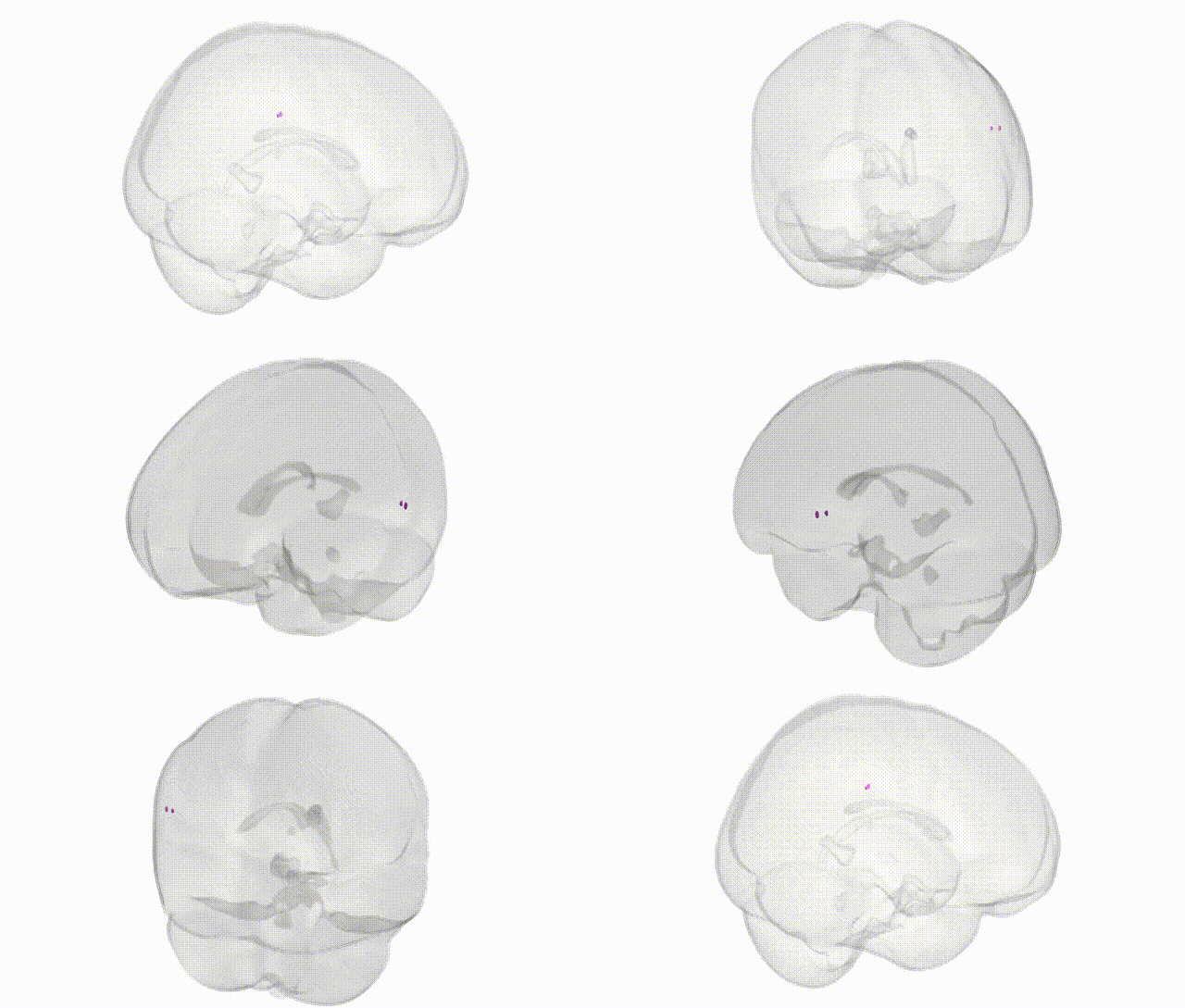
Full Quality Version: Download MP4
Wali Sidiqyar*, Gaurav Rudravaram*, Elyssa M. McMaster, Trent M. Schwartz, Adam M. Saunders, Kurt G. Schilling, Bennett A. Landman "Introducing SPINS: A Shared Public Visualization Library of Neuroanatomical Structures." Medical Imaging with Deep Learning- short paper
This resource is licensed under CC0 1.0 Universal (Public Domain).