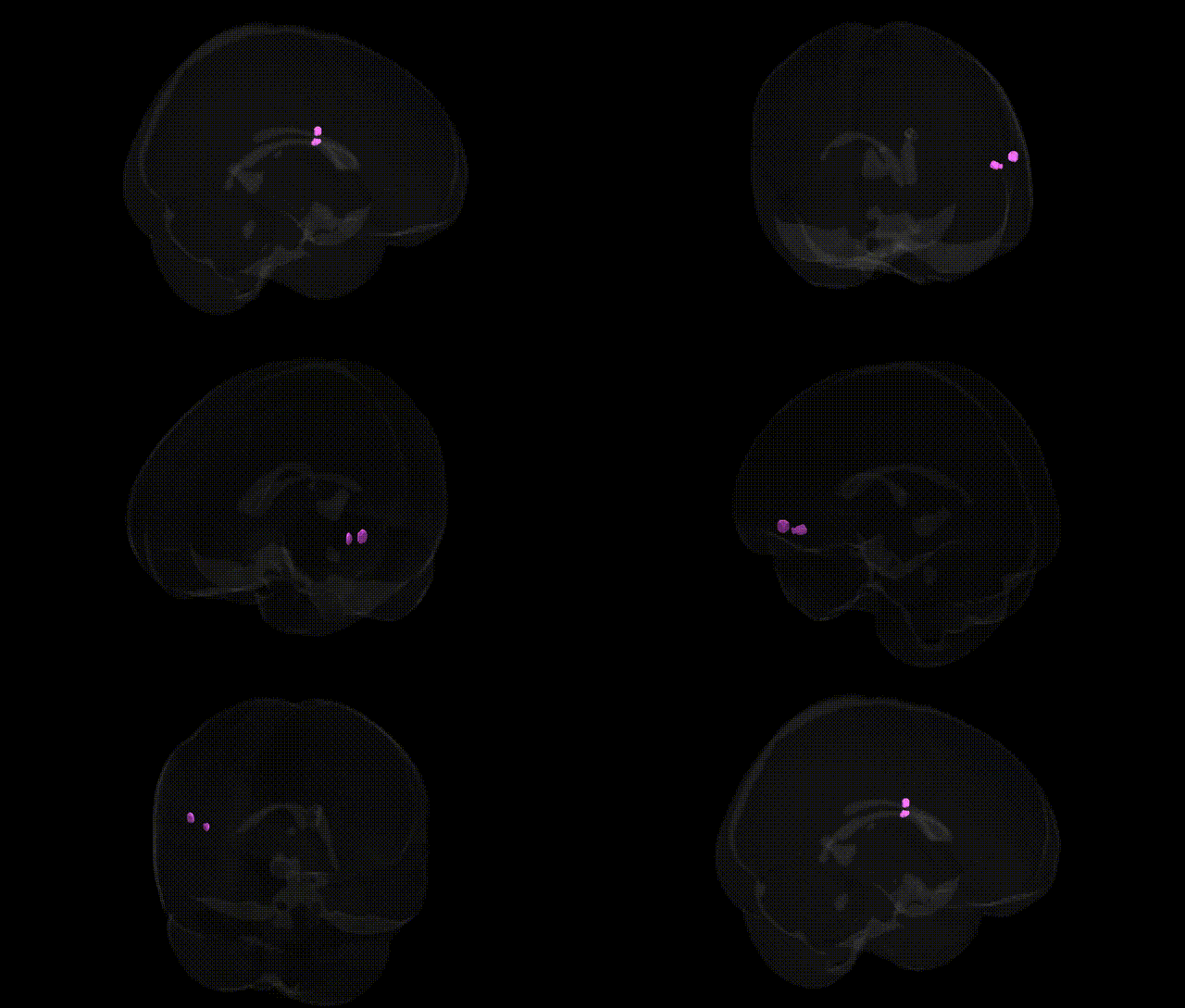
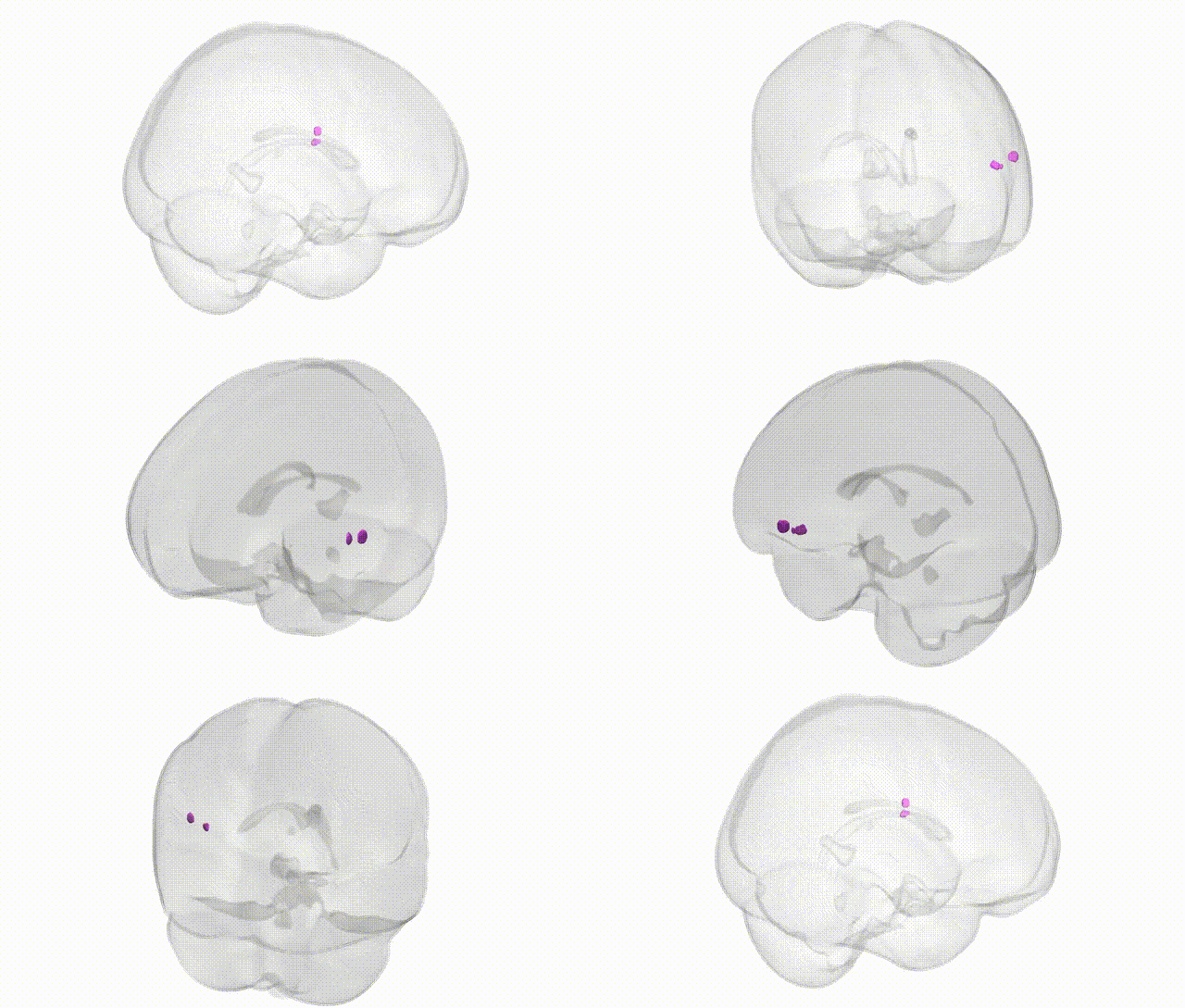
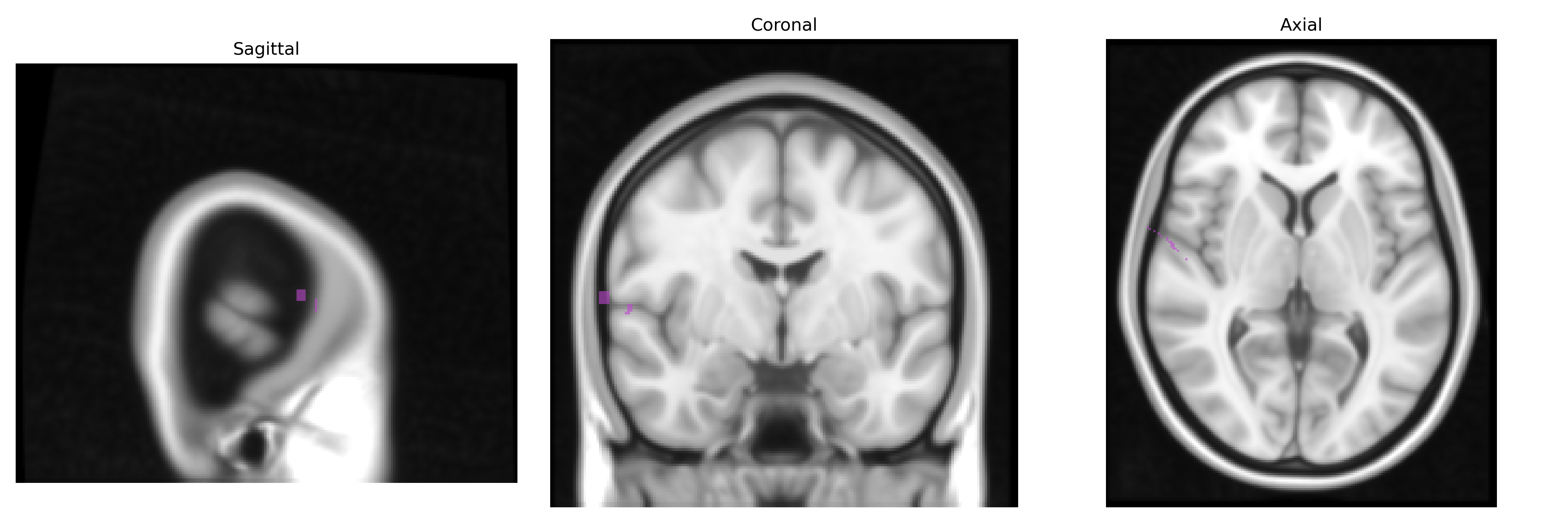
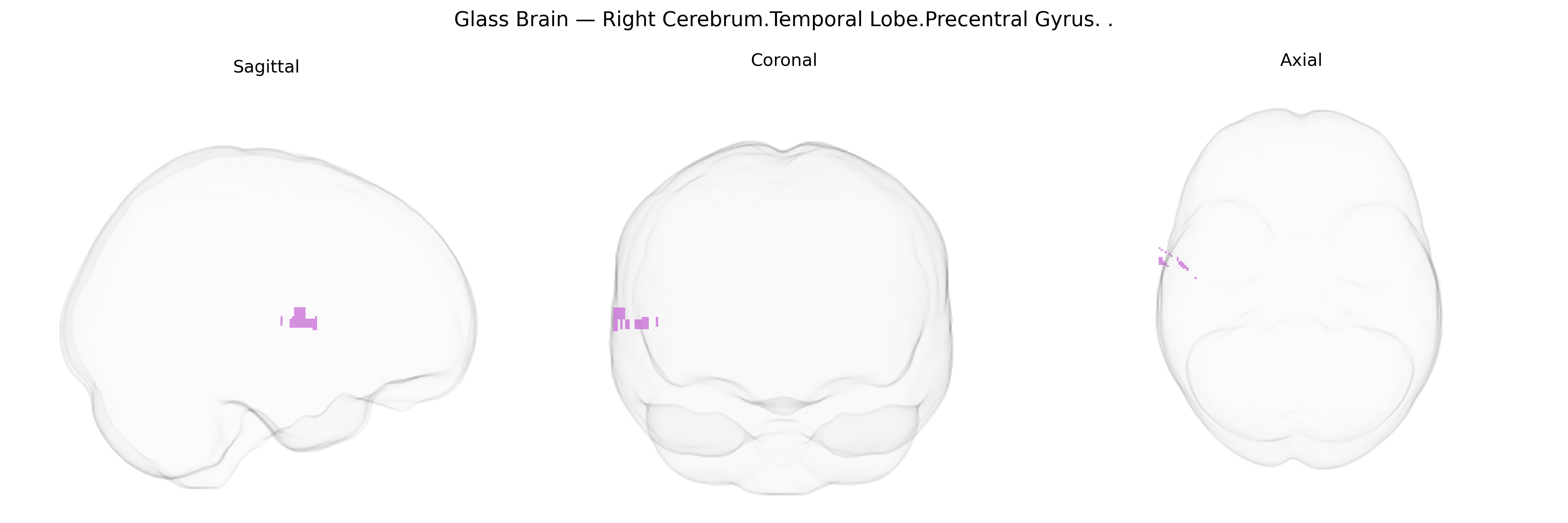
The “bilateral Right Cerebrum.Temporal Lobe.Precentral Gyrus” label in the Talairach 1 mm atlas reflects a composite or overlapping assignment rather than a single anatomically standard structure, as the precentral gyrus is classically located in the frontal lobe, not the temporal lobe. In neuroanatomical terms, the precentral gyrus is the primary motor cortex (Brodmann area 4), situated immediately anterior to the central sulcus, and is responsible for the initiation and execution of voluntary movements via its somatotopic representation of the contralateral body (motor homunculus). It contains the upper motor neurons whose axons form the corticospinal and corticobulbar tracts, projecting to spinal and cranial motor nuclei. Functionally, this region is critical for fine motor control, motor planning in concert with premotor areas, and integration of sensory feedback to modulate ongoing movement.
The bilateral right temporal lobe/precentral gyrus region (as defined in Talairach 1 mm labels) has been implicated in several genetic and GWAS findings through its roles in motor control, language-related processing, and auditory/temporal functions, although few studies target this exact parcel in isolation; rather, it typically appears within broader cortical or temporal/motor networks. Large-scale imaging–genetics consortia (e.g., ENIGMA, UK Biobank) have identified common variants in genes such as MAPT, APOE, GRIN2B, and synaptic or neurodevelopmental loci (e.g., near BDNF and CNTNAP2) that associate with cortical thickness, surface area, or volume in temporal and adjacent precentral regions, often in the context of aging, Alzheimer’s disease risk, and neurodegenerative atrophy patterns. Temporal–precentral circuits are frequently implicated in genetic studies of focal epilepsy (notably temporal lobe epilepsy), where variants in ion-channel and synaptic genes (e.g., SCN1A, SCN2A, LGI1) contribute to seizure susceptibility and structural alterations in temporal cortex. GWAS of neurodevelopmental and psychiatric disorders—such as autism spectrum disorder, schizophrenia, and attention-deficit/hyperactivity disorder—have linked risk loci in genes involved in synaptic function, cortical patterning, and axon guidance (e.g., NRXN1/3, DLG2, GRIA1) to altered activation or morphology in temporal and precentral gyri during language, motor, or social-cognition tasks. Additionally, heritability studies indicate that variation in this region’s structural and functional measures is substantially genetically influenced, aligning with polygenic contributions from many small-effect variants rather than single strong loci, and overlapping with genetic architectures of cognitive performance, handedness, and motor skill traits.
Overview generated by GPT-4o (2026).
Region ID: 681
Hemisphere: bilateral
Atlas: Talairach labels 1mm
Full Quality Version: Download MP4
Full Quality Version: Download MP4
Wali Sidiqyar*, Gaurav Rudravaram*, Elyssa M. McMaster, Trent M. Schwartz, Adam M. Saunders, Kurt G. Schilling, Bennett A. Landman "Introducing SPINS: A Shared Public Visualization Library of Neuroanatomical Structures." Medical Imaging with Deep Learning- short paper
This resource is licensed under CC0 1.0 Universal (Public Domain).