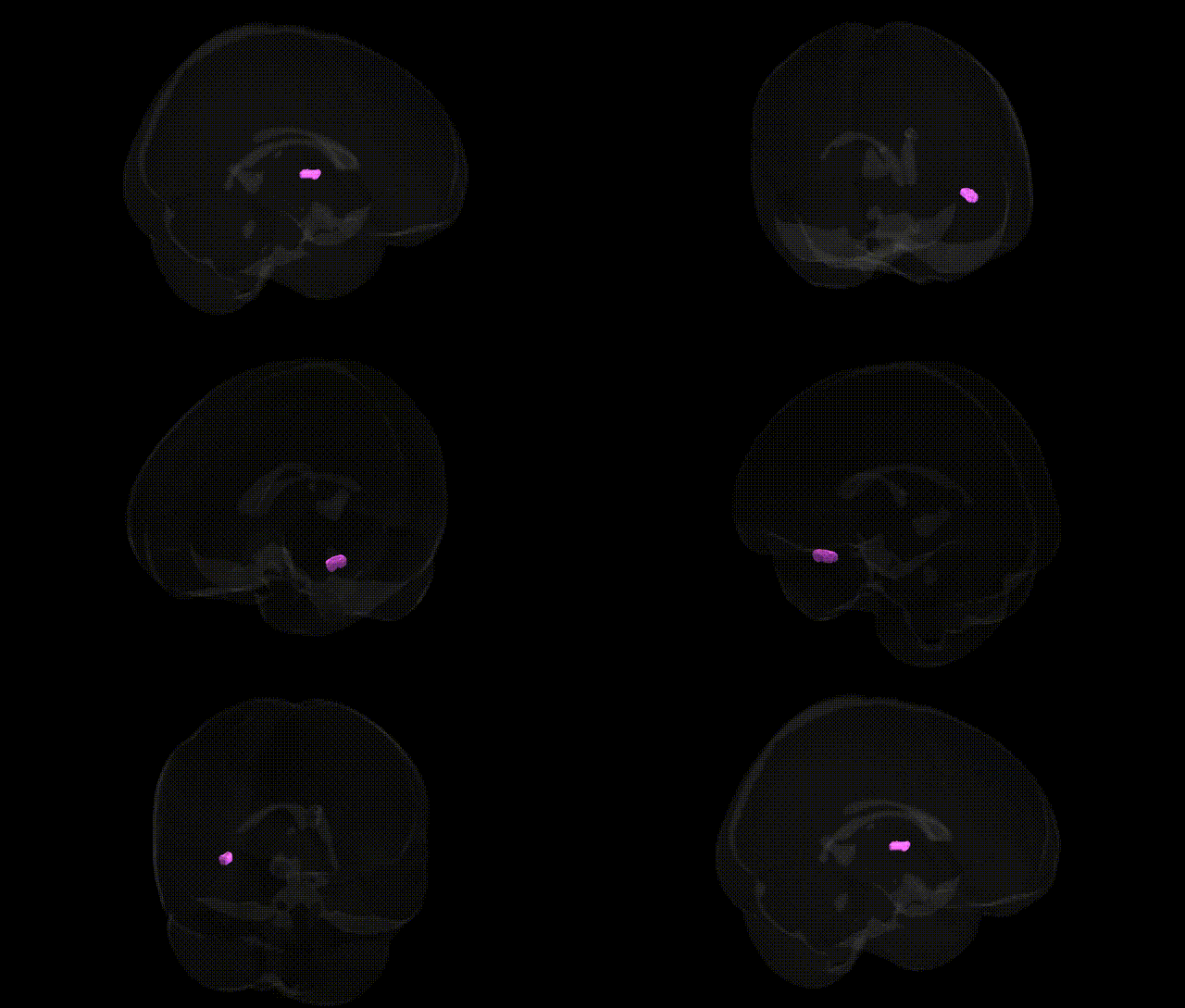
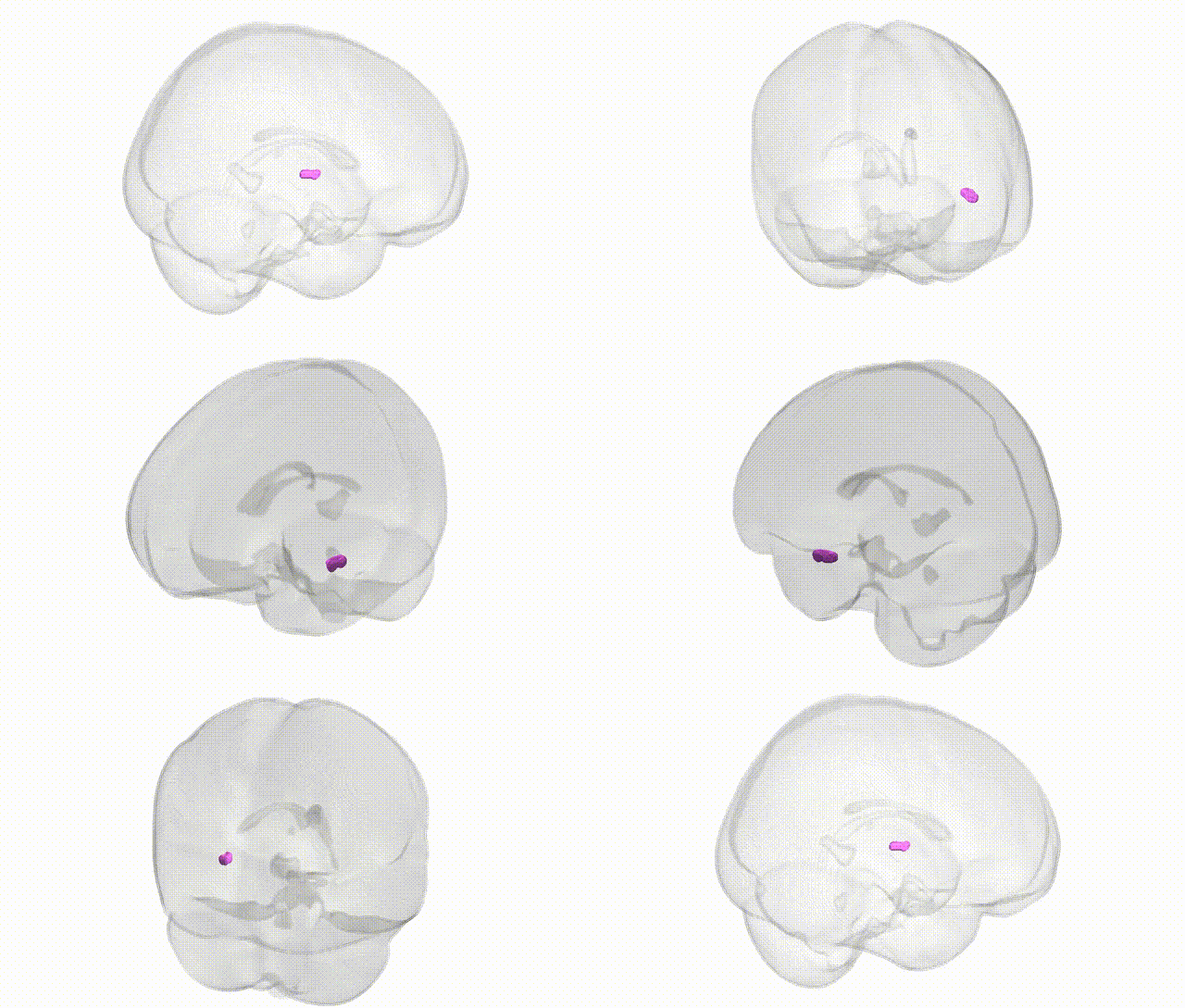
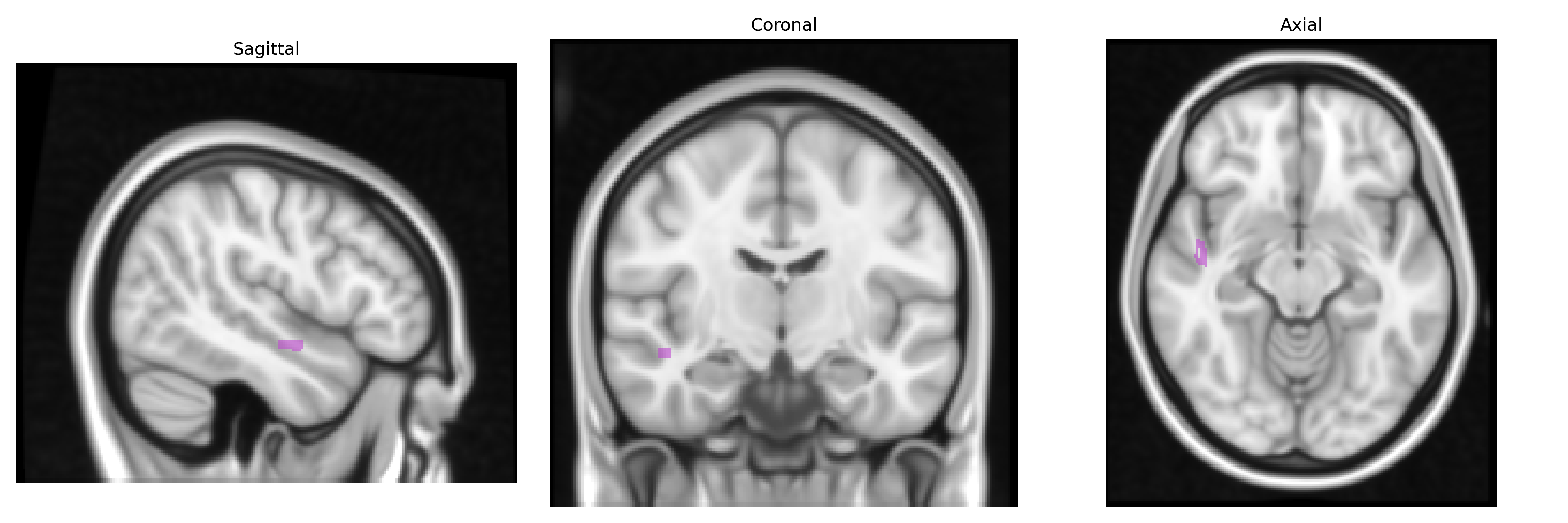
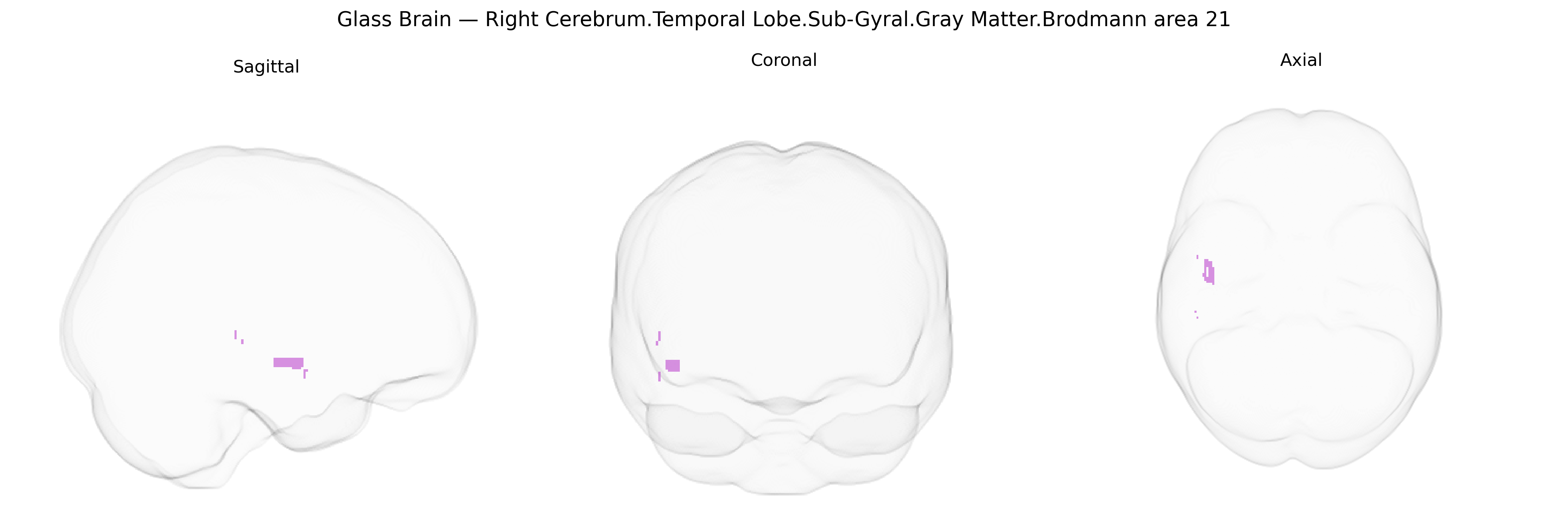
The bilateral Right Cerebrum.Temporal Lobe.Sub-Gyral.Gray Matter.Brodmann area 21 corresponds primarily to the middle temporal gyrus cortex classified cytoarchitectonically as Brodmann area 21, a region involved in higher-order auditory processing, language comprehension, semantic memory, and aspects of visual object and face recognition. Located in the lateral temporal neocortex beneath the gyral surface (sub-gyral gray matter), this area integrates multimodal sensory information and supports the analysis of complex sounds, word meaning, and narrative processing, with strong connectivity to adjacent temporal, parietal, and frontal association cortices as well as limbic structures. Functionally, it contributes to the broader temporal lobe networks implicated in language, social cognition, and episodic memory retrieval, and lesions or dysfunction in this region have been associated with aphasia, semantic dementia, and certain forms of temporal lobe epilepsy. There is no direct Wikipedia article for this exact Talairach label; a closely related structure is Brodmann area 21.
Brodmann area 21 (BA21) in the temporal lobe sub-gyral gray matter, encompassing higher-order auditory and semantic regions, has been implicated in multiple genetic and GWAS-based associations, particularly through its overlap with the superior and middle temporal gyri. Common neuropsychiatric risk variants—such as those in CACNA1C, ZNF804A, and MIR137—have been linked to altered temporal lobe structure and function in schizophrenia and bipolar disorder, with imaging–genetics studies showing associations between polygenic risk scores and reduced temporal gray matter volume, including BA21-adjacent cortex. Large-scale GWAS of cortical thickness and surface area (e.g., ENIGMA-related consortia) have identified loci near genes such as WNT3, KIAA0586, and genes involved in neurodevelopment and synaptic signaling that influence temporal lobe morphology, and BA21 falls within these temporally defined phenotypes. Language-related and autism spectrum disorder genetics also implicate this region through variants in genes like FOXP2, CNTNAP2, and others affecting frontotemporal language networks, where BA21 plays a central role in semantic processing; these genes have been associated with atypical activation or structure in the lateral temporal cortex. In Alzheimer’s disease and frontotemporal dementia, risk alleles in APOE, MAPT, GRN, and C9orf72 relate to patterns of temporal lobe atrophy and hypometabolism that include BA21, as shown by imaging-genetics analyses. Overall, while relatively few GWAS target BA21 specifically, converging evidence from cortical morphometry GWAS, imaging–genetics, and disorder-focused studies indicates that polygenic variation in neurodevelopmental, synaptic, and neurodegenerative pathways contributes to interindividual differences in the structure and function of this bilateral temporal BA21 region.
Overview generated by GPT-4o (2026).
Region ID: 275
Hemisphere: bilateral
Atlas: Talairach labels 1mm
Full Quality Version: Download MP4
Full Quality Version: Download MP4
Wali Sidiqyar*, Gaurav Rudravaram*, Elyssa M. McMaster, Trent M. Schwartz, Adam M. Saunders, Kurt G. Schilling, Bennett A. Landman "Introducing SPINS: A Shared Public Visualization Library of Neuroanatomical Structures." Medical Imaging with Deep Learning- short paper
This resource is licensed under CC0 1.0 Universal (Public Domain).