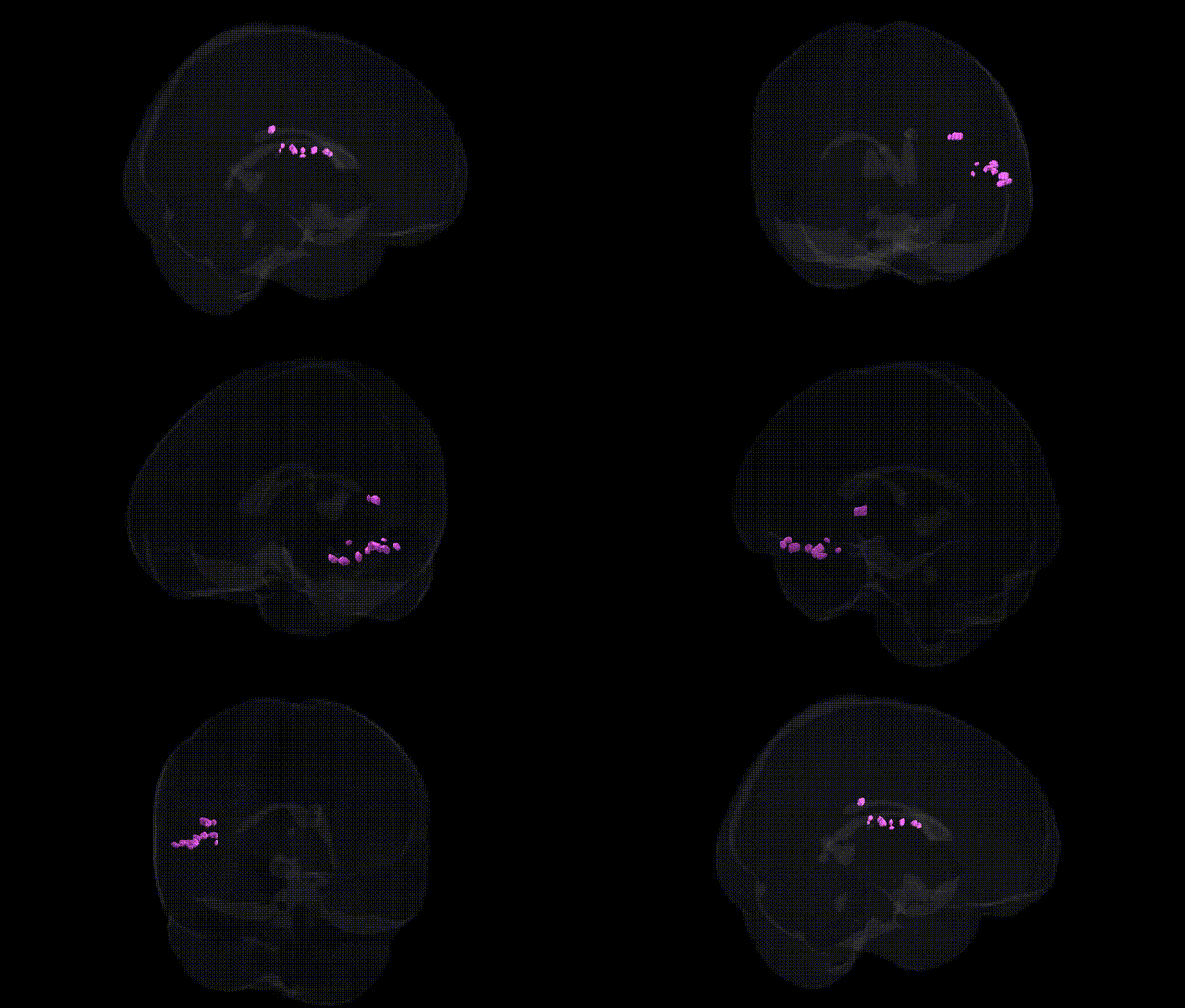
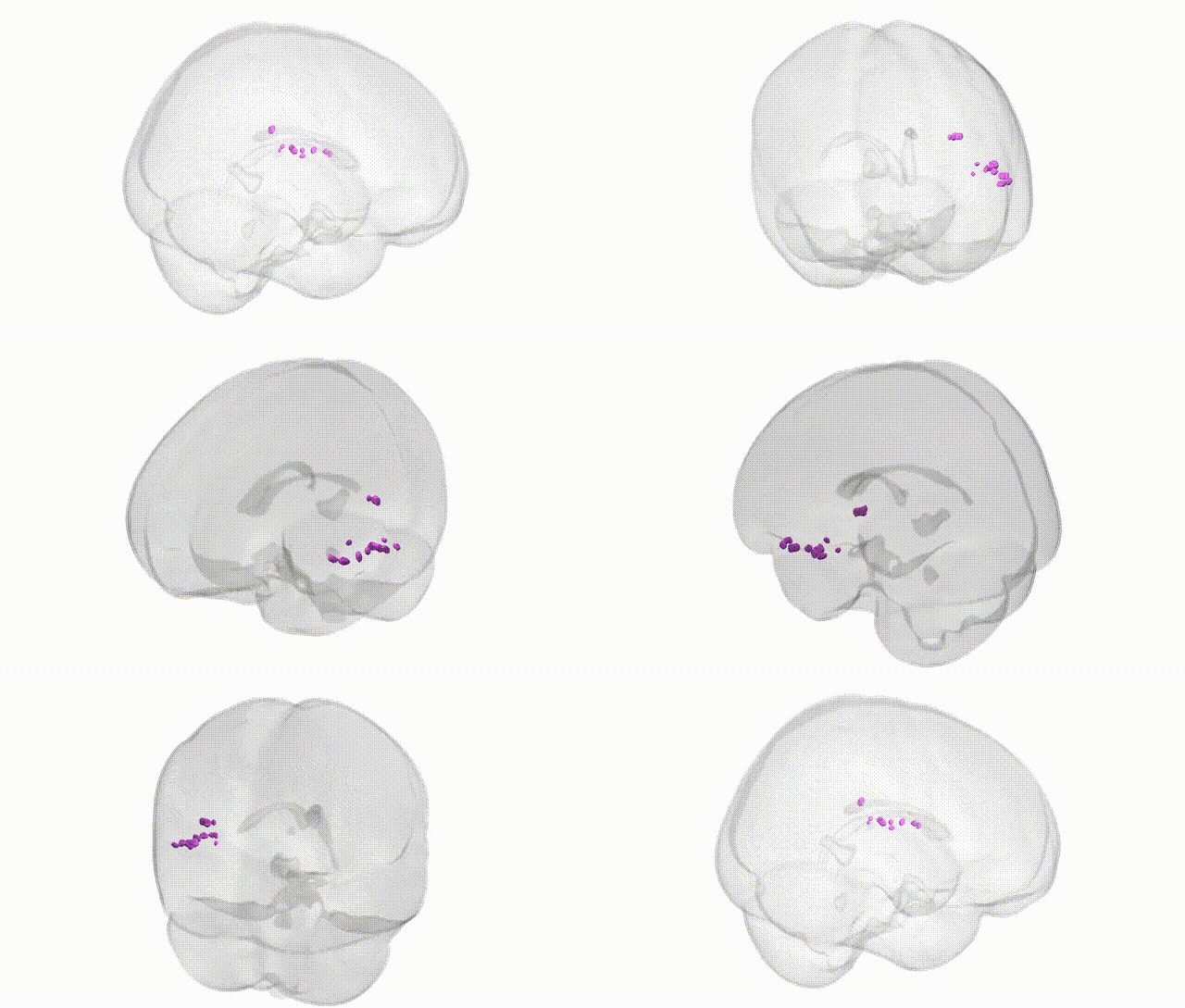
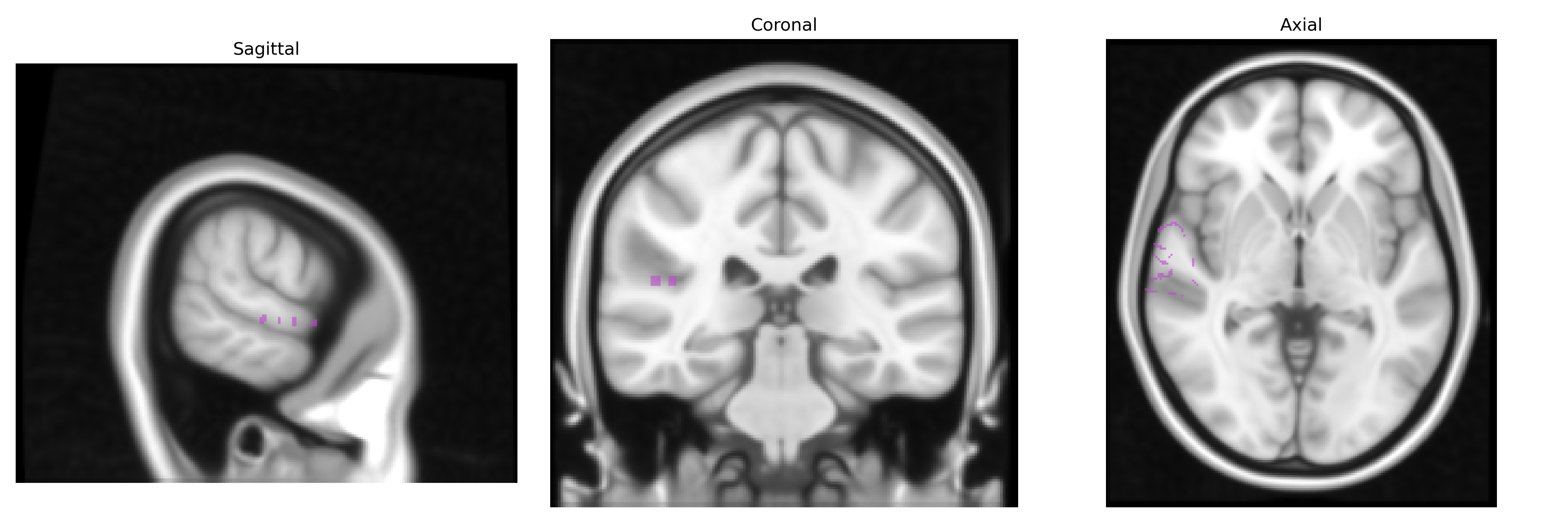
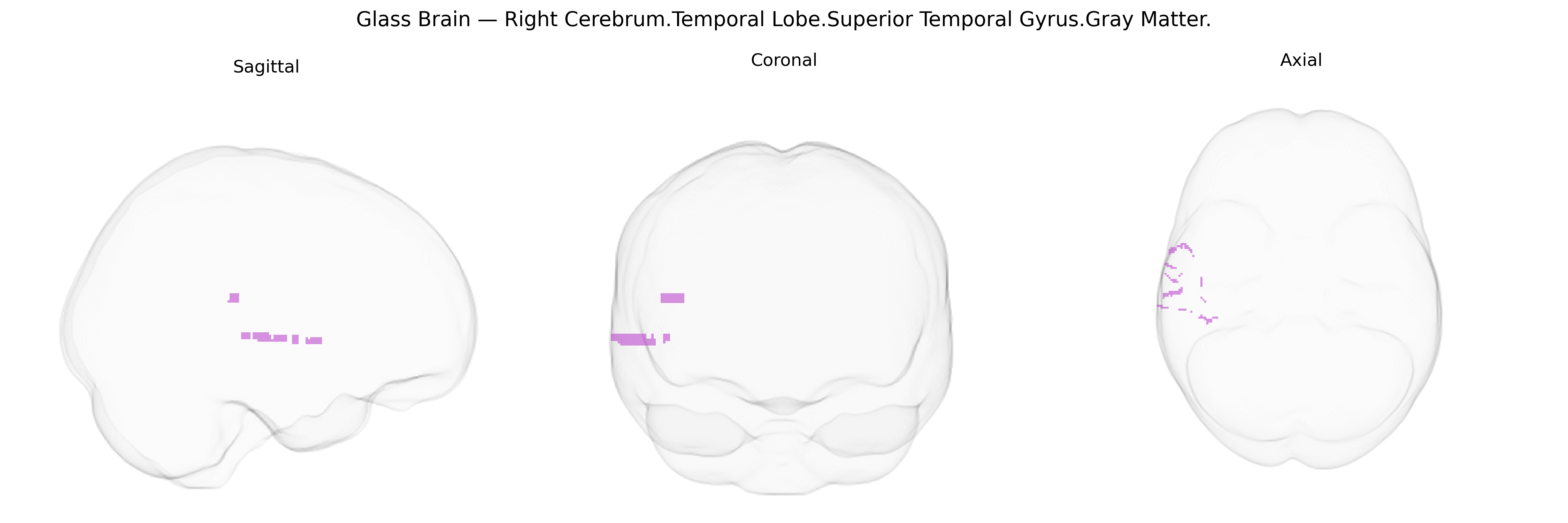
The bilateral Right Cerebrum.Temporal Lobe.Superior Temporal Gyrus.Gray Matter corresponds to cortex in the superior temporal gyrus (STG) of the right temporal lobe, a key region for auditory and higher-order perceptual processing. This gray matter territory encompasses primary and secondary auditory areas and association cortex involved in sound feature analysis, speech and language perception (including aspects of prosody), and the integration of auditory information with multimodal social and emotional cues. It participates in networks underlying speech discrimination, voice recognition, and the interpretation of complex environmental sounds, and shows hemispheric specialization with relatively greater involvement in nonverbal auditory and spectral–temporal processing compared with the left homologue. The STG also interfaces with adjacent temporal and parietal regions to support broader functions such as auditory attention, audiovisual integration, and aspects of social cognition. Superior temporal gyrus
The bilateral Right Cerebrum.Temporal Lobe.Superior Temporal Gyrus.Gray Matter, as defined in the Talairach 1 mm atlas, corresponds largely to auditory and language-related cortex, including parts of primary and association auditory areas and the superior temporal sulcus, and has been implicated in multiple imaging-genetics and GWAS-based phenotypes. Large-scale ENIGMA and UK Biobank studies of cortical thickness and surface area have identified genome-wide significant associations in this region with common variants in genes involved in neurodevelopment and synaptic function, including loci near or within genes such as MIR137, GRIN2A, FOXP2, DCDC2, and CNTNAP2, though effects are often shared with broader temporal-lobe measures rather than confined strictly to the superior temporal gyrus. Structural and functional variation in this region shows robust genetic correlation with language ability, reading and phonological processing, musical aptitude, and general cognitive performance, and has been implicated in polygenic risk for schizophrenia, autism spectrum disorder, and bipolar disorder, where altered superior temporal gyrus gray matter volume and activation patterns are repeatedly observed. Imaging-genetics work has linked risk variants for schizophrenia (e.g., in complement pathway genes like C4A and synaptic genes such as NRG1 and DISC1) and autism-related genes (e.g., SHANK3 and CNTNAP2) to abnormal superior temporal gyrus structure or function, particularly in social perception and auditory processing tasks. Additional GWAS on auditory hallucinations, tinnitus, and hearing-related traits show convergent effects on superior temporal cortex morphology, suggesting that genetic variation affecting this region contributes to susceptibility to psychotic symptoms and auditory perceptual disorders. Overall, heritability estimates for superior temporal gyrus gray matter metrics are moderate to high, indicating substantial genetic influence, but the architecture is highly polygenic, with many small-effect variants shared with general cortical and temporal-lobe measures rather than region-specific genes.
Overview generated by GPT-4o (2026).
Region ID: 575
Hemisphere: bilateral
Atlas: Talairach labels 1mm
Full Quality Version: Download MP4
Full Quality Version: Download MP4
Wali Sidiqyar*, Gaurav Rudravaram*, Elyssa M. McMaster, Trent M. Schwartz, Adam M. Saunders, Kurt G. Schilling, Bennett A. Landman "Introducing SPINS: A Shared Public Visualization Library of Neuroanatomical Structures." Medical Imaging with Deep Learning- short paper
This resource is licensed under CC0 1.0 Universal (Public Domain).