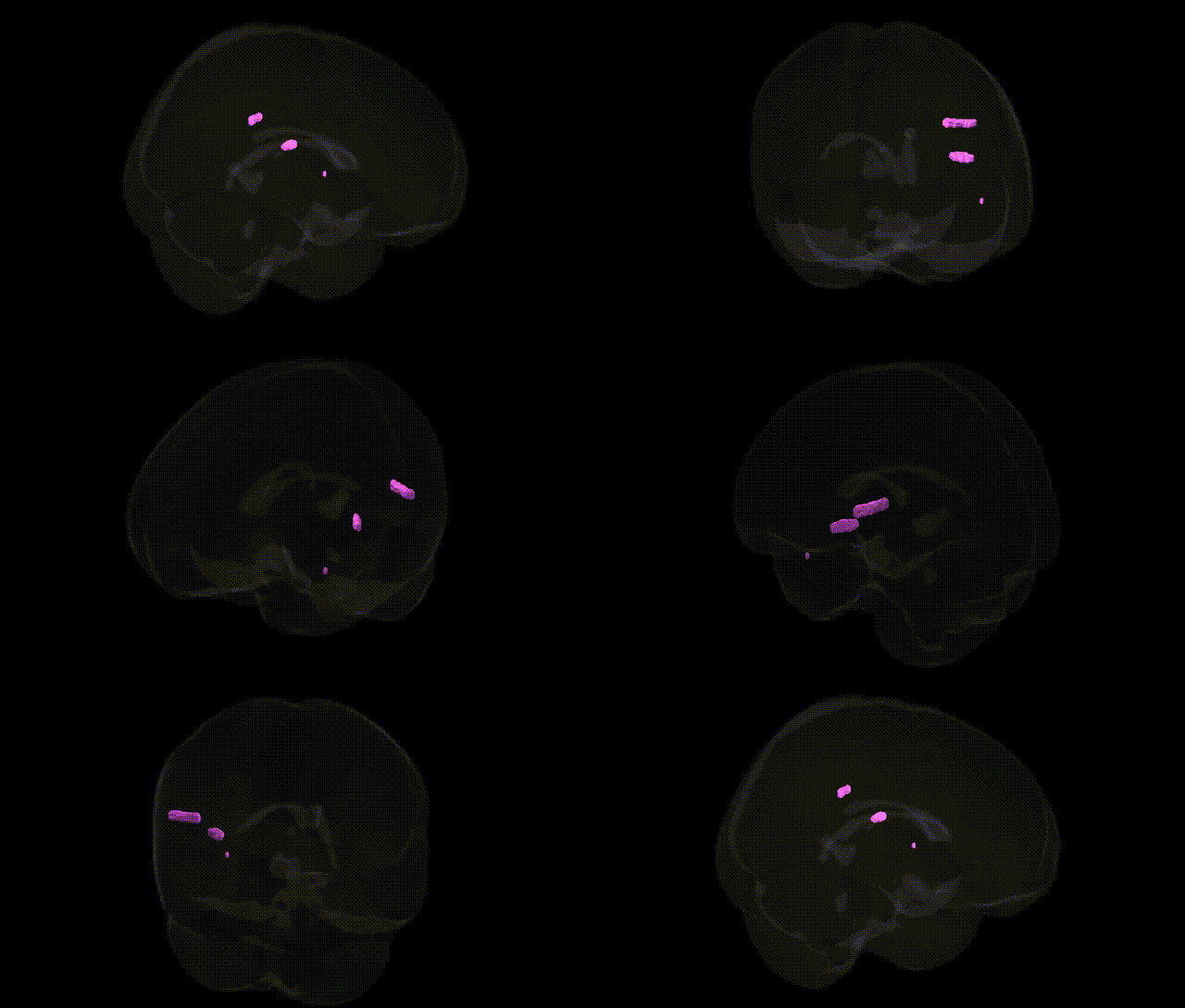
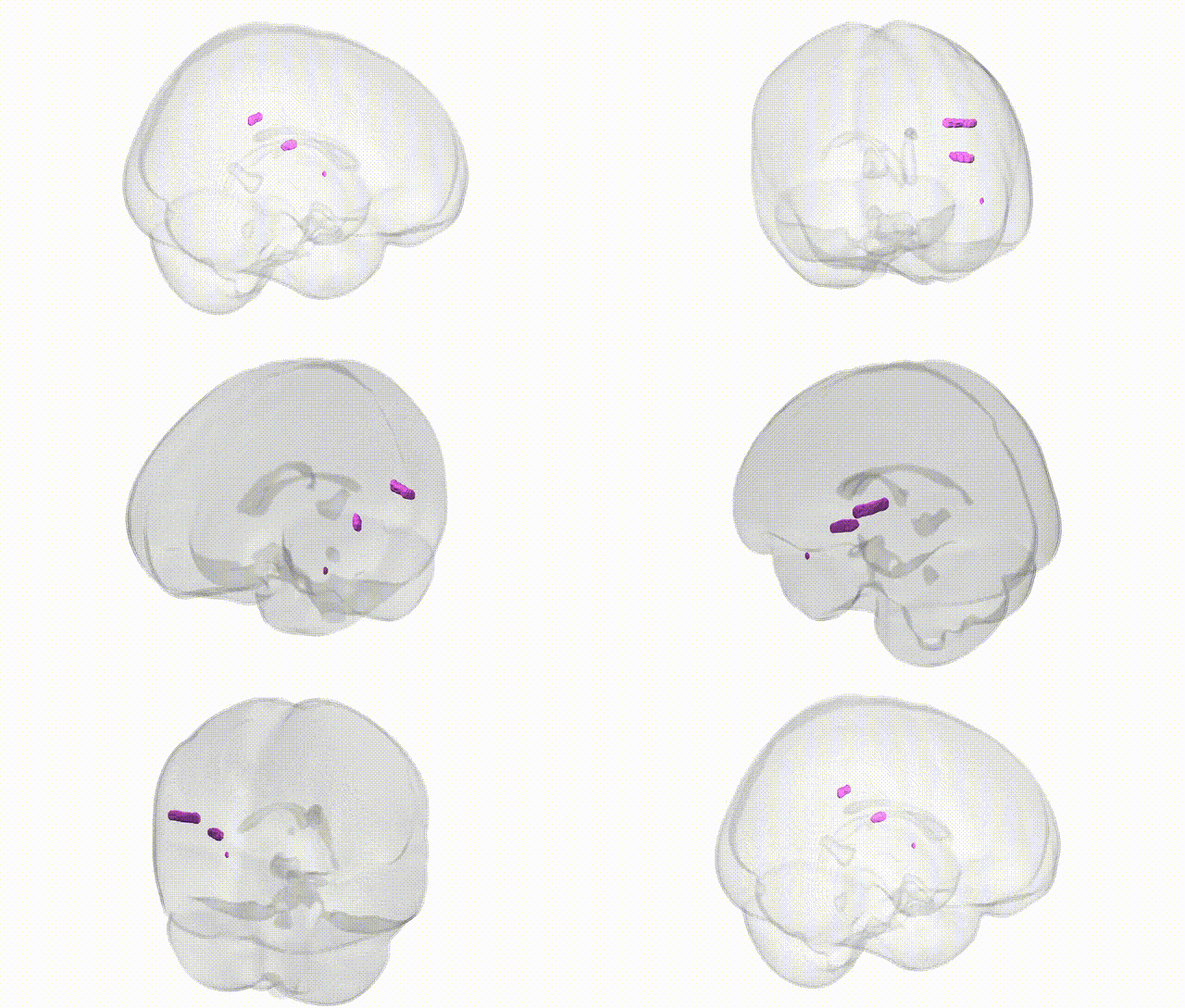
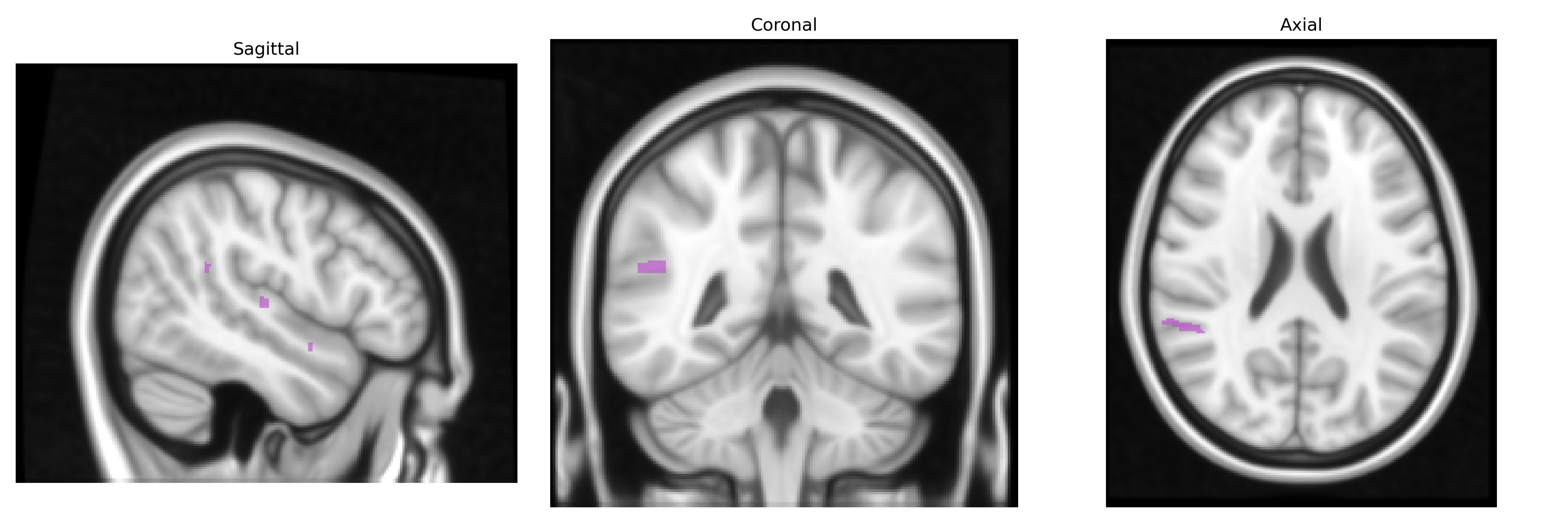
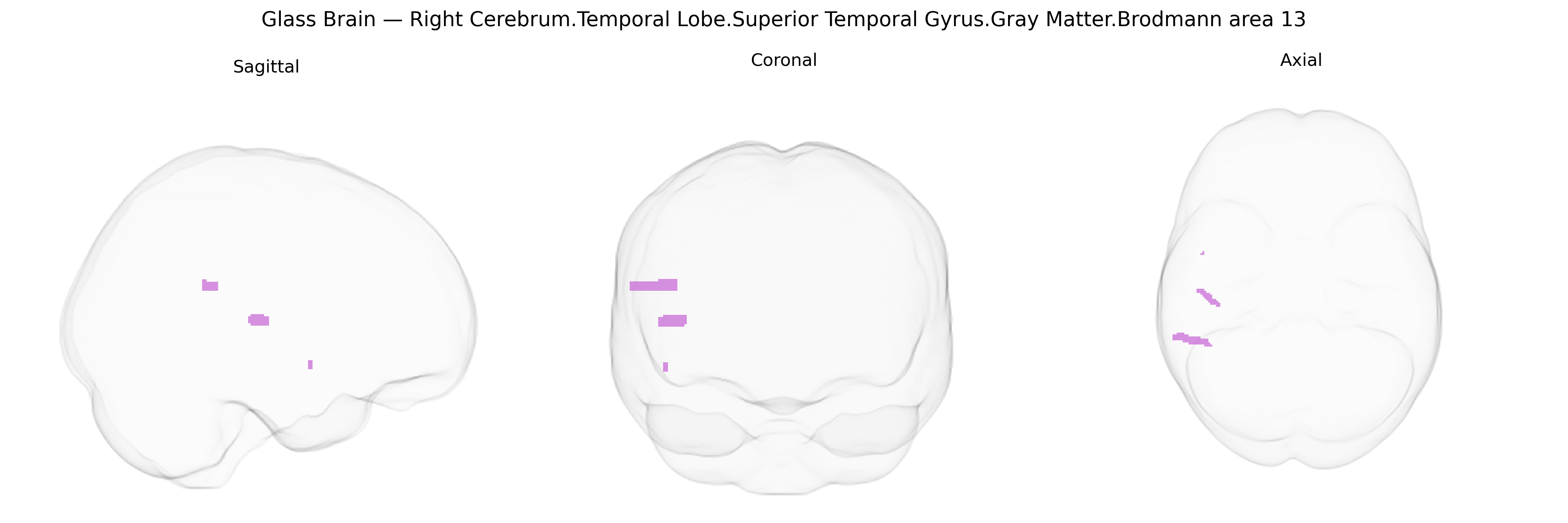
The bilateral Right Cerebrum.Temporal Lobe.Superior Temporal Gyrus.Gray Matter.Brodmann area 13 corresponds to a portion of the insular-related cortex buried within the lateral sulcus, functionally associated with multimodal integration of visceral, somatosensory, and affective information. Although labeled by Talairach as part of the superior temporal gyrus, Brodmann area 13 is classically considered an insular area, participating in interoceptive awareness, gustatory processing, and aspects of emotional and autonomic regulation. It contributes to circuits linking limbic structures, frontal association cortices, and temporal regions, thereby influencing decision-making, social-emotional evaluation, and subjective feeling states. There is no direct Wikipedia article for Brodmann area 13; a closely related structure is the Insular cortex.
The bilateral superior temporal gyrus gray matter region overlapping Brodmann area 13 (anterior insula/temporo-insular cortex in the Talairach 1 mm atlas) has been implicated in multiple genetic and GWAS-based associations, primarily via imaging genetics and large-scale neuropsychiatric studies. Variants in glutamatergic (e.g., GRIN2A, GRM3), GABAergic (e.g., GAD1), and synaptic plasticity genes (e.g., BDNF, NRG1) have been linked to gray matter volume, cortical thickness, or functional activation in superior temporal/anterior insular territories, especially in schizophrenia, where risk loci converge on temporal and insular networks involved in auditory processing, language, and salience integration. GWAS of cortical thickness and surface area (e.g., ENIGMA consortium) have identified polygenic influences from widespread loci (including microtubule, calcium-channel, and chromatin-remodeling genes) on superior temporal cortex morphology, with shared genetic architecture across schizophrenia, bipolar disorder, major depression, and autism spectrum disorder, all of which often show structural or functional alterations in this region. Additional GWAS and candidate gene studies in language and social cognition have tied FOXP2-related pathways, CNTNAP2, and other neurodevelopmental genes to superior temporal/temporo-insular structure and function, while addiction, anxiety, and pain-sensitivity GWAS implicate genes regulating interoceptive and affective processing in anterior insular/superior temporal territories corresponding to Brodmann area 13. Overall, the genetic architecture of this region appears highly polygenic and pleiotropic, with many loci exerting small effects on general cortical development and connectivity rather than conferring region-specific risk.
Overview generated by GPT-4o (2026).
Region ID: 367
Hemisphere: bilateral
Atlas: Talairach labels 1mm
Full Quality Version: Download MP4
Full Quality Version: Download MP4
Wali Sidiqyar*, Gaurav Rudravaram*, Elyssa M. McMaster, Trent M. Schwartz, Adam M. Saunders, Kurt G. Schilling, Bennett A. Landman "Introducing SPINS: A Shared Public Visualization Library of Neuroanatomical Structures." Medical Imaging with Deep Learning- short paper
This resource is licensed under CC0 1.0 Universal (Public Domain).