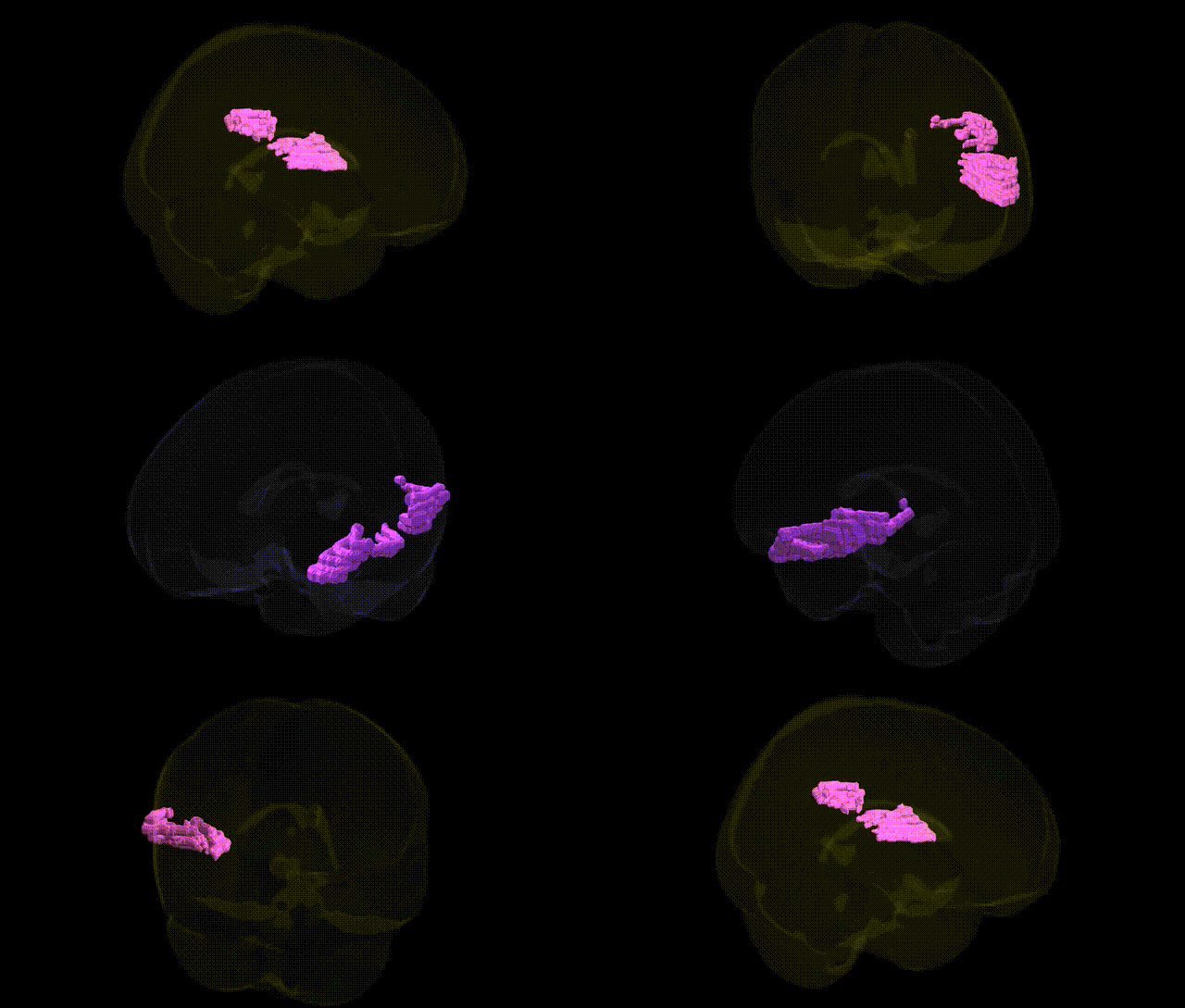
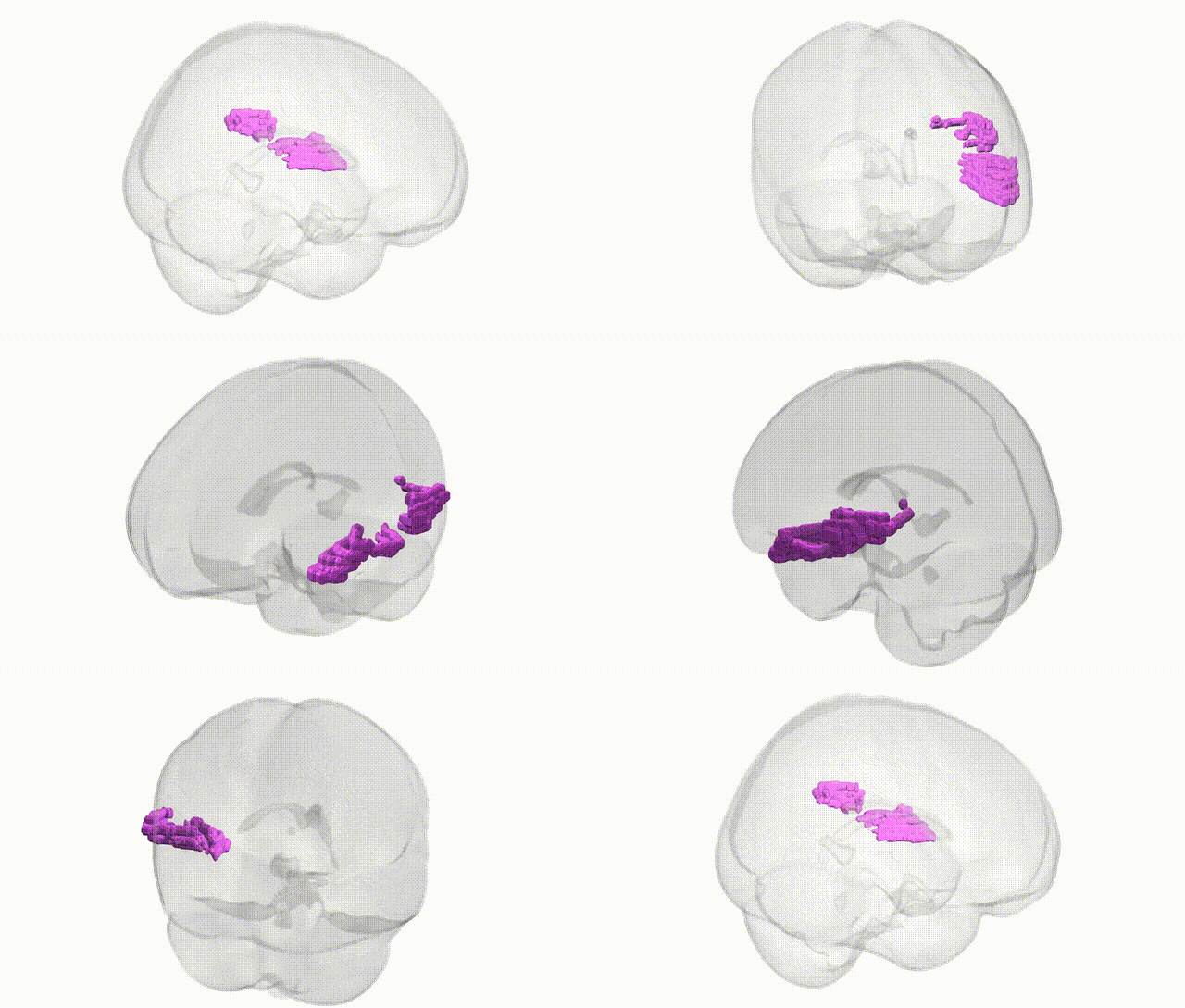
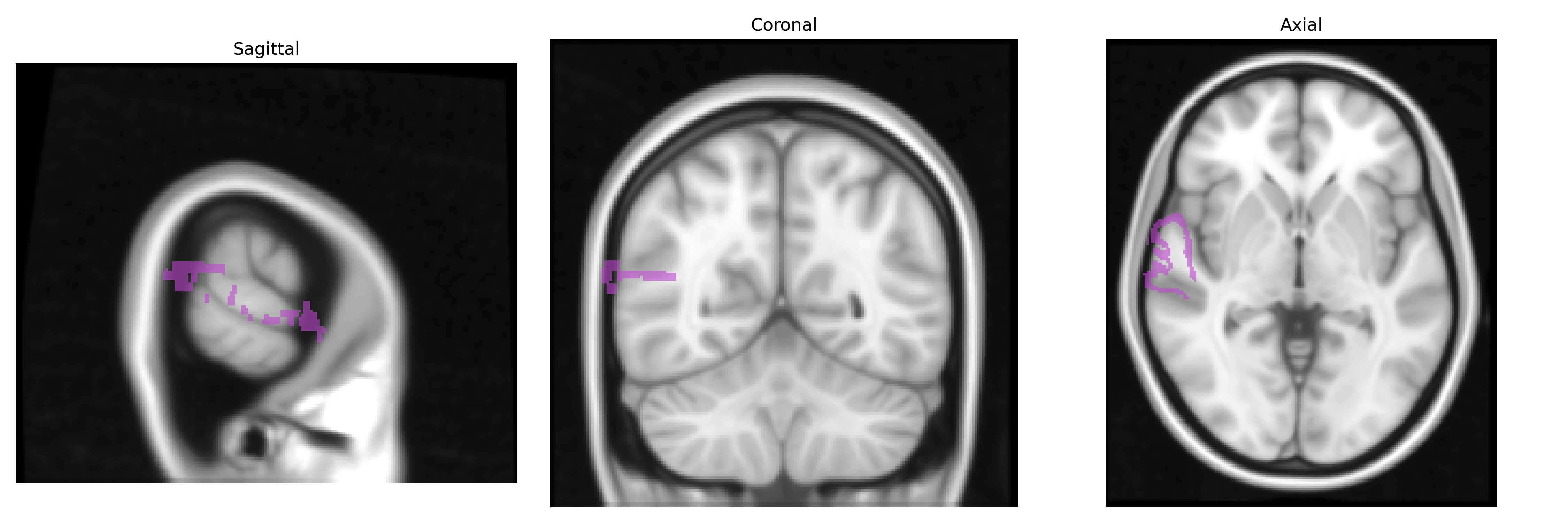
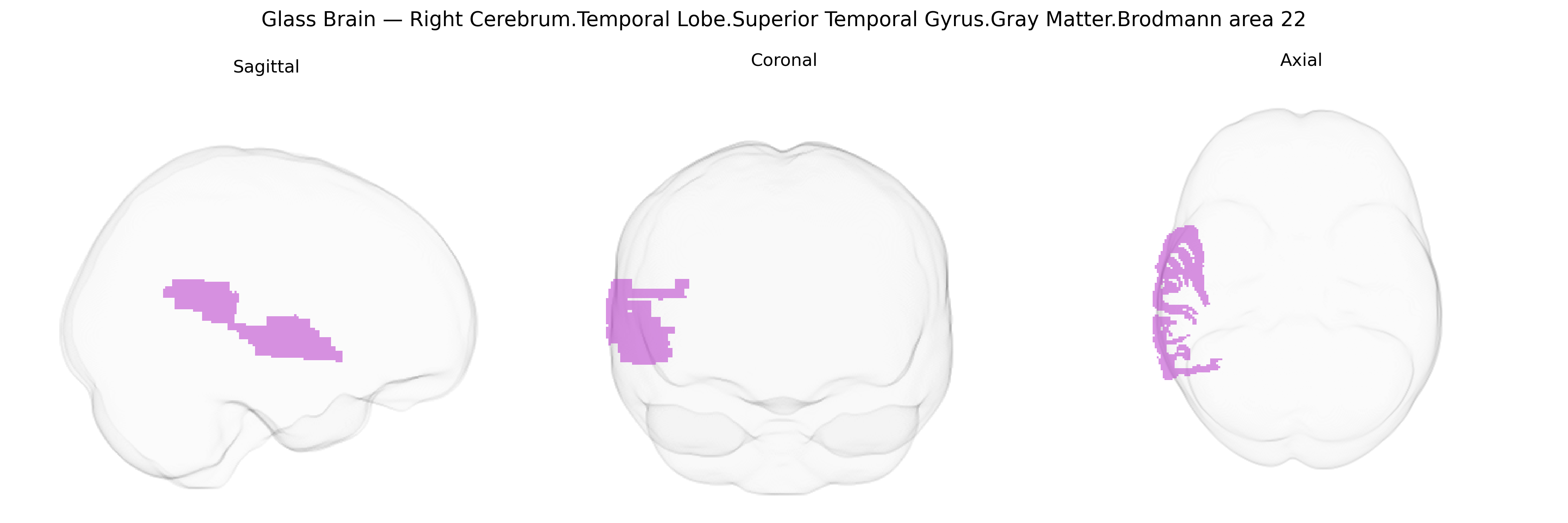
The bilateral Right Cerebrum.Temporal Lobe.Superior Temporal Gyrus.Gray Matter.Brodmann area 22 corresponds primarily to the posterior superior temporal cortex, a key component of the auditory association cortex involved in higher-order processing of complex sounds and language. This region participates in the integration of auditory inputs with linguistic and semantic information, contributing to speech perception, phonological decoding, and aspects of auditory scene analysis. In the dominant hemisphere, it forms a major part of Wernicke’s area, supporting comprehension of spoken language, while in the non-dominant hemisphere it is implicated in processing prosody and certain aspects of music and environmental sound perception. Cytoarchitectonically, Brodmann area 22 is characterized by a well-developed granular layer and distinct columnar organization typical of association cortex, receiving extensive input from primary and secondary auditory areas and projecting to multimodal temporal, parietal, and frontal association regions. Brodmann area 22
The bilateral Right Cerebrum.Temporal Lobe.Superior Temporal Gyrus.Gray Matter.Brodmann area 22 (STG/BA22), a core auditory and language-processing region, shows convergent genetic associations across multiple disorders and traits. GWAS and imaging-genetics studies implicate common variants influencing STG volume, cortical thickness, and functional connectivity, including loci near genes involved in synaptic development and glutamatergic signaling (for example, GRIN2A and other NMDA receptor–related genes), as well as widespread polygenic influences captured by brain-structure GWAS consortia (e.g., ENIGMA) that report heritable variation in temporal lobe morphology. In schizophrenia, risk loci in complement and synaptic genes (such as C4 and others) have been linked to gray matter reductions and altered activation in BA22, consistent with disturbances in auditory hallucinations and language processing; similar structural and functional abnormalities in this region have been associated with polygenic risk for psychosis and with rare copy-number variants (e.g., 22q11.2 deletion). In autism spectrum disorder, de novo and rare variants in synaptic and neurodevelopmental genes (such as SHANK, NRXN, and related pathways) have been tied to atypical superior temporal gyrus development and social communication deficits. In primary progressive aphasia and other frontotemporal lobar degenerations, mutations in genes such as GRN, MAPT, and C9orf72 contribute to neurodegeneration that frequently involves left and right BA22, while APOE ε4 and other Alzheimer’s disease risk loci are associated with temporal lobe atrophy and altered default-mode/auditory network connectivity that includes this region. Additionally, language-related traits (e.g., reading and phonological skills) show associations with genes such as FOXP2 and DCDC2, whose variation affects temporal cortical circuitry encompassing BA22, although effects are typically distributed across broader perisylvian networks rather than confined solely to this specific Talairach-defined parcel.
Overview generated by GPT-4o (2026).
Region ID: 446
Hemisphere: bilateral
Atlas: Talairach labels 1mm
Full Quality Version: Download MP4
Full Quality Version: Download MP4
Wali Sidiqyar*, Gaurav Rudravaram*, Elyssa M. McMaster, Trent M. Schwartz, Adam M. Saunders, Kurt G. Schilling, Bennett A. Landman "Introducing SPINS: A Shared Public Visualization Library of Neuroanatomical Structures." Medical Imaging with Deep Learning- short paper
This resource is licensed under CC0 1.0 Universal (Public Domain).