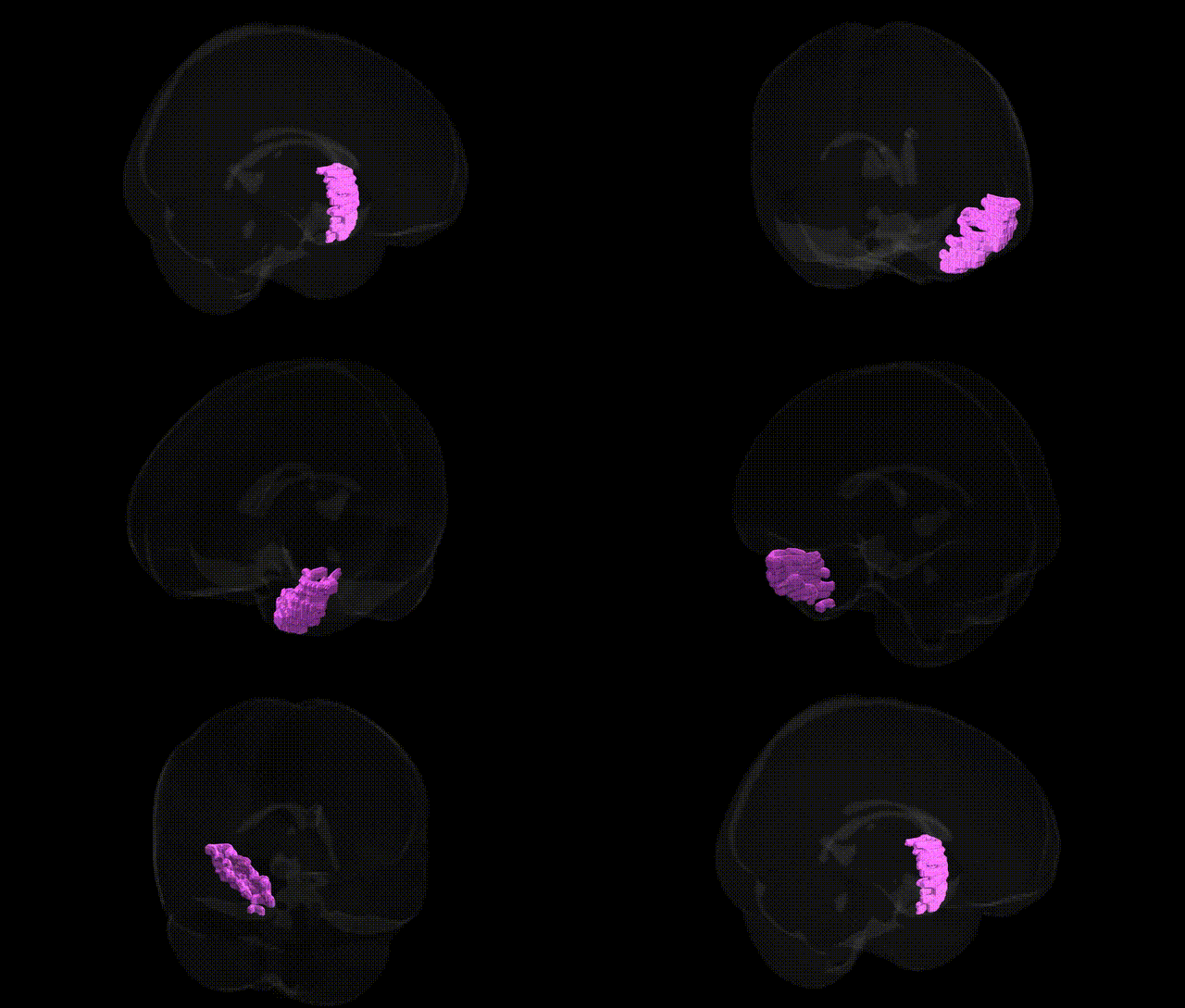
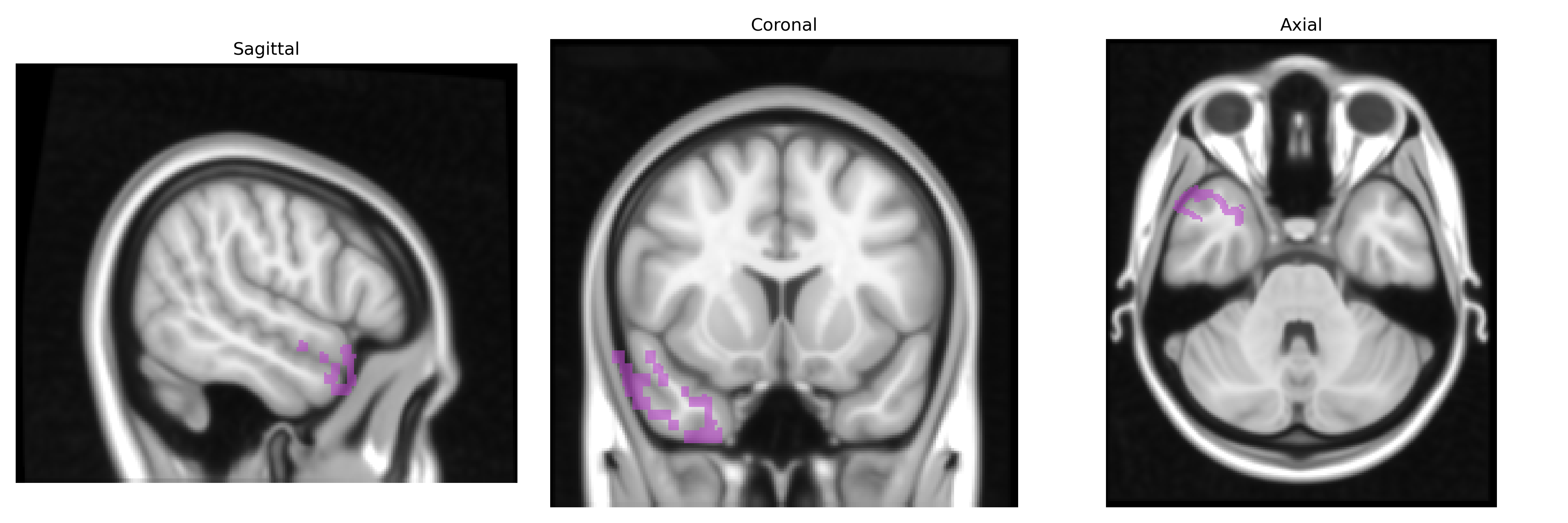
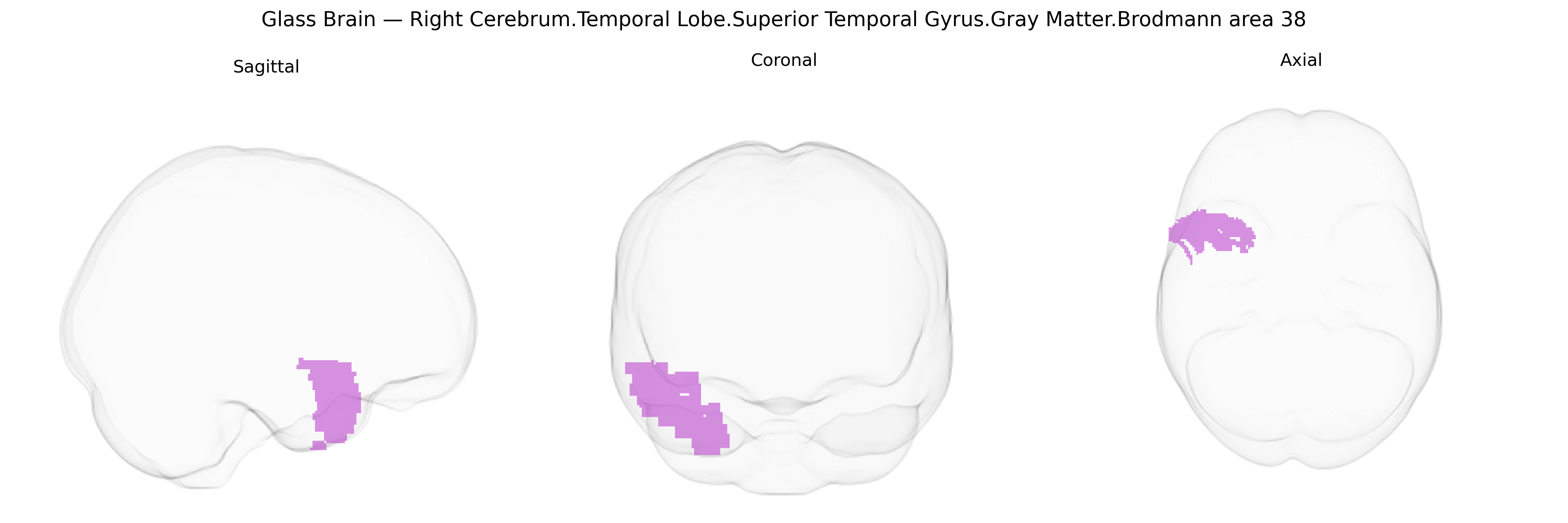
The bilateral Right Cerebrum.Temporal Lobe.Superior Temporal Gyrus.Gray Matter.Brodmann area 38 corresponds to the right temporal pole portion of the superior temporal gyrus, representing the most anterior segment of the temporal cortex in the Talairach 1 mm atlas. This region is cytoarchitectonically defined as Brodmann area 38 and is implicated in high-level multimodal integration, including complex social-emotional processing, semantic memory, and aspects of language and person-related knowledge. It receives convergent input from auditory, visual, and limbic structures, contributing to the association of sensory information with affective and contextual meaning, and is often involved in networks underlying theory of mind and autobiographical memory. There is no direct link for this exact labeled combination; a closely related structure is the Temporal pole.
The bilateral right superior temporal gyrus gray matter in Brodmann area 38 (temporal pole) has been implicated in multiple genetic and GWAS findings through its role in social, emotional, and language-related networks rather than via region-specific genes. Large neuroimaging genetics consortia (e.g., ENIGMA, UK Biobank) report that cortical thickness and surface area in superior temporal regions, including BA38, show significant SNP-based heritability and polygenic influences, with loci near genes involved in neurodevelopment (such as HMGA2, MIR588, and others on 15q21 and 3p26) contributing to temporal lobe morphology; some variants overlap with those affecting global brain size and height. GWAS of schizophrenia, bipolar disorder, and major depressive disorder frequently identify case–control differences and genetically influenced cortical thinning or volume reduction in anterior and superior temporal cortex, while autism spectrum disorder and social cognition traits show associations between polygenic risk scores and altered structure or activation in temporal pole/superior temporal regions. Temporal lobe epilepsy genetics (including variants in LGI1, RELN, and other synaptic or neuronal migration genes) often involve anterior temporal structures, with imaging studies linking genetic risk to gray matter abnormalities encompassing BA38. Language-related GWAS (e.g., for reading, verbal abilities, and developmental language disorder) and studies of FOXP2-related pathways implicate superior and anterior temporal regions, including BA38, via structural and functional imaging endophenotypes, although no single gene is uniquely tied to this specific Talairach-defined parcel. Overall, genetic influences on this region appear highly polygenic and pleiotropic, shared with broader temporal and frontotemporal networks involved in social-emotional processing, semantic memory, and language.
Overview generated by GPT-4o (2026).
Region ID: 41
Hemisphere: bilateral
Atlas: Talairach labels 1mm
Full Quality Version: Download MP4
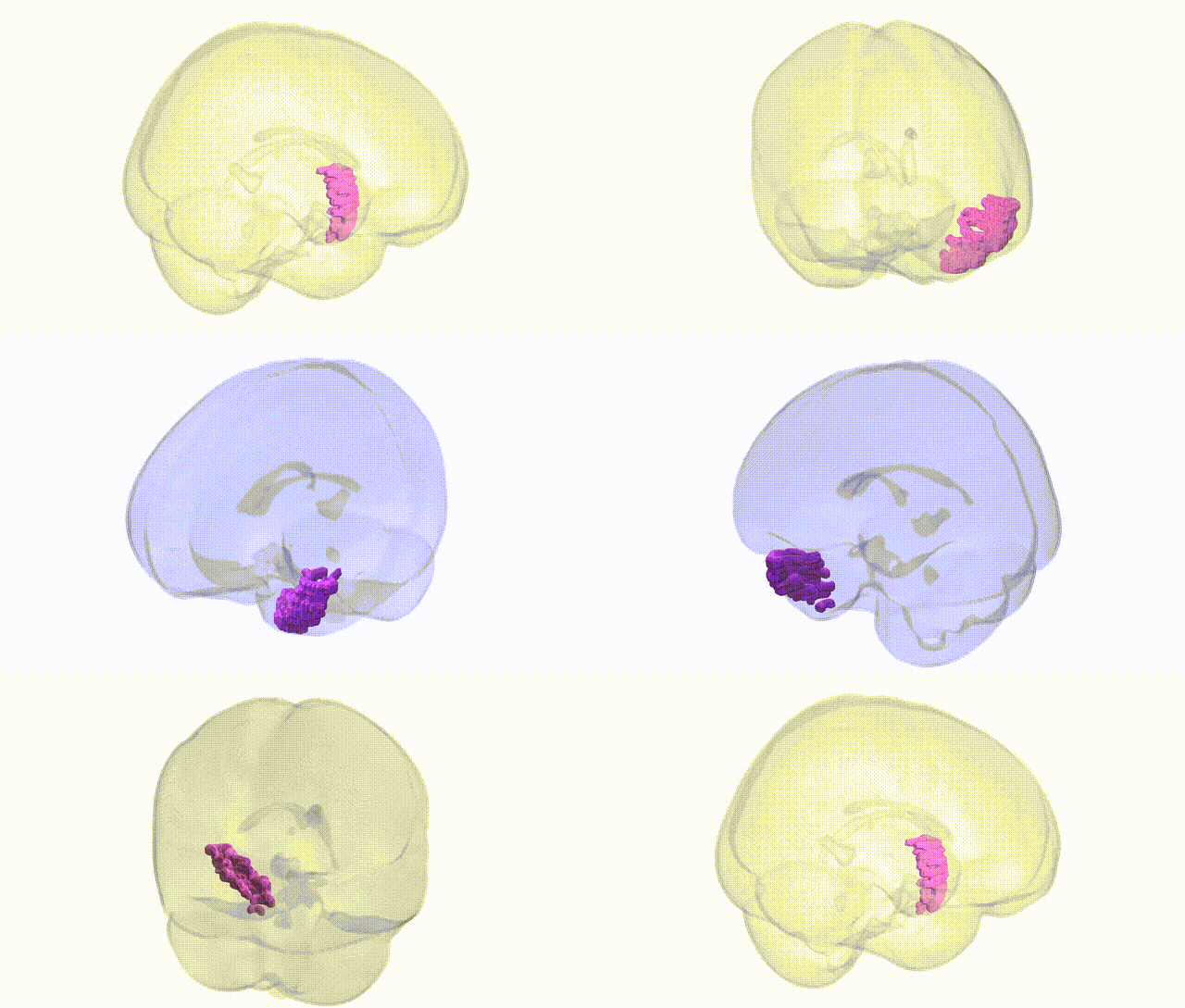
Full Quality Version: Download MP4
Wali Sidiqyar*, Gaurav Rudravaram*, Elyssa M. McMaster, Trent M. Schwartz, Adam M. Saunders, Kurt G. Schilling, Bennett A. Landman "Introducing SPINS: A Shared Public Visualization Library of Neuroanatomical Structures." Medical Imaging with Deep Learning- short paper
This resource is licensed under CC0 1.0 Universal (Public Domain).