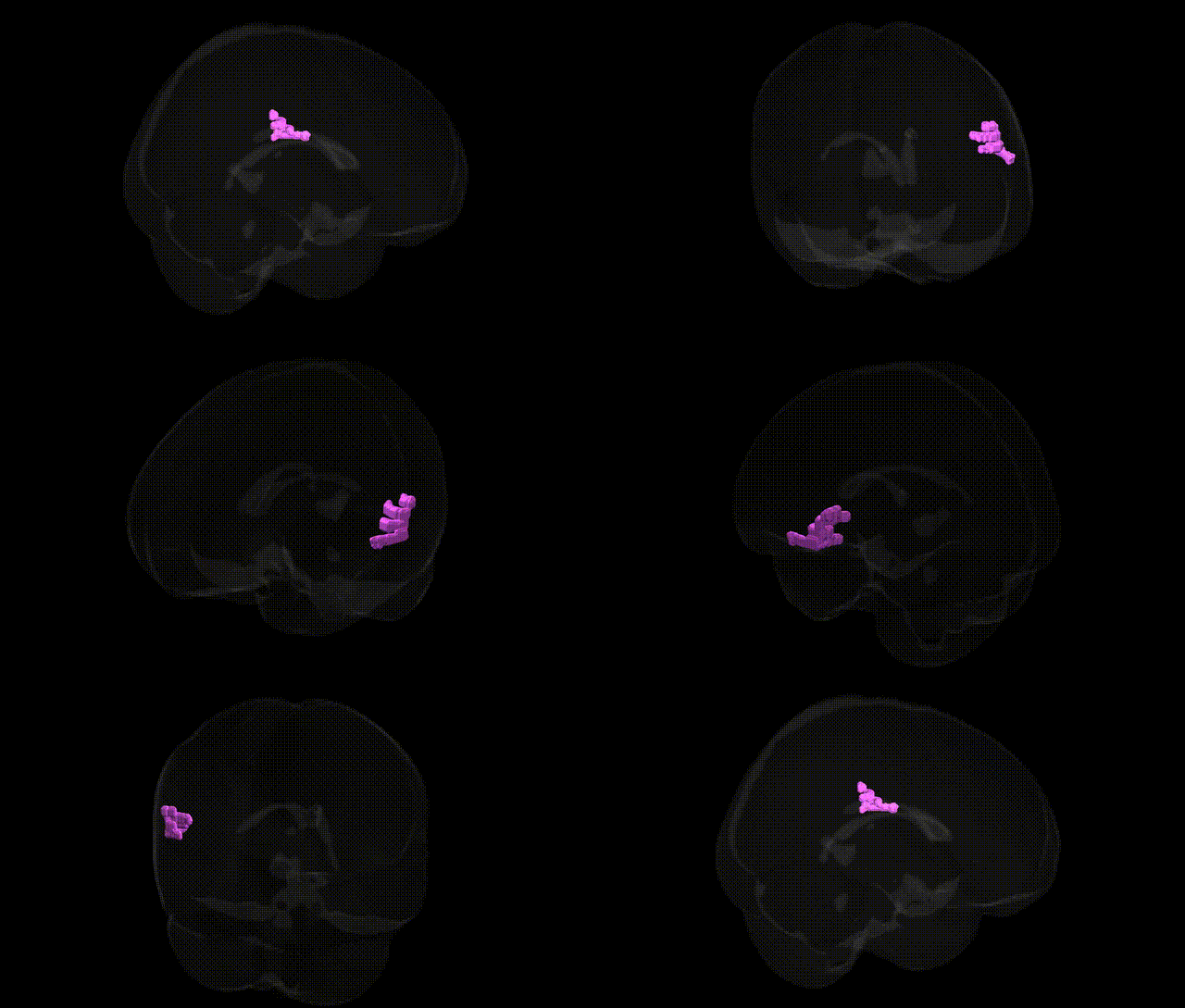
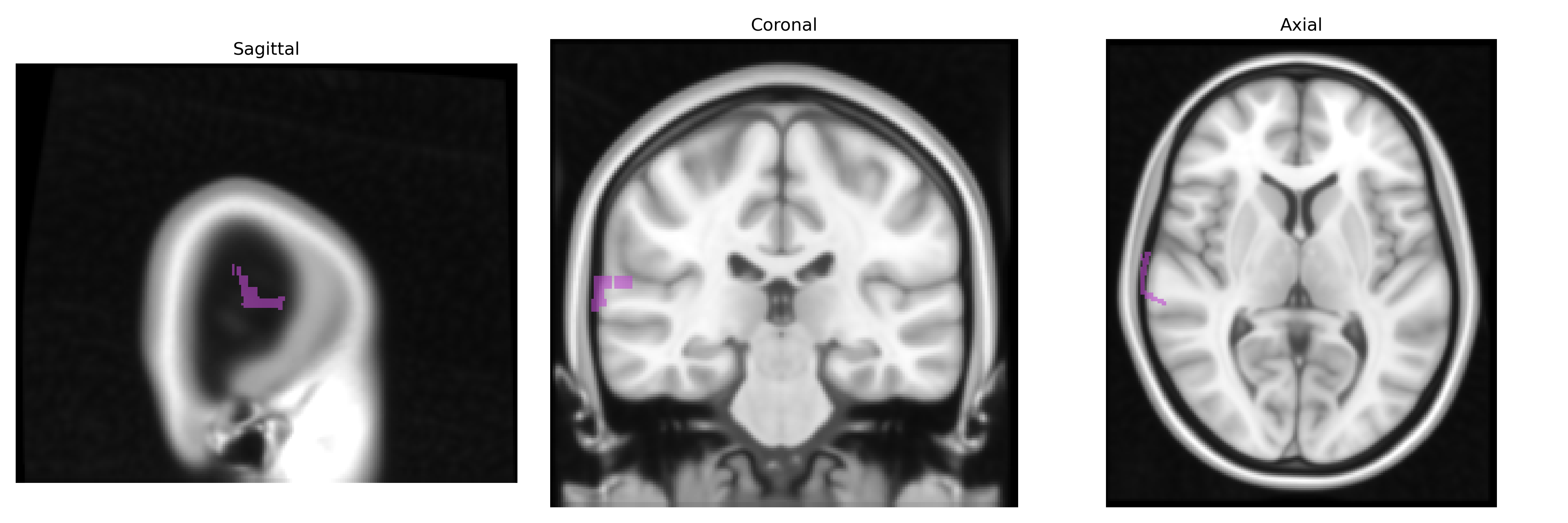
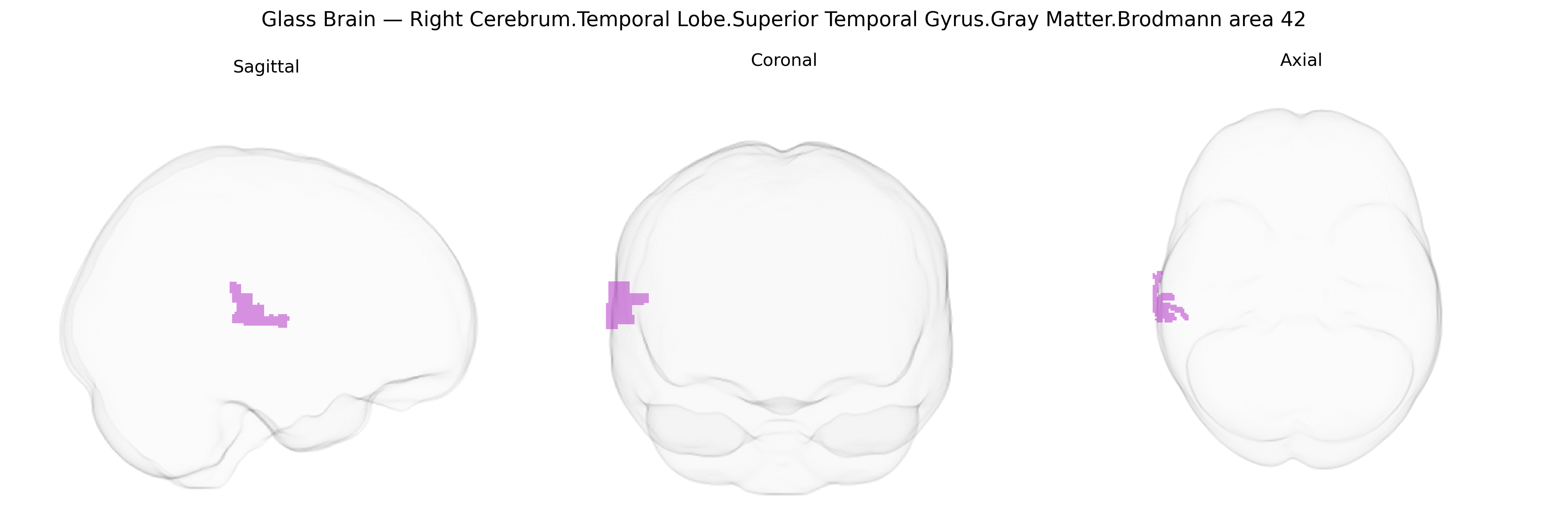
The bilateral Right Cerebrum.Temporal Lobe.Superior Temporal Gyrus.Gray Matter.Brodmann area 42 corresponds to a segment of the primary auditory cortex situated on the superior temporal gyrus of the right hemisphere, adjacent to and often functionally integrated with Brodmann area 41. This region participates in early-stage processing of auditory information, including basic spectral and temporal features of sound, and contributes to the analysis of complex acoustic patterns such as speech and environmental sounds. Although often less dominant than the left hemisphere for language-specific processing, the right BA42 is particularly implicated in aspects of prosody, pitch, and music perception, supporting hemispheric specialization within the auditory system. Cytoarchitectonically, it is characterized by granular cortex typical of primary sensory areas, receiving dense thalamocortical projections from the medial geniculate nucleus of the thalamus and projecting to higher-order auditory association areas in the temporal lobe.
Brodmann area 42 in the bilateral superior temporal gyrus, a core auditory and speech-perception region, has been implicated in multiple genetic and GWAS-based associations, though typically as part of broader temporal-lobe or superior temporal gyrus measures rather than isolated BA42. Structural and functional variation in this region has been linked to common variants in genes involved in synaptic function, neurodevelopment, and language/auditory processing, including FOXP2, CNTNAP2, DCDC2, KIAA0319, and ROBO1 in studies of language impairment, dyslexia, and speech-sound disorders, as well as GRIN2A in epilepsy-aphasia syndromes and speech/language impairment. Large-scale imaging–genetics consortia (e.g., ENIGMA and UK Biobank) have reported associations between temporal cortical thickness or surface area and loci near genes such as HMGA2, IGF1, and WNT signaling components, while polygenic risk for schizophrenia, bipolar disorder, and major depression correlates with gray matter reductions or altered activation in superior temporal regions implicated in auditory hallucinations and social cognition. GWAS of tinnitus and hearing-related traits have identified risk loci (e.g., near RCOR1, ARID5B, and genes regulating cochlear or synaptic function) that show downstream effects on auditory cortex including BA42, and autism-spectrum and social-communication GWAS have implicated temporal-lobe–expressed genes (e.g., NRXN1, SHANK3, and other synaptic scaffolding genes) in structural and connectivity alterations encompassing superior temporal regions. Overall, genetic influences on this area appear highly polygenic and pleiotropic, involving networks of neurodevelopmental and synaptic genes that impact auditory perception, language, psychosis risk, and neurodevelopmental/psychiatric phenotypes rather than BA42-specific effects.
Overview generated by GPT-4o (2026).
Region ID: 675
Hemisphere: bilateral
Atlas: Talairach labels 1mm
Full Quality Version: Download MP4
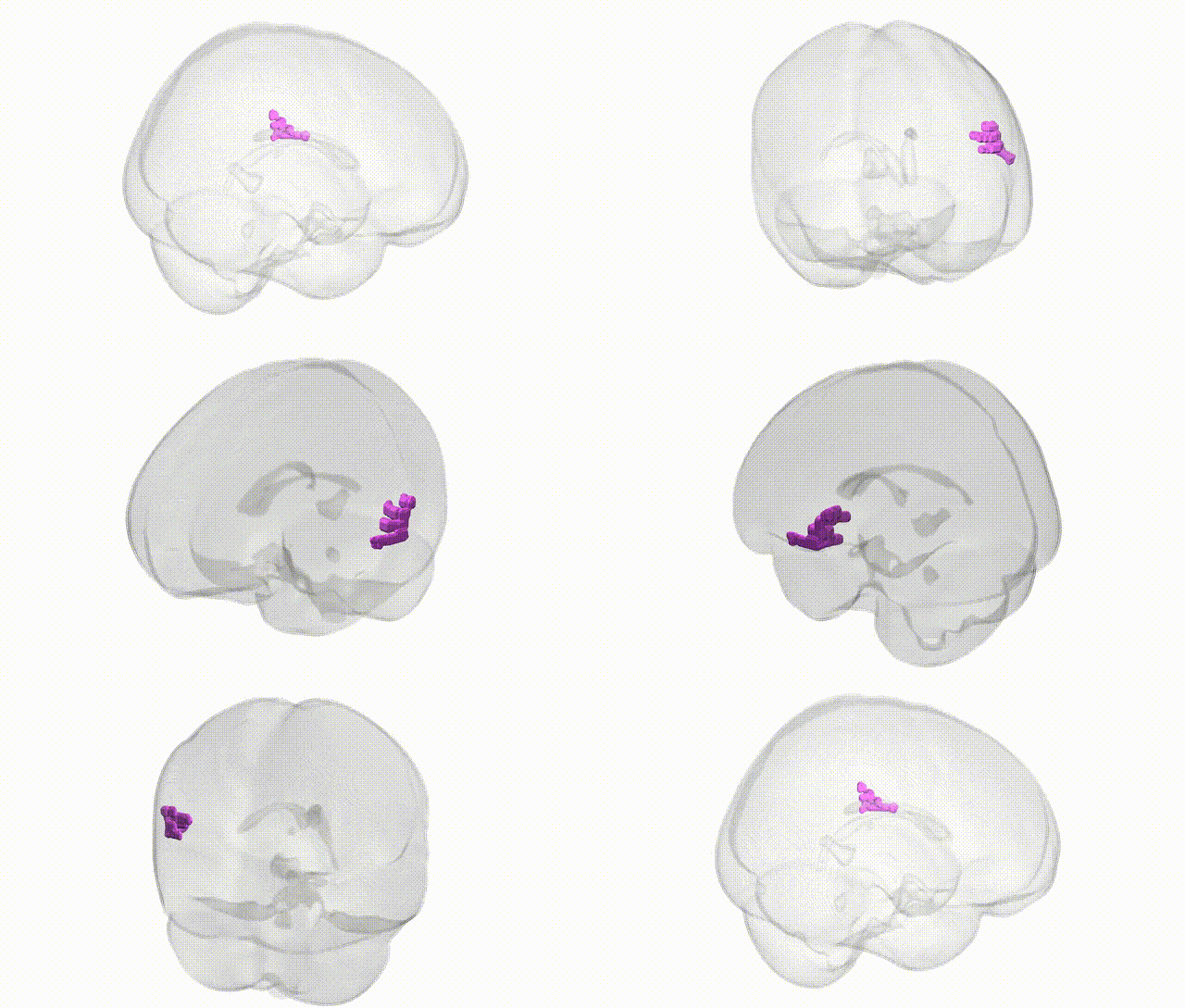
Full Quality Version: Download MP4
Wali Sidiqyar*, Gaurav Rudravaram*, Elyssa M. McMaster, Trent M. Schwartz, Adam M. Saunders, Kurt G. Schilling, Bennett A. Landman "Introducing SPINS: A Shared Public Visualization Library of Neuroanatomical Structures." Medical Imaging with Deep Learning- short paper
This resource is licensed under CC0 1.0 Universal (Public Domain).