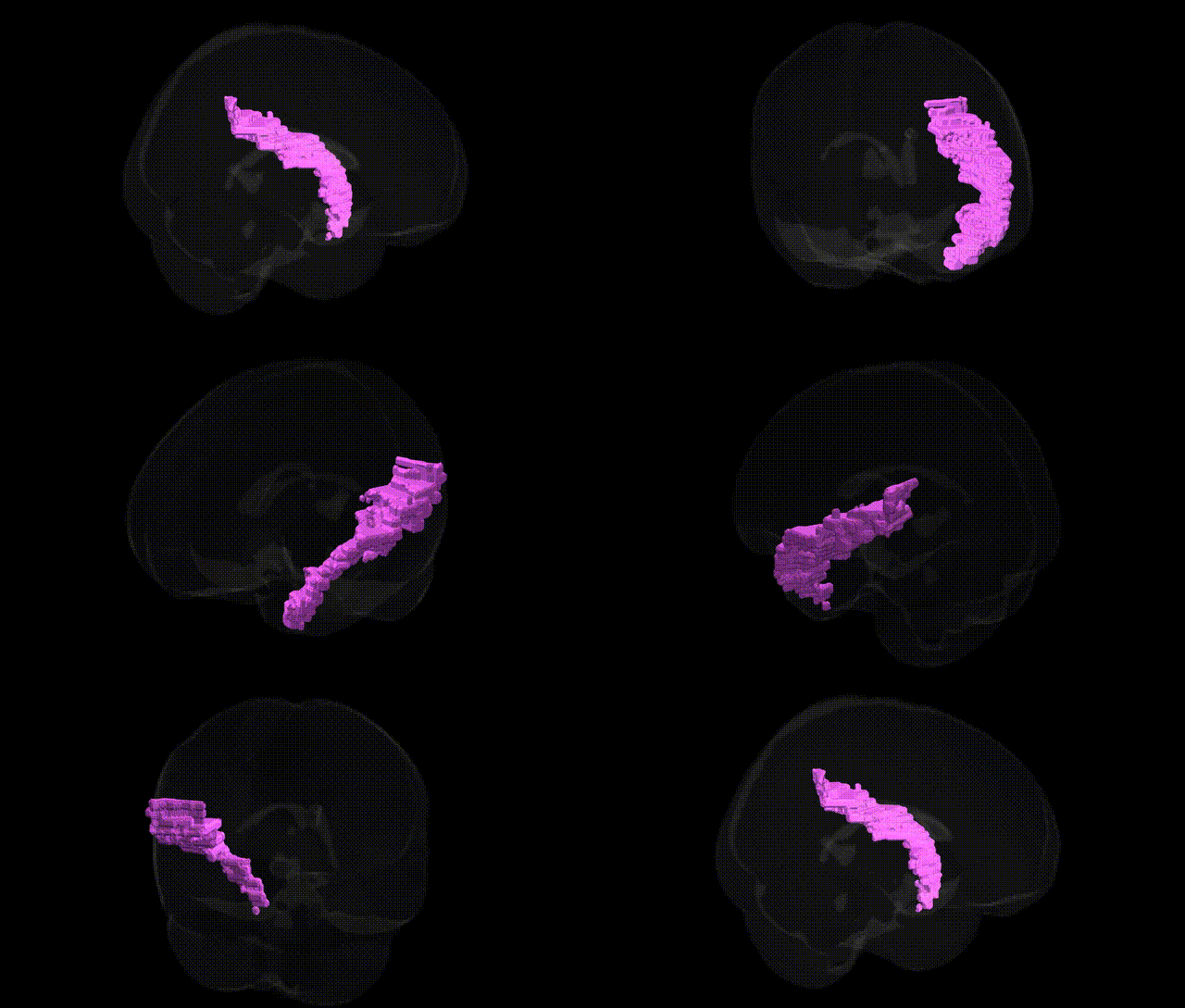
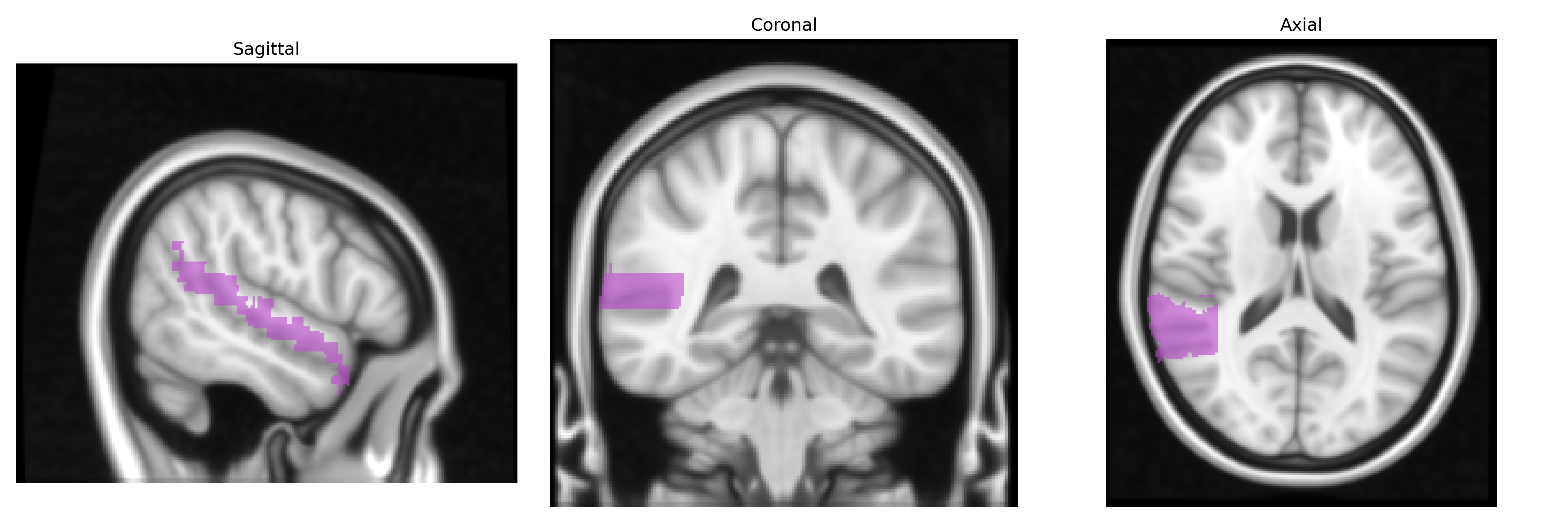
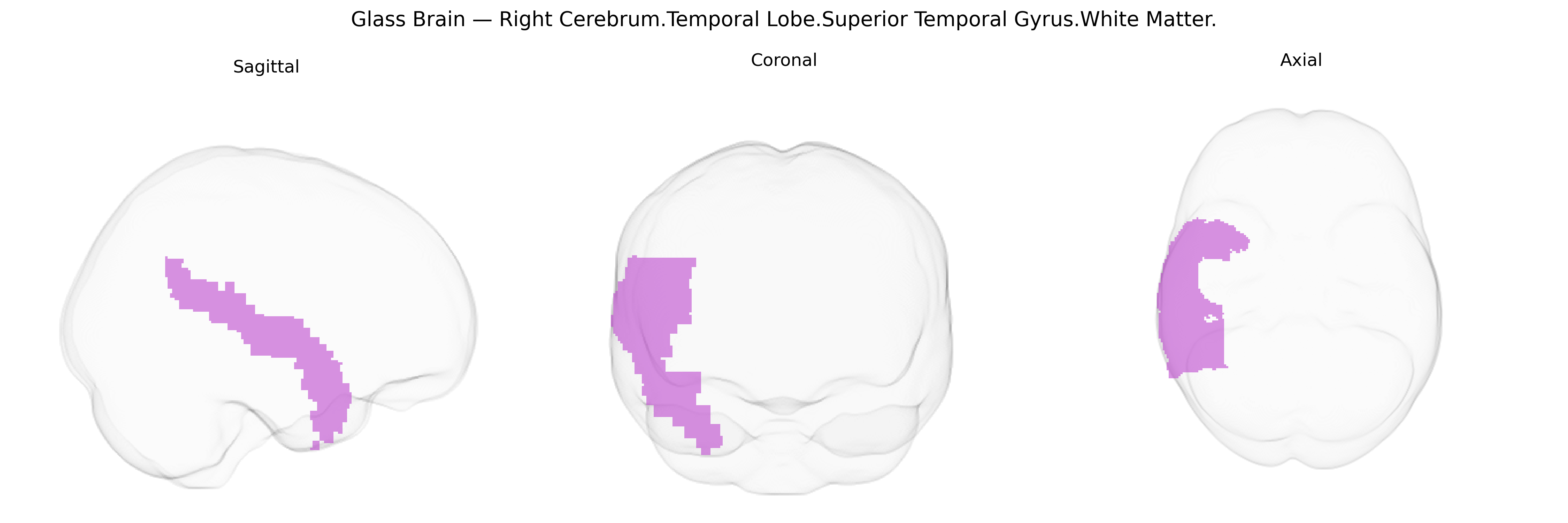
The bilateral Right Cerebrum.Temporal Lobe.Superior Temporal Gyrus.White Matter corresponds to the deep myelinated fiber pathways underlying the right superior temporal gyrus, a key region of the lateral temporal cortex. These white matter tracts interconnect primary and secondary auditory areas, language-related cortex (particularly in the dominant hemisphere via interhemispheric connections), and multimodal association regions involved in social cognition, speech perception, and higher-order auditory processing. Major fasciculi coursing through or near this white matter include segments of the arcuate/superior longitudinal fasciculus and fibers linking temporal regions with parietal and frontal association cortices, supporting integration of auditory, linguistic, and contextual information. There is no direct Wikipedia article for this specific white matter label; a related cortical structure is the Superior Temporal Gyrus.
The bilateral Right Cerebrum.Temporal Lobe.Superior Temporal Gyrus.White Matter region, as defined in the Talairach 1 mm atlas, encompasses major long-range association pathways (notably arcuate and superior longitudinal fasciculi components) that have been repeatedly implicated in genetic imaging and GWAS studies of language, social cognition, and psychiatric risk. Twin and SNP-heritability work shows substantial genetic influence on superior temporal white-matter microstructure (e.g., fractional anisotropy), with variants in genes involved in axon guidance, myelination, and synaptic development—such as CNTNAP2, FOXP2 pathways, NRG1/ERBB signaling, and neuregulin-related loci—linked to structural and functional differences in temporal language networks. Large-scale imaging-genetics consortia (ENIGMA and related datasets) report that polygenic scores for schizophrenia, bipolar disorder, and major depression associate with altered temporal lobe white-matter integrity, and GWAS of psychosis risk highlight loci (e.g., ZNF804A, CACNA1C, and other calcium-channel and synaptic genes) whose carriers show reduced superior temporal connectivity. Autism spectrum disorder risk variants and polygenic scores have been associated with atypical superior temporal white matter, particularly in tracts supporting social perception and language. GWAS of reading ability, dyslexia, and language-related traits link common variants in KIAA0319, DCDC2, and other neuronal migration genes to microstructural properties of temporal lobe white matter, while hearing-related and auditory processing genes have also been tied to superior temporal pathways. Overall, genetic influences on this region’s white matter converge on neurodevelopmental, synaptic, and myelination processes, and are reflected in susceptibility to schizophrenia, autism, language and reading disorders, and mood-related traits.
Overview generated by GPT-4o (2026).
Region ID: 42
Hemisphere: bilateral
Atlas: Talairach labels 1mm
Full Quality Version: Download MP4
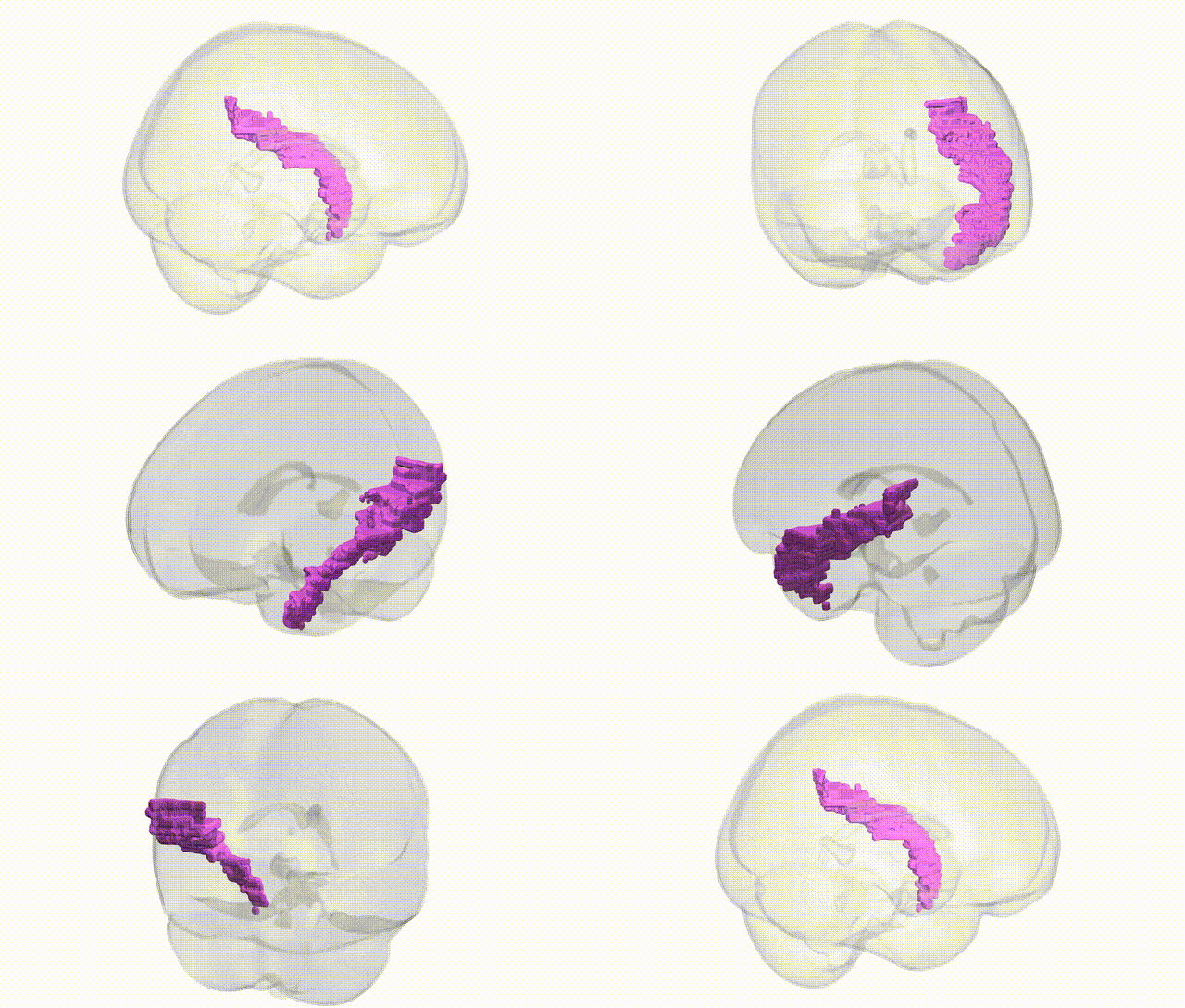
Full Quality Version: Download MP4
Wali Sidiqyar*, Gaurav Rudravaram*, Elyssa M. McMaster, Trent M. Schwartz, Adam M. Saunders, Kurt G. Schilling, Bennett A. Landman "Introducing SPINS: A Shared Public Visualization Library of Neuroanatomical Structures." Medical Imaging with Deep Learning- short paper
This resource is licensed under CC0 1.0 Universal (Public Domain).