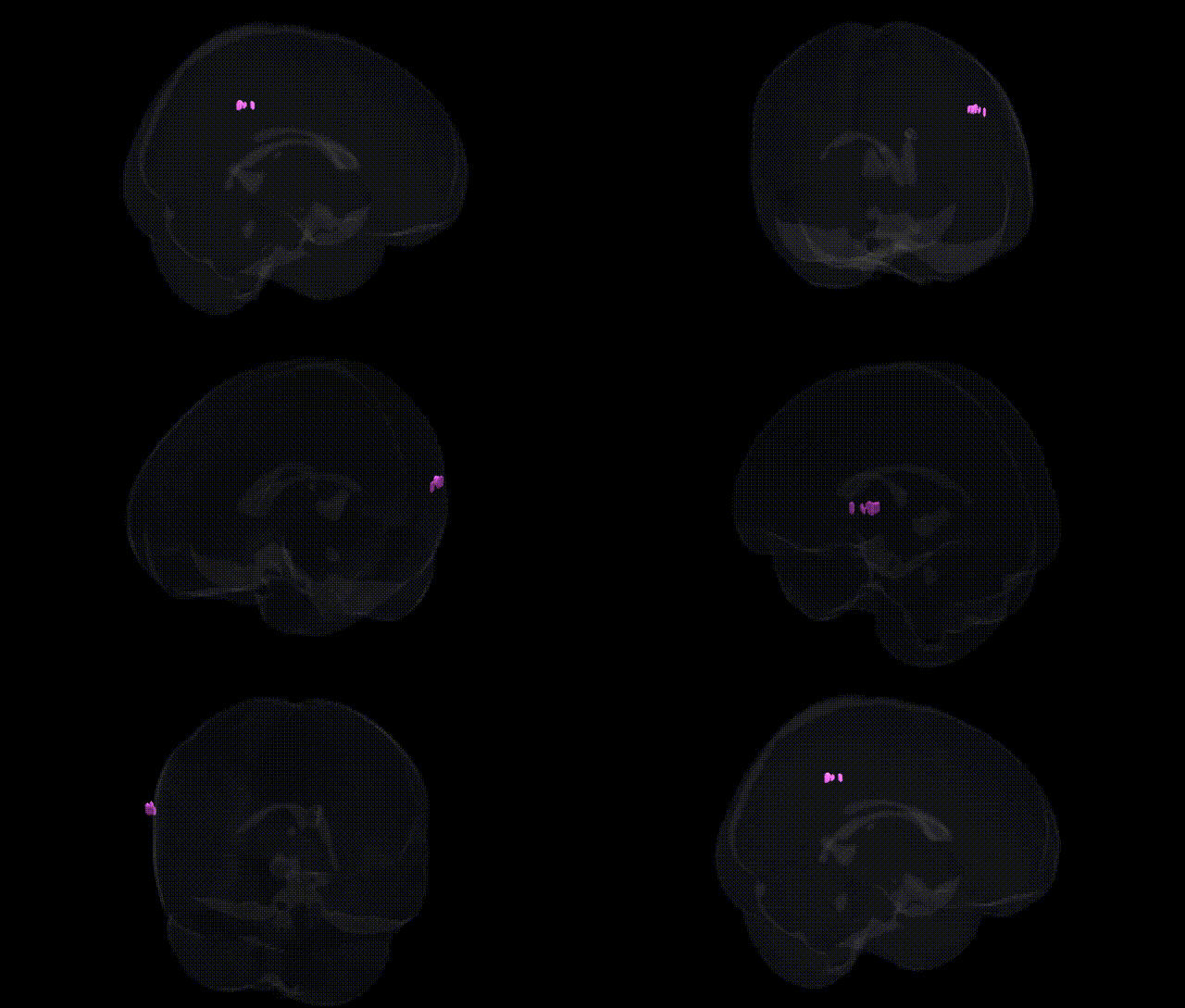
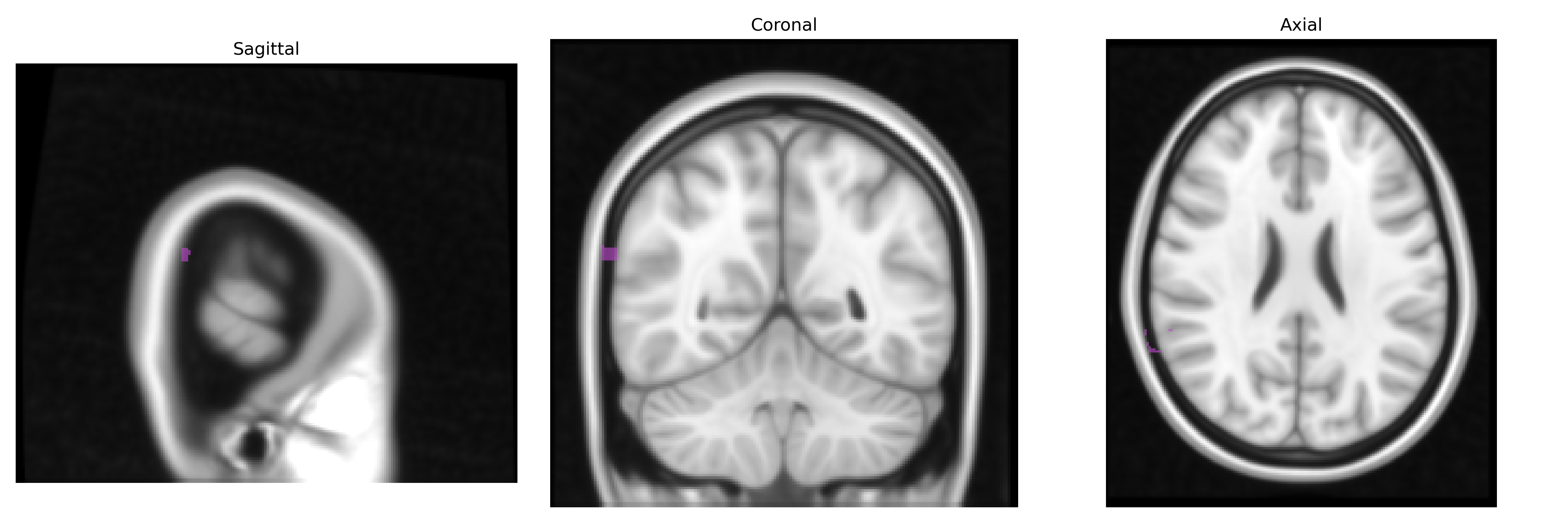
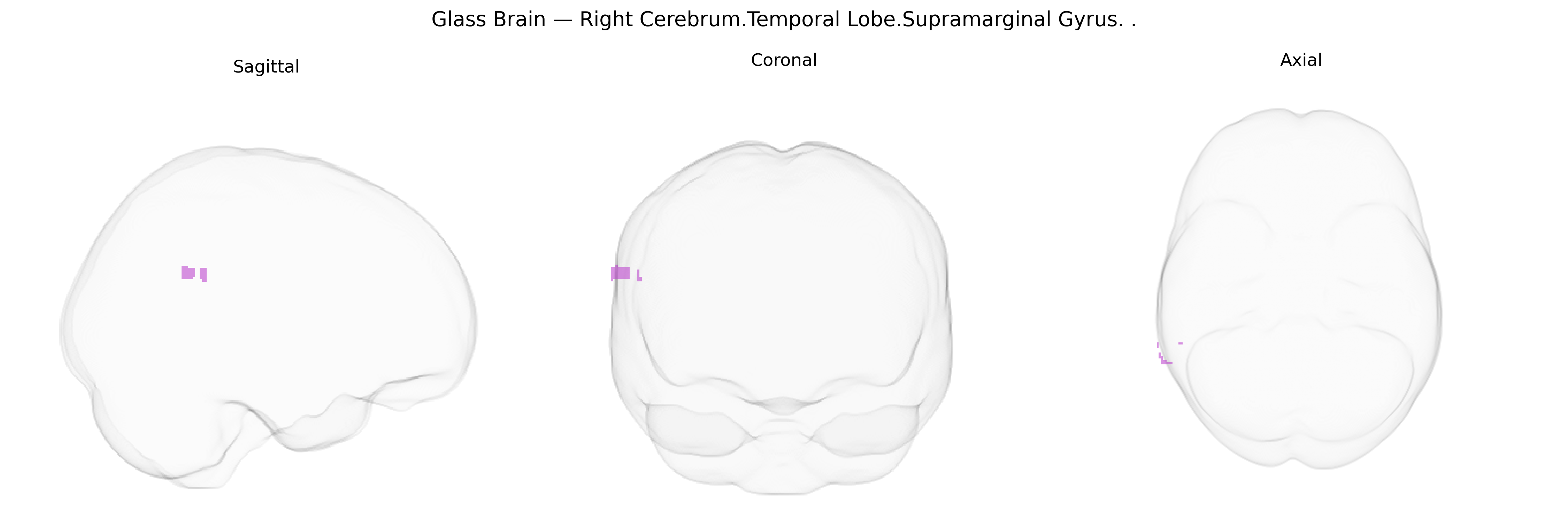
The bilateral Right Cerebrum.Temporal Lobe.Supramarginal Gyrus, as defined in the Talairach labels 1 mm atlas, corresponds primarily to the supramarginal gyrus located at the posterior end of the Sylvian (lateral) fissure, wrapping around its terminal segment and forming part of the inferior parietal lobule at the parietotemporal junction. Functionally, this region is implicated in phonological processing, language comprehension, and integration of auditory, somatosensory, and visual information, and it plays a role in praxis, spatial attention, and aspects of social cognition such as empathy and perspective taking. Although the atlas label specifies the temporal lobe, the supramarginal gyrus is classically considered a parietal structure bordering temporal cortex and interacting closely with adjacent superior temporal and angular gyri in multimodal association networks. There is no direct link for “Right Cerebrum.Temporal Lobe.Supramarginal Gyrus”; a related article is Supramarginal gyrus.
The supramarginal gyrus, a key component of the inferior parietal lobule bordering the temporal lobe, shows convergent genetic associations from GWAS and imaging–genetics studies implicating neurodevelopmental, synaptic, and language-related pathways. Structural and functional variation in this region has been linked to common polymorphisms in genes affecting cortical development and connectivity (e.g., CNTNAP2, FOXP2-related networks, and other synaptic genes) in the context of language ability, reading and dyslexia, and speech–language disorders; several large-scale ENIGMA and UK Biobank analyses have identified polygenic influences on supramarginal gyrus thickness and surface area, indicating substantial heritability and overlap with general cognitive ability and educational attainment polygenic scores. Genetic risk for neurodevelopmental and psychiatric conditions—including autism spectrum disorder, ADHD, and schizophrenia—has been associated with altered supramarginal gyrus morphology or activation, with risk loci often converging on synaptic, glutamatergic, and neuronal migration pathways that show enriched expression in temporoparietal association cortex. In mood and anxiety disorders, polygenic risk scores for depression and related traits correlate with microstructural and volumetric measures in inferior parietal and supramarginal regions, suggesting this territory as a downstream target of broad affective risk architectures. GWAS of chronic pain, social cognition, empathy, and prosocial behavior have also highlighted temporoparietal association areas—including the supramarginal gyrus—as sites where identified genetic variants (e.g., in genes regulating neuroinflammation, myelination, and large-scale network organization) may exert effects on perspective-taking, emotional processing, and pain reappraisal. Collectively, these findings support the supramarginal gyrus as a genetically influenced hub for language, higher-order cognition, social–emotional processing, and psychiatric vulnerability, shaped by polygenic architectures rather than single-gene effects.
Overview generated by GPT-4o (2026).
Region ID: 873
Hemisphere: bilateral
Atlas: Talairach labels 1mm
Full Quality Version: Download MP4
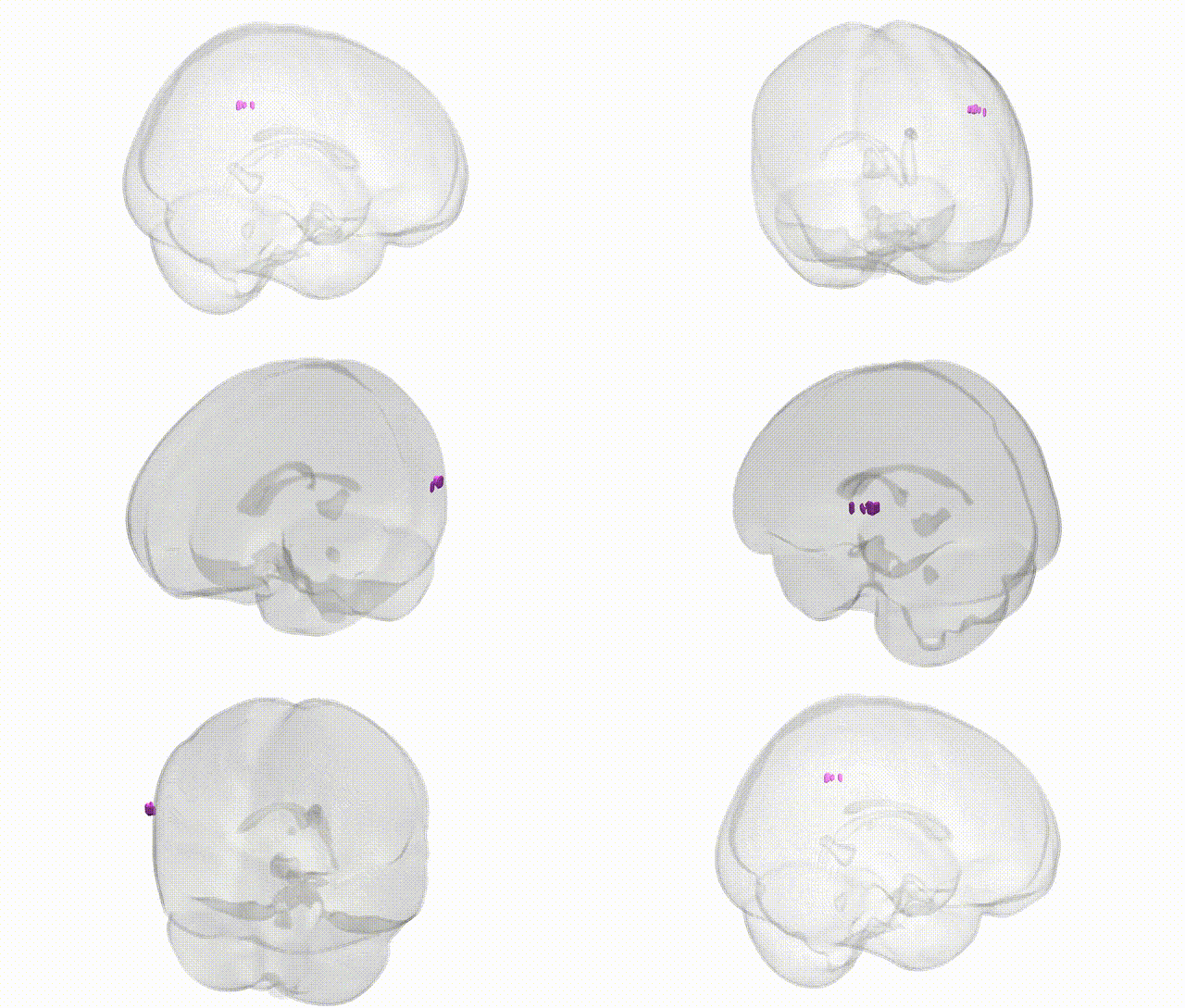
Full Quality Version: Download MP4
Wali Sidiqyar*, Gaurav Rudravaram*, Elyssa M. McMaster, Trent M. Schwartz, Adam M. Saunders, Kurt G. Schilling, Bennett A. Landman "Introducing SPINS: A Shared Public Visualization Library of Neuroanatomical Structures." Medical Imaging with Deep Learning- short paper
This resource is licensed under CC0 1.0 Universal (Public Domain).