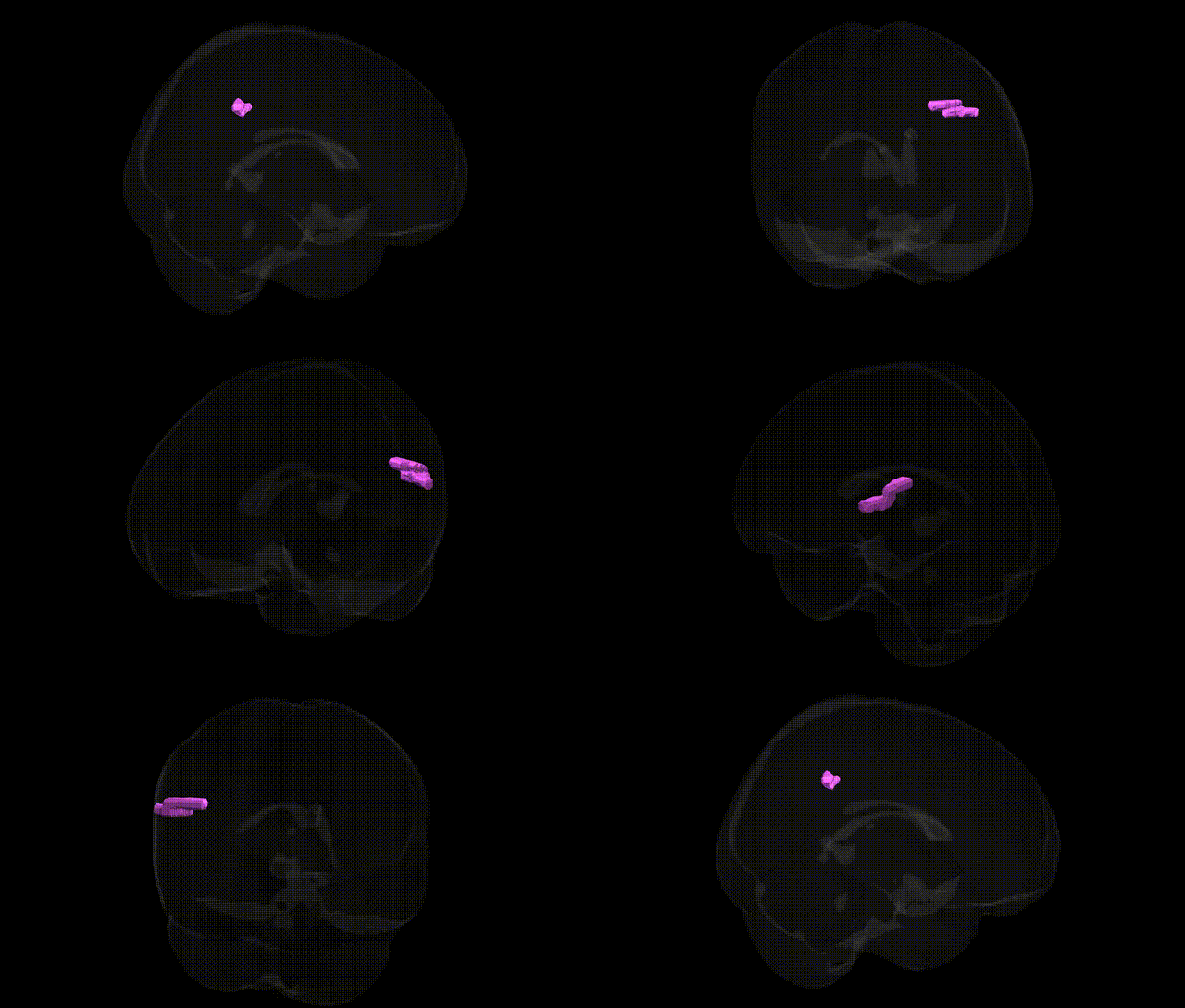
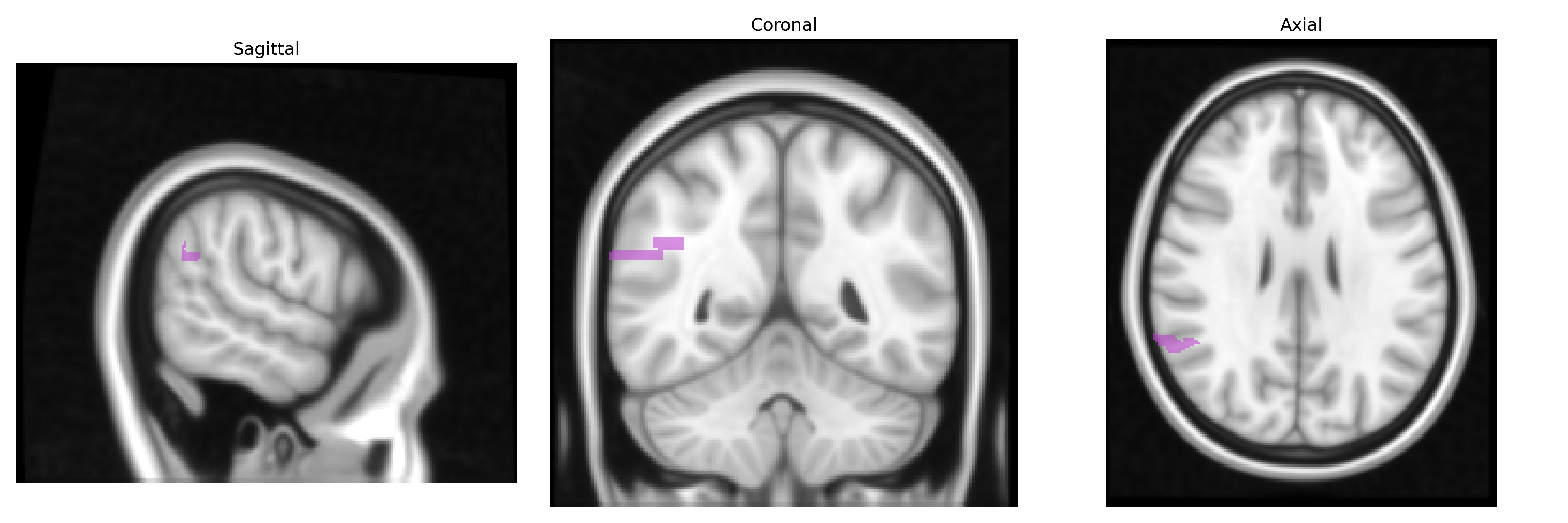
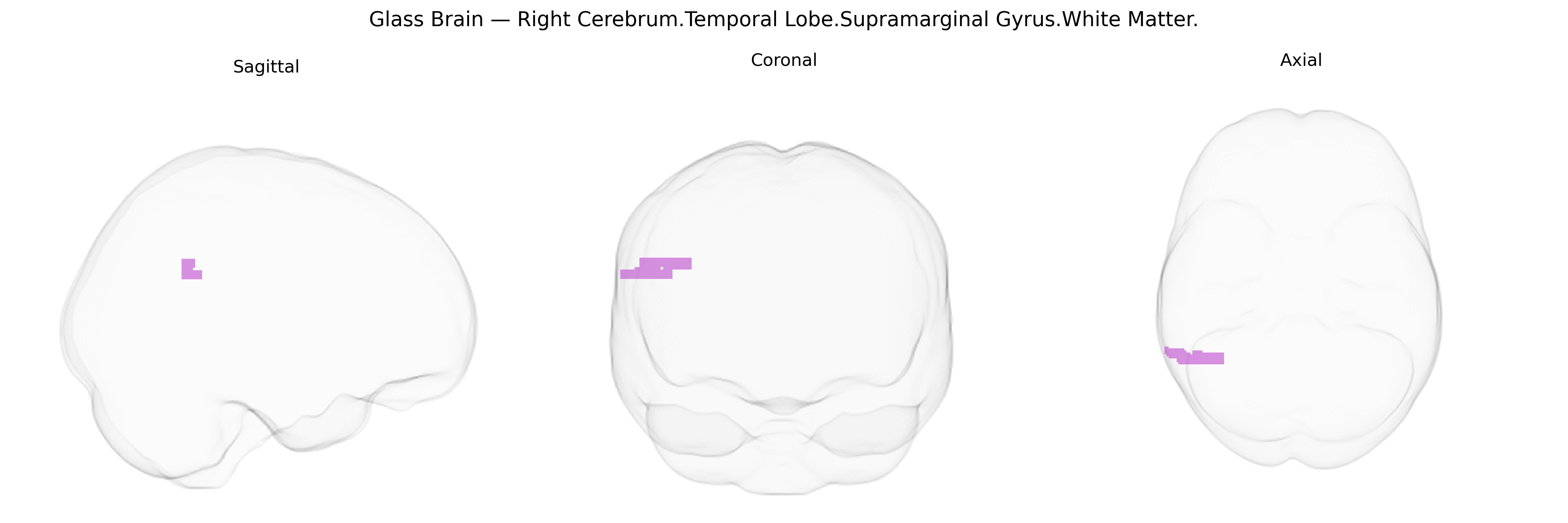
The bilateral Right Cerebrum.Temporal Lobe.Supramarginal Gyrus.White Matter region, as defined in the Talairach 1 mm Atlas, corresponds to subcortical association fibers underlying the supramarginal gyrus at the temporoparietal junction, which is traditionally considered part of the inferior parietal lobule rather than the temporal lobe proper. These white matter tracts participate in long-range connectivity linking perisylvian language areas, somatosensory association cortices, and multimodal integration regions involved in phonological processing, praxis, spatial attention, and aspects of social cognition. Major fasciculi traversing or adjacent to this area may include components of the superior longitudinal and arcuate fasciculi, which support dorsal language and sensorimotor networks. There is no direct Wikipedia article for this exact white matter label; a closely related cortical structure is the Supramarginal gyrus.
The bilateral right supramarginal gyrus white matter, as labeled in the Talairach 1 mm atlas, lies within the temporo‑parietal association network and has been implicated indirectly through GWAS and imaging‑genetics studies that link common variants to white‑matter microstructure, language, social cognition, and psychiatric risk. Large consortia (e.g., ENIGMA) have shown that polymorphisms in genes involved in myelination and axon guidance (such as variants near NTRK3, ERBB4, and genes in the neuregulin/ErbB and oligodendrocyte pathways) are associated with diffusion MRI metrics in temporoparietal tracts coursing through or adjacent to the supramarginal gyrus, including segments of the superior longitudinal and arcuate fasciculi. These tracts, and thus their supramarginal white matter segments, show genetic correlations with language‑related traits (reading ability, dyslexia risk), working memory, and social communication phenotypes, as well as liability to neurodevelopmental and psychiatric disorders such as autism spectrum disorder, schizophrenia, and attention‑deficit/hyperactivity disorder, in which risk loci often converge on synaptic, glutamatergic, and neurodevelopmental genes that modulate temporoparietal connectivity. In addition, polygenic scores for Alzheimer’s disease, major depressive disorder, and general cognitive ability have been associated with interindividual differences in temporoparietal white‑matter integrity, suggesting that the right supramarginal gyrus white matter participates in broader genetically influenced networks underpinning language, episodic memory, and higher‑order association functions, even though very few GWAS report this sub‑region as a primary, isolated locus.
Overview generated by GPT-4o (2026).
Region ID: 871
Hemisphere: bilateral
Atlas: Talairach labels 1mm
Full Quality Version: Download MP4
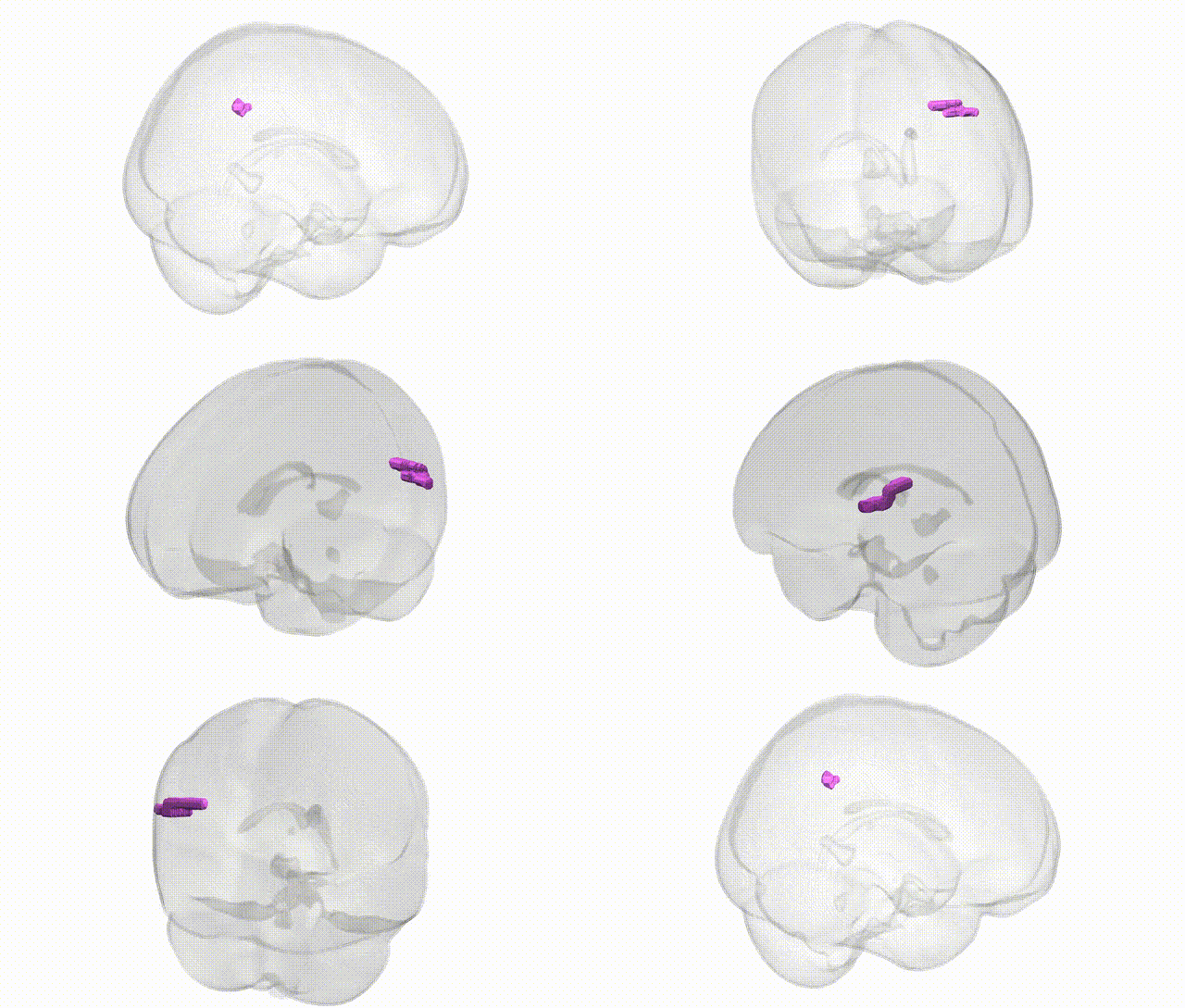
Full Quality Version: Download MP4
Wali Sidiqyar*, Gaurav Rudravaram*, Elyssa M. McMaster, Trent M. Schwartz, Adam M. Saunders, Kurt G. Schilling, Bennett A. Landman "Introducing SPINS: A Shared Public Visualization Library of Neuroanatomical Structures." Medical Imaging with Deep Learning- short paper
This resource is licensed under CC0 1.0 Universal (Public Domain).