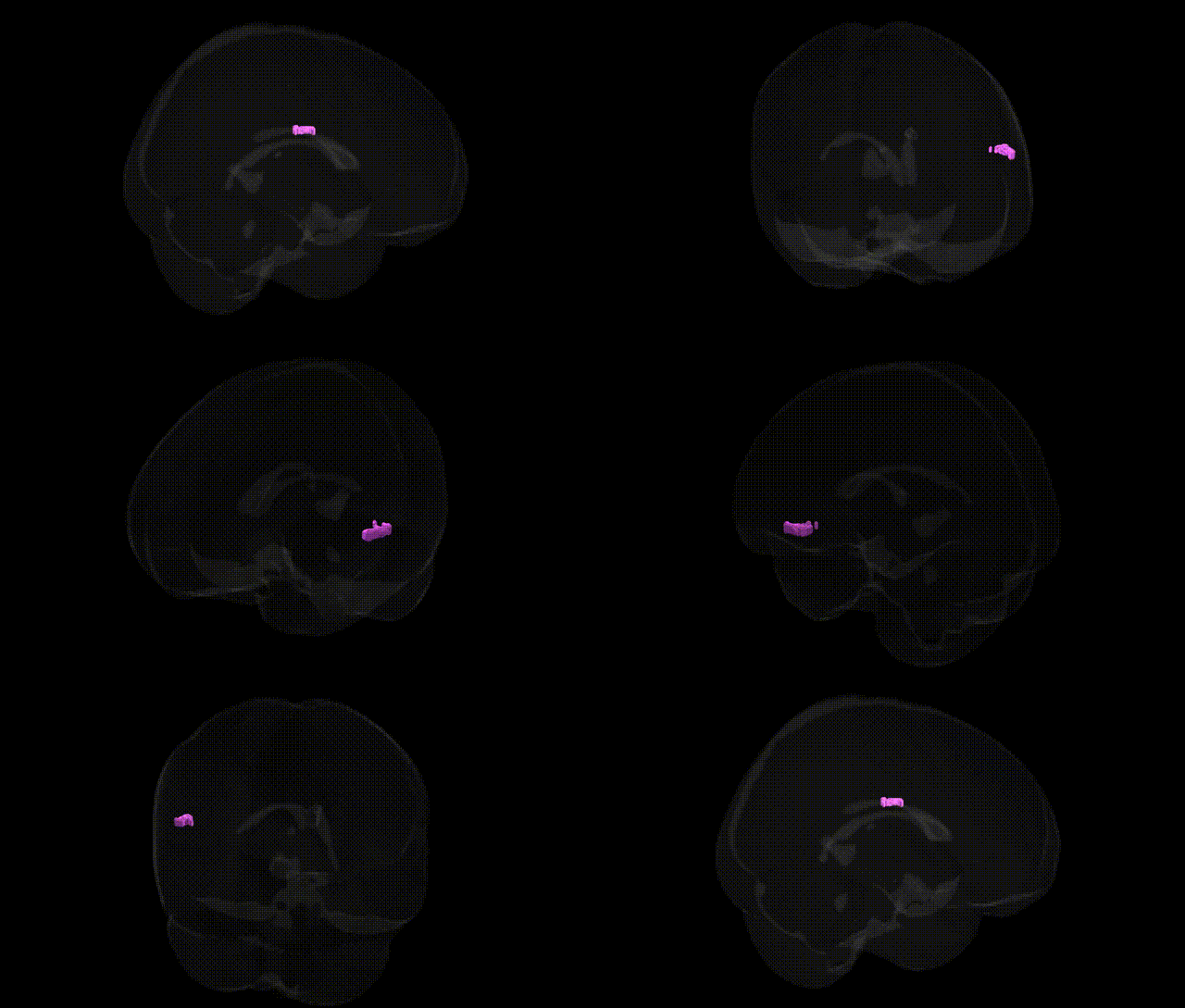
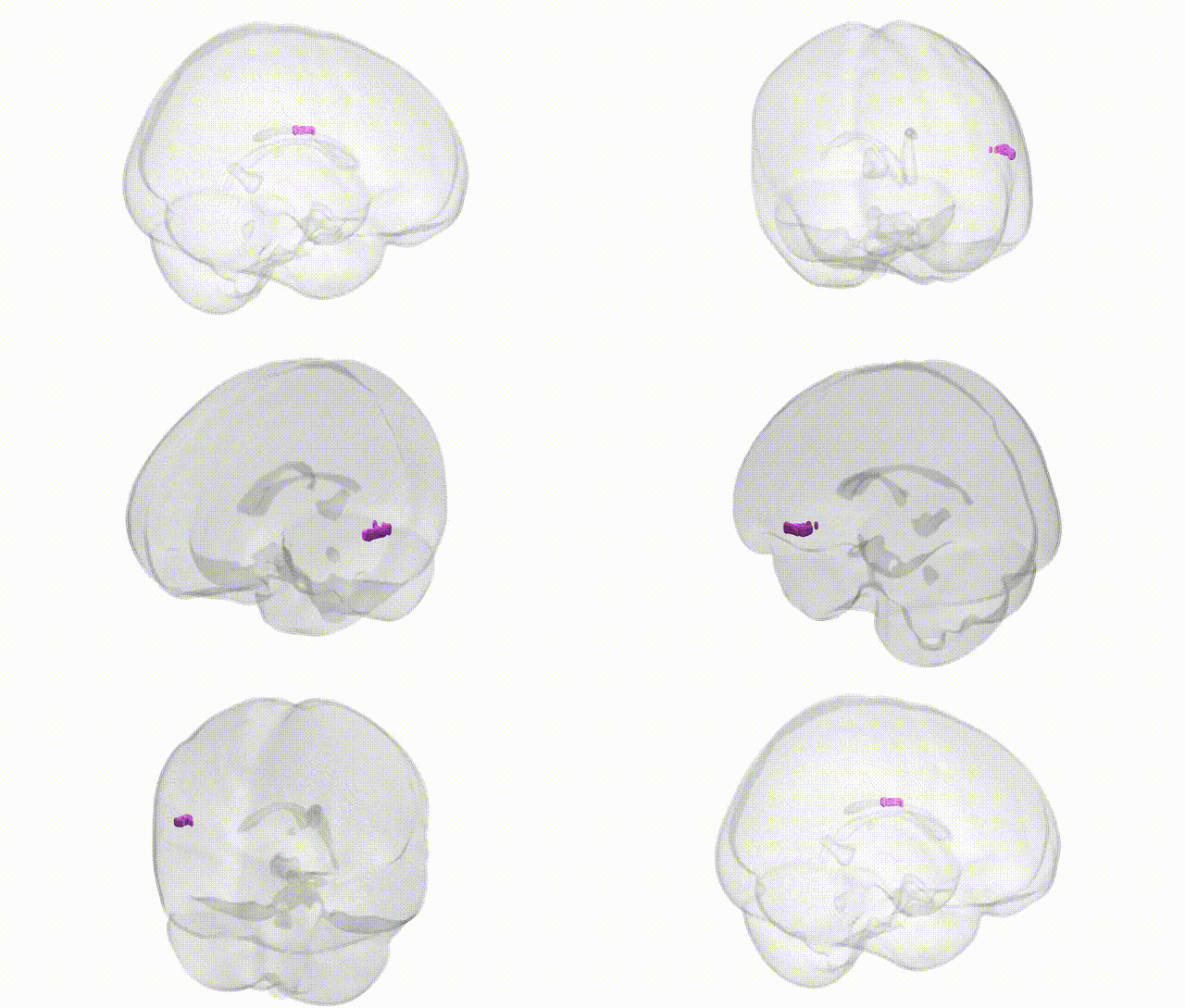
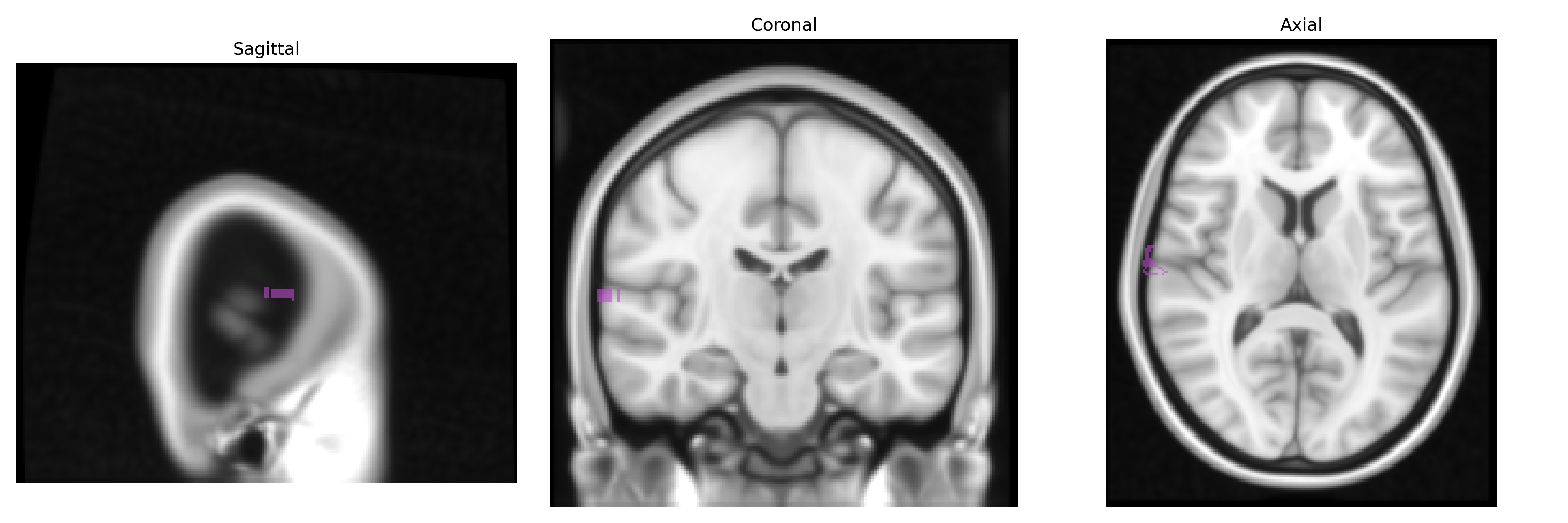
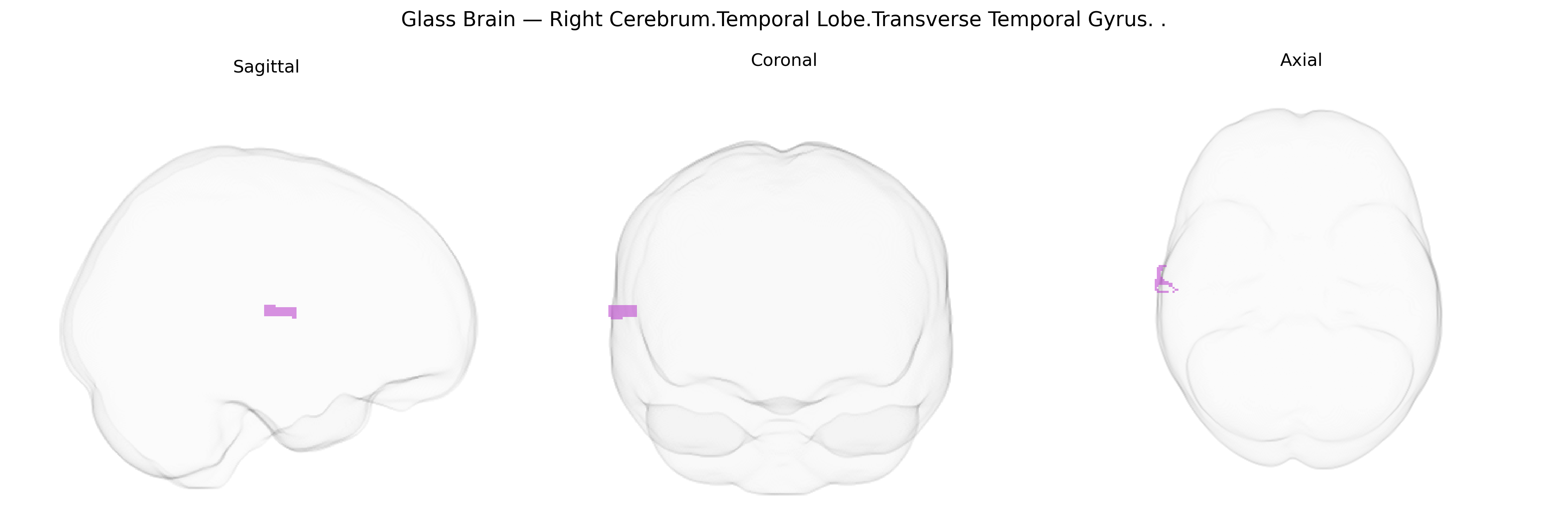
The bilateral Right Cerebrum.Temporal Lobe.Transverse Temporal Gyrus corresponds to Heschl’s gyrus, a cortical structure located on the superior surface of the temporal lobe within the lateral sulcus, forming part of the primary auditory cortex (Brodmann areas 41 and partially 42). This gyrus is the first cortical recipient of auditory input from the medial geniculate nucleus of the thalamus and is crucial for early-stage acoustic feature processing, including sound frequency, intensity, and temporal patterns that underlie speech and music perception. It is cytoarchitectonically distinct, with dense granular layer IV characteristic of primary sensory cortex, and shows strong tonotopic organization, reflecting systematic mapping of sound frequencies across its surface. Functionally, the Right transverse temporal gyrus is often implicated in aspects of spectral and spatial sound analysis and works in concert with surrounding superior temporal regions to support higher-order auditory and language functions.
Transverse temporal gyrus
The bilateral right transverse temporal gyrus (part of primary auditory cortex/Heschl’s gyrus within the temporal lobe) has been implicated in several genetic and GWAS-derived associations, largely through imaging genetics and disorder-specific studies rather than region-exclusive loci. Structural and functional measures of this area show heritability and have been linked in large neuroimaging GWAS consortia (e.g., ENIGMA, UK Biobank) to common variants in genes affecting neurodevelopment, synaptic function, and myelination (such as variants near genes involved in cortical surface area and thickness, including general temporal lobe–linked loci like those near MIR124-1, WNT signaling genes, and other broad neurodevelopmental loci), but typically not restricted uniquely to the transverse temporal gyrus. Genetic risk for psychiatric and neurodevelopmental disorders—particularly schizophrenia, autism spectrum disorder, and major depressive disorder—has been associated with altered morphology or activation of Heschl’s/transverse temporal gyri, consistent with polygenic risk influencing auditory and language-related cortex, while risk variants for reading and language traits (e.g., dyslexia-related loci in KIAA0319 and DCDC2 and FOXP2-related networks) have been associated with functional differences across temporal auditory regions, including this gyrus, in imaging-genetics and candidate-gene studies. GWAS of auditory hallucinations and psychosis-related traits implicate polygenic architectures overlapping with temporal auditory cortex, including transverse temporal gyrus activation differences in carriers of higher schizophrenia polygenic risk. In addition, GWAS of hearing function and speech-in-noise perception, as well as brain-wide morphometric GWAS that identify temporal lobe surface area and thickness loci, suggest that common variation in genes governing cortical development, synaptic plasticity, and axonal guidance contributes to interindividual variation in the structure and function of the right transverse temporal gyrus, though few variants are currently assigned as uniquely specific to this Talairach-defined region.
Overview generated by GPT-4o (2026).
Region ID: 730
Hemisphere: bilateral
Atlas: Talairach labels 1mm
Full Quality Version: Download MP4
Full Quality Version: Download MP4
Wali Sidiqyar*, Gaurav Rudravaram*, Elyssa M. McMaster, Trent M. Schwartz, Adam M. Saunders, Kurt G. Schilling, Bennett A. Landman "Introducing SPINS: A Shared Public Visualization Library of Neuroanatomical Structures." Medical Imaging with Deep Learning- short paper
This resource is licensed under CC0 1.0 Universal (Public Domain).