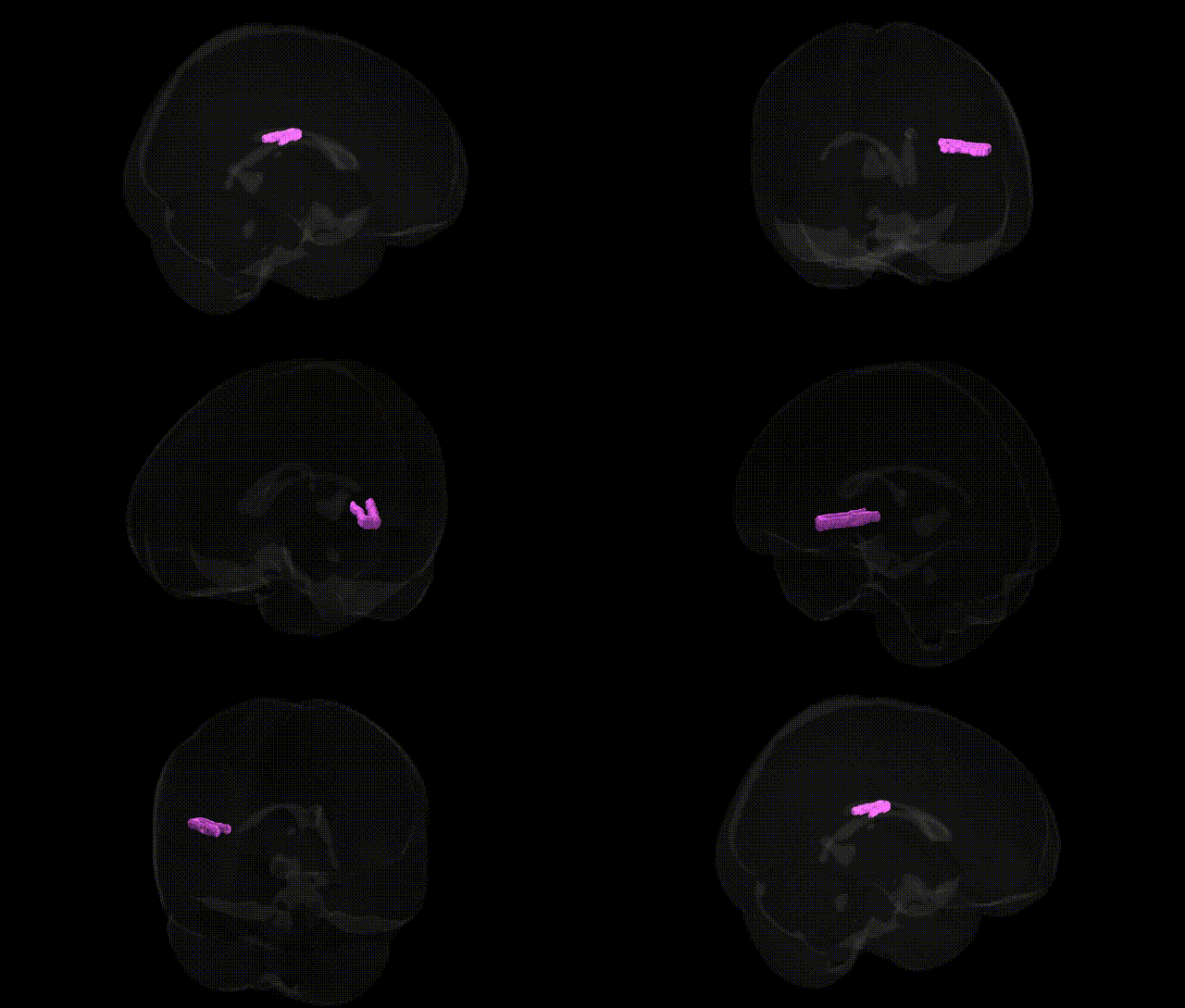
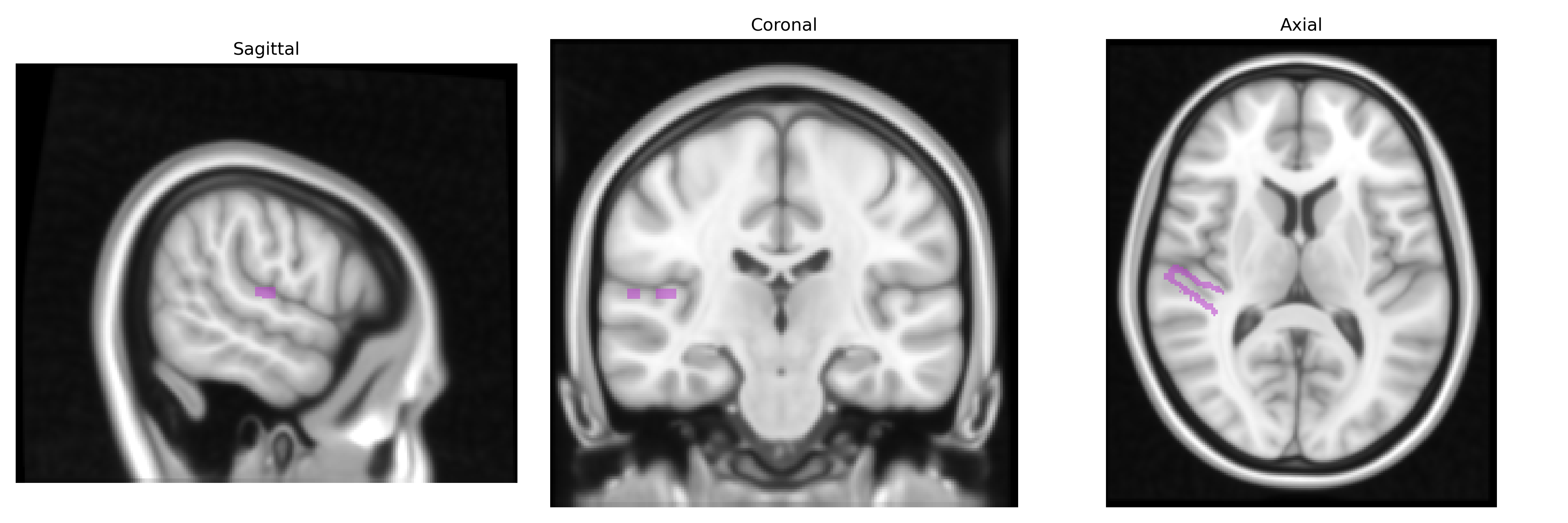
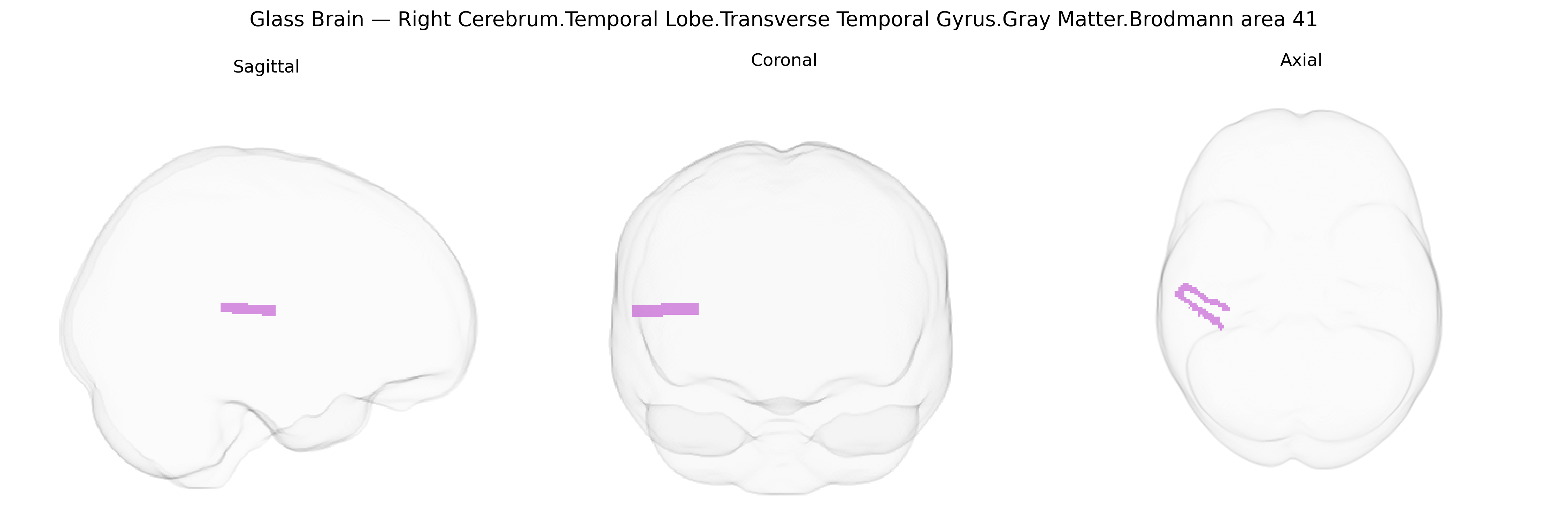
The bilateral Right Cerebrum.Temporal Lobe.Transverse Temporal Gyrus.Gray Matter.Brodmann area 41 corresponds primarily to the primary auditory cortex located on the superior surface of the temporal lobe within Heschl’s gyrus. This cytoarchitectonic area receives thalamocortical input from the medial geniculate nucleus of the thalamus and is crucial for the initial cortical processing of acoustic information, including sound frequency, intensity, and temporal features. Neurons in Brodmann area 41 are organized tonotopically, supporting spectral analysis necessary for basic auditory perception and contributing to higher-order auditory functions through reciprocal connections with adjacent auditory association cortices (such as Brodmann areas 42 and 22), as well as with multisensory and language-related regions. There is no direct link for Brodmann area 41; a closely related structure is Heschl’s gyrus.
The bilateral right transverse temporal gyrus of Brodmann area 41 (primary auditory cortex) has been implicated in genetic studies mainly through large-scale neuroimaging–genetics and GWAS analyses of brain structure and function, which show that gray matter volume, cortical thickness, and surface area in superior and transverse temporal regions are moderately heritable and influenced by common variants in genes involved in neurodevelopment, synaptic signaling, and axon guidance (for example, variants in genes such as MIR137, GRIN2A, and FOXP2 have been linked to auditory and language-related temporal lobe phenotypes, though not always specifically localized to BA41). GWAS meta-analyses from consortia such as ENIGMA and UK Biobank report associations between temporal lobe auditory cortex measures and polygenic risk scores for schizophrenia, autism spectrum disorder, and major depressive disorder, consistent with observed structural and functional alterations of the right primary auditory cortex in these conditions; additional associations have been noted with traits such as musical aptitude, language and phonological processing, and auditory hallucinations, where temporal cortex morphometry and activation—including in BA41—covary with genetic risk. Some epilepsy-related genetic studies also implicate temporal neocortex, including auditory cortex, via genes affecting cortical excitability (e.g., ion channel genes like SCN2A), though spatial resolution is often coarse and not restricted to the transverse temporal gyrus; overall, current evidence supports that this region’s gray matter characteristics are influenced by polygenic neurodevelopmental pathways that partially overlap with genetic architectures of psychiatric, language, and sensory-processing traits, but no single gene or variant is uniquely or specifically assigned to the right BA41 label in the Talairach atlas.
Overview generated by GPT-4o (2026).
Region ID: 719
Hemisphere: bilateral
Atlas: Talairach labels 1mm
Full Quality Version: Download MP4
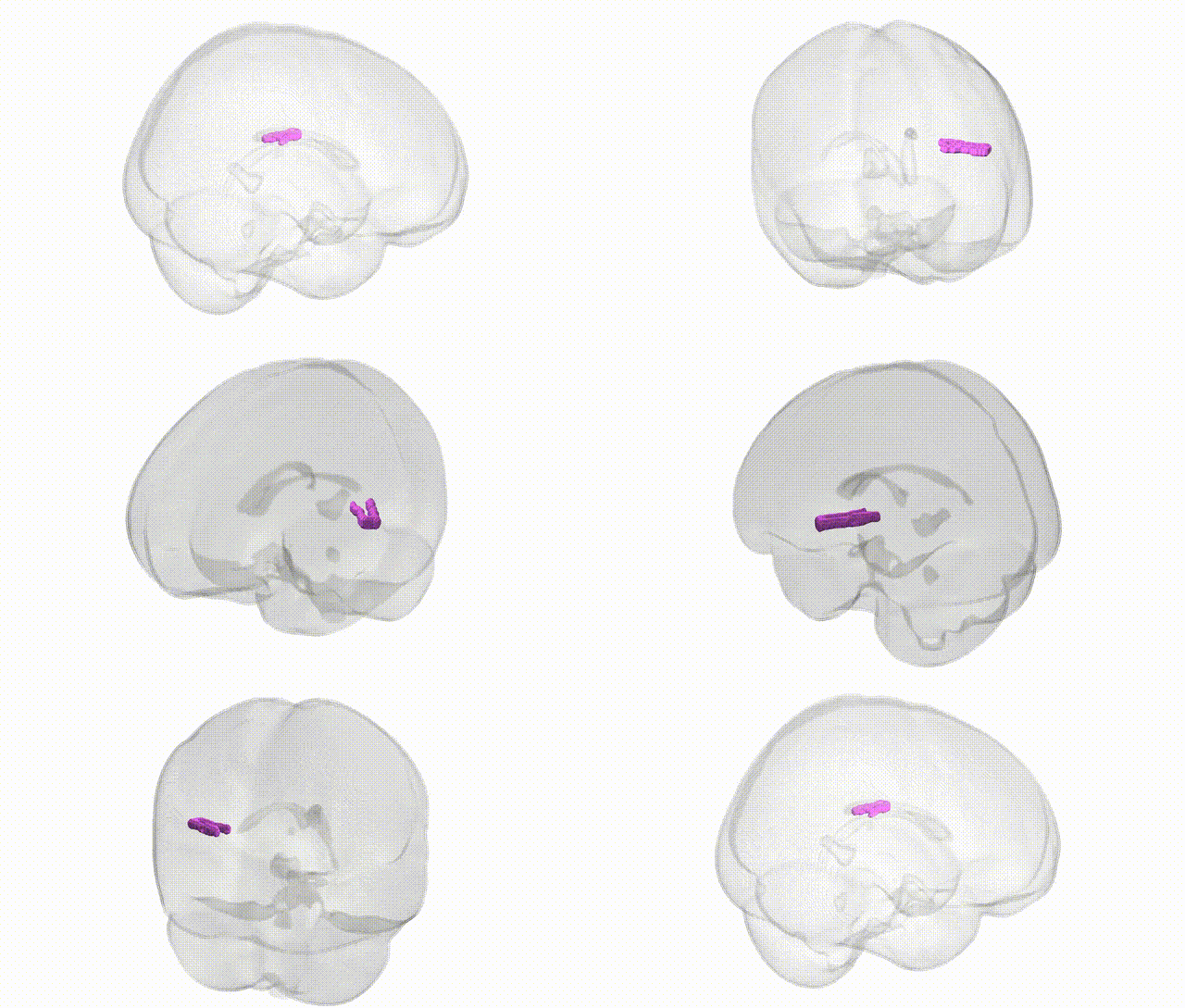
Full Quality Version: Download MP4
Wali Sidiqyar*, Gaurav Rudravaram*, Elyssa M. McMaster, Trent M. Schwartz, Adam M. Saunders, Kurt G. Schilling, Bennett A. Landman "Introducing SPINS: A Shared Public Visualization Library of Neuroanatomical Structures." Medical Imaging with Deep Learning- short paper
This resource is licensed under CC0 1.0 Universal (Public Domain).