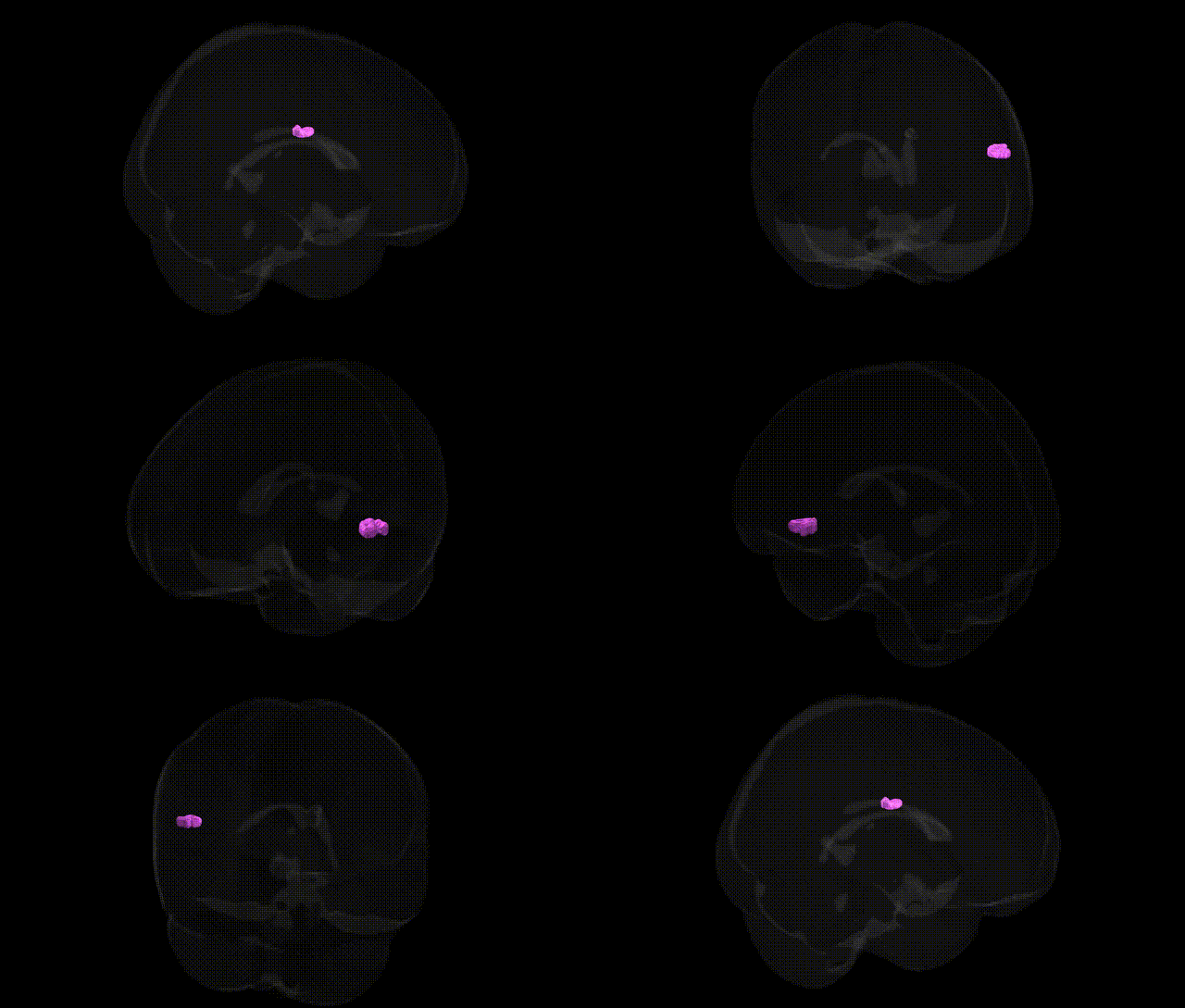
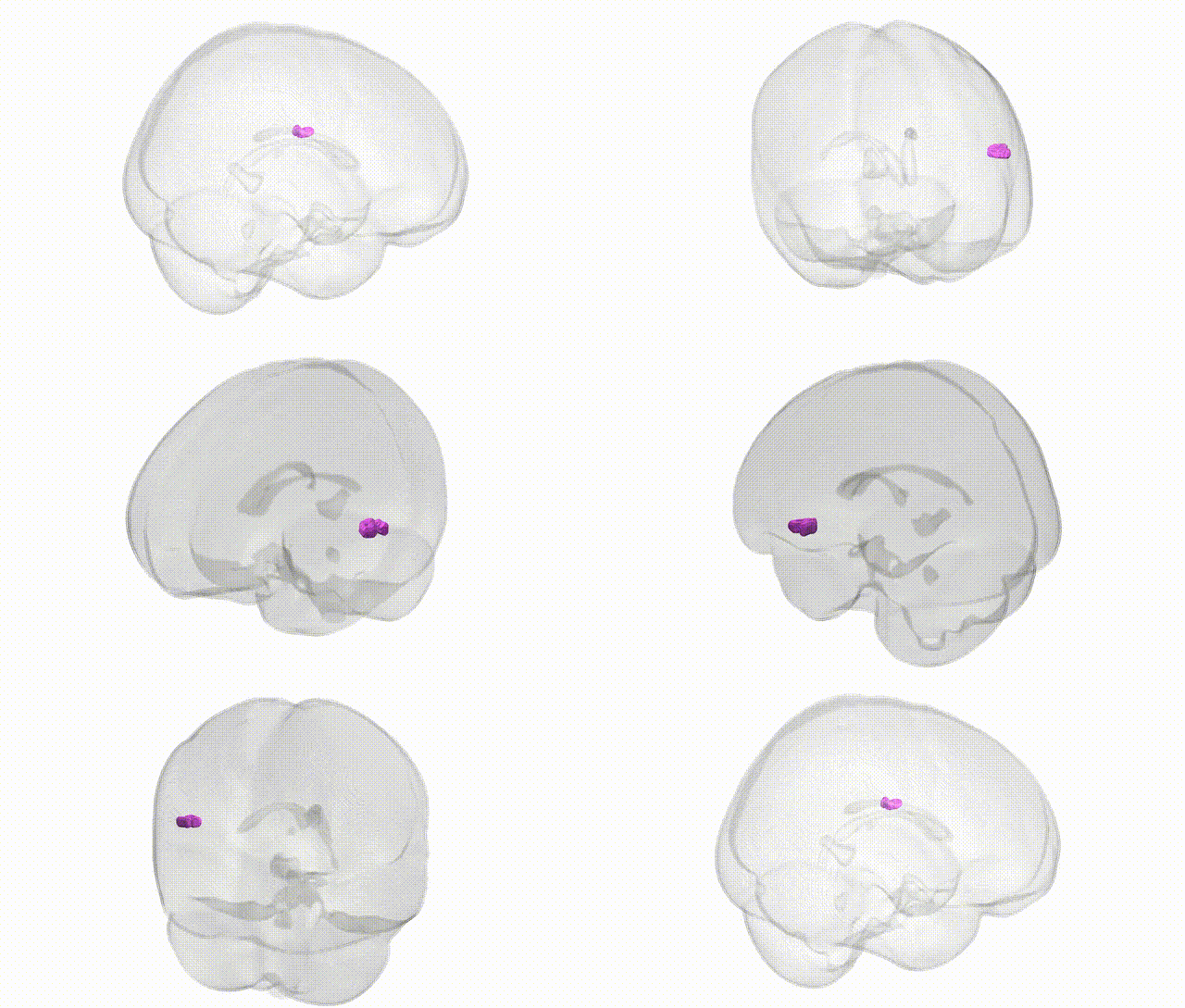
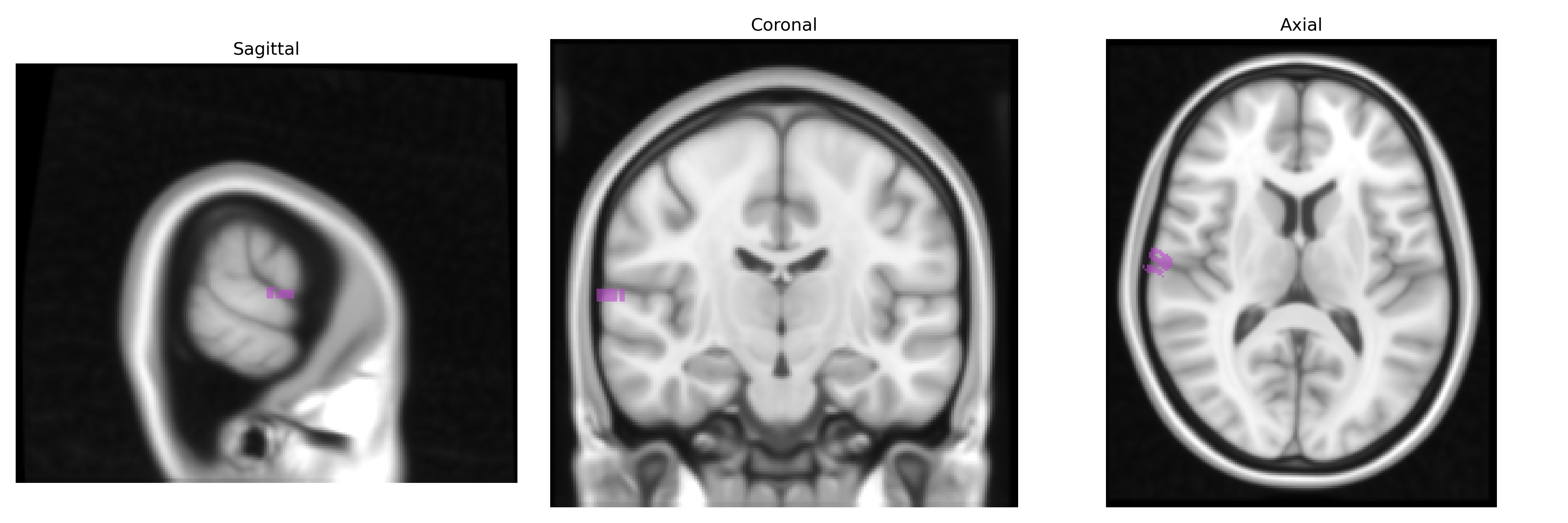
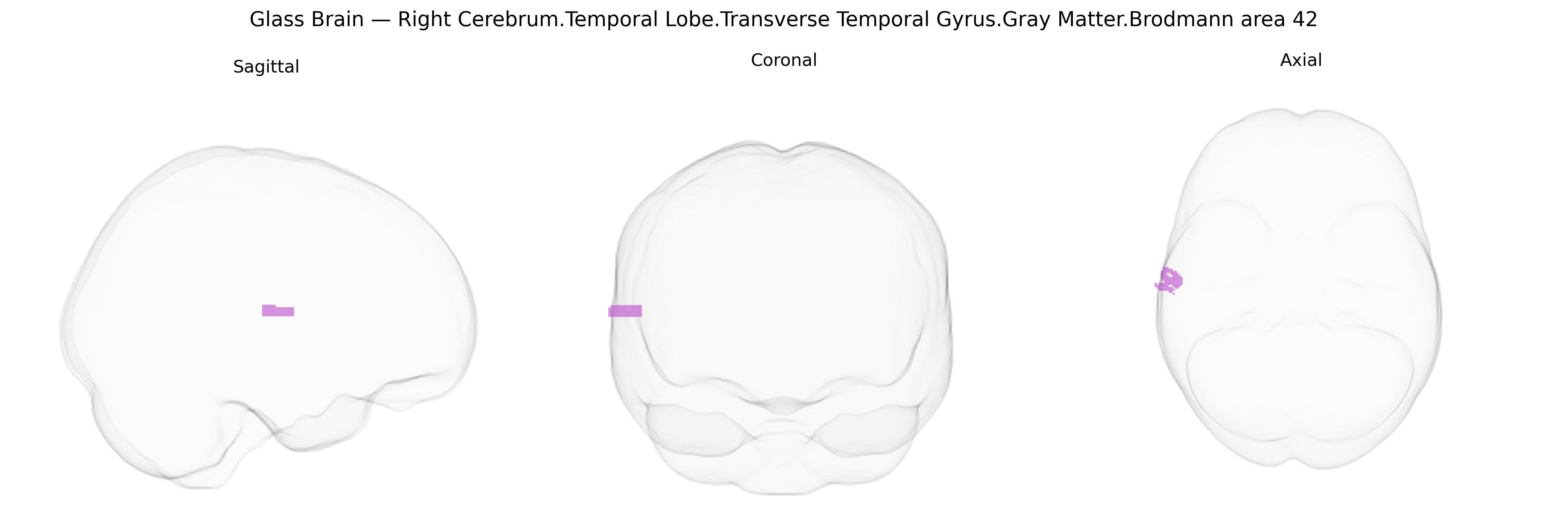
The bilateral Right Cerebrum.Temporal Lobe.Transverse Temporal Gyrus.Gray Matter.Brodmann area 42 corresponds to the secondary auditory cortex located in the posterior superior temporal region of the right hemisphere, extending into Heschl’s gyrus. This area receives and further processes auditory information relayed from primary auditory cortex (Brodmann area 41), contributing to higher-order sound analysis such as complex acoustic pattern recognition, temporal sequencing of auditory stimuli, and aspects of auditory scene analysis. Functionally, right BA42 is implicated in processing nonverbal and spectral features of sound, including music and prosody, and participates in auditory attention and integration with multimodal associative networks. A directly dedicated Wikipedia article for Brodmann area 42 does not exist; a closely related structure encompassing much of this territory is the Auditory cortex.
The bilateral right transverse temporal gyrus (Brodmann area 42) is a primary auditory association region, and genetic associations involving this area largely emerge from imaging–genetics and GWAS of cortical structure, auditory function, and language-related traits. Large-scale ENIGMA and UK Biobank studies have shown that gray matter thickness and surface area in superior and transverse temporal regions are moderately heritable and associated with common variants in genes involved in neurodevelopment, synaptic signaling, and cell-adhesion pathways (for example, loci near microcephaly-related genes and axon-guidance genes), though specific, consistently replicated SNPs uniquely tied to BA42 remain limited. Variants in FOXP2, CNTNAP2, KIAA0319, DCDC2, and other language and reading-associated genes have been linked to structural and functional differences in superior and transverse temporal cortices, implicating BA42 in dyslexia, language impairment, and aspects of speech perception. GWAS of schizophrenia, bipolar disorder, and autism spectrum disorder have identified polygenic risk patterns that correlate with altered gray matter volume or cortical thickness in auditory and superior temporal regions, including BA42, particularly in relation to auditory hallucinations and social communication deficits, though the associations are generally polygenic and not region-specific. Additional imaging–genetics work connects BA42 metrics with loci influencing hearing function and tinnitus, as well as with general cognitive ability and educational attainment, again reflecting broad polygenic influences on temporal lobe morphology rather than single-gene effects uniquely defining this area.
Overview generated by GPT-4o (2026).
Region ID: 727
Hemisphere: bilateral
Atlas: Talairach labels 1mm
Full Quality Version: Download MP4
Full Quality Version: Download MP4
Wali Sidiqyar*, Gaurav Rudravaram*, Elyssa M. McMaster, Trent M. Schwartz, Adam M. Saunders, Kurt G. Schilling, Bennett A. Landman "Introducing SPINS: A Shared Public Visualization Library of Neuroanatomical Structures." Medical Imaging with Deep Learning- short paper
This resource is licensed under CC0 1.0 Universal (Public Domain).